
APT-110 · Lesson 2 of 12 · 25 min
Automotive, heavy equipment, industrial and other parts sectors
▶ Video coming soon A video version of this lesson is on the way.
On Thursday, September 17, Rolf sent Talia across town with Gideon on the afternoon delivery run. The van stopped at an independent garage, a collision repair shop and a tire dealer, and then made a detour Rolf had arranged on purpose: a visit to Linmore Truck and Equipment, the dealer group's heavy truck and equipment branch on the South Service Road in Stoney Creek, and then to Linmore Parts Supply, the group's aftermarket store on Centennial Parkway. "You should see what the rest of the trade looks like," Rolf had said. "Most people think parts means car parts. It's a lot bigger than that."
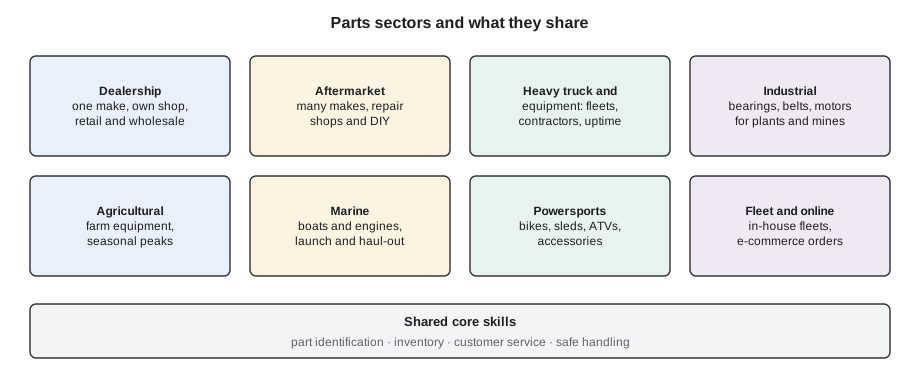
This lesson surveys the sectors where parts technicians work. The skills are the same everywhere: identifying the right part, keeping stock, serving customers and working safely. But the products, the customers, the pace and the hazards differ a great deal between a car dealership, a heavy equipment dealer, an industrial supply house and a marine store. Many parts technicians move between sectors during their careers, and the Red Seal standard is written to cover all of them.
Automotive dealerships
A new-vehicle dealership's parts department, like Linmore Tessaro's, sells mainly the parts made or approved by one manufacturer. These are usually called original equipment manufacturer (OEM) parts, or genuine parts. The manufacturer supplies the dealership through its own parts distribution centres, sets suggested prices, provides the electronic catalogue, and pays for warranty repairs. Dealership parts departments are measured on sales, gross profit, inventory turns and fill rate, and they work closely with their own service and body shops.
The advantages of dealership work are steady hours tied to the service shop, manufacturer training, and deep knowledge of one product line. The challenges are the sheer number of models and model years, the frequent changes to part numbers, and the pressure from technicians waiting at the back counter.
The automotive aftermarket
The aftermarket is everything outside the vehicle manufacturer's own network: parts made by independent companies to fit many brands of vehicle, sold through warehouse distributors, jobber stores, retail chains and online sellers. Linmore Parts Supply is an aftermarket store. It stocks brake parts, filters, belts, hoses, batteries, ignition parts, chemicals and tools for most popular cars and light trucks, and it sells mainly to independent garages, with a retail counter for the public.
Aftermarket work demands broad knowledge rather than deep knowledge of one brand. A counter person may look up parts for a dozen makes in an hour, compare several brands and price levels for the same part, and explain the difference between an economy brake pad and a premium one. The aftermarket also includes remanufactured parts, such as starters, alternators, brake calipers and steering racks, which are rebuilt from used cores; lesson 1 introduced cores, and APT-210 covers them in detail.
| Feature | Dealership parts | Aftermarket store |
|---|---|---|
| Main product | OEM parts for one or a few brands | Parts from many makers for many brands |
| Main customers | Own service shop, body shops, wholesale garages | Independent garages, fleets, retail public |
| Catalogue | Manufacturer's electronic catalogue | Aftermarket catalogue covering many brands |
| Price levels | Usually one quality level | Often several brands and price levels |
| Warranty work | Manufacturer warranty claims | Supplier warranty on the part |
Heavy truck and equipment
At Linmore Truck and Equipment, Talia met Hamish Corrigall, the branch parts manager, who had come over from the car side ten years before. The branch sells and services heavy trucks, trailers and a line of construction equipment: compact excavators, wheel loaders and skid steers. Its parts are bigger, heavier and more expensive than car parts: a truck brake drum weighs about 45 kg (100 lb), a loader bucket tooth set can fill a pallet, and a single hydraulic pump can cost more than a used car.
The pace is different too. When a truck or a machine on a job site breaks down, the owner may be losing hundreds or thousands of dollars an hour, so heavy equipment parts departments often run extended hours, emergency call-outs and same-day courier deliveries. Customers are usually knowledgeable fleet managers and mechanics who know exactly what they need and expect the parts person to keep up. Heavy equipment parts work relies heavily on serial numbers, because machines of the same model can differ in components from one production run to the next. APT-310 covers heavy and industrial parts in depth.
Worked problem
The cost of a machine waiting for a part
A contractor's wheel loader is stopped on a site with a failed hydraulic hose. The contractor estimates the stopped machine and its idle operator cost 340 dollars an hour (a sample figure). The branch can courier the hose in 2.5 hours, or the contractor can wait for the next scheduled delivery in 9 hours. How much does the faster option save, and what would the courier have to cost for it not to be worth it?
Show solution
- Cost of waiting 9 hours:
- \[340 \times 9 = 3{,}060\ \text{dollars}\]
- Cost of waiting 2.5 hours:
- \[340 \times 2.5 = 850\ \text{dollars}\]
- Saving from the courier:
- \[3{,}060 - 850 = 2{,}210\ \text{dollars}\]
Answer: The courier saves about 2,210 dollars of downtime, so it is worth using unless it costs more than that. This is why heavy equipment parts departments think in terms of the customer's downtime, not just the price of the part.
Industrial and maintenance, repair and operations (MRO)
Industrial distributors supply factories, mines, food plants, utilities and other businesses with the parts they need to keep machinery running: bearings, power transmission parts such as belts, chains, sprockets and couplings, hydraulic and pneumatic components, seals, fasteners, motors and safety supplies. This is often called MRO, for maintenance, repair and operations. Industrial parts technicians work with part numbers and specifications more than with vehicle applications. A bearing is identified by its dimensions and its standard designation; a V-belt by its cross-section and length; a hydraulic fitting by its thread and seal type.
Many industrial distributors run stockrooms inside their customers' plants, called vendor-managed inventory, and parts technicians may spend their days in a mine or a factory rather than behind a counter. The work rewards a methodical approach and a good grasp of measurement, which APT-120 covers.
Agricultural, marine, powersports and other sectors
Several other sectors employ parts technicians, each with its own seasons and specialties:
- Agricultural equipment dealers sell parts for tractors, combines, balers and sprayers. Their busiest seasons are spring planting and fall harvest, when a farmer with a broken combine may need a part within hours. Rural dealers often carry a wide range of parts because the nearest alternative is far away.
- Marine dealers serve boat owners and marinas with engine parts, propellers, electrical parts, safety equipment and maintenance supplies. Much of the work is seasonal, with a spring rush as boats go into the water and a fall rush as they are winterized.
- Powersports dealers sell parts and accessories for motorcycles, snowmobiles, all-terrain vehicles and personal watercraft. Accessories and clothing are a large share of sales, and customers are often enthusiasts who know their machines well.
- Outdoor power equipment and small engine dealers supply parts for lawn mowers, chainsaws, trimmers and generators.
- Recreational vehicle dealers handle chassis parts plus the appliances, plumbing and electrical systems of motorhomes and trailers.
- Fleet and municipal stores keep parts for a city's trucks, buses or utility vehicles inside the fleet's own garage.
- Online and mail-order sellers pick, pack and ship parts ordered on websites, with little counter work but a great deal of warehouse and shipping work.
How the sectors differ in hazards
Every sector shares the basic warehouse hazards covered in lesson 3: lifting, ladders, forklifts, falling objects and slips. But each adds its own. Heavy equipment parts are often too heavy to lift by hand at all and need cranes, hoists or forklifts. Agricultural dealers store large quantities of oils, greases and sometimes crop chemicals. Marine stores handle fuel additives and flares. Powersports and outdoor power stores often stock small fuel containers and lithium-ion battery packs. Industrial stores carry cutting tools, compressed gases and chemicals for their customers' plants. A parts technician moving between sectors has to learn the new hazards as carefully as the new catalogue.
Worked problem
Comparing the weight of a typical order
Talia compared a typical delivery from each branch. At Linmore Tessaro, a body shop order of 23 boxes averaged 4.2 kg (9.3 lb) each. At Linmore Truck and Equipment, a fleet order of 6 items averaged 38 kg (84 lb) each. Which order is heavier in total, and by how much?
Show solution
- Body shop order:
- \[23 \times 4.2 = 96.6\ \text{kg}\]
- Fleet order:
- \[6 \times 38 = 228\ \text{kg}\]
- Difference:
- \[228 - 96.6 = 131.4\ \text{kg}\]
Answer: The fleet order of only 6 items weighs about 131 kg more than the 23-box body shop order. Every one of those 38 kg items is over the 23 kg lifting benchmark in lesson 4, so they move by hand truck, pallet jack or forklift, never by hand alone.
Moving between sectors
Hamish told Talia that the hardest part of moving from cars to heavy trucks had been learning to think in serial numbers and in downtime. "On the car side, a customer will wait until tomorrow for most things. Here, if a truck's down, every hour counts, and they'll pay for a courier." He had kept his car-side habits of checking every part twice and keeping the warehouse tidy, and they had served him well.
The Parts Technician standard reflects this. Its core skills, identification, inventory, customer service, shipping and receiving, and safety, apply in every sector, and apprentices in any sector write the same Red Seal exam. Some sectors add their own training on top: heavy equipment dealers run manufacturer courses, and industrial distributors often have their own programs. Lesson 11 returns to these career paths.
Back in the van, Talia asked Gideon which sector he liked best. He had delivered for an industrial distributor before joining Linmore. "Industrial paid better," he said, "but here I know every customer by name." Talia noted that too: the sectors differ in their people as much as their products.
Seasons and cycles in each sector
Each sector has its own rhythm, and a parts technician learns to plan stock and staffing around it. At Linmore Tessaro, the car side is busiest in spring and fall, when customers switch between summer and winter tires and get their vehicles ready for the season, and after the first heavy snowfall, when body shops fill with collision repairs. Linmore Truck and Equipment is busiest in spring, when construction restarts and contractors service their machines, and through the summer building season. An agricultural dealer stocks up on planter and tillage parts before spring and on combine and baler parts before harvest. A marine store's year is built around launch in spring and haul-out in fall.
These cycles matter for stocking: a department that runs out of wiper blades in the first snowstorm, or combine belts in the middle of harvest, loses sales and customers. They matter for safety too, because the busiest weeks are when rushing, fatigue and cluttered aisles cause injuries. Rolf schedules the department's annual safety refreshers for August and January, the two quietest months on the car side.
Worked problem
Planning for a seasonal peak
Linmore Parts Supply normally sells about 60 wiper blade sets a week. In the three weeks after the first snowfall, sales usually run at about 2.5 times normal. How many sets should the store have available for those three weeks, and how many more than a normal three weeks is that?
Show solution
- Normal three weeks:
- \[60 \times 3 = 180\]
- Peak three weeks:
- \[180 \times 2.5 = 450\]
- Extra stock needed:
- \[450 - 180 = 270\]
Answer: About 450 sets, or 270 more than usual. The extra blades arrive in October and are stored on a temporary shelf near the counter, checked against the racking load signs, rather than stacked in the aisle. The sales figures are sample values for this course.
The same planning applies in every sector, and later courses on inventory control, APT-210, show how sales history is used to forecast these peaks.
Common mistakes
MistakeAssuming every parts job is about cars.
InsteadRecognize the full range of sectors: heavy equipment, industrial, agricultural, marine, powersports and more.
MistakeLooking up heavy equipment parts by model alone.
InsteadUse the machine's serial number, because components change between production runs.
MistakeJudging an urgent order only by the price of the part.
InsteadConsider the customer's downtime cost; a courier is often the cheaper choice overall.
MistakeLifting heavy truck parts by hand because they come in a box.
InsteadCheck the weight on the label and use a hand truck, hoist or forklift above the lifting benchmark.
MistakeCarrying car-sector hazard knowledge into a new sector unchanged.
InsteadLearn each sector's own hazards, such as fuels, flares, compressed gases or lithium batteries.
Summary and key terms
- Dealerships sell mainly OEM parts for one manufacturer, supported by its catalogue, distribution centres and warranty.
- The aftermarket sells parts from many makers for many brands, including remanufactured parts built from cores.
- Heavy truck and equipment parts are heavy and costly, and customers measure delays in downtime per hour.
- Industrial MRO distributors supply bearings, power transmission, hydraulics and other plant parts, often identified by specification.
- Agricultural, marine, powersports, small engine, RV, fleet and online sellers each have their own seasons and products.
- All sectors share warehouse hazards, and each adds its own, such as heavy items, fuels, flares or lithium batteries.
- The core parts skills apply in every sector, so parts technicians can move between them.
- OEM part
- A part made or approved by the vehicle or equipment manufacturer.
- Aftermarket
- Parts made by independent companies to fit many brands, sold outside the manufacturer's network.
- Remanufactured part
- A used part rebuilt to working order and sold again, usually with a core charge.
- MRO
- Maintenance, repair and operations: the parts and supplies a plant uses to keep running.
- Vendor-managed inventory
- A stockroom in a customer's plant that the distributor stocks and manages.
- Downtime
- The time a vehicle or machine cannot work, often measured by its cost per hour.
- Jobber
- A local aftermarket parts store that sells mainly to repair shops.
Practice problems
Work each problem on paper first, then reveal the answer to check.
What is the difference between an OEM part and an aftermarket part?
Show answer
An OEM part is made or approved by the vehicle maker; an aftermarket part is made by an independent company to fit many brands.
Why are heavy equipment parts looked up by serial number?
Show answer
Machines of the same model can have different components from one production run to another.
A machine costs 340 dollars an hour to sit idle. How much does waiting 9 hours cost?
Show answer
3,060 dollars.
What does MRO stand for?
Show answer
Maintenance, repair and operations.
When are agricultural dealers busiest?
Show answer
In spring planting and fall harvest.
Lesson quiz · 5 questions
Score 60% or more to complete this lesson.
Create a free account to save your progress, take quizzes and earn a certificate.