
APP-310 · Lesson 8 of 12 · 23 min
Electric water heaters
▶ Video coming soon A video version of this lesson is on the way.
Mirela Dragomir phoned on Monday, September 28, because her showers in Chedoke ran hot for about two minutes and then turned lukewarm. Fenna's first question at booking was one Penfold asks every Ontario water heater caller: "Do you own the water heater, or is it rented?" Many Ontario homes rent their water heaters, and the rental company services its own tanks. Ms. Dragomir owned hers, a twelve-year-old electric tank. Dee switched off its double-pole breaker, proved the terminals dead at both elements, and measured: the upper element read 12.8 Ω, as its 4,500 W, 240 V rating predicts, but the lower element read open. With only the upper element working, the tank heated just its top portion. Dee drained the tank below the lower element, replaced the element, flushed out a bucket of sediment while it was drained, refilled the tank and bled the air from a hot tap before she restored power. "Never switch the power on to an empty tank," she told Kiran on the November 13 water night. "An element out of water burns out in seconds."
This lesson explains how an electric storage water heater works, how its two elements and thermostats share the work, the safety devices that protect it, how to test elements and thermostats safely, and the tank parts that wear out: the anode, the dip tube and the relief valve. Heat pump water heaters are covered in APP-330, and gas water heaters in lesson 9.
The electric storage water heater
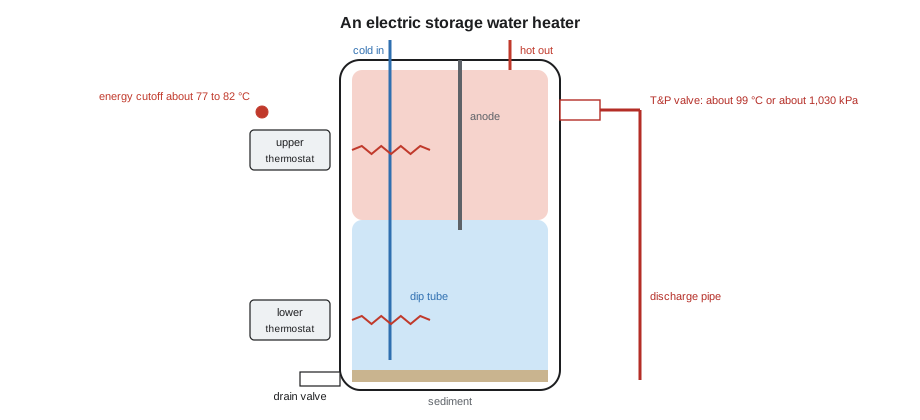
An electric storage water heater is an insulated steel tank, lined with glass enamel to resist corrosion, that holds hot water ready for use. Cold water enters through a dip tube that carries it to the bottom of the tank; hot water leaves from the top. Because hot water rises, the tank holds a layer of hot water above cooler water, and the hot outlet draws from the top. Typical household sizes are about 150 to 270 L (40 to 80 gal) (typical).
Most residential electric water heaters have two immersion elements, an upper and a lower, each rated typically between 3,000 and 5,500 W at 240 V (typical; the plate governs), each controlled by its own surface-mounted thermostat pressed against the tank wall behind an access panel and insulation. The heater is supplied by a dedicated 240 V circuit through a junction box on top of the tank. Working on that circuit's wiring beyond the heater's own terminals is an electrician's work.
Non-simultaneous operation
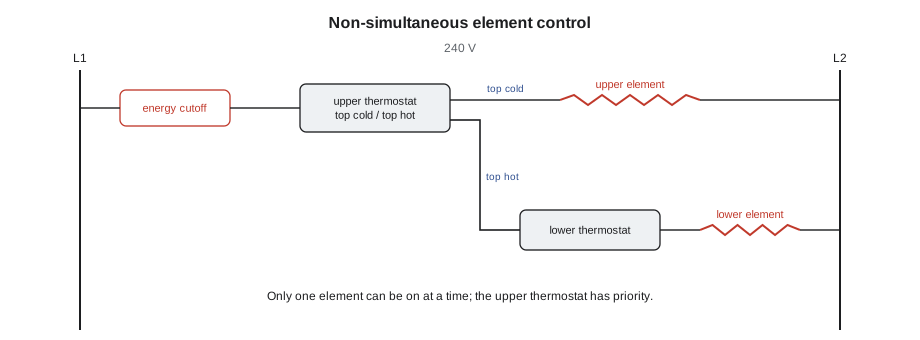
In most residential two-element heaters the elements are non-simultaneous: only one is on at a time, so the circuit need only carry one element's current. The upper thermostat has priority. When the top of the tank is cold, the upper thermostat powers the upper element. When the top is hot, the upper thermostat switches power down to the lower thermostat, which then powers the lower element if the bottom of the tank is cold. A large draw of cold water into the bottom brings on the lower element; a very large draw that cools the top brings on the upper element to recover the top quickly.
That arrangement explains two classic symptoms:
- No hot water at all: the upper element or upper thermostat has failed, or the energy cutoff has tripped. The upper element never heats the top, the upper thermostat never passes power down, and the lower element never comes on either.
- Hot water runs out quickly, then lukewarm: the lower element or lower thermostat has failed. The upper element heats only the top part of the tank, as at Ms. Dragomir's house. A broken dip tube gives a similar symptom by letting cold water mix at the top.
Element ratings and testing
Worked problem
Element resistance, current and power at 208 V
A water heater element is rated 4,500 W at 240 V. What should it read cold, what current does it draw at 240 V, and what power does it give if the building supplies 208 V?
Show solution
- Resistance:
- \[R = \frac{240^2}{4500} = \frac{57600}{4500} = 12.8 \ \Omega\]
- Current at 240 V:
- \[I = \frac{4500}{240} = 18.75 \text{ A}\]
- Power at 208 V:
- \[P = \frac{208^2}{12.8} = \frac{43264}{12.8} \approx 3380 \text{ W}\]
Answer: About 12.8 Ω and 18.75 A at 240 V. On a 208 V supply the element gives only about 3,380 W, three-quarters of its rating, so recovery is slower. That is a supply characteristic, not a fault.
Element tests follow the same pattern as other heaters. With the breaker off and the circuit proven dead at the thermostat terminals with a meter rated for 240 V, disconnect one lead from the element and measure across the element: about its calculated resistance is good; open is failed. Then measure from each element terminal to the tank (an element screw or the bare metal of the tank): any continuity means the element sheath has failed and is leaking to ground. A grounded element can make the breaker trip or the energy cutoff trip, and can make the tank and pipes live if the grounding is poor.
Thermostats are tested with the power off for continuity in each position, by adjusting the dial across the tank's temperature to make the contacts change, as the tech sheet shows. Some technicians test with the power on, measuring voltage at each element; that is live work at 240 V, done only by those trained and equipped for it, with insulated tools and the correct meter category, and with the insulation and access panel kept clear of the terminals.
Replacing an element means draining the tank at least below that element, removing the old element with an element wrench, fitting the new element with a new gasket, refilling the tank completely and opening a hot tap to purge the air until water flows steadily, then restoring power. A low-watt-density element, with its heat spread over a longer, folded sheath, lasts longer in hard water and is often the better replacement.
The energy cutoff
Above the upper thermostat sits the energy cutoff (ECO), a high-limit switch that opens both supply lines if the water at the top of the tank becomes too hot, typically around 77 to 82 °C (170 to 180 °F) (typical). Most are manual reset: a red button that must be pressed to restore power. An ECO that has tripped is a warning that something overheated the tank: a thermostat stuck closed, a thermostat not pressed tightly against the tank so it reads low, an element grounded to the tank so it heats even when its thermostat is open, or a loose terminal that overheated. The technician finds the cause before resetting it. Pressing the reset repeatedly without a diagnosis risks the relief valve opening, or worse.
Recovery and sizing
Worked problem
Recovery rate and time to heat a tank
A 189 L tank has a 4,500 W element running alone (non-simultaneous). Cold water enters at 10 °C and the thermostat is set to 60 °C. How many litres per hour can it heat, and how long does a full cold tank take to heat? Use 4.186 kJ per kilogram per °C, and 1 L as 1 kg; electric elements put nearly all their energy into the water.
Show solution
- Temperature rise: 60 − 10 = 50 °C.
- Heat per hour: 4.5 kW × 3,600 s = 16,200 kJ.
- \[\text{Recovery} = \frac{16200}{4.186 \times 50} \approx 77 \text{ L per hour}\]
- Heat for the whole tank:
- \[189 \times 4.186 \times 50 \approx 39\,560 \text{ kJ}\]
- \[t = \frac{39560}{4.5} \approx 8790 \text{ s} \approx 2.4 \text{ h}\]
Answer: About 77 L of hot water per hour, and nearly two and a half hours to heat a full tank from cold. That slow recovery is why an electric tank with one failed element can leave a family without hot water for much of the morning.
The tank: anode, dip tube, sediment and relief valve
The glass lining always has tiny flaws, so every tank has a sacrificial anode rod, usually magnesium or aluminum, screwed into the top. The anode corrodes instead of the steel tank. When it is used up, the tank begins to rust and eventually leaks; a leaking tank cannot be repaired and must be replaced. Makers suggest inspecting the anode every few years (typical), more often in soft or softened water. A rotten-egg smell in the hot water usually comes from bacteria in the water reacting with a magnesium anode; replacing it with an aluminum-zinc or powered anode, or treating the water, may cure it.
A broken or cracked dip tube lets incoming cold water mix at the top of the tank, giving lukewarm water and small plastic flakes in faucet screens. Sediment, minerals from hard water, collects at the bottom, covers the lower element, and makes popping or rumbling sounds and slow recovery. Flushing the tank through its drain valve as the use and care guide says removes some of it.
Every tank has a temperature and pressure relief valve (T&P valve) near the top, set to open if the water reaches about 99 °C (210 °F) or the tank's rated pressure, often about 1,030 kPa (150 psi) (typical; the valve's label governs). Its discharge pipe must run down to within a short distance of the floor or a drain as the plumbing code says, never be capped or reduced, and never point at a person. A T&P valve that drips may be reacting to excess pressure from thermal expansion in a closed system, which an expansion tank fitted by a plumber solves, or may be worn. Makers recommend operating the lever periodically; the water released is scalding, and an old valve may not reseat, so the technician warns the customer, uses a bucket and stands clear.
What Penfold does and does not do
Penfold's technicians service electric water heaters the customer owns: elements, thermostats, energy cutoffs, anodes and drain valves, working at the heater's own terminals and fittings. Replacing a tank means disconnecting and reconnecting the water piping and often bringing it up to current code with an expansion tank, new relief discharge or a drain pan. In Ontario that is plumbing work for a licensed plumber, usually under a permit. Rented heaters are serviced by the rental company, so Penfold confirms ownership at booking.
Thermostat settings and dial markings
Water heater thermostat dials are often marked with letters or numbers rather than degrees, and the markings are approximate. The actual temperature at the tap depends on the dial setting, the thermostat's accuracy, the length of pipe and how recently hot water was used. When a customer complains that the water is too hot or not hot enough, the technician measures the temperature at the nearest tap after running it until it stops rising, compares it with the setting the use and care guide recommends, and adjusts both thermostats to the same setting, because an upper thermostat set much lower than the lower one gives odd results. GAS-210 explained the balance between scalding and bacteria; the water heater's own guide gives the maker's recommended setting, and where a household needs lower temperatures at the taps, a mixing valve fitted by a plumber is the usual answer.
Element types
Replacement elements come in several forms. Screw-in elements have a threaded boss that screws into the tank fitting with a gasket; older tanks may use flange elements bolted on with four bolts. High-watt-density elements are short and straight; low-watt-density elements fold the same wattage into a longer sheath, which runs cooler, scales less and lasts longer in hard water. Stainless steel and ceramic-sheathed elements resist corrosion. The replacement must match the voltage and wattage on the heater's rating plate and the thermostat it works with; fitting a higher-wattage element can overload the circuit and is not done.
When the tank itself has failed
Water dripping from under the jacket, rust-coloured water from the hot taps only, or a wet floor that returns after every fitting has been checked usually means the tank is leaking. A leaking steel tank cannot be repaired. The technician checks first that the water is not coming from the relief valve discharge, a fitting on top or a drain valve that weeps, because those can be repaired. If the tank is leaking, the customer is told plainly, the power is switched off and the water supply closed if the leak is significant, and replacement is referred to a licensed plumber. The rating plate's date and model help the customer decide on a replacement, and many makers' tank warranties run for six to twelve years (typical), which is worth checking before the old tank is removed.
Common mistakes
MistakeRestoring power to a tank that has not been completely refilled.
InsteadRefill and purge air through a hot tap until water flows steadily first.
MistakeTesting elements only across their terminals.
InsteadAlso test each terminal to the tank; a grounded element is a hazard.
MistakePressing the energy cutoff reset without finding why it tripped.
InsteadCheck thermostat contact and operation, grounded elements and loose terminals.
MistakeDiagnosing a no-hot-water call by replacing the lower element first.
InsteadNo hot water at all points first to the upper element, upper thermostat or ECO.
MistakeCapping a dripping T&P discharge pipe.
InsteadNever cap it; find the cause, often thermal expansion, and refer plumbing to a plumber.
Summary and key terms
- Electric storage heaters have upper and lower elements with surface thermostats.
- Non-simultaneous control lets the upper thermostat decide which element is on.
- No hot water at all points to the upper side; hot water that runs out quickly points to the lower side or the dip tube.
- Element resistance is V² ÷ P; any reading to the tank means a grounded element.
- The energy cutoff opens on overheating; find the cause before resetting.
- Recovery is slow: about 77 L (20 gal) per hour for a 4,500 W element.
- Anodes protect the tank; a used-up anode leads to a leaking tank.
- The T&P valve and its discharge pipe must never be capped; tank replacement is plumbing work.
- Storage water heater
- An insulated tank that heats and stores hot water.
- Dip tube
- The tube that carries cold water to the bottom of the tank.
- Immersion element
- An electric heating element that sits in the water.
- Non-simultaneous
- Two-element control in which only one element can be on at a time.
- Energy cutoff
- A manual-reset high limit above the upper thermostat.
- Anode rod
- A sacrificial metal rod that corrodes instead of the tank.
- T&P valve
- A temperature and pressure relief valve.
- Expansion tank
- A small tank that absorbs pressure rise from heating in a closed system.
Practice problems
Work each problem on paper first, then reveal the answer to check.
A two-element heater gives no hot water at all. Which parts are checked first?
Show answer
The energy cutoff, upper thermostat and upper element.
What should a 4,500 W, 240 V element read cold?
Show answer
About 12.8 Ω.
What power does that element give at 208 V?
Show answer
About 3,380 W.
Why must the tank be full before power is restored after an element change?
Show answer
An element out of water burns out in seconds.
What causes a rotten-egg smell in hot water?
Show answer
Bacteria reacting with a magnesium anode, usually.
Lesson quiz · 5 questions
Score 60% or more to complete this lesson.
Create a free account to save your progress, take quizzes and earn a certificate.