
APP-310 · Lesson 3 of 12 · 23 min
Fill, drain and leak detection
▶ Video coming soon A video version of this lesson is on the way.
"Water on the floor" calls make customers anxious, and Dee treats them as urgent. Her file from Friday, September 18, recorded one at Lucian Ravensworth's house in Huntington. Foam had poured out from under the door and across the kitchen tiles. Mr. Ravensworth had run out of dishwasher detergent and used a squirt of hand dish soap instead. Dee dried the floor, ran two rinse cycles with a cup of vinegar in the tub to break the suds, checked the base pan for water and the flood switch for operation, and found nothing broken. A week later, on the APP-110 call of Wednesday, November 4, she and Kiran found a real leak: a compression fitting at the supply valve that someone had wrapped in tape. "Two leaks, two causes," she told Kiran at the October 30 water night. "One was soap, one was plumbing. Find out which before you order anything."
This lesson covers how a dishwasher controls the amount of water it takes in, how it drains, how it protects the floor from a leak inside the machine, and how the drain connection keeps dirty water from flowing back into the tub. It also covers the common causes of leaks and a method for finding them.
The inlet valve
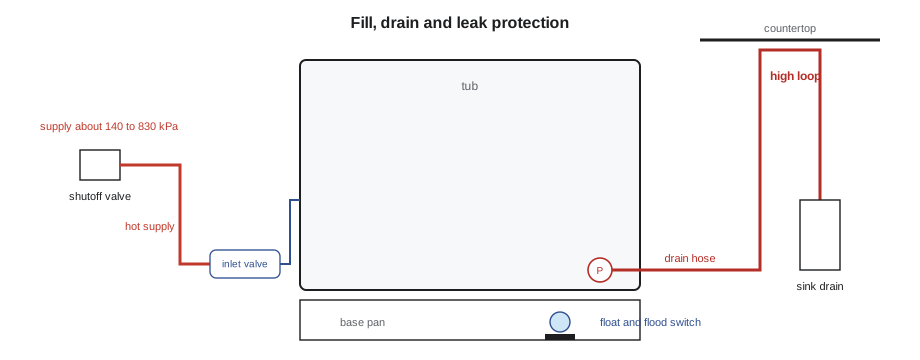
Water enters through an inlet valve (fill valve) at the front of the machine, under the tub, behind the toe-kick panel. It is a solenoid valve: when the control energizes its coil with 120 V, the plunger lifts and water flows. The valve has a flow restrictor, a small rubber washer with a precise hole, that limits the flow to a set rate over a range of supply pressures, often around 2 L per minute (0.5 gal per minute) (typical). A fine screen at the inlet keeps grit out of the valve. APP-120's call of Thursday, October 29, found an inlet valve with an open coil: the control was sending 120 V, but the coil measured open instead of the roughly 900 Ω on the tech sheet.
The supply must be within the pressure range in the installation instructions, commonly about 140 to 830 kPa (20 to 120 psi) (typical). Low pressure means a short fill on machines that fill by time; very high pressure can make the valve close with a bang and may need a pressure-reducing valve on the house supply, which is plumbing work.
How the machine knows how much water it has
A dishwasher must get the water level right: too little and the pump draws air; too much and the tub may overflow at the door. Machines use one or more of these methods:
- Timed fill: the control opens the valve for a set time. With the flow restrictor, the time sets the volume. Low supply pressure gives a short fill.
- Float switch: a float in the tub rises with the water and, at the set level, operates a switch that closes the valve or acts as an overfill safety.
- Pressure switch or sensor: a tube from the sump to a pressure device measures the water's depth by the air pressure it creates, as in a washer.
- Flow meter: a small turbine in the fill line sends pulses to the control, which counts them to measure the volume.
Many machines combine a timed or metered fill with a float switch as an overfill safety: if the float rises too high, the control shuts the inlet valve and runs the drain pump. Suds, a stuck float or a failed valve that will not close can all trigger that safety.
Worked problem
Timed fill and low pressure
A dishwasher fills by time: the valve opens for 90 seconds. With normal pressure, the flow restrictor passes 2.1 L per minute (0.55 gal per minute). In a house with low pressure, the flow drops to 1.4 L per minute (0.37 gal per minute). What volume does each fill give?
Show solution
- Normal pressure:
- \[2.1 \times 1.5 = 3.15 \text{ L}\]
- Low pressure:
- \[1.4 \times 1.5 = 2.1 \text{ L}\]
Answer: At low pressure, each fill is about two-thirds of what it should be, so the pump may draw air and the spray weakens. A clogged inlet screen has the same effect. Measuring the fill, by catching and measuring the water in the sump or by timing the fill into a container, confirms it.
Worked problem
Flow meter pulses
A dishwasher's flow meter gives 450 pulses per litre (sample value for this training machine). The control stops the fill at 1,440 pulses. What volume does it fill?
Show solution
- Volume:
- \[1440 \div 450 = 3.2 \text{ L}\]
Answer: The control counts water rather than time, so low pressure makes the fill slower but not smaller. If the meter fails, the control usually shows a fill error after a time limit.
The drain path
The drain pump pushes water out through a check valve, a flap or ball that stops drained water from flowing back into the sump, and into the drain hose. The hose must then do two things: carry the water to the house drain, and stop dirty water from the sink or the drain from siphoning or backing up into the dishwasher. The installation instructions and the local plumbing code set how this is done. The two common methods are:
- A high loop: the drain hose is raised and fastened as high as possible under the countertop before it goes down to the drain connection, so water in the sink drain cannot run back into the machine by gravity.
- An air gap: a fitting mounted on the sink or counter, above the sink's flood rim, with an open gap that the drained water crosses before it goes down to the drain. If the drain backs up, water spills out of the air gap into the sink instead of flowing back into the dishwasher.
Some jurisdictions require an air gap; others accept a high loop; the dishwasher's instructions always require one or the other. Lesson 11 explains the connection in more detail. The drain hose usually connects to a wye branch on the sink's tailpiece, above the trap, or to the dishwasher inlet on a food waste disposer, as lesson 6 explains. A hose connected below the trap, a hose with no high loop and no air gap, or a kinked hose behind the machine are all installation faults.
A machine that will not drain may have a blocked filter, a jammed drain pump, a blocked check valve, a kinked or blocked hose, a blocked air gap, a blocked sink drain, or a new disposer with its knockout plug still in place. A machine that has dirty water in the tub when the customer opens it in the morning may be siphoning or back-flowing because the high loop or air gap is missing, or may simply have stopped mid-cycle.
Leak protection
Under the tub, most dishwashers have a base pan that catches water from any leak inside the machine. A float in the pan rises if water collects and operates a flood switch, sometimes called the anti-flood or overflow switch. When it trips, the control shuts the inlet valve, runs the drain pump to empty the tub, and shows an error code or flashes a light. Some machines also have a sensor in the pan that detects water electrically.
Water in the base pan is a symptom, not a fault. The leak must be found, the pan dried, and the float checked for free movement before the machine is put back in service. Some machines have a small amount of water in the pan normally from condensation or from removing the pump; the tech sheet says what to expect. Tilting a machine to empty its pan without finding the cause guarantees a return visit.
| Where the water appears | Common causes | Checks |
|---|---|---|
| Under the door, foam | Hand dish soap, too much detergent | Ask; break suds with rinse cycles |
| Under the door, water | Door gasket damaged or dirty, machine not level, spray arm hitting door | Gasket, level, spray arm |
| Under the machine, at the front | Inlet valve or its fitting, supply line, drain hose clamp | Inspect with toe-kick off during a fill |
| In the base pan, flood code | Pump seal, heater seal, sump gasket, cracked tub, hose inside | Find the leak before resetting |
| Under the sink | Drain hose connection, air gap, disposer inlet | Inspect during drain |
A method for finding leaks
Dee's method starts with questions: when does the water appear, how much, and what detergent is used? Then she looks: she removes the toe-kick and lower access panel with the power off, dries everything, and uses a flashlight and a dry paper towel to find where water collects. With the panels off but the door closed and the water connected, she runs the diagnostic test or a short cycle, watching the inlet valve, the supply fitting, the pump and the drain hose connections. Water runs downhill and along hoses, so the place it drips is often not the place it leaks: she traces upward from the wettest point.
Common leak points include the supply connection at the inlet valve, where a compression fitting is over-tightened, under-tightened or taped; the door gasket, torn or caked with soil; the pump seals and sump gasket; a heater seal on machines with an exposed element; cracked fill or drain hoses inside the machine; and a cracked tub, which on most machines means the dishwasher must be replaced. The customer's own floor may hide a slow leak for months, so damp subfloor, swollen cabinet bases or a musty smell are clues to report.
A slow drip from the supply connection is plumbing at the edge of the appliance. The technician tightens or re-makes the dishwasher's own connection to the existing valve as the installation instructions describe. If the house's shutoff valve itself leaks or will not close, replacing it is plumbing work for a licensed plumber; Penfold's rule is to tell the customer and not to touch the valve beyond closing it.
Inlet screens and supply problems
The fine screen at the inlet valve's entry catches grit and scale that come down the supply line, especially after work on the house plumbing or the water main. A partly blocked screen gives slow fills and fill error codes that look like a failing valve. With the water off and the supply line disconnected, the screen can usually be inspected and cleaned with a small brush; some valves have a screen that cannot be removed without damaging it, and the valve is then replaced. Kinked supply lines behind the machine, a shutoff valve that is only partly open, and old rubber supply hoses that have swollen inside all restrict flow in the same way. Dee checks the simplest thing first: whether the shutoff valve under the sink is fully open. Customers and other trades sometimes close it partly and forget.
A valve that will not close is more serious than one that will not open. If the valve sticks open or its diaphragm fails, the machine keeps filling until the float or flood switch stops it, or overflows at the door. Most controls respond to an overfill by running the drain pump and stopping the cycle, so a customer may report a machine that "drains all the time". The diagnostic test shows whether water keeps entering when the valve should be closed.
Siphoning and back-flow
A dishwasher whose drain hose runs straight down to the drain, with no high loop or air gap, can siphon: once the drain pump starts the flow, the falling water in the hose pulls the rest of the water out of the tub, including the water the machine needs for the wash. The machine then fills again, and the cycle may stall with a fill error. Back-flow is the opposite: when the sink is full and draining, or the house drain is partly blocked, dirty water can run back up the hose into the tub, leaving it smelling of the sink. Both are cured by a correct high loop or air gap and, where the drain is blocked, by clearing it. If the customer's kitchen drain itself is slow or blocked beyond the trap, that is plumbing work.
An air gap fitted on the sink deck can block too. When it does, drain water spills out of the air gap's vent into the sink during the drain, which alarms customers but is the air gap doing its job. Cleaning the air gap's cap and the hose to the drain clears it.
Common mistakes
MistakeEmptying the base pan and resetting the flood code without finding the leak.
InsteadFind and fix the cause; dry the pan; check the float moves.
MistakeAssuming the leak is where the water drips.
InsteadTrace upward from the wettest point; water follows hoses.
MistakeOrdering parts for a foam leak.
InsteadAsk about detergent; hand dish soap causes foam.
MistakeAccepting a drain hose with no high loop and no air gap.
InsteadInstall a high loop or air gap as the instructions and local code require.
MistakeReplacing a leaking house shutoff valve.
InsteadClose it, report it, and leave valve replacement to a plumber.
Summary and key terms
- The inlet valve is a 120 V solenoid valve with a flow restrictor and screen.
- Fill volume is set by time, float, pressure sensing or flow meter; a float often acts as an overfill safety.
- Low pressure shortens timed fills but only slows metered fills.
- The drain pump pushes water through a check valve to the hose.
- A high loop or air gap stops dirty water flowing back into the machine.
- The flood switch in the base pan shuts the fill and runs the drain when a leak is detected.
- Find the leak by tracing upward from the wettest point during a test cycle.
- House shutoff valve replacement is plumbing work.
- Inlet valve
- The solenoid valve that lets water into the dishwasher.
- Flow restrictor
- A washer in the inlet valve that limits the flow rate.
- Float switch
- A switch operated by a float as water rises.
- Flood switch
- A float switch in the base pan that detects a leak.
- Check valve
- A one-way valve in the drain path.
- High loop
- A drain hose raised and fastened under the counter to prevent backflow.
- Air gap
- A fitting above the sink rim with an open gap that prevents backflow.
- Base pan
- The tray under the tub that catches leaks.
Practice problems
Work each problem on paper first, then reveal the answer to check.
A timed fill runs 90 s at 1.4 L per minute. What volume does it give?
Show answer
About 2.1 L.
What does the flood switch do when it trips?
Show answer
Closes the inlet valve, runs the drain pump and shows an error.
Name two ways to stop dirty water flowing back into the dishwasher.
Show answer
A high loop and an air gap.
Why might a leak drip far from its source?
Show answer
Water runs along hoses and parts before it drips.
A customer used hand dish soap. What is the fix?
Show answer
Run rinse cycles, with vinegar if needed, to clear the suds, and explain.
Lesson quiz · 5 questions
Score 60% or more to complete this lesson.
Create a free account to save your progress, take quizzes and earn a certificate.