
APP-310 · Lesson 4 of 12 · 25 min
Dishwasher heating and drying
▶ Video coming soon A video version of this lesson is on the way.
Hortense Mbatha's complaint on Thursday, October 15, was one Dee hears every week: "My new dishwasher doesn't dry. My old one did." The new machine in her Allison kitchen had no exposed heating element at all; it dried by condensation, with an automatic door opening at the end of the cycle. The old one had baked the dishes dry with a hot element that also melted a spatula every few months. The rinse aid indicator was showing empty, and Ms. Mbatha was unloading the top rack after the bottom one, so the water collected in the cup bottoms dripped onto the dry plates below. Dee filled the rinse aid, set the dose dial one step higher for the area's water, showed her the unloading order, and explained what the machine was designed to do. On a different call, recorded in APP-120 on Wednesday, November 11, she found a real heater fault: a heater sheath leaking to ground at 1.8 MΩ cold that tripped a new GFCI.
This lesson explains how dishwashers heat their water, the sensors and safety devices that control the heater, the different ways machines dry, and how to tell a drying complaint that needs a part from one that needs an explanation. It also covers testing heaters and thermistors safely.
Heaters
A dishwasher's heater raises the water temperature during the main wash and the final rinse and, in some machines, heats the air for drying. There are two main designs:
- An exposed tubular element in the bottom of the tub, a metal-sheathed resistance element like an oven element, bent around the sump. It heats the water around it and, in heated-dry machines, the air after the final drain.
- A flow-through heater built into the circulation pump housing or a heater tube in the water path, which heats water only as it is pumped. These cannot heat air for drying and are safer for plastics.
Most dishwasher heaters are rated between about 800 and 1,200 W at 120 V (typical; the rating plate and tech sheet govern). As APP-120 showed, the expected cold resistance follows from the rating: R = V² ÷ P. The heater is switched by a relay or triac on the control board, and is protected by one or more high-limit thermostats or thermal fuses that open if the heater overheats, for example if it runs without water.
Worked problem
Expected heater resistance and current
A dishwasher heater is rated 1,100 W at 120 V. What cold resistance should it read, and what current does it draw?
Show solution
- Resistance:
- \[R = \frac{V^2}{P} = \frac{120^2}{1100} = \frac{14400}{1100} \approx 13.1 \ \Omega\]
- Current:
- \[I = \frac{P}{V} = \frac{1100}{120} \approx 9.2 \text{ A}\]
Answer: About 13 Ω and 9.2 A. An open reading means a broken element; a much lower reading means a short. The element must also be tested from each terminal to its sheath and the machine's frame: any measurable leakage there can trip a GFCI and is a shock hazard, so the heater is replaced.
Heater faults show up as poor cleaning, long cycles, a sanitize light that does not come on, wet dishes on heated-dry machines, a burnt smell, or a GFCI that trips. Before blaming the heater, the technician checks the supply water temperature (lesson 1), because a cool supply makes a good heater look slow.
Temperature sensing
The control needs to know the water temperature to decide when to stop heating and whether the cycle reached its target. Most current dishwashers use an NTC thermistor, a resistor whose resistance falls as it warms, mounted in the sump, the pump housing or the tub wall. Older machines used bimetal thermostats that closed or opened at a set temperature. The thermistor's resistance at each temperature comes from the tech sheet's chart; APP-120 explained how thermistors are read.
| Water temperature | Resistance of a 50 kΩ thermistor (sample) | What the control does |
|---|---|---|
| 25 °C | about 50 kΩ | Room temperature: starting point |
| 49 °C | about 18.6 kΩ | Typical supply water temperature |
| 65.5 °C | about 10.3 kΩ | Sanitize final rinse target |
A thermistor that reads open makes most controls show a sensor error at once. One that reads wrong but plausible, for example because of scale on its surface or a poor connector, can make the machine heat too long or not enough. Comparing the thermistor reading with a thermometer in the tub water during the diagnostic test catches that.
Worked problem
Checking a thermistor against the tub water
During the diagnostic test, a thermometer in the tub water reads 49 °C (120 °F). The thermistor, measured at its connector with the power off moments later, reads 31 kΩ. The tech sheet chart, like the sample above, says about 18.6 kΩ at that temperature. What does the reading suggest?
Show solution
- Expected at that temperature: about 18.6 kΩ.
- Measured: 31 kΩ, which on the chart corresponds to a much cooler temperature.
- The control therefore believes the water is cooler than it is, and will heat longer than needed.
Answer: The thermistor or its wiring is reading high resistance. The technician checks the connector and harness for corrosion first, then replaces the thermistor if the reading is still wrong at the part itself.
How dishwashers dry
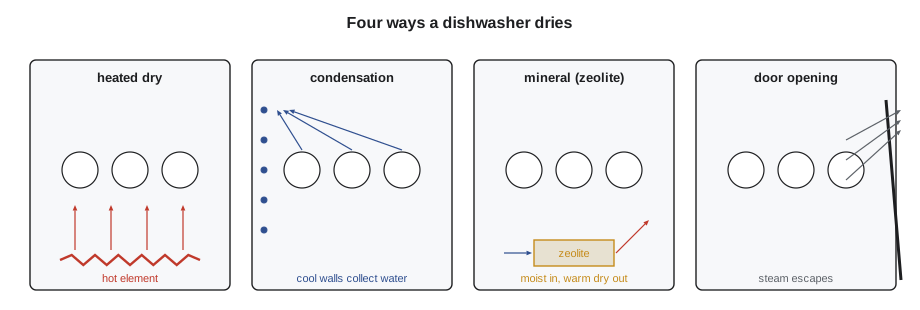
Drying is the part of the cycle that customers judge most, and the part that has changed most. Dishwashers now dry in one or more of these ways:
- Heated dry: the exposed element stays on after the final drain, heating the air in the tub. Effective, but uses more energy and can deform plastics on the bottom rack.
- Condensation drying: the hot final rinse heats the dishes; after the drain, moisture leaving the hot dishes condenses on the cooler stainless steel tub walls and drains away. Rinse aid is essential so the water sheets off. Plastics, which hold little heat, often stay wet.
- Fan-assisted drying: a small fan draws moist air out through a vent, sometimes past a condenser, or circulates air in the tub.
- Mineral drying: some machines have a container of a drying mineral called zeolite in the tub floor. After the final rinse, moist air is blown through it; zeolite adsorbs water vapour and releases heat as it does, which warms the air and dries the dishes. The mineral is dried out again during the next cycle's heating.
- Automatic door opening: at the end of the cycle the door opens a few centimetres so steam can escape and dishes dry in the room's air. The cabinet face above the door must be protected from steam as the installation instructions say.
Drying problems that need a part include a heated-dry element that is open, a failed drying fan or vent, a failed door-opening actuator, a rinse aid dispenser that does not release, and a thermistor that lets the final rinse finish too cool. Drying complaints that need an explanation include plastics that stay wet, water in cup bottoms that spills when the top rack is unloaded last, an empty rinse aid dispenser, and an eco cycle that uses a cooler final rinse by design.
Rinse aid dispensers
The rinse aid dispenser is a small reservoir in the door with a dosing chamber that releases a set amount into the final rinse when the control energizes its actuator, the same type of actuator that opens the detergent cup (lesson 5). A dial sets the dose. Too little gives spots and wet dishes; too much can leave a streaky film or cause suds. Many machines sense the rinse aid level with a float and magnet or an optical sensor and light an indicator when it is low. A dispenser that never empties, or a level indicator that is always lit, may have a failed actuator or sensor; the diagnostic test exercises both.
Worked problem
Expected heating rate during the main wash
A machine heats 3.2 L (0.85 gal) of water with a 1,100 W heater. Ignoring losses to the tub and dishes, how fast should the water warm?
Show solution
- Heat per minute: 1,100 W × 60 s = 66,000 J = 66 kJ.
- Water heated per degree: 3.2 kg × 4.186 kJ ≈ 13.4 kJ per °C.
- \[66 \div 13.4 \approx 4.9 \ ^{\circ}\text{C per minute}\]
Answer: In theory about 5 °C per minute; in practice much less, because the tub, racks and dishes absorb heat. Controls allow for that and only set a heating error when the rise is far slower than they expect, which lesson 5 uses as an example.
Testing heaters safely
A dishwasher heater draws close to 10 A at 120 V, sits in water, and is wired close to the door switch and control. Heater tests are done with the power off and proven dead, following the tech sheet: resistance across the element terminals, then resistance from each terminal to the sheath or the frame. A good element reads its expected resistance across and open (or many megohms on an insulation tester) to ground. The high-limit thermostats and thermal fuses in the heater circuit are tested for continuity at room temperature. If a thermal fuse has opened, the technician finds why before replacing it: a heater relay welded on, a thermistor reading wrong, or a machine that ran without water.
On flow-through heaters built into the pump, the heater and pump are often a single part. The tech sheet shows which terminals belong to the heater and which to the pump motor; mixing them up gives misleading readings.
Heated dry, energy and customer settings
On machines that offer it, heated dry is usually a button the customer can switch on or off. With it off, an older machine dries by the residual heat of the final rinse and condensation. Heated dry uses noticeably more electricity, because the heater runs for many minutes in air rather than water. Energy rules that limit a dishwasher's annual energy use have pushed makers toward condensation and fan drying and toward cooler eco cycles that run longer. Customers who replace a twenty-year-old machine with a new one often find that the new machine takes two or three hours on its normal cycle; that is the trade the maker made for lower energy and water use, and the use and care guide usually explains it.
Many machines also have options that change the heating: a high-temperature wash, a sanitize final rinse, an extra-dry setting and a quick cycle that skips most heating. A customer who always chooses the quick cycle and complains of poor drying and cleaning is using a cycle designed for lightly soiled loads.
Sanitize and high-temperature options
A sanitize option raises the final rinse to the certified temperature and holds it long enough for the bacteria reduction the certification requires; lesson 1 gave the NSF/ANSI 184 figure. The control checks that the water actually reached the target, using the thermistor, and lights the sanitized indicator only if it did. If the indicator does not come on, the technician checks the supply temperature, the heater and its relay, and the thermistor reading against a thermometer. A sanitize light that never comes on in a house with a cool supply is a supply problem first.
High-temperature options also make the dishes and tub hotter at the end of the cycle. The use and care guide warns customers to let the dishes cool before unloading, and a technician opening a machine just after a sanitize cycle should expect hot water in the sump and hot metal around the heater.
Drying vents and fans
Machines that dry with a fan usually have a small motor near the door top or in the tub wall that draws moist air out through a vent, sometimes through a condensing channel that returns the water to the tub, and releases it at the door edge or the toe-kick. A failed fan motor, a blocked vent or a vent flap that does not open leaves dishes wet and may show a code. Some vents are opened by a wax motor like the detergent dispenser. The diagnostic test runs the fan and the vent actuator in turn, and a little tissue paper held near the vent outlet during the test shows whether air is moving. On machines with automatic door opening, the door actuator is tested the same way, and the cabinet face above the door is checked for the steam protection strip the installation instructions require.
Common mistakes
MistakeReplacing a heater on a condensation-dried machine because plastics are wet.
InsteadExplain condensation drying; check rinse aid and unloading order.
MistakeTesting the heater only across its terminals.
InsteadAlso test each terminal to the sheath or frame; leakage trips GFCIs.
MistakeReplacing an open thermal fuse without finding the cause.
InsteadCheck for a welded heater relay, a wrong thermistor reading or a dry run.
MistakeBlaming a thermistor without comparing it with the water temperature.
InsteadMeasure the water with a thermometer and compare with the tech sheet chart.
MistakeSetting the rinse aid dose to maximum for every customer.
InsteadToo much causes streaks and suds; adjust in steps.
Summary and key terms
- Dishwasher heaters are exposed tubular elements or flow-through heaters, typically 800 to 1,200 W at 120 V.
- Expected cold resistance is V² ÷ P; leakage to the sheath or frame is a fault.
- NTC thermistors tell the control the water temperature; their charts are on the tech sheet.
- Machines dry by heat, condensation, fans, zeolite or automatic door opening.
- Condensation drying needs rinse aid and leaves plastics damp.
- Rinse aid dispensers release a set dose into the final rinse.
- High limits and thermal fuses protect the heater; find why one opened.
- Many drying complaints need an explanation rather than a part.
- Tubular element
- A metal-sheathed resistance heater.
- High limit
- A thermostat that opens the heater circuit if it overheats.
- Thermal fuse
- A one-time device that opens permanently if a set temperature is exceeded.
- NTC thermistor
- A sensor whose resistance falls as temperature rises.
- Heated dry
- Drying by running a heater after the final drain.
- Zeolite
- A mineral that adsorbs water vapour and releases heat, used for drying.
- Rinse aid dispenser
- The door reservoir that releases rinse aid into the final rinse.
- Insulation test
- A resistance test from a live part to the frame to find leakage.
Practice problems
Work each problem on paper first, then reveal the answer to check.
What cold resistance should a 1,100 W, 120 V heater read?
Show answer
About 13 Ω.
Why do plastics stay damp in a condensation-dried dishwasher?
Show answer
They hold little heat, so moisture does not leave them.
What does zeolite do in a dishwasher?
Show answer
It adsorbs moisture and releases heat to dry the dishes.
A heater reads 13 Ω across its terminals and 1.8 MΩ to the sheath. Is it good?
Show answer
No; leakage to the sheath can trip a GFCI, so replace it.
A thermal fuse in the heater circuit is open. What must be done before replacing it?
Show answer
Find why it opened, such as a welded relay or a dry run.
Lesson quiz · 5 questions
Score 60% or more to complete this lesson.
Create a free account to save your progress, take quizzes and earn a certificate.