
APP-310 · Lesson 1 of 12 · 24 min
How dishwashers clean and dry
▶ Video coming soon A video version of this lesson is on the way.
On Friday, October 30, Dee Szymanska stayed late at the shop for the first of three Friday-evening "water nights" she had promised Kiran Beaulac. On the bench sat a scrapped built-in dishwasher with its side panels off and a clear acrylic door that a factory trainer had left with Penfold years ago. "More dishwasher calls are about how the machine is used than about broken parts," Dee said, "so before we take anything apart, you need to know how a dishwasher is supposed to clean." She opened her case file from Friday, September 11: Constance Pemberly in Landsdale had called because her two-year-old dishwasher left her glasses cloudy and her pots gritty. Nothing was broken. The rinse aid dispenser was empty, the filter had not been cleaned since the machine was installed, and Ms. Pemberly was loading her pots face-up on the top rack. Dee cleaned the filter, filled the rinse aid, showed her the loading diagram in the use and care guide and left a note on the bill. The call took forty minutes and no parts.
This lesson explains what a dishwasher does in each part of its cycle, why water temperature, detergent and water spray all matter, how a modern machine dries the dishes, and how to read a customer's complaint about cleaning or drying before assuming a part has failed. Later lessons in this course take apart each system: pumps and spray arms in lesson 2, fill, drain and leak protection in lesson 3, heating and drying in lesson 4 and controls in lesson 5.
Four things that clean dishes
Cleaners in every industry talk about four factors that together remove soil: chemistry, temperature, mechanical action and time. A dishwasher uses all four. The detergent is the chemistry: modern dishwasher detergents contain enzymes that break down proteins and starches, alkaline builders that loosen grease, and bleaching agents that remove stains such as tea. Warm water makes the detergent work faster and melts fats. The water sprayed from the spray arms provides the mechanical action, washing loosened soil off the dishes. Time ties the others together: a long, cooler eco cycle can clean as well as a short, hot one because it gives the enzymes more time to work.
If one factor is weak, the others must make up for it. A machine fed with cool water needs more heating time or a longer cycle. A machine with blocked spray arm holes has poor mechanical action, and no amount of detergent will fix that. A customer who uses too little detergent, or old detergent that has absorbed moisture and caked, has weak chemistry. When a customer complains of poor cleaning, Dee runs through all four in her head before she opens the toolbox.
| Factor | What provides it | What weakens it |
|---|---|---|
| Chemistry | Detergent and rinse aid | Too little, old or wrong detergent; very hard water |
| Temperature | Hot supply water and the dishwasher heater | Cool supply, failed heater or thermistor, eco settings |
| Mechanical action | Circulation pump and spray arms | Blocked filters or spray arm holes, poor loading, low water level |
| Time | The cycle the customer chooses | Quick cycles used for heavy soil |
The parts of a cycle
A modern dishwasher does not fill its tub with water. It uses a few litres at a time, circulating the same water through the spray arms again and again, then draining it and filling again for the next stage. A typical normal cycle looks like this:
- Drain at the start, to empty any water left in the sump from the last cycle.
- Pre-wash: a fill, a short circulation that rinses loose soil off the dishes, then a drain. Some cycles add detergent from a small pre-wash cup at this stage.
- Main wash: a fill, the detergent dispenser opens, and the water is heated and circulated for the longest part of the cycle, from about 20 minutes to well over an hour depending on the cycle (typical).
- One or more rinses: fill, circulate, drain, removing detergent and remaining soil.
- Final rinse: a fill heated to a higher temperature, with rinse aid released from its dispenser, then a drain.
- Drying: by heat, by condensation on the cooler walls of the tub, by a fan, by a drying mineral in some models, or by the door opening itself at the end. Lesson 4 explains each.
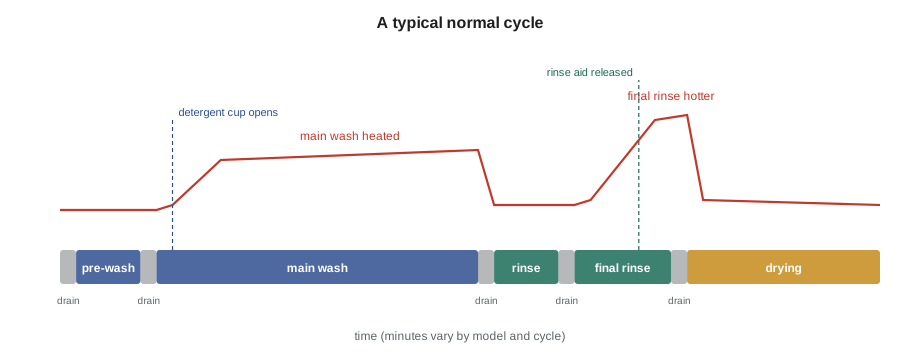
Each fill is only a few litres. Dee's training machine used about 3.2 L (0.85 gal) per fill, and the normal cycle had four fills. That is why a modern dishwasher uses less water than washing the same load by hand under a running tap.
Worked problem
Water used in a normal cycle
A dishwasher fills to 3.2 L (0.85 gal) for each of four fills in its normal cycle. How much water does the cycle use?
Show solution
- Total water:
- \[4 \times 3.2 = 12.8 \text{ L}\]
Answer: The cycle uses about 12.8 L. A long, heavy-soil cycle may add a fill or two, and an eco cycle may use fewer, longer stages.
Water temperature
The dishwasher's heater raises the water during the main wash and the final rinse, but most North American dishwashers are designed to be fed with hot water, usually through a supply line from the hot side of the kitchen sink. The installation instructions give the incoming temperature the maker wants, commonly about 49 °C (120 °F) at the dishwasher (typical). If the water arriving at the dishwasher is cooler than that, the machine spends longer heating, may extend its cycle, or may not reach its target temperature in the time it allows.
Some newer models are designed for a cold-water connection and heat all their own water. The installation instructions say which supply a model expects. When a hot-fed dishwasher cleans poorly, one of Dee's first checks is the water temperature at the kitchen tap. She runs the hot tap until the water is as hot as it gets, holds a thermometer in the stream, and notes how long it took. If the water heater is far from the kitchen, the first fill of the cycle may be nearly cold, because it is the water that was sitting in the pipe. The fix may be as simple as running the kitchen hot tap until it is hot before starting the dishwasher.
Many dishwashers have a sanitize option. Residential dishwashers certified to the NSF/ANSI 184 standard must reach a final rinse of at least 65.5 °C (150 °F) on their sanitizing cycle and reduce bacteria on test dishes by at least five logarithmic steps, which is 99,999 in 100,000. The sanitize light on the control comes on only when the cycle actually reached its target; if it does not, the machine did not get hot enough, which points to the supply temperature, the heater or the temperature sensor.
Worked problem
Heating the final rinse
A dishwasher's final rinse fill of 3.2 L (0.85 gal) arrives at 49 °C (120 °F) and must be heated to 65.5 °C (150 °F). The heater is rated 1,100 W. Ignoring the heat taken up by the tub and dishes, about how long does the heating take? Use 4.186 kJ per kilogram per degree Celsius, and 1 L of water as 1 kg (8.33 Btu to heat a gallon of water by 1 °F, and 3.412 Btu per watt-hour).
Show solution
- Temperature rise: 65.5 − 49 = 16.5 °C.
- Heat needed:
- \[Q = 3.2 \times 4.186 \times 16.5 \approx 221 \text{ kJ}\]
- Time at 1,100 W (1.1 kJ per second):
- \[t = 221 \div 1.1 \approx 201 \text{ s} \approx 3.4 \text{ min}\]
Answer: About three and a half minutes of heating in theory. In practice it takes longer, because the tub, racks and dishes also absorb heat. If the water arrives cooler, the heating time grows, which is why a cool supply lengthens cycles.
Detergent, rinse aid and hard water
The detergent dispenser in the door holds the main wash detergent behind a lid that the control opens at the right moment. Lesson 5 explains the actuator. The customer's choice of detergent matters: powders, gels and single-dose packs all work if used as the maker says, but dishwasher detergent must never be replaced by hand dish soap, which makes a mountain of suds. Suds overflow the tub, fool the water level sensing, cushion the spray and make the circulation pump lose its prime, so the machine may leak, stop or show an error.
The rinse aid dispenser holds a liquid that the machine releases in small doses into the final rinse. Rinse aid lowers the surface tension of the water, so the water sheets off the dishes instead of standing in drops. That helps drying, especially in machines that dry by condensation, and prevents spots as the drops evaporate. Many current detergents and most current dishwashers are designed around rinse aid: without it, drying suffers and spots appear. The dispenser usually has a dial that sets the dose, and an indicator that shows when it is empty.
Hard water contains dissolved calcium and magnesium. When it is heated, those minerals can come out of solution as scale: a white, chalky film on glasses and on the inside of the tub, and a crust on the heater and in spray arm holes. A rough, white film that comes off with vinegar is usually hard-water scale. A film that cannot be removed, sometimes with a rainbow sheen, may be etching: permanent damage to the glass, often caused by too much detergent in soft water. Some European-designed dishwashers have a built-in water softener with a salt reservoir; others rely on detergent and rinse aid. Lesson 10 covers household water softeners and how hardness is measured.
Loading and use
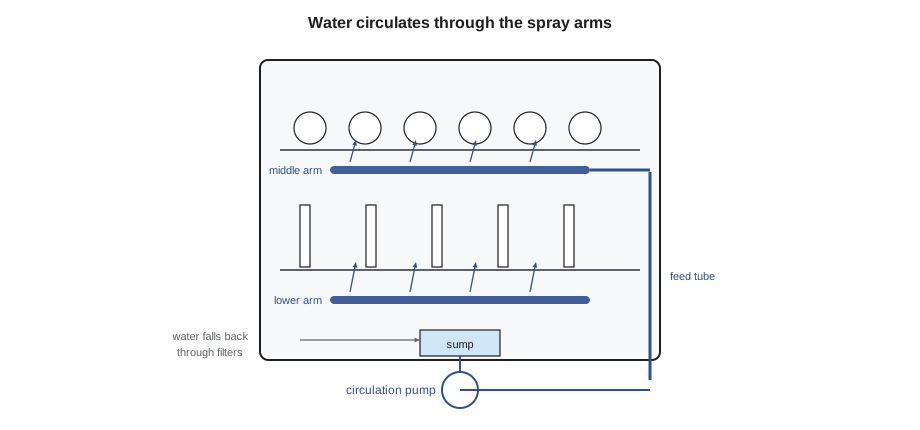
The spray arms throw water upward and outward, so dishes clean best when their dirty surfaces face the spray and nothing blocks the arms. Large pans laid across the lower rack can block the middle spray arm's feed or stop the arm from turning. Tall items can hit the upper arm. Bowls nested together stay dirty inside. The use and care guide shows the maker's loading pattern, and a technician can often fix a "poor cleaning" complaint by turning the spray arms by hand with the racks loaded to show the customer where they catch.
Customers also ask whether they should rinse dishes first. Modern detergents work best with some soil to act on, and the machine's turbidity sensor, explained in lesson 5, may choose a shorter cycle if the first water it sees is clean. Most makers now advise scraping food off but not rinsing. Large bones, toothpicks, labels and seeds do not belong in the machine: they block filters and spray arm holes and can jam the drain pump.
Drying in brief
Older dishwashers dried with an exposed heating element at the bottom of the tub, which baked the dishes dry and sometimes melted plastic left on the bottom rack. Many current models avoid a hot exposed element. They dry by condensation: the final rinse heats the dishes, and when it drains, the moisture leaving the hot dishes condenses on the cooler stainless steel walls of the tub and runs back down to the sump. Rinse aid helps the water sheet off. Some models add a fan, a vent that opens, a drying mineral that absorbs moisture, or a door that opens a little at the end of the cycle. Plastic items, with their low heat capacity, often stay wet in condensation-dried machines; that is normal, and the use and care guide usually says so. Lesson 4 explains each drying system and how to tell normal from faulty.
Reading a cleaning or drying complaint
Because so many cleaning and drying complaints come from use rather than faults, Dee taught Kiran a sequence of questions to ask before opening the machine: which items are dirty and where are they in the racks; what detergent is used and how much; is the rinse aid full; when was the filter last cleaned; how hot does the kitchen tap get and how fast; which cycle is used; and does the problem happen on every load. The answers usually point to one of the four cleaning factors.
| Complaint | Often caused by | First checks |
|---|---|---|
| Gritty dishes, food on upper rack | Clogged filter, recirculated soil | Clean filter; check spray arm holes |
| White chalky film | Hard water, no rinse aid, too little detergent | Vinegar test; rinse aid; detergent dose |
| Permanent cloudiness on glass | Etching from too much detergent in soft water | Explain; reduce detergent |
| Dishes wet at end | No rinse aid, plastics, unloading bottom rack first | Rinse aid; explain condensation drying |
| Dishes not clean on quick cycle | Not enough time for the soil | Use normal or heavy cycle |
| Suds on floor | Hand dish soap used | Explain; run rinse cycles to clear suds |
When the use questions do not explain the problem, the technician moves on to the machine: water level, spray arm rotation, pump operation, heating and the control's own diagnostic test. The rest of this course covers each.
Common mistakes
MistakeReplacing parts for a cleaning complaint before checking use.
InsteadAsk the use questions and check filter, rinse aid and supply temperature first.
MistakeTesting supply temperature with the first cup of water from the tap.
InsteadRun the hot tap until the temperature stops rising, and note how long it took.
MistakeTreating plastics that stay wet as a fault.
InsteadCondensation drying leaves plastics damp; explain the normal behaviour.
MistakeTelling a customer that cloudiness will wash off when it is etching.
InsteadDo the vinegar test; etching is permanent damage.
MistakeIgnoring hand dish soap as a cause of leaks.
InsteadAsk what was used; suds overflow the tub and fool the machine.
Summary and key terms
- Dishes are cleaned by chemistry, temperature, mechanical action and time together.
- A cycle repeats fill, circulate and drain several times with a few litres of water each fill.
- Most hot-fed dishwashers want supply water around 49 °C (120 °F); a cool supply lengthens cycles.
- Sanitize cycles certified to NSF/ANSI 184 reach a 65.5 °C (150 °F) final rinse.
- Rinse aid helps water sheet off dishes and is needed for good drying in most current machines.
- Hard-water film comes off with vinegar; etching does not.
- Loading blocks spray arms more often than parts fail.
- Ask about use before testing parts on a cleaning or drying complaint.
- Main wash
- The longest stage of a cycle, when detergent is released and the water is heated and circulated.
- Final rinse
- The last, hotter rinse, into which rinse aid is released.
- Rinse aid
- A liquid released into the final rinse that helps water sheet off dishes.
- Sanitize option
- A cycle option that raises the final rinse to a set temperature to reduce bacteria.
- Scale
- Mineral deposit left by hard water when it is heated.
- Etching
- Permanent cloudiness of glass, often from too much detergent in soft water.
- Condensation drying
- Drying in which moisture from hot dishes condenses on cooler tub walls.
- Sump
- The low part of the tub where water collects for the pumps.
Practice problems
Work each problem on paper first, then reveal the answer to check.
Name the four factors that together clean dishes.
Show answer
Chemistry, temperature, mechanical action and time.
A dishwasher uses 3.2 L per fill and four fills. How much water is that?
Show answer
12.8 L.
What does rinse aid do?
Show answer
It lowers surface tension so water sheets off dishes, helping drying and preventing spots.
How can you tell hard-water film from etching?
Show answer
Hard-water film comes off with vinegar; etching does not.
Why might the first fill of a cycle be cool even with a good water heater?
Show answer
It is the water that was standing in the pipe to the kitchen.
Lesson quiz · 5 questions
Score 60% or more to complete this lesson.
Create a free account to save your progress, take quizzes and earn a certificate.