
APP-310 · Lesson 12 of 12 · 25 min
Dishwasher service case studies
▶ Video coming soon A video version of this lesson is on the way.
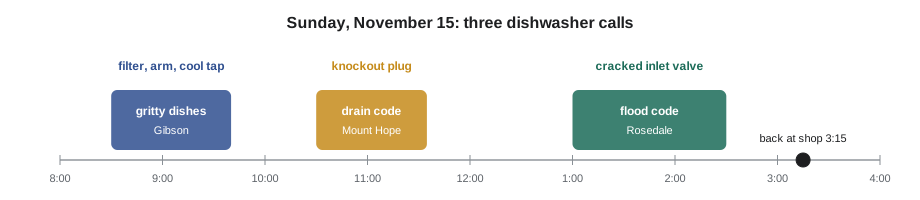
Penfold runs a weekend on-call rotation, and on Sunday, November 15, Dee and Kiran had the van. Fenna had booked three dishwasher calls on Friday afternoon and left the tickets on the dashboard. "Three different machines, three different problems," Dee said as they left the shop at 8:05. "I'll ask the questions on the first one. You ask them on the second. You run the third." This lesson follows the day, call by call, as a review of the whole course: the four factors of cleaning, the water path, fill and drain, leak protection, controls and fault codes, and the installation checks that turned out to matter at the second house.
Call 1, 8:30: gritty dishes and a cool tap
Wilhelmina Strathdee's 2018 dishwasher in Gibson had been leaving grit on the upper rack and a dull film on glasses for a month. Dee started with the use questions from lesson 1. Ms. Strathdee used single-dose packs and kept the rinse aid full. She had never cleaned the filter, because she did not know it came out. And when Dee asked how hot the kitchen tap got, she laughed: she had turned the water heater down in September to save money.
With the power off at the breaker, Dee lifted out the lower rack and twisted out the filter assembly. The coarse filter was packed with food, and the fine mesh was coated. Kiran rinsed both at the sink while Dee checked the lower spray arm: two holes were blocked, one by a lemon seed and one by scale. She cleared them with the maker's tool and turned the arm by hand: it spun freely. Then she ran the kitchen hot tap and held a thermometer in the stream. After a full minute it reached only 41 °C (106 °F), well short of the 49 °C (120 °F) the dishwasher's instructions ask for.
Worked problem
What a cool supply costs the dishwasher
Each fill of Ms. Strathdee's dishwasher is about 3.2 L (0.85 gal), and the machine heats its main wash to at least the supply temperature its program expects. If the water arrives at 41 °C (106 °F) instead of 49 °C (120 °F), how much extra heating does each fill need, and about how long does the 1,100 W heater take to supply it, ignoring losses?
Show solution
- Shortfall: 49 − 41 = 8 °C.
- Extra heat:
- \[3.2 \times 4.186 \times 8 \approx 107 \text{ kJ}\]
- Time at 1.1 kW:
- \[107 \div 1.1 \approx 97 \text{ s}\]
Answer: About a minute and a half of extra heating per heated fill in theory, and more in practice. On a short or eco cycle the machine may never reach its target, so the detergent works poorly. The saving on the water heater is lost in the dishwasher, and the dishes come out dirty.
Dee explained the filter to Ms. Strathdee and showed her how to clean it monthly, and suggested she run the kitchen hot tap until it was hot before starting a cycle. On the water heater, she explained what lesson 8 and GAS-210 say about temperature: water stored too cool can let bacteria grow, and water delivered too hot can scald, and the right setting is the one in the water heater's guide, with a mixing valve where the household needs it. Ms. Strathdee said she would set it back to the guide's setting herself. Dee ran a normal cycle with a test load while Kiran wrote the ticket: no parts, service call 95 dollars plus HST, 107.35 dollars. They left at 9:40.
Call 2, 10:30: a new disposer and a full tub
Fergus Ballantyne in Mount Hope had replaced his old disposer himself on Saturday. Since then, his dishwasher ended every cycle with dirty water in the tub and an E2 code flashing. Kiran asked the questions: when did it start, what changed, had any chemical gone down the drain? The answer to the second question was the whole story, but Kiran checked rather than assumed.
Dee switched off the disposer's circuit at the panel and unplugged its cord; Kiran proved the receptacle dead. Under the sink, the dishwasher's drain hose was clamped neatly to the new disposer's inlet. Kiran loosened the clamp and pulled the hose off: the inlet was sealed by the disposer's knockout plug, never removed. The drain hose itself lay along the floor of the cabinet with no high loop. Kiran knocked out the plug with a screwdriver and hammer, as the disposer's instructions show, and fished the loose disc out of the grinding chamber with tongs, by flashlight, without putting his hand in. He refitted and clamped the hose, raised it in a high loop and fastened it under the countertop with a strap, and Dee restored the power.
Worked problem
Checking the drain after the repair
Kiran ran the dishwasher's diagnostic drain step and timed it: the sump, holding about 3.2 L (0.85 gal), emptied in 14 seconds. Lesson 2 estimated about 13 seconds for this size of sump with a pump rated 15 L per minute (4 gal per minute). Is the drain normal?
Show solution
- Flow achieved:
- \[3.2 \div 14 \times 60 \approx 13.7 \text{ L per minute}\]
- That is within about 10 in 100 of the pump's rating.
Answer: Yes. A 14-second drain shows the path is clear from the pump through the hose and disposer. The E2 code was the control reporting a drain that could not happen, not a failed pump. Kiran cleared the fault history after writing it down: E2 four times since Saturday.
Kiran explained the knockout plug and the high loop to Mr. Ballantyne, who had followed the disposer's instructions in every other way. Dee added a note to the ticket that the disposer and dishwasher shared one receptacle under the sink, and that the dishwasher's instructions call for its own circuit; she recommended an electrician check it, as lesson 11 explained. Service call 95 dollars plus HST, 107.35 dollars. They left at 11:35.
Call 3, 1:00: a flood code
Odalys Vantongeren's 2021 Northwind dishwasher in Rosedale had stopped mid-cycle with an E5 code, and the drain pump kept running. Kiran ran the call. The E5 code on Penfold's training binder is the flood switch (lesson 5's sample table), so he expected water in the base pan, and he asked the leak questions from lesson 3 first: was there foam, had any other detergent been used, had she seen water on the floor? None.
With the power off and the water valve closed, Kiran removed the toe-kick and the lower access panel. The base pan held a shallow pool of clean water, and the float sat high on its switch. He soaked up the water, dried the pan, and checked that the float moved freely and the switch changed state with his meter. Then he looked for the source. Following Dee's method, he traced upward from the wettest point, along the inside fill hose to the inlet valve: there was a white mineral trail down from the valve's outlet spigot, where the plastic had cracked.
He opened the water valve with the panels off and the door closed and started the diagnostic fill step while Dee watched the valve with a flashlight. A thin spray came from the crack as soon as the valve opened. That confirmed it. The van carried the valve assembly for this model. Kiran closed the water, fitted the new valve with the supply elbow transferred and resealed on its pipe threads, reconnected the fill hose, and ran the fill step again: dry. He entered service mode and read the fault history before clearing it: E5 twice in the past month, both short. Ms. Vantongeren had noticed the machine stopping before but thought it was a power flicker.
Worked problem
The invoice
The call was the 95 dollar service call and an 85 dollar flat rate for the inlet valve assembly. What is the total with HST at 13 in 100?
Show solution
- Subtotal: 95 + 85 = 180 dollars.
- HST: 180 × 0.13 = 23.40 dollars.
- Total: 203.40 dollars.
Answer: 203.40 dollars, with Penfold's 90-day labour warranty on the repair.
Before refitting the panels, Kiran ran a short cycle with the toe-kick off, checking the pan with a dry towel at the end, then refitted the panels and showed Ms. Vantongeren the filter. They left at 2:30 and were back at the shop at 3:15.
What the day showed
Back at the shop, Dee went through the three tickets with Kiran while he entered them. The first call needed no parts at all: a clogged filter, two blocked spray arm holes and a cool supply, found by asking about use and checking the four cleaning factors. The second needed no parts either: an installation fault made by a homeowner, found by asking what had changed and confirmed by looking. Only the third needed a part, and even then the fault code pointed to a symptom, water in the base pan, and the technician had to find the source himself before ordering.
| Call | Complaint | Cause | Lesson that applied |
|---|---|---|---|
| 1 | Gritty dishes, film | Clogged filter, blocked arm holes, cool supply | Lessons 1, 2, 4 |
| 2 | Water in tub, E2 drain code | Disposer knockout plug left in, no high loop | Lessons 3, 6, 11 |
| 3 | E5 flood code | Cracked inlet valve outlet | Lessons 3, 5 |
Dee's other point was about records. Each ticket showed what was found, every reading taken, the fault history before it was cleared, the parts used and the advice given: the filter cleaning, the hot tap, the knockout plug, the shared circuit. If a machine comes back, the next technician starts from the record, not from scratch. Fenna's follow-up calls to all three customers are booked for Monday, November 16. Kiran's ODP course on Saturday, December 5, is still on the calendar, and Dee has promised one more water night, on water heaters, when it is done.
A method for every dishwasher call
The day followed a method that works on any dishwasher call, and it ties the course together:
- Ask about use: detergent, rinse aid, loading, filter cleaning, cycle choice, supply temperature, and what changed recently.
- Look before touching: filters, spray arms, the drain hose and its loop, the disposer connection, the base pan.
- Make safe: power off at the panel and proven dead; water valve closed when opening any water connection.
- Test with the machine's own diagnostic mode, watching each component, and read the fault history before clearing it.
- Measure to confirm: resistance, voltage, temperature, drain time, fill volume.
- Repair the cause, not only the symptom, and test a full cycle or step with the panels off and a dry towel to check for leaks.
- Explain and record: what was found, the readings, the parts and the advice, including anything for a plumber or electrician.
What Kiran would do differently
At the end of the day, Dee asked Kiran what he would do differently next time. He had three answers. On the first call, he would have asked about the water heater setting at the start instead of waiting for the thermometer to tell him; the customer knew, and asking would have saved a few minutes. On the second, he would have looked under the sink before knocking out the plug to check that the disposer was fully locked on its mounting ring, because a homeowner installation may have other faults, and a loose disposer can drop when it is struck. On the third, he would have checked the parts list before leaving the van, because the valve was on board only by luck.
Dee added one of her own. On every call that day, the answer had been found by following water: where it came from, how much there was, how hot it was and where it went. "Dishwashers, disposers, water heaters, softeners, the whole course," she said. "Follow the water and keep the electricity off while you do it." She signed off his water nights in the training binder that evening, with a note for Harriet that he was ready to run dishwasher calls on his own, with Dee on the phone.
The tickets from the day went into Penfold's system with photographs Kiran had taken of the packed filter, the knockout plug lying in the disposer and the cracked valve. Fenna attached them to the customers' files, so that the follow-up calls on Monday could refer to them, and so that the parts claim for the inlet valve, if the maker's warranty covered it, had the evidence the maker asks for.
Common mistakes
MistakeOrdering a part from the fault code alone.
InsteadFind the source of the symptom the code reports and confirm it with a test.
MistakeSkipping the use questions on a cleaning complaint.
InsteadAsk them first; many cleaning calls need no parts.
MistakeAssuming the drain pump has failed on a drain code after a disposer change.
InsteadCheck the disposer's knockout plug and the drain hose first.
MistakeClearing the fault history before writing it down.
InsteadRecord it; repeated short codes tell their own story.
MistakeLeaving without testing for leaks.
InsteadRun a cycle or the fill step with the panels off and check with a dry towel.
Summary and key terms
- Cleaning complaints often come from filters, spray arms, use and supply temperature.
- A cool hot-water supply forces the dishwasher to heat longer or clean worse.
- A new disposer with its knockout plug in place stops the dishwasher draining.
- Drain codes describe a symptom; the pump may be fine.
- Flood codes mean water in the base pan; trace the leak upward from the wettest point.
- Read and record the fault history before clearing it.
- Test every repair and check for leaks before refitting panels.
- Records and clear advice prevent return visits.
- On-call
- A rotation in which a technician takes calls outside normal hours.
- Fault history
- The list of past fault codes stored by the control.
- Diagnostic drain step
- A service-mode test that runs only the drain pump.
- Flat rate
- A set price for a repair that includes the part and labour.
- Labour warranty
- The company's guarantee on its repair work for a set period.
- Service ticket
- The record of a call: complaint, findings, readings, parts and advice.
- Use questions
- Questions about how the customer uses the appliance, asked before testing.
- Follow-up call
- A call after the repair to confirm the customer is satisfied.
Practice problems
Work each problem on paper first, then reveal the answer to check.
What three things caused the poor cleaning at the first call?
Show answer
A clogged filter, blocked spray arm holes and a cool hot-water supply.
Why did the second dishwasher show a drain code?
Show answer
The new disposer's knockout plug had not been removed.
How did Kiran find the source of the flood code?
Show answer
He traced upward from the wet base pan to the cracked inlet valve and confirmed it during a fill.
The repair was 95 + 85 dollars. What is the total with HST at 13 in 100?
Show answer
203.40 dollars.
What should be recorded on every ticket?
Show answer
What was found, every reading, the fault history, parts used and advice given.
Lesson quiz · 5 questions
Score 60% or more to complete this lesson.
Create a free account to save your progress, take quizzes and earn a certificate.