
APP-230 · Lesson 9 of 12 · 23 min
Induction cooktops and their electronics
▶ Video coming soon A video version of this lesson is on the way.
Nkechi Arbuthnot's induction cooktop in Lisgar was a year old when it began switching itself off after about ten minutes of cooking, on Wednesday, September 16, with an error code on the display. Dee's first step was not a meter: it was a flashlight under the counter. The cooktop had been installed above a new drawer unit, and the installer had pushed a solid wood panel right up against the cooktop's underside, blocking the cooling fan's inlet. The power electronics were overheating, and the cooktop was protecting itself exactly as designed. Dee showed the customer the installation instructions' required air gap, the cabinet maker cut the panel back, and the error never returned. "Half of induction service is installation," she said at the cooking night. "The other half is high voltage, so you'd better understand what's inside before you open one."
This lesson explains how an induction cooktop heats, the parts inside one, how pan detection and power sharing work, what goes wrong, and how to work safely on electronics that store dangerous energy even when switched off. Board-level diagnosis of modern controls is covered in APP-320; here the aim is to understand the system, recognize installation and cookware problems, and replace the major assemblies following the tech sheet.
How induction heats
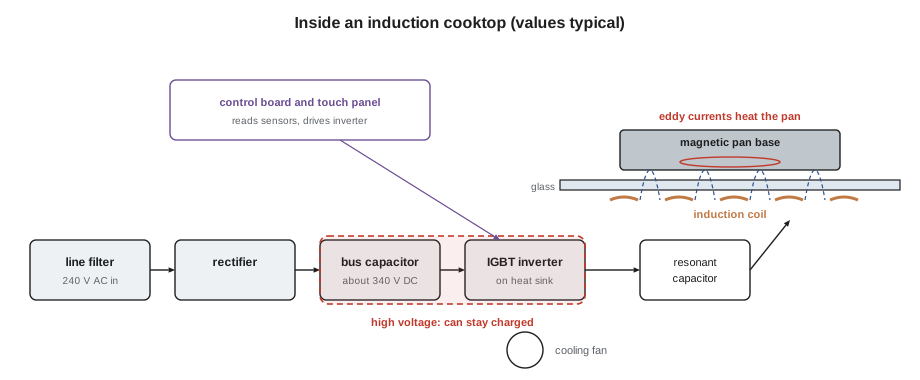
An induction cooking zone is a flat coil of copper wire under the glass-ceramic top. The cooktop's electronics drive a high-frequency alternating current through the coil, typically around 20 to 100 kHz (20 to 100 kHz) (typical), which produces a rapidly alternating magnetic field above the glass. When a pan made of a ferromagnetic material, such as cast iron or magnetic stainless steel, sits in that field, the field induces eddy currents in the pan's base, and the pan's own electrical resistance turns those currents into heat. In iron, magnetic hysteresis, the energy lost as the material's magnetism is repeatedly reversed, adds more heat. The pan heats itself; the glass gets hot only from the pan sitting on it.
Induction is fast and efficient, because the heat is produced in the pan rather than in an element that must heat the glass first, and it responds almost instantly when the setting changes. It also needs suitable cookware. A pan must be magnetic for induction to work well: a simple test is whether a fridge magnet sticks firmly to its base. Aluminum, copper, glass and some stainless steels do not work, or work only on cooktops with special all-metal zones. Many customer calls about a "dead zone" are actually about a pan that the cooktop does not recognize.
What is inside
An induction cooktop takes its 240 V supply through a line filter that keeps its high-frequency noise out of the house wiring. A rectifier turns the alternating supply into direct current, and a DC bus capacitor smooths it. Because the rectified 240 V supply peaks at about √2 × 240 ≈ 340 V, the DC bus of an induction cooktop runs at roughly 300 to 340 V DC (typical). An inverter, made of power transistors called IGBTs (insulated-gate bipolar transistors) on a large heat sink, switches that DC on and off at high frequency to drive the coil.
The coil is connected with a resonant capacitor, forming a resonant circuit that the inverter drives close to its natural frequency, which makes the system efficient. The control varies the power, for example by changing the switching frequency or by switching the zone on and off in a cycle at the lowest settings. A cooling fan draws air across the heat sink and electronics, because the IGBTs produce heat even though they are efficient. Temperature sensors, thermistors under the glass at each zone and on the heat sink, let the control protect the glass, the pan and the electronics. A separate control board runs the touch panel, the display and the logic, and talks to the power boards.
Most full-size induction cooktops have two power boards, each driving two zones, sharing the cooktop's total power. That is why power sharing happens: setting one zone to boost may reduce another zone's setting automatically, because both are fed from the same board and the cooktop must stay within its total rating and its circuit.
Worked problem
The DC bus voltage and power sharing
An induction cooktop runs on 240 V. Its two right-hand zones share one power board with a limit of 3,700 W. The front right zone is set to boost at 3,200 W. What is the peak of the supply voltage, and how much power is left for the rear right zone?
Show solution
- Peak of the rectified supply:
- \[V_{peak} = \sqrt{2} \times 240 \approx 1.414 \times 240 \approx 339 \text{ V}\]
- Power left on the shared board:
- \[3700 - 3200 = 500 \text{ W}\]
- So the rear right zone can run at no more than about 500 W while the front zone is on boost.
Answer: The DC bus charges to about 340 V. The rear zone is limited to about 500 W, so the cooktop drops its setting automatically. That is normal power sharing, not a fault, and the use and care guide explains it.
Pan detection and protection
An induction zone does not heat until it detects a suitable pan. The control sends short pulses to the coil and measures how the resonant circuit responds; a magnetic pan of adequate size changes the response in a recognizable way. If no pan, or an unsuitable pan, is detected, the zone shows a pan-detection symbol and switches off after a short time. A pan that is too small for the zone, often smaller than about half the zone's marked diameter, may not be detected either. Lifting a pan stops the heat at once, which is one of induction's safety advantages.
The control also protects itself. If the glass over a zone gets too hot, as when a pan boils dry, it reduces power or switches the zone off. If the heat sink overheats because the fan has failed or the air path is blocked, as in Nkechi Arbuthnot's cooktop, it reduces power and eventually shuts down with an error code. Supply problems, such as low voltage, a missing supply leg or a 208 V supply on a cooktop not rated for it, also produce error codes. The maker's error code list, in the tech sheet or service manual, tells the technician which part of the system the control is reporting.
| Complaint | Often caused by | Check |
|---|---|---|
| Zone shows pan symbol, will not heat | Pan not magnetic or too small | Magnet test on pan base; pan size against zone |
| Cooktop shuts off after some minutes | Blocked air path, failed cooling fan | Installation air gap, fan running, filters |
| One zone reduces when another boosts | Power sharing on a shared board | Explain; normal operation |
| Buzzing or humming from pan | Normal at high settings, especially with multi-layer pans | Explain; try a different pan |
| Whole cooktop dead | Supply, breaker, line filter, control board | Supply voltage, fuses, board power |
| Error code | Fault reported by control | Maker's error code list; follow its steps |
Induction cooktops make some noises that worry customers: a buzz or hum at high settings, especially with pans made of layers of different metals; a clicking as the control switches zones at low settings; and the cooling fan running during and after cooking. These are normal and are described in the use and care guide. A loud rattle or a fan that runs without stopping is not.
High voltage and stored energy
An induction cooktop's power boards are dangerous to work on. The DC bus runs at around 340 V, and the bus capacitor, and the resonant capacitors, can stay charged for some time after the cooktop is unplugged or the breaker is off. Touching the bus or the IGBT terminals can give a severe or fatal shock. APP-110's demonstration of a microwave oven's high-voltage capacitor showed the same hazard in a more extreme form.
The safe procedure follows the tech sheet. Switch off the breaker or unplug the cooktop, prove the supply is dead at the terminal block with a meter, then wait the discharge time the maker gives before opening the power board area, often several minutes. Then measure the DC bus voltage at the test points the tech sheet names, with the meter on a DC voltage range rated for it, and confirm it has fallen to a safe level before touching anything. If the maker specifies a discharge method, such as a resistor tool, use exactly that. Never short a capacitor with a screwdriver: it can damage the board, weld the tool and spray molten metal.
Worked problem
How long a bus capacitor takes to discharge
A cooktop's DC bus capacitor is 5 µF with a bleed resistor of 470 kΩ across it. The time constant of a resistor-capacitor circuit is τ = R × C, and after about five time constants the voltage has fallen to under 1 in 100 of its starting value. How long does the bus take to fall from 340 V to a safe level?
Show solution
- Time constant:
- \[\tau = R \times C = 470\,000 \times 0.000005 = 2.35 \text{ s}\]
- Five time constants:
- \[5\tau = 5 \times 2.35 \approx 11.8 \text{ s}\]
- After about 12 s, the voltage is below about 1 in 100 of 340 V, under 3.4 V.
Answer: With a working bleed resistor, the bus discharges in about 12 seconds. If the bleed resistor has failed open, the capacitor can hold its charge for a long time, which is exactly why the technician measures the bus before touching anything rather than trusting the time.
Induction cooktops are also sensitive to static electricity. Boards are handled by their edges, with an antistatic wrist strap where the tech sheet calls for one, and new boards stay in their antistatic bags until they are fitted. APP-320 covers static handling in detail.
Replacing assemblies
Field repair of an induction cooktop is mostly replacement of assemblies: the control board, a power board, a coil, the cooling fan, a temperature sensor, the line filter, or the glass top with its frame. The error code and the maker's diagnostic procedure point to the assembly. Before ordering a power board, the technician confirms that the fault is not caused by the installation, the supply, the cookware or a failed fan, because a new board fitted into a cooktop with a blocked air path will fail again. Coils are tested for resistance and insulation as the tech sheet shows; their resistance is very low, a fraction of an ohm, so the useful tests are continuity and insulation to the frame.
When a cooktop's electronics are replaced, the connectors, ribbon cables and thermal paste on the heat sink must be fitted exactly as the tech sheet shows. A power board's IGBT module depends on good thermal contact with the heat sink; missing or uneven thermal paste makes it overheat. After repair, the technician runs each zone with a suitable pan, checks the fan and confirms no error codes return.
Customer advice
The use and care guide carries advice that the technician repeats: use flat-bottomed magnetic pans of the right size, lift pans rather than slide them to avoid scratching the glass, keep the underside air paths clear, and do not use the glass as a work surface for metal objects, which can heat if left on a live zone. Makers also include guidance for people with pacemakers and other implanted medical devices, typically advising them to follow their doctor's and the device maker's guidance and to keep a set distance from an operating zone. The technician points customers to that section rather than giving medical advice.
Installation checks for induction
Because so many induction problems come from the installation, Dee checks the same things on every induction call before opening anything. The cooktop must have the air gap and ventilation openings its instructions require, both under the cooktop and, for some models, at the front of the cabinet. It must sit on a cabinet of the required depth, with any drawer or oven below it at the distances the instructions give. Its supply must be the voltage and circuit size the plate requires, connected as the instructions show; a cooktop rated for 240 V that is installed on 208 V produces less power and may show supply errors. And it must not be installed over a dishwasher or another heat source unless its instructions allow it, because warm, moist air can overheat or damage the electronics.
Dee also checks the cookware the customer actually uses, the condition of the glass, and whether the touch controls are being affected by water or a pan handle resting on them, which can make the cooktop switch off or ignore key presses. Only when all of those check out does she move on to error codes and assemblies.
Common mistakes
MistakeCondemning a zone when the customer's pan is not magnetic.
InsteadDo the magnet test on the pan before testing the cooktop.
MistakeReplacing a power board without checking the air path.
InsteadCheck the installation air gap and the fan first, or the new board fails too.
MistakeOpening the power board area as soon as the power is off.
InsteadWait the discharge time and measure the DC bus before touching anything.
MistakeShorting a capacitor with a screwdriver.
InsteadUse only the discharge method the maker gives.
MistakeTreating power sharing as a fault.
InsteadShared boards limit total power; explain how the zones interact.
Summary and key terms
- Induction coils make an alternating magnetic field that heats a magnetic pan directly.
- Pans must be magnetic and large enough for the zone; a magnet test checks the base.
- A rectifier and bus capacitor make about 340 V DC; IGBTs drive the coil at high frequency.
- Shared power boards reduce one zone when another boosts.
- Pan detection, glass sensors and heat sink sensors protect the cooktop.
- Blocked air paths and failed fans make cooktops overheat and shut down.
- Bus and resonant capacitors can stay charged; wait, measure and follow the tech sheet.
- Most repairs replace assemblies after installation, supply and cookware are ruled out.
- Induction
- Heating a pan by inducing currents in it with an alternating magnetic field.
- Ferromagnetic
- Strongly attracted to a magnet, like iron and magnetic stainless steel.
- Eddy currents
- Circulating currents induced in a conductor by a changing magnetic field.
- IGBT
- A power transistor used to switch the coil current in an induction cooktop.
- DC bus
- The rectified, smoothed direct-current supply inside the cooktop.
- Resonant capacitor
- The capacitor that forms a resonant circuit with an induction coil.
- Power sharing
- Limiting zones on one power board so their total stays within a set power.
- Pan detection
- The control's test for a suitable pan before it heats a zone.
Practice problems
Work each problem on paper first, then reveal the answer to check.
How can a customer check that a pan will work on induction?
Show answer
See whether a magnet sticks firmly to its base.
About what voltage does the DC bus of a 240 V induction cooktop reach?
Show answer
About 340 V DC.
A 5 µF capacitor has a 470 kΩ bleed resistor. What is the time constant?
Show answer
About 2.35 s.
Why does one zone drop its setting when another is on boost?
Show answer
The zones share a power board with a total power limit.
An induction cooktop shuts down after ten minutes with an overheat code. What should be checked first?
Show answer
The installation air gap and the cooling fan.
Lesson quiz · 5 questions
Score 60% or more to complete this lesson.
Create a free account to save your progress, take quizzes and earn a certificate.