
APP-230 · Lesson 12 of 12 · 29 min
Cooking appliance service case studies
▶ Video coming soon A video version of this lesson is on the way.
Saturday, October 31, was Hiro's on-call day, and Harriet sent Kiran with him. "Three cooking calls," Fenna said, handing Hiro the route sheet at 8:00. "A gas oven that won't bake, a glass-top element that won't turn down, and an induction cooktop with a noisy fan. You'll be home before the trick-or-treaters." Hiro looked at the sheet and then at Kiran. "Gas oven first. You run the electrical tests, I handle anything that touches gas, and you write it all down like Dee taught you."
This lesson follows the three calls from start to finish. Each one shows the same method the earlier lessons built: listen to the complaint, check the installation and the use, read the plate and tech sheet, make the appliance safe, test before replacing, repair, verify, and record. Each call also shows one of the course's main hazards being handled correctly: gas and carbon monoxide, high current, and stored energy in electronics.
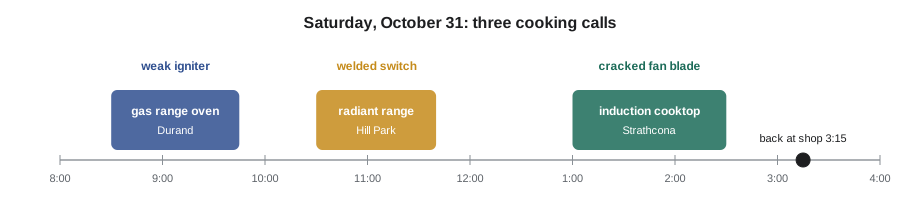
Call 1: a gas oven that won't bake
At 8:30 they arrived at Oriel Fanshawe's house in Durand. Her 2016 gas range's top burners worked, but the oven had been slow to light for a week and that morning would not light at all; she could see a glow through the oven floor slots. Kiran read the plate behind the drawer: natural gas, 120 V, the model and serial for the tech sheet, and no conversion label. The tech sheet in the range's back panel gave the bake igniter's minimum operating current as 3.2 A.
Hiro checked the room with his combustible gas detector, then had Kiran unplug the range and pull it forward after releasing the anti-tip bracket. With the range plugged back in and the back panel off, Kiran clamped his meter around one igniter lead, set the oven to bake and timed it. After 90 seconds the current had levelled off at 2.6 A, and the safety valve had not clicked. With the power off again, Kiran measured the igniter cold: 210 Ω, within the tech sheet's cold range. "It's not open," Hiro said. "It's tired."
Worked problem
Call 1: is it the igniter or the valve?
The igniter circuit draws 2.6 A from 120 V after 90 seconds. The valve's bimetal heater measures 1.1 Ω, and the tech sheet says the valve opens at 3.2 A. What is the hot resistance of the igniter, and what hot resistance would a new igniter need to reach 3.2 A?
Show solution
- Circuit resistance now:
- \[R = \frac{120}{2.6} \approx 46.2 \ \Omega\]
- Hot igniter resistance now: 46.2 − 1.1 ≈ 45.1 Ω.
- Largest circuit resistance that still gives 3.2 A:
- \[R_{max} = \frac{120}{3.2} = 37.5 \ \Omega\]
- Largest igniter resistance: 37.5 − 1.1 = 36.4 Ω.
Answer: The igniter has aged to about 45 Ω hot; it must be below about 36 Ω for the valve to open. The valve's heater reads normally, so the igniter is the part to replace.
Hiro shut off the gas at the appliance valve before the oven floor and burner baffle came out, because the new igniter mounts beside the burner, and Kiran fitted the igniter listed for the model, handling it by its bracket. With the gas back on, Hiro leak-tested the safety valve connection he had disturbed while moving the burner. The new igniter drew 3.4 A after 60 seconds, the valve clicked, and the burner lit with a clean blue flame. Hiro set the oven to 260 °C (500 °F), let it run, and measured at the oven vent with his combustion analyzer, which Kiran had zeroed outside in the van: 22 ppm CO at 15.9 in 100 O₂.
Worked problem
Call 1: checking CO after the repair
The analyzer read 22 ppm CO and 15.9 in 100 O₂ at the oven vent after warm-up. What is the air-free CO?
Show solution
- Oxygen term: 20.9 − 15.9 = 5.0.
- \[CO_{air\text{-}free} = 22 \times \frac{20.9}{5.0} = 22 \times 4.18 \approx 92 \text{ ppm}\]
Answer: About 92 ppm air-free, just under Penfold's 100 ppm investigate level. Hiro checked the oven burner flame and air shutter anyway, found the shutter slightly closed, opened it a little as the tech sheet allows, and remeasured 54 ppm air-free. He recorded both readings.
Kiran pushed the range back, engaged the anti-tip bracket and checked it by tilting the range gently forward. He wrote up the call: complaint, plate data, the 2.6 A and 3.4 A readings, the igniter part number, the leak test, the two CO readings and the air shutter change. The invoice was the service call of 95 dollars and the igniter at its flat rate of 140 dollars.
| Invoice item | Amount (dollars) |
|---|---|
| Service call | 95.00 |
| Oven igniter, installed (flat rate) | 140.00 |
| Subtotal | 235.00 |
| HST at 13 in 100 | 30.55 |
| Total | 265.55 |
Call 2: an element that won't turn down
At 10:30 they reached Tamsin Elkhorn's 2019 radiant glass-top range in Hill Park. The left rear element glowed bright on every setting, from low to high, and would not cycle. The other elements worked normally. She had kept cooking on it, turning it off and on to control the heat. Kiran asked whether anything had happened before it started; she remembered a pot boiling over two weeks earlier.
Kiran unplugged the range, proved it dead at the receptacle with his meter, and removed the control panel's back cover. The left rear infinite switch had a brown stain of dried starch down its body. With the switch's wires labelled and removed, he checked its contacts with the knob at Off: L1 to H1 read 0.3 Ω. With the switch off, the contacts should have read open. They were welded closed. He checked the element too, because a welded switch had kept it on high for two weeks: 26.4 Ω, close to the 26.2 Ω the tech sheet's 2,200 W rating predicts, and open to its sheath on the highest range. The limiter read close to zero cold.
Worked problem
Call 2: checking the element after two weeks on high
The element is rated 2,200 W at 240 V. What cold resistance should it read, and does Kiran's 26.4 Ω reading mean the element is good?
Show solution
- \[R = \frac{240^2}{2200} = \frac{57\,600}{2200} \approx 26.2 \ \Omega\]
- The reading of 26.4 Ω is within about 1 in 100 of the expected value.
- The sheath and limiter tests also passed.
Answer: The element is good. Only the switch needs replacing. The boil-over had soaked the switch and burned its contacts together, which is why the stain matters: Kiran also cleaned the panel area so nothing else would track into the neighbouring switches.
Kiran fitted the new infinite switch, wiring it to the labels, refitted the panel and, with power restored, watched the element and his clamp meter at a middle setting. It cycled: 19 seconds on, 26 seconds off. He showed Ms. Elkhorn the stain, explained how a boil-over can reach the controls on that model, and showed her the use and care guide's advice on wiping spills promptly. The invoice was the service call and the switch at its flat rate of 75 dollars.
Worked problem
Call 2: checking the new switch's cycling
At the middle setting, the new switch gave 19 seconds on and 26 seconds off. What is the duty cycle, and what average power does the 2,200 W element deliver?
Show solution
- Cycle: 19 + 26 = 45 s.
- \[D = \frac{19}{45} \approx 0.42\]
- \[P_{avg} = 0.42 \times 2200 \approx 930 \text{ W}\]
Answer: About 42 in 100 duty, giving about 930 W on average: a normal middle setting.
| Invoice item | Amount (dollars) |
|---|---|
| Service call | 95.00 |
| Infinite switch, installed (flat rate) | 75.00 |
| Subtotal | 170.00 |
| HST at 13 in 100 | 22.10 |
| Total | 192.10 |
Call 3: an induction cooktop with a noisy fan
After lunch in the van, they reached Desmond Okonedo's 2022 induction cooktop in Strathcona at 1:00. He had two complaints: a rattling noise from under the cooktop that had been getting louder for a month, and a new pan that "didn't work" on the front left zone, which showed the pan symbol and switched off. The cooktop had a clear air gap beneath it, as its instructions required.
Kiran tried the new pan first. A fridge magnet barely clung to its base: it was a copper-bottomed pan with only a thin magnetic layer, and the cooktop did not recognize it. On the same zone, Mr. Okonedo's cast-iron skillet heated normally. "That one's the pan, not the cooktop," Hiro said. The rattle was another matter. With a zone running, the noise came from the cooling fan, and it changed pitch when Kiran pressed lightly on the cooktop frame.
Before the cooktop came out of the counter, the stored-energy procedure from lesson 9 applied. Kiran switched off the cooktop's breaker, proved the supply dead at the terminal block, and waited the five minutes the tech sheet gave. With the bottom cover off, he measured the DC bus at the test points the tech sheet named: 4 V. Only then did he touch the boards. The cooling fan's inlet screen was matted with grease-laden dust, and one blade had cracked and was striking the housing.
Worked problem
Call 3: confirming the bus had discharged
The tech sheet gives the bus capacitor as 4.7 µF with a 680 kΩ bleed resistor and says to wait five minutes. What is the time constant, how many time constants is five minutes, and is the 4 V reading consistent with a working bleed resistor?
Show solution
- Time constant:
- \[\tau = 680\,000 \times 0.0000047 \approx 3.2 \text{ s}\]
- Five minutes is 300 s:
- \[300 \div 3.2 \approx 94 \text{ time constants}\]
- After that many time constants, a capacitor with a working bleed resistor would read essentially zero.
Answer: The capacitor should have discharged almost completely, and 4 V is a safe level. Large capacitors can recover a few volts after being discharged, an effect called dielectric absorption, so a small reading like this is expected. A reading of tens or hundreds of volts would have meant a failed bleed resistor, which is why Kiran measured rather than trusting the clock.
Kiran replaced the cooling fan with the part listed for the model, cleaned the inlet screen and the heat sink fins with a brush and vacuum, and refitted the cover. With the breaker on, he ran each zone with the cast-iron skillet, listened, and watched for error codes. The rattle was gone and the fan ran quietly. He explained the magnet test to Mr. Okonedo and suggested he return the copper pan or keep it for another stove. The invoice was the service call and the fan at its flat rate of 120 dollars.
| Invoice item | Amount (dollars) |
|---|---|
| Service call | 95.00 |
| Cooling fan, installed (flat rate) | 120.00 |
| Subtotal | 215.00 |
| HST at 13 in 100 | 27.95 |
| Total | 242.95 |
Back at the shop
They were back at Penfold at 3:15. Kiran entered the three calls in the service system while Hiro restocked the van, and Ade ordered a replacement igniter and infinite switch for the van stock. Fenna scheduled a follow-up phone call to Mrs. Fanshawe for the next week, a plan, to confirm the oven was baking normally. Kiran's notes for the day read like the course: one gas call with a weak igniter, a leak test and a CO check; one high-current call with a welded switch caused by a spill; and one electronics call where the stored-energy procedure came before anything else, and where half the complaint was the cookware.
| Call | Complaint | Cause found | Key safety step | Repair |
|---|---|---|---|---|
| 1 | Gas oven won't bake | Weak igniter: 2.6 A vs 3.2 A needed | Gas off before burner work; leak test; air-free CO check | New igniter; air shutter adjusted |
| 2 | Radiant element stuck on high | Infinite switch contacts welded by a boil-over | Power off and proved dead; sheath test on element | New infinite switch |
| 3 | Induction fan rattle; pan not detected | Cracked fan blade, clogged screen; pan not magnetic | Breaker off, wait, measure DC bus before touching | New fan; cleaned; pan advice |
Hiro's last word to Kiran that day was about the first call. "You read 2.6 amps and you knew what it meant. Most people replace the valve on that call, or the control, and the customer pays twice. Measure, compare with the tech sheet, then fix."
What made the day work
Hiro and Kiran spent less than five hours on three calls and fixed all three on the first visit, because they had the right parts on the van, a tech sheet for every model, and a method. The parts were there because Ade stocks the common cooking parts on every van, as lesson 1 described. The tech sheets were there because Kiran checked for them on arrival and photographed the plate first. And the method meant that nothing was replaced on a guess: the igniter, the switch and the fan were each condemned by a measurement or an inspection that the work order recorded.
Common mistakes
MistakeReplacing the gas valve when the oven won't light.
InsteadMeasure the igniter circuit current first; a weak igniter is far more common.
MistakeReplacing only the element when it stays on high.
InsteadTest the switch; welded contacts keep the element on. Test the element too.
MistakeOpening an induction cooktop as soon as the breaker is off.
InsteadWait the discharge time and measure the bus first.
MistakeIgnoring the customer's cookware.
InsteadDo the magnet test before blaming an induction zone.
MistakeLeaving out readings from the record.
InsteadRecord currents, resistances, CO readings and adjustments.
Summary and key terms
- Every call follows the same method: listen, check installation and use, test, repair, verify, record.
- A gas oven that glows but won't light usually has a weak igniter; measure the current.
- After any gas work: leak test, check flames and measure air-free CO.
- A surface element stuck on high usually has a welded infinite switch.
- Spills that reach controls cause switch and board failures.
- On induction, follow the stored-energy procedure before touching boards.
- Many induction complaints are cookware; use the magnet test.
- Invoices show the service call, flat-rate parts and tax; records show every reading.
- Service call
- The basic charge for a technician's visit and diagnosis.
- Flat rate
- A fixed price for a repair, including the part and labour.
- Welded contacts
- Switch contacts that have fused together and cannot open.
- Operating current
- The current a hot igniter must pass to open its safety valve.
- Bleed resistor
- A resistor that discharges a capacitor when the power is off.
- Combustible gas detector
- An instrument that senses fuel gas in air.
- Air shutter
- An adjustable opening that sets a burner's primary air.
- Work order
- The record of a service call: complaint, readings, repair and charges.
Practice problems
Work each problem on paper first, then reveal the answer to check.
Call 1's igniter circuit drew 2.6 A from 120 V. What was the total circuit resistance?
Show answer
About 46 Ω.
Why did Hiro shut off the gas before the oven floor came out?
Show answer
The igniter mounts beside the burner, which is gas-side work.
What did the stain on Call 2's switch suggest?
Show answer
A boil-over had reached the switch and burned its contacts.
A new switch gives 19 s on and 26 s off on a 2,200 W element. What is the average power?
Show answer
About 930 W.
What did Kiran do before touching Call 3's power board?
Show answer
Switched off the breaker, proved it dead, waited and measured the DC bus.
Lesson quiz · 5 questions
Score 60% or more to complete this lesson.
Create a free account to save your progress, take quizzes and earn a certificate.