
APP-230 · Lesson 4 of 12 · 21 min
Self-cleaning ovens and door locks
▶ Video coming soon A video version of this lesson is on the way.
Agathe Pellow had run the self-clean cycle on her range in Stinson on a Sunday in September to get ready for a family dinner. On Monday, September 21, the door was still locked and the display flashed LOCK. Dee was there by ten. "The oven was cold," she told Kiran at the cooking night. "The control was waiting for the lock switch to say the door was unlocked, and the switch never said it. The motor had run, the latch had moved, but the switch inside the lock assembly was worn and stayed closed." With the power off, Dee removed the cooktop and back panel to reach the lock assembly on top of the oven, released the latch by hand as the tech sheet showed, and fitted a new lock motor and switch assembly. The door opened, the oven passed a short test cycle, and Mrs. Pellow's turkey went in on time.
This lesson explains the high-temperature self-clean cycle, the door lock that makes it safe, and the steam-clean and catalytic alternatives. It covers how the lock motor, latch and switches work, how the control sequences a cycle, what fails, and how to free a locked door. It also covers what to tell customers about running self-clean safely, because a high-temperature cycle has risks that customers do not always expect.
How high-temperature self-clean works
A self-cleaning oven burns food soil off its walls by heating the empty cavity far above cooking temperatures. During the cycle the cavity reaches about 480 to 500 °C (900 to 930 °F) (typical; the maker's figures govern), and the soil turns to a fine, pale ash that the customer wipes out once the oven has cooled. This is pyrolytic cleaning. A complete cycle takes about two to four hours, set on the control, plus the time it takes the oven to cool enough to unlock, often another hour or more.
To survive those temperatures, a self-cleaning oven has heavier insulation around the cavity, a more heat-resistant cavity enamel, a door with more glass layers and better insulation, and a high-temperature door gasket. The elements are the same bake and broil elements used for cooking, run by the control in a special sequence; on gas self-cleaning ovens, the bake and broil burners do the same job. A smoke eliminator, a catalytic element in the oven vent, burns most of the smoke and odour before they leave the oven on many models.
The control runs the cycle in stages: it locks the door, heats the cavity to the clean temperature and holds it, then switches the heat off and lets the oven cool. It unlocks the door only when the cavity temperature has fallen below a safe level, typically about 300 °C (575 °F) (typical). The lock is the essential safety device. An oven door opened at clean temperature would let in a rush of air that could make the ash flare and would expose the customer to temperatures that cause instant burns.
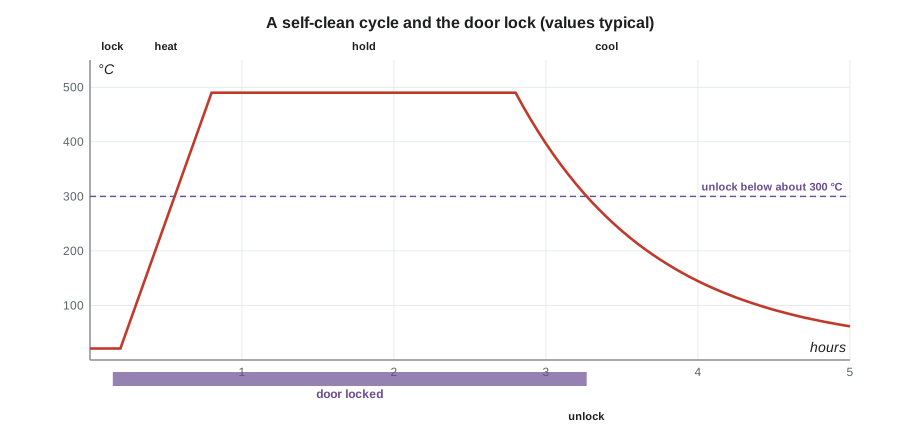
The door lock
The door lock assembly sits above the oven cavity, at the front, under the cooktop on most ranges or behind the control panel on wall ovens. It has three parts. A latch hooks into a slot in the top of the door. A lock motor, a small 120 V gear motor, or on some ranges a lock solenoid, drives the latch in and out. And one or more lock switches tell the control where the latch is: locked, unlocked, or somewhere between. Some locks are mechanical, with a lever the customer slides by hand, and a switch that tells the control the lever is closed.
When a clean cycle starts, the control first checks that the door is closed, using the door switch. Then it drives the lock motor until the lock switch reports locked. Only then does it start heating. At the end of the cycle, when the cavity has cooled below the unlock temperature, it drives the motor the other way until the switch reports unlocked. If the switch never reports the expected position within a set time, the control stops the cycle and shows a lock fault code, and it will not unlock on its own if it cannot prove where the latch is. That is what happened in Agathe Pellow's oven.
Many ranges also lock the door during some cooking modes, such as broil at the highest settings or certain speed-cook modes, and some lock it whenever the cavity is above a set temperature. A customer who finds the door locked after a long broil is seeing normal operation until the oven cools.
| Lock part | What it does | Typical failure and symptom |
|---|---|---|
| Latch | Hooks into the door to hold it shut | Bent or binding: lock jams, fault code |
| Lock motor | 120 V gear motor that moves the latch | Open winding or stripped gears: lock never moves |
| Lock solenoid | Electromagnet that moves the latch on some models | Open coil: lock never moves |
| Lock switches | Tell the control whether the latch is locked or unlocked | Worn or stuck: control cannot prove position, door stays locked |
| Door switch | Tells the control the door is closed | Open: clean cycle will not start |
| Wiring and connectors | Join motor and switches to the control | Heat-damaged connector: intermittent lock faults |
Freeing a locked door
When the door will not unlock, the first question is whether the oven is still hot. If it is, the door is meant to be locked; the customer waits until it cools. If the oven is cold and the door still will not open, the technician starts with the simplest step the tech sheet gives, which is often to switch off the breaker for a minute or so and restore power. On many controls, a power reset makes the control run the lock motor to its unlocked position as it starts up. If that works, the technician still tests the lock, because a lock that has stuck once will stick again.
If a reset does not free the door, the lock assembly is reached with the power off, as the tech sheet describes. On a freestanding range that usually means lifting the cooktop or removing the back panel; on a wall oven, sliding the oven partly out of its cabinet. The latch is then moved to its open position by hand, or the lock assembly is unbolted so the latch drops free. The door is never forced, and a screwdriver is never driven between the door and the frame, because the latch is designed to hold against exactly that and the door, gasket or frame will be damaged first.
With the door open, the technician tests each part. The lock motor winding is checked for resistance, often a few kilohms for a small gear motor, as the tech sheet lists. Each lock switch is checked for continuity in the locked and unlocked positions while the latch is moved by hand. The connectors are inspected for heat damage, which is common because the assembly sits close to the hottest part of the oven. A failed part is replaced, usually as a complete assembly.
Worked problem
Checking a lock motor from its current
A lock motor's tech sheet gives a winding resistance of 2.9 kΩ (2.9 kΩ) and a rated voltage of 120 V. What current should it draw when running, approximately, if it behaves like a resistance? Kiran's clamp meter, with a ten-turn loop of the motor lead to increase its sensitivity, reads 0.38 A. Is the motor drawing current normally?
Show solution
- Expected current, treating the winding as a resistance:
- \[I = \frac{120}{2900} \approx 0.041 \text{ A}\]
- With ten turns through the jaw, the clamp reads ten times the actual current.
- Actual current: 0.38 ÷ 10 = 0.038 A.
- That is close to the 0.041 A estimate; a running motor draws a little less than the resistance estimate because of its inductance.
Answer: The motor is drawing a normal current of about 0.04 A. Wrapping the lead through the clamp several times is a standard way to read small currents; the reading is divided by the number of turns.
Self-clean safety and customer advice
Self-clean is the hardest thing a range does. The high temperature stresses the elements, the lock, the thermal fuse, the control and the wiring near the oven, and a part that is near the end of its life often fails during or just after a clean cycle. Dee's practical advice to customers is to clean the oven a few days before a holiday meal rather than the morning of it, so that if something fails there is time for a repair.
The cycle also produces smoke and odour, especially if the oven is heavily soiled, and some fumes. The use and care guide tells customers to remove racks that are not designed for self-clean, wipe out loose soil and spills first, ventilate the kitchen and keep pets, particularly birds, out of the kitchen. Birds are very sensitive to the fumes produced when non-stick coatings and oven soils are heated, and makers warn about this. A customer with a pet bird is advised to move it well away from the kitchen or not to use the cycle.
A thermal fuse or high-limit thermostat protects the range if the oven overheats, for example if the control fails with a relay welded closed during a clean cycle. It is usually on the back of the oven or near the lock and is a one-time device on many models: once it opens, the oven, or the whole range, has no heat until it is replaced. A thermal fuse that has opened is a sign that something made the oven too hot, and the technician finds that cause, such as a welded relay or a failed cooling fan, before replacing the fuse.
Steam and catalytic cleaning
Many newer ranges offer a steam clean or low-temperature clean cycle. The customer pours a measured amount of water into the cool oven floor, and the oven heats it gently, typically to about 100 °C (212 °F) for 20 minutes to an hour, so the steam softens light soil for wiping. It is quicker and uses much less energy than self-clean, and the door usually does not lock, but it does not remove baked-on soil. Some ovens combine both. Customers who expect steam clean to do the work of self-clean are disappointed; explaining the difference prevents a call.
Catalytic or continuous-clean ovens have walls coated with a porous enamel containing oxidation catalysts that break down grease at normal cooking temperatures. They have no special cycle and no lock. The coating must not be scrubbed or sprayed with oven cleaner, which clogs it. Older ovens with no cleaning feature at all are cleaned by hand.
What fails after a clean cycle
Because self-clean is so hard on an oven, a call the morning after a clean cycle is common, and the failures fall into a few groups. The lock may stay locked, as in Agathe Pellow's oven. The thermal fuse may have opened, leaving the oven, or the whole range, dead. The control board may have failed from the heat behind the control panel, especially if the cooling fan had stopped. A bake or broil element near the end of its life may have burned open. And on some ranges, a wire or connector near the oven, already brittle from years of heat, may have finally failed.
The technician works through them in order of simplicity: is there power to the range, is the thermal fuse closed, does the lock report its position, do the elements read correctly, and does the control respond. Each test is made with the power off except where the tech sheet calls for a live check. Finding the actual cause matters, because replacing a control board when the real fault was a thermal fuse that opened because the cooling fan had seized leaves the customer with a new board that will fail the next time the oven cleans.
Customers sometimes ask whether they should stop using self-clean altogether. The honest answer is that the cycle is designed for the range and safe when used as the use and care guide says, but that it does stress older parts, that wiping out spills after cooking reduces how often it is needed, and that steam clean, where the range has it, handles light soil with far less stress.
Common mistakes
MistakeForcing a locked oven door with a screwdriver.
InsteadReset the power, then release the latch from the lock assembly with the power off, as the tech sheet shows.
MistakeReplacing a thermal fuse without finding why it opened.
InsteadFind the cause, such as a welded relay or failed cooling fan, first.
MistakeTreating a hot, locked oven as a fault.
InsteadThe door stays locked until the oven cools below the unlock temperature.
MistakeTelling a bird owner to run self-clean as usual.
InsteadAdvise moving the bird well away, or not using the cycle, as makers warn.
MistakeExpecting steam clean to remove baked-on soil.
InsteadSteam clean softens light soil; self-clean is for heavy soil.
Summary and key terms
- Self-clean heats the empty oven to about 480 to 500 °C (900 to 930 °F) and burns soil to ash (typical).
- The door lock prevents opening above a safe temperature; the control must prove the latch position.
- Lock assemblies have a latch, a motor or solenoid, and lock switches.
- A worn lock switch can leave a cold oven locked with a fault code.
- Free a locked door with a power reset first, then by hand at the assembly with the power off.
- Self-clean stresses parts; advise customers not to run it just before a holiday.
- Thermal fuses are one-time devices; find why one opened before replacing it.
- Steam clean is gentle and quick; catalytic coatings clean during normal cooking.
- Self-cleaning oven
- An oven that burns soil to ash at very high temperature.
- Pyrolytic cleaning
- Cleaning by heating soil until it breaks down to ash.
- Door lock assembly
- The latch, motor or solenoid and switches that lock an oven door.
- Lock switch
- A switch that tells the control whether the door latch is locked or unlocked.
- Thermal fuse
- A one-time heat-sensitive device that cuts power if the oven overheats.
- Smoke eliminator
- A catalytic element in the oven vent that burns smoke and odour.
- Steam clean
- A short, low-temperature cycle that uses water to soften light soil.
- Catalytic oven
- An oven with a coating that breaks down grease during normal cooking.
Practice problems
Work each problem on paper first, then reveal the answer to check.
Why does the door lock during self-clean?
Show answer
Opening the door at clean temperature could cause burns and flare-ups.
When does the control unlock the door after a clean cycle?
Show answer
When the cavity has cooled below the unlock temperature.
What is the first step when a cold oven stays locked?
Show answer
Switch off the breaker briefly and restore power, as the tech sheet says.
A clamp with a ten-turn loop reads 0.38 A. What is the actual current?
Show answer
0.038 A.
Why should birds be kept away during self-clean?
Show answer
They are very sensitive to the fumes the cycle produces.
Lesson quiz · 5 questions
Score 60% or more to complete this lesson.
Create a free account to save your progress, take quizzes and earn a certificate.