
APP-230 · Lesson 10 of 12 · 22 min
Oven controls, sensors and calibration
▶ Video coming soon A video version of this lesson is on the way.
Leopold Ashgrove baked bread every weekend, and on Wednesday, September 23, he was sure his electric range's oven, about six years old, had started running hot. His loaves were dark on the outside and his oven thermometer read high. Dee did not touch a part for the first forty minutes. She put her own calibrated thermocouple probe in the centre of the oven, set it to 175 °C (350 °F), and logged the temperature every minute through several heating cycles once the oven had settled. The average was 187 °C (369 °F), about 12 °C (19 °F) high. She then unplugged the range, checked the oven's temperature sensor at its connector, 1,092 Ω (1,092 Ω) at a room temperature of 22 °C (72 °F), which matched the tech sheet's table. Sensor and control were both working; the oven simply needed its offset adjusted. Dee set it to −10 °C (−20 °F) using the control's calibration mode, as the use and care guide described, rechecked and left Mr. Ashgrove with a note of what she had changed.
This lesson explains how an oven decides when to heat: the electronic oven control and its temperature sensor, the older mechanical thermostat, how both are tested, and how to check an oven's accuracy properly and adjust its calibration. Electronic control boards in general, with their power supplies, displays and communication, are covered in APP-320; this lesson covers what a technician needs for oven temperature complaints.
The electronic oven control
Most electric and gas ovens made in the last thirty years have an electronic oven control (EOC), a board with a display and touch keys or knobs, a microcontroller, and relays that switch the bake, broil and convection elements, the lock motor and, on gas ovens, the igniter circuits. The control reads the oven temperature from a temperature sensor in the oven cavity and switches the heat on and off to hold the set temperature, following a heating program that may use more than one element. It also runs the clock, timers, the self-clean sequence and its safety checks, and it reports faults as error codes.
On many ranges, the control switches only low-current relay coils, and the relays switch the 240 V element current on the same board or on a separate relay board. A relay that has failed with its contacts welded closed keeps an element on whatever the control wants, which can overheat the oven; most controls detect a temperature that keeps rising with the heat supposedly off and shut down with an error code. That is why thermal fuses exist as a last line of protection, as lesson 4 explained.
The temperature sensor
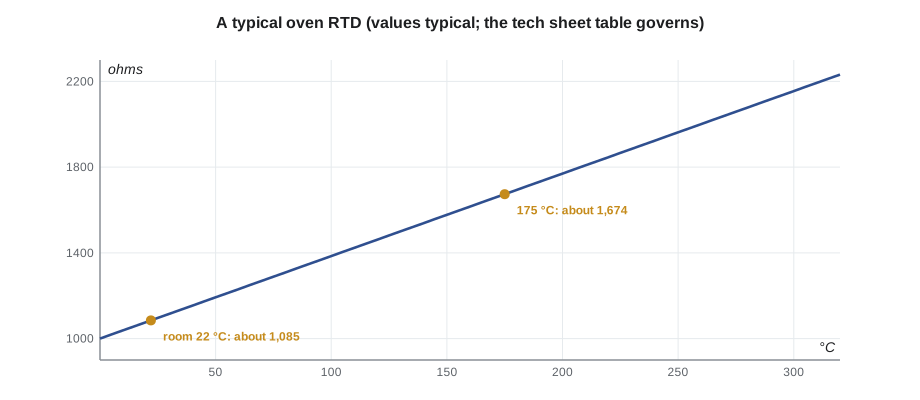
The sensor is usually a resistance temperature detector (RTD), a sensing element sealed in a stainless steel probe that sticks into the top rear of the oven cavity. Its resistance rises with temperature in a known, nearly linear way. A common oven sensor behaves like a platinum sensor with a resistance of about 1,000 Ω (1,000 Ω) at 0 °C (32 °F), rising by about 3.85 Ω for each degree Celsius, or about 2.14 Ω for each degree Fahrenheit; at a room temperature of about 21 °C (70 °F) it reads around 1,080 Ω (1,080 Ω) (typical; the tech sheet's table governs). The control measures the resistance and converts it to a temperature.
Some ovens use a thermistor instead, typically a negative temperature coefficient type whose resistance falls as it heats, like the sensors APP-120 and APP-210 described. Either way, the tech sheet gives a table of resistance against temperature, and that table is the reference for testing.
Worked problem
What an RTD should read
An oven sensor follows R = 1000 × (1 + 0.00385 × T), with T in degrees Celsius. What should it read at a room temperature of 22 °C, and at a baking temperature of 175 °C?
Show solution
- At room temperature, T = 22:
- \[R = 1000 \times (1 + 0.00385 \times 22) = 1000 \times 1.0847 \approx 1085 \ \Omega\]
- At baking temperature, T = 175:
- \[R = 1000 \times (1 + 0.00385 \times 175) = 1000 \times 1.674 \approx 1674 \ \Omega\]
Answer: The sensor should read about 1,085 Ω at room temperature and about 1,670 Ω at baking temperature. A reading far from the table, or an open or very low reading, means a faulty sensor or wiring. Dee's reading of 1,092 Ω at about 22 °C was within the tech sheet's tolerance.
The sensor is tested with the range unplugged and the oven at room temperature, at the sensor's connector behind the oven or at the control's harness. The technician compares the reading with the table, then flexes the wire and connector while watching the meter, because an intermittent connection is a common cause of erratic temperatures and error codes. A sensor that reads correctly at its own connector but wrong at the control end points to the harness. A probe that has been bent or pushed against the oven wall reads the wall's temperature rather than the air's; it is straightened or repositioned as the tech sheet shows.
Common sensor-related error codes report an open sensor, a shorted sensor, or a temperature that rises when it should not or fails to rise when it should, which may be the sensor, the wiring, a relay or an element. The maker's error list says which; the tests confirm which part is at fault before anything is replaced.
Mechanical thermostats
Older ovens, and some simple ones still made, use a mechanical thermostat: a knob-operated switch connected by a thin capillary tube to a sensing bulb clipped in the oven cavity. The bulb and tube contain a fluid that expands as it heats, pushing a diaphragm in the thermostat body that opens the contacts at the set temperature. On gas ovens, a hydraulic thermostat may control the gas flow directly or switch the igniter circuit. Thermostats have a calibration screw, often inside the knob shaft, that the tech sheet describes. A kinked or broken capillary, or a bulb out of its clips, makes the thermostat inaccurate or dead; it is replaced as an assembly, routing the capillary exactly as the old one ran.
Testing oven accuracy properly
Most "my oven runs hot" or "runs cold" complaints are about how the temperature was measured. An oven cycles around its set point, as lesson 3 explained, often by about ±10 °C (±20 °F), sometimes more on older or larger ovens, so a single reading means little. Inexpensive dial oven thermometers can be well off themselves. And opening the door to read a thermometer lets heat out and starts a recovery cycle.
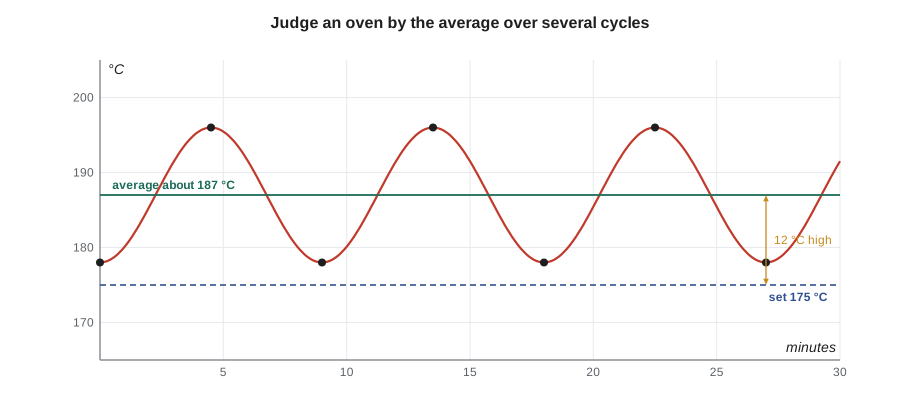
The reliable method is the one Dee used. Place an accurate probe, ideally a thermocouple or digital probe with the wire led out past the door gasket, in the centre of the oven with nothing else inside. Set the oven to a common temperature, often 175 °C (350 °F), and let it preheat and then run for at least twenty minutes so the walls settle. Record the temperature every minute or so through several complete heating cycles, without opening the door. Average the readings, or average the highest and lowest of each cycle. Compare the average with the set temperature. Many makers consider an average within about ±15 °C (±25 °F) of the setting to be within normal operation (typical; the maker's figure governs).
Worked problem
Averaging an oven test
Dee's readings over three cycles at a 175 °C (350 °F) setting had highs of 196, 195 and 197 °C (385, 383 and 387 °F) and lows of 178, 179 and 177 °C (352, 354 and 351 °F). What is the average temperature, and how far is it from the setting?
Show solution
- Average of the highs: (196 + 195 + 197) ÷ 3 = 588 ÷ 3 = 196 °C.
- Average of the lows: (178 + 179 + 177) ÷ 3 = 534 ÷ 3 = 178 °C.
- Midpoint: (196 + 178) ÷ 2 = 374 ÷ 2 = 187 °C.
- Difference from the setting: 187 − 175 = 12 °C high.
Answer: The oven averages about 187 °C, 12 °C high. That is within many makers' normal range, but the customer bakes bread and notices it, so an offset adjustment is reasonable. With the sensor tested good, Dee adjusted the offset rather than replacing parts.
Adjusting the offset
Most electronic oven controls let the customer or technician adjust the oven's offset, sometimes called oven temperature adjustment or calibration, by a set amount, often up to about ±20 °C (±35 °F) in steps of a degree or a few degrees. The method, usually a key combination or a settings menu, is in the use and care guide. The offset shifts every temperature the control aims for, so setting it to −10 °C (−20 °F) makes an oven that averaged 12 °C (19 °F) high average about 2 °C high (1 °F low). On mechanical thermostats, the calibration screw does the same job.
An offset is an adjustment, not a repair. It is used only after the sensor, its wiring and the elements test correctly and the oven still averages away from its setting. An oven that has drifted far beyond the offset range, or keeps drifting, has a fault to find. The technician records the offset change on the work order and tells the customer, because a later technician, or the customer, who resets the control to factory settings will undo it.
Customers' expectations matter too. A new oven often bakes differently from the old one it replaced, even when both are accurate, because ovens differ in their heating programs, convection and insulation, and the old one may have run cool for years. Dee's advice to customers who think a new oven is wrong is to test it properly first, and if it is accurate, to adjust recipes or the offset to their preference rather than to replace parts.
Other inputs to the control
The control also reads the door switch, which tells it the door is open so it can switch off the convection fan and the oven light, and the lock switches (lesson 4). Some ovens have a meat probe jack, a socket in the cavity wall for a probe the customer inserts into food, with its own resistance table, and its own error code when the probe is damaged. Keys and touch panels can fail, giving phantom key presses or dead keys, and controls display errors for those too. Each input is tested against the tech sheet the same way: resistance or continuity, then the connector and harness.
Gas oven temperature control
Gas ovens use the same kinds of controls. On a gas oven with an electronic control, the control reads the same kind of RTD and switches the bake igniter circuit on and off through a relay; when the igniter circuit is switched off, the safety valve closes and the burner goes out. A gas oven therefore cycles in the same way as an electric one, and its accuracy is tested in the same way. On older gas ovens with a mechanical thermostat, the thermostat may modulate the gas flow to the burner, turning it down rather than off as the oven approaches its setting, or it may switch the igniter circuit; the tech sheet says which. Gas oven thermostats are gas components, and replacing one is Hiro's work.
One complaint is special to gas ovens: an oven that takes a long time to recover after the door is opened, or that never reaches a high setting, may have a weak igniter that takes too long to open the valve on each cycle, as lesson 6 described. The sensor and control may be perfect while the burner spends much of each cycle waiting to light. The current test on the igniter circuit sorts that out before anyone adjusts the offset.
Kiran asked Dee how often an offset is the real answer. Her estimate, from her own records, was that most "runs hot" and "runs cold" complaints end with an explanation, a correctly measured test that shows the oven is within its normal range, and perhaps a small offset change for a customer who prefers it, rather than a part. The rest are sensors, connectors, elements, igniters and, least often, controls.
Common mistakes
MistakeJudging oven accuracy from one thermometer reading.
InsteadAverage the temperature over several cycles after the oven has settled.
MistakeReplacing the sensor without testing it.
InsteadCompare its resistance with the tech sheet's table, flexing the harness.
MistakeUsing the offset to hide a faulty sensor.
InsteadAdjust the offset only after the sensor, wiring and elements test good.
MistakeOpening the door repeatedly to read the thermometer.
InsteadLead a probe wire past the gasket and read it outside.
MistakeForgetting to record an offset change.
InsteadWrite it on the work order and tell the customer.
Summary and key terms
- The electronic oven control reads the sensor and switches the elements through relays.
- A typical oven RTD reads about 1,080 Ω at room temperature and rises about 3.85 Ω per °C (typical).
- Test the sensor at room temperature against the tech sheet's table, flexing the harness.
- Mechanical thermostats use a capillary and bulb and have a calibration screw.
- Ovens cycle around the set point; judge accuracy by the average over several cycles.
- Many makers accept an average within about ±15 °C (±25 °F) of the setting (typical).
- The offset shifts every set temperature; use it only after the parts test good.
- Record any offset change and tell the customer.
- Electronic oven control
- The board that runs an oven's heating, timers and self-clean.
- RTD
- A resistance temperature detector, whose resistance rises with temperature.
- Thermistor
- A temperature-sensing resistor whose resistance changes strongly with temperature.
- Mechanical thermostat
- A fluid-filled bulb and capillary thermostat that switches at a set temperature.
- Offset
- A control adjustment that shifts every temperature the oven aims for.
- Relay board
- A board whose relays switch the oven's element currents.
- Meat probe
- A temperature probe the customer inserts into food, plugged into the oven wall.
- Error code
- A code the control displays to report a detected fault.
Practice problems
Work each problem on paper first, then reveal the answer to check.
What should a typical oven RTD read at about 22 °C (72 °F)?
Show answer
About 1,085 Ω (1,085 Ω).
Why is one thermometer reading not enough to judge an oven?
Show answer
The oven cycles above and below its set point.
When is adjusting the offset appropriate?
Show answer
After the sensor, wiring and elements test good and the average is still off.
An oven averages 12 °C (19 °F) high. What offset brings it close to the setting?
Show answer
About −10 °C (−20 °F).
What does a mechanical thermostat use to sense temperature?
Show answer
A fluid-filled bulb and capillary tube.
Lesson quiz · 5 questions
Score 60% or more to complete this lesson.
Create a free account to save your progress, take quizzes and earn a certificate.