
APP-230 · Lesson 11 of 12 · 21 min
Gas leak testing and carbon monoxide
▶ Video coming soon A video version of this lesson is on the way.
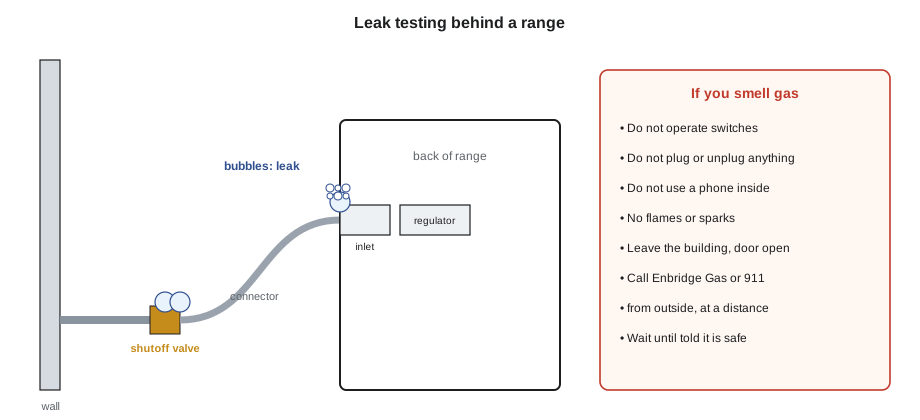
Hester Quarles called Penfold on Thursday, October 15, because she smelled gas "now and then" near her range in Ainslie Wood, usually after she had pushed it back against the wall following a clean. Fenna asked the questions Penfold's dispatch script lists: was the smell strong, was it there now, was anyone feeling unwell. It was faint and intermittent, and nobody was ill, so Fenna booked Hiro for that afternoon and told Mrs. Quarles what to do if it got stronger: leave the house and call the gas utility from outside. Hiro found the cause with a bottle of leak-detection solution in about ten minutes. The flexible connector's flare nut at the range inlet had been strained each time the range was pushed back, because the connector was too short for the range's position, and it leaked a few bubbles a minute when the range was in its normal place. A new connector of the correct length, routed so it did not kink, cured it, and Hiro leak-tested the new joints and the shutoff valve before he left.
This lesson covers the two gas hazards an appliance technician must never miss on a cooking call: gas leaks and carbon monoxide. It explains what to do when gas is smelled, how leaks are found and confirmed, how carbon monoxide is produced and measured at a range, what readings mean, and what the technician does when an appliance is unsafe. Leak testing joints the technician has disturbed, and adjusting or repairing gas parts, is gas work; recognizing a hazard and acting on it is everyone's job.
When anyone smells gas
Natural gas and propane have no smell of their own. The utility or supplier adds an odorant, usually a sulphur compound such as ethyl mercaptan or a blend of mercaptans, so leaks can be noticed at a concentration far below the level at which the gas could burn. The smell is often described as rotten eggs or cabbage. Some people notice it less than others, and odorant can fade, especially in new propane tanks and piping, which is why gas detectors and careful testing matter.
If a strong smell of gas is present on arrival, or develops during a call, the technician stops work and does not operate any electrical switch, plug or unplug anything, use a phone inside, or create any spark or flame. Everyone leaves the building, leaving the door open behind them, and the technician calls the gas utility's emergency line, Enbridge Gas in most of Ontario, or 911, from a safe distance outside. Nobody goes back in until the utility or fire service says it is safe. A faint, intermittent smell, as in Mrs. Quarles's kitchen, is investigated by the gas technician, with the gas shut off at the appliance valve if the leak is in the appliance or its connector.
Kiran's part, on any call, is to recognize the smell, stop, and follow the procedure. He carries a personal gas detector clipped to his belt, as every Penfold technician does, and if it alarms he treats it like a strong smell. Fenna's dispatch script asks every customer who mentions a gas smell the same questions before booking, and tells them to leave and call the utility if the smell is strong.
Finding a leak
Gas leaks are found by testing joints, not by sniffing. The standard tool is leak-detection solution, a liquid made for the purpose, brushed or sprayed on each joint. A leak blows bubbles, from a slow cluster of tiny bubbles for a small leak to a steady foam for a larger one. The solution is wiped off afterwards, because some formulas can corrode brass if left on. Household dish soap is not used; it is less sensitive and can leave a corrosive residue. A combustible gas detector with a sniffer probe helps locate a leak in an area, such as behind a range, before the joints are tested one by one, and it is how the technician checks a room is clear.
A flame is never used to find a gas leak. Neither is a spark from a meter or tool. On a range, the joints that most often leak are those the technician or a previous installer has disturbed: the connector's flare nuts at the shutoff valve and the range inlet, the regulator's inlet and outlet, and the orifice spuds and valve connections after a conversion. A leak test of every joint that was opened, with the gas on and the range's burners off, is the last step of every gas job, and the first step when a customer reports a smell.
The appliance connector deserves its own check. It must be a listed connector of the correct size and length, in good condition, not kinked, crushed or stretched, not passing through a wall, floor or cabinet, and not reused if it is an older type the code no longer accepts. Old uncoated brass connectors, made decades ago, have been the subject of safety warnings because their flare joints can crack; a technician who finds one tells the customer it should be replaced by a qualified person.
Carbon monoxide from cooking appliances
Carbon monoxide (CO) is a colourless, odourless gas produced when fuel burns without enough oxygen. It is poisonous because it binds to the blood's haemoglobin far more readily than oxygen does, so it starves the body of oxygen. Low exposures cause headache, nausea and tiredness that are easily mistaken for flu; higher exposures cause confusion, collapse and death. Gas ranges are unvented appliances: their combustion products, including any CO, go straight into the kitchen. That is why their burners must burn cleanly, why range hoods matter (lesson 8), and why a gas oven or cooktop must never be used to heat a home.
A properly adjusted range produces very little CO. A burner produces much more when it lacks air or is overfired: a misaligned head or cap, blocked ports, a pan sitting too low in the flame, a large pot or wok covering the flame, an oven with its floor or vents blocked by foil, an oven burner with a badly set air shutter, or a range running on the wrong gas or converted badly, as lesson 7 warned. A gas oven running for a long time, as during a holiday meal or a self-clean cycle on a gas range, adds CO to the kitchen over hours.
Ranges are certified to a standard that limits the CO their burners may produce in laboratory tests, measured as an air-free concentration in the flue products; for household gas ranges, a limit of 800 ppm air-free is commonly cited for the oven and broiler burners (commonly cited; the standard's text governs). Field readings are taken at the oven vent with a combustion analyzer after the oven has warmed up, and many training organizations use much lower action levels: a well-adjusted oven typically settles well below 100 ppm air-free after warm-up, and readings above a few hundred ppm call for correction before use (typical guidance; the maker's instructions and company procedure govern). Penfold's procedure, written by Hiro, uses those levels.
Measuring CO at a range
CO in flue gas is measured with a combustion analyzer, which reads both CO and oxygen (O₂). Because flue gas is diluted by the extra air drawn into the oven vent, the raw CO reading depends on how much air has mixed in. The analyzer corrects for that by calculating the air-free CO: the concentration the flue gas would have with no excess air. The correction uses the oxygen reading:
where 20.9 is the oxygen content of normal air in parts per 100, and O₂ is the measured oxygen in the same units. Most analyzers display the air-free value directly. The measurement is taken at the oven vent, usually under the rear surface element area on a freestanding range or at the vent the tech sheet shows, after the oven has run at a set temperature, often 260 °C (500 °F) or the setting the procedure calls for, for several minutes. Top burners are checked with the analyzer probe held above each burner, with a pan of water on the grate, as the procedure describes.
Worked problem
Calculating air-free CO
After warm-up, Hiro's analyzer at the oven vent of a gas range reads 38 ppm CO and 16.4 in 100 O₂. What is the air-free CO, and how does it compare with Penfold's action levels of 100 ppm (investigate) and 300 ppm (correct before use)?
Show solution
- Oxygen term:
- \[20.9 - 16.4 = 4.5\]
- Air-free CO:
- \[CO_{air\text{-}free} = 38 \times \frac{20.9}{4.5} = 38 \times 4.64 \approx 176 \text{ ppm}\]
Answer: The air-free CO is about 176 ppm. The raw 38 ppm looked low, but most of the flue gas was dilution air. At 176 ppm, above Penfold's 100 ppm investigate level, Hiro checks the oven burner flame, air shutter, orifice, floor and vents before the range is used normally. The values here are company guidance; the maker's instructions govern.
| Air-free CO at oven vent, after warm-up | Penfold action (company guidance) |
|---|---|
| Below about 100 ppm | Acceptable; record it |
| About 100 to 300 ppm | Investigate: flame, air shutter, orifice, floor, vents, cookware |
| Above about 300 ppm | Correct before use; tell the customer not to use the oven until repaired |
| Rising steadily, or any reading with symptoms in the home | Treat as an unsafe condition: shut off, ventilate, follow the unsafe condition procedure |
Kiran's first CO reading came on a range Hiro had just converted, with Hiro beside him. He learned three habits from it: zero the analyzer in fresh outdoor air before the call, never in the kitchen; let the oven warm up before reading, because CO is often higher during the first minutes; and record the air-free reading, the O₂ and the time, not just a single number.
CO alarms and unsafe conditions
Ontario's Fire Code requires working carbon monoxide alarms in homes with fuel-burning appliances, adjacent to each sleeping area and, as GAS-230 noted, on every storey. A technician who finds an alarm missing, unplugged or past its replacement date tells the customer, as Dee did in lesson 8. CO alarms are a backup, not a substitute for a properly working appliance.
When a gas technician finds a hazardous condition, Ontario's regulations require the condition to be corrected or the appliance shut off, and the technician must notify the customer and, for hazards that are not corrected, the gas distributor, using the procedures GAS-340 described; an appliance may be tagged so it is not used until repaired. At Penfold, Hiro follows that procedure. An appliance technician who finds a hazard, such as a strong smell, a high CO reading or a sooting burner, stops, makes the area safe as far as is safe to do, and calls Hiro.
Customers sometimes argue, especially when an oven is needed for a meal that evening. The technician explains plainly what was found and why it is dangerous, offers what can be done safely, such as using the cooktop if it tested clean while the oven waits for a part, and records what was said. A technician never leaves an appliance operating in a condition known to be dangerous because a customer insists.
Customer questions about gas cooking and air quality
Customers increasingly ask whether gas cooking is safe to breathe. A gas burner produces carbon dioxide, water vapour and small amounts of nitrogen dioxide and other pollutants even when it is burning perfectly, along with the particles that come from cooking food itself. The technician does not give health advice, but can explain the practical steps the makers and public health agencies commonly recommend: use a range hood that is ducted outdoors whenever the cooktop or oven is in use, run it on a higher speed for heavy cooking and for a few minutes afterwards, use the back burners where the hood captures best, open a window when possible, and keep the burners clean and correctly adjusted so they burn as cleanly as they were designed to.
A customer who wants more is pointed to the guidance of public health agencies and to the range's use and care guide, and, if they are considering a change of appliance, to the options an induction cooktop offers. The technician's job is to make sure the appliance they have burns cleanly and safely, and to say so when it does not.
Common mistakes
MistakeUsing a flame or a meter spark to find a leak.
InsteadUse leak-detection solution and a combustible gas detector.
MistakeUsing dish soap as leak solution.
InsteadUse solution made for leak detection; wipe it off afterwards.
MistakeJudging CO from the raw reading.
InsteadUse the air-free value, which corrects for dilution air.
MistakeZeroing the analyzer in the kitchen.
InsteadZero it in fresh outdoor air before the call.
MistakeLeaving a high-CO oven in use because the customer insists.
InsteadShut it off, explain the hazard and follow the unsafe condition procedure.
Summary and key terms
- Odorant makes gas smell; it can fade, so detectors and testing matter.
- With a strong smell: no switches, no phones inside, leave, call the utility from outside.
- Find leaks with leak-detection solution, never with a flame.
- Leak-test every joint disturbed, and check connectors for type, length and condition.
- Ranges are unvented, so their burners must burn cleanly.
- CO comes from too little air, overfiring, blocked ports or vents, and bad conversions.
- Air-free CO = measured CO × 20.9 ÷ (20.9 − O₂).
- Hazards are corrected or the appliance shut off and the customer told, under the procedure.
- Odorant
- A strong-smelling compound added to fuel gas so leaks can be noticed.
- Leak-detection solution
- A liquid that bubbles at a gas leak when applied to a joint.
- Combustible gas detector
- An instrument that senses fuel gas in air.
- Appliance connector
- The listed flexible pipe between the shutoff valve and an appliance.
- Carbon monoxide
- A poisonous, colourless, odourless gas from incomplete burning.
- Air-free CO
- CO concentration corrected to what it would be with no excess air.
- Unvented appliance
- An appliance whose combustion products go into the room.
- CO alarm
- A device that sounds when carbon monoxide builds up indoors.
Practice problems
Work each problem on paper first, then reveal the answer to check.
What should a technician do on smelling a strong gas smell?
Show answer
Stop, operate no switches, leave with everyone and call the utility from outside.
What is used to find a gas leak at a joint?
Show answer
Leak-detection solution.
An analyzer reads 38 ppm CO and 16.4 in 100 O₂. What is the air-free CO?
Show answer
About 176 ppm.
Why must a gas oven never be used to heat a home?
Show answer
It is unvented, so its combustion products, including CO, go into the house.
Where is the analyzer zeroed?
Show answer
In fresh outdoor air.
Lesson quiz · 5 questions
Score 60% or more to complete this lesson.
Create a free account to save your progress, take quizzes and earn a certificate.