
APP-230 · Lesson 7 of 12 · 21 min
Natural gas and propane conversion under CSA B149
▶ Video coming soon A video version of this lesson is on the way.
On Tuesday, September 8, Hiro drove out to a farmhouse near Millgrove, in rural Flamborough, where Rufus Calloway had bought a new freestanding gas range for a kitchen supplied by a propane tank. The range had been built for natural gas, as most are, and its carton held the maker's propane conversion kit and a sheet of instructions. Mr. Calloway's nephew had offered to do the conversion with a set of orifices from a hardware store. "He was trying to save me the call," Mr. Calloway said. Hiro thanked him for waiting. "In Ontario, converting a gas appliance is work for a certified gas technician, with the maker's kit, done exactly as the kit says, and labelled. That isn't paperwork. It's the difference between a range that burns clean and one that fills a kitchen with carbon monoxide."
This lesson explains why a cooking appliance built for one gas cannot simply burn the other, what a range conversion kit changes, the rules that govern who may convert a range and how, the steps of a range conversion as Hiro did it, and the checks that prove it worked. GAS-210 covered conversions across all gas appliances from the gas technician's side; this lesson follows the same rules and applies them to ranges and cooktops. At Penfold the conversion is Hiro's; Kiran watched and kept the record.
Why a range cannot burn both gases
Natural gas and propane differ in three ways that matter at the burner. Propane carries about two and a half times as much energy in each cubic metre, it is heavier than air rather than lighter, and it is supplied to appliances at a higher pressure. A burner orifice sized for natural gas passes far too much propane: the burners overfire with long, yellow, smoky flames that produce soot and dangerous levels of carbon monoxide, and the oven overheats. An orifice sized for propane passes too little natural gas: the flames are tiny, lift off the ports and may not light or stay lit.
| Property | Natural gas | Propane |
|---|---|---|
| Heating value | About 37.5 MJ/m³ | About 93 MJ/m³ |
| Specific gravity (air = 1) | About 0.60 | About 1.52 |
| Typical range manifold pressure | About 1.0 to 1.25 kPa (4 to 5 in w.c.) | About 2.5 kPa (10 in w.c.) |
| If it leaks | Rises and disperses | Sinks and collects in low places |
A range conversion therefore changes two things: the pressure the appliance regulator delivers, and the orifices at every burner. Because propane runs at a higher pressure and carries more energy, the propane orifices are much smaller. GAS-210's worked example showed that a propane orifice needs a diameter a little over six-tenths of the natural gas orifice for the same input. The kit supplies orifices drilled and marked to the maker's exact sizes; the calculation explains why they look so small, not how to make them.
The rules
CSA B149.1, the natural gas and propane installation code adopted in Ontario, permits an appliance to be converted from one gas to another only with the manufacturer's certified conversion kit for that appliance, following the kit's instructions, and requires the appliance to be marked to show the conversion. Under Ontario's regulations, the work must be done by a gas technician holding a TSSA certificate whose scope covers the appliance, working for a registered contractor. A G.3 technician may help under supervision but may not perform the initial activation of a newly converted appliance. Where the maker offers no certified kit for a range, it cannot be field-converted; it would need a field approval or replacement. At Penfold, Hiro, who holds a G.2 certificate, does every conversion.
These rules exist because a conversion changes the appliance's certified configuration. The kit contains the parts that were tested when the range was certified: orifices of the exact size, a regulator insert or setting, sometimes a different oven orifice or oven valve setting, and a conversion label. Drilling orifices, borrowing spuds from another range or setting the regulator by ear leaves a range whose behaviour nobody has tested. Penfold, like Bayline in the gas program, keeps no loose orifices for conversions for exactly that reason.
What a range kit changes
A range conversion kit typically includes new orifice spuds for each top burner, marked with their sizes and burner positions, a new oven burner orifice and broil burner orifice, or an instruction to turn down an adjustable orifice hood on older models, and an instruction for converting the appliance regulator, usually by unscrewing its cap and reversing or replacing an insert so it delivers the propane pressure. It also tells the technician to adjust each top burner valve's low-flame setting, because the low flame on propane is set differently, and to set the oven burner air shutters for the new gas. The kit's instructions list every step in order, and every step is done.
Kits are specific to the model, and sometimes to a serial number range, so the first step is to confirm that the kit part number matches the one listed on the range's plate and in its installation instructions. Some newer ranges ship with the propane orifices already stored in a holder on the range itself, or in the bag with the literature; the instructions still apply.
The procedure
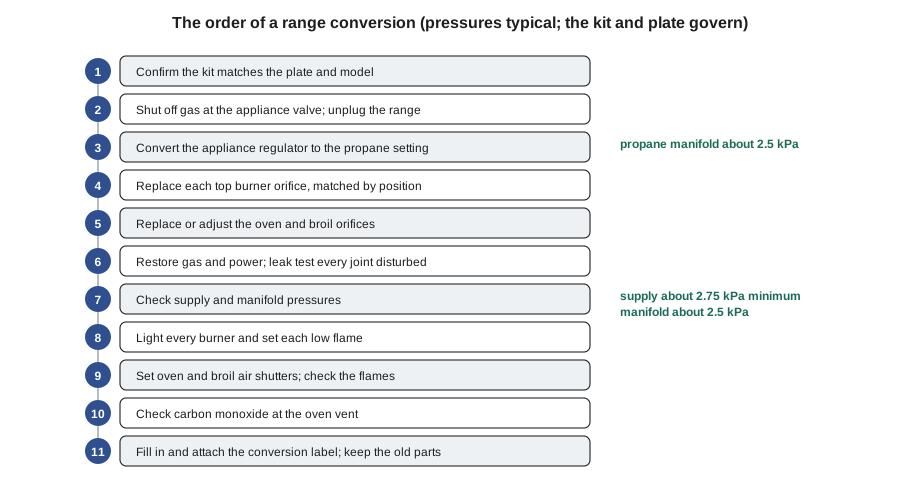
Kiran read the steps aloud from the kit's instructions while Hiro worked, and wrote down each one as it was finished. Hiro confirmed the kit part number against the range's plate, shut off the gas at the appliance valve, unplugged the range and laid the kit's parts on a towel on the counter. He converted the appliance regulator first, at the back of the range, by removing its cap, reversing the insert to the propane position marked on it and refitting the cap. Then he lifted the burner caps and heads, unscrewed each natural gas orifice spud with the nut driver the instructions named, and fitted the propane spuds, each marked for its position: two large burners, one medium, one small.
For the oven, he removed the oven floor and the burner baffle to reach the bake burner orifice at the safety valve outlet and replaced it with the kit's propane orifice; he did the same for the broil burner at the top of the oven. He bagged and labelled every original orifice for Mr. Calloway's file, so the range could be converted back if he ever moved to natural gas, and checked that none was missing.
With everything reassembled, Hiro turned the gas back on and leak-tested every joint he had disturbed with leak-detection solution, as lesson 11 describes. He measured the supply pressure at the range's inlet with all burners on high and the manifold pressure at the test port, both within the plate's limits for propane. He then lit each top burner, checked its flame on high, and turned it down to low. On propane, the low flame from a natural gas setting is too large, so he adjusted each valve's low-flame screw until the flame was small but stable, then checked that it stayed lit when he turned the knob quickly from high to low several times.
Worked problem
Checking the propane pressures
The range plate gives a propane manifold pressure of 2.49 kPa and a minimum supply pressure of 2.74 kPa. The propane system's second-stage regulator is set for about 2.74 kPa. With all burners on high, Hiro's manometer reads 2.70 kPa at the range inlet and 2.47 kPa at the manifold test port. Are both acceptable if the plate allows ± 0.07 kPa on the manifold?
Show solution
- Supply: 2.70 kPa is just below the 2.74 kPa minimum, by 0.04 kPa.
- Manifold allowed range: 2.49 ± 0.07 = 2.42 to 2.56 kPa. The reading of 2.47 kPa is inside it.
- The regulator is holding the correct manifold pressure even with the supply slightly low.
Answer: The manifold pressure is correct. The supply is a fraction under the plate minimum with everything on high, so Hiro checked the second-stage regulator at the house and the piping before accepting it. The supply pressure belongs to the propane system, which GAS-240 covers, and is the gas technician's to correct.
For the oven, Hiro lit the bake burner, let it run for several minutes and adjusted its air shutter until the flame had distinct blue inner cones with no yellow tips and did not lift. He did the same for the broil burner. He then ran the oven to 175 °C (350 °F) and measured carbon monoxide in the flue gases at the oven vent with his combustion analyzer after the oven had warmed up, as lesson 11 explains, and recorded the air-free reading.
The last step was the conversion label. Hiro filled in the date, the gas, his company and his certificate or identification as the label asked, and attached it next to the rating plate, where the next technician would see it. He also marked the plate's gas type as the kit's instructions directed. Kiran photographed the label and the plate for Penfold's records, and Hiro gave Mr. Calloway the bag of original orifices and showed him the label.
When a range will not convert
Not every range can be converted. Some imported ranges and some older models have no certified kit, and some combination appliances are built for one gas only. A customer who has bought such a range for a propane house has two choices: return it, or replace it with one built for or convertible to propane. A technician never improvises a conversion with parts from another model, because the result is an uncertified appliance that can burn dangerously.
Conversions also happen in the other direction, when a rural house gets a natural gas service and the customer's propane range needs converting back. The same kit, or a kit for the reverse direction, is used with the same steps in reverse: regulator to natural gas, natural gas orifices, low flames reset, air shutters set, pressures and carbon monoxide checked, label updated. The original orifices, if the customer kept them, must still be checked against the parts list before they are used.
Propane at the range: what changes for the customer
A range converted to propane cooks the same way, but a few things change for the customer, and Hiro made a point of telling Mr. Calloway. Propane is heavier than air, so a leak collects in low places such as a basement or a floor cavity rather than rising and dispersing; a propane leak detector, if the customer has one, is mounted low, as its instructions say. The odorant can fade in a new tank or new piping, so the customer should not rely on smell alone in the first weeks. And the supply depends on the tank: when the tank runs low, or the regulator at the tank freezes in very cold weather, the range's flames weaken, and the cure is at the tank, not at the range.
If a propane tank runs completely empty, the supplier must check the system for leaks before it is refilled and relit, because air and moisture may have entered and a leak may have gone unnoticed. Every appliance pilot and burner in the house then has to be relit and checked. A customer who runs out of propane is told not to try to relight the range or other appliances until the supplier or a gas technician has checked the system. GAS-240 covers propane systems and their safety rules in detail.
Hiro also explained the conversion label to Mr. Calloway in plain terms: it is there so that the next technician, or a new owner, knows the range has been converted and when, and does not assume it is still set up for natural gas. A range sold with a house, or moved to a new home, can easily end up on the wrong gas if its label is missing.
For the record, Kiran wrote down the kit part number, every orifice size and position, the regulator setting, the supply and manifold pressures, the low-flame adjustments, the air shutter settings and the air-free carbon monoxide reading at the oven vent, as Hiro dictated. If the range ever had a complaint, those numbers would show exactly how it was left.
Common mistakes
MistakeUsing hardware-store orifices for a conversion.
InsteadUse only the maker's certified kit for that model, following its instructions.
MistakeConverting the orifices but not the regulator.
InsteadConvert the regulator first; it sets the pressure every orifice is sized for.
MistakeLeaving the natural gas low-flame setting on propane.
InsteadReset each low flame and check that it stays lit when turned down quickly.
MistakeSkipping the label because the customer knows.
InsteadFill in and attach the conversion label so every later technician knows the gas.
MistakeLetting an uncertified apprentice do any step on the gas side.
InsteadThe qualified gas technician does the whole conversion; the apprentice watches and records.
Summary and key terms
- Propane carries about two and a half times the energy of natural gas per unit volume and runs at a higher pressure.
- A conversion changes the regulator setting and every burner orifice, and resets low flames and air shutters.
- CSA B149.1 requires the maker's certified kit, its instructions and a conversion label; in Ontario the work needs a certified gas technician.
- Confirm that the kit matches the model and plate before starting.
- Leak-test every disturbed joint and check supply and manifold pressures.
- Set each low flame, adjust oven and broil air shutters, and check carbon monoxide.
- Keep the original orifices for the customer and fill in the label.
- A range without a kit cannot be field-converted.
- Conversion kit
- The maker's set of parts and instructions for changing an appliance to another gas.
- Conversion label
- A label recording the date, gas and person who converted an appliance.
- Orifice spud
- A replaceable orifice fitting for a burner.
- Regulator insert
- The reversible or replaceable part that sets an appliance regulator for one gas.
- Low-flame setting
- The adjustment that sets the smallest flame a burner valve gives.
- Specific gravity
- A gas's density compared with air.
- Supply pressure
- The gas pressure at an appliance's inlet, before its regulator.
- Combustion analyzer
- An instrument that measures oxygen and carbon monoxide in flue gases.
Practice problems
Work each problem on paper first, then reveal the answer to check.
What two things does every range conversion change?
Show answer
The regulator setting and the burner orifices.
Why must each low flame be reset on propane?
Show answer
The natural gas low-flame setting gives too large a flame on propane.
What does a conversion label record?
Show answer
The date, the new gas and who did the conversion.
What should happen to the original orifices?
Show answer
They are bagged, labelled and given to the customer.
What if no certified kit exists for a range?
Show answer
It cannot be field-converted; return or replace it.
Lesson quiz · 5 questions
Score 60% or more to complete this lesson.
Create a free account to save your progress, take quizzes and earn a certificate.