
APP-210 · Lesson 9 of 12 · 21 min
Sealed system diagnosis
▶ Video coming soon A video version of this lesson is on the way.
"Here's the rule," Hiro said on November 10, writing it across the top of the whiteboard. "You don't say sealed system until you've ruled out everything else, and you don't put a piercing valve on anything until you're sure." Under it he wrote the list he wanted Kiran to work through on every no-cooling call: power and controls, the condenser and its fan, the evaporator fan and airflow, defrost and frost, and only then the sealed system. "Most fridges that someone tells you need a recharge," he said, "have a dirty condenser, a dead fan or a frozen-up evaporator. A real sealed-system fault has a pattern, and the pattern is on the outside of the tubes if you know how to read it."
Sealed system faults are the most expensive faults in a refrigerator and the ones most often misdiagnosed. A refrigerator that is sent for a sealed-system repair it did not need costs the customer a large bill and still fails. One that is written off for a sealed-system fault it does not have goes to the landfill for nothing. This lesson sets out how to diagnose the sealed system from the outside, using current, wattage, temperatures, frost patterns and sounds, and how to tell the main sealed-system faults apart: a low charge from a leak, a restriction, an overcharge and an inefficient compressor. Lesson 10 covers the repairs.
Rule out the rest first
Before suspecting the sealed system, confirm that everything around it is working. The compressor must be running, which lesson 3 covered. The controls must be calling for cooling. The condenser must be clean and its fan running. The evaporator fan must be running and the evaporator must not be packed with frost. The doors must seal and the unit must be level enough for them to close, as lesson 11 explains. And the refrigerator must have had time to pull down: a unit that has just been plugged in, or loaded with warm food, can take many hours to reach its temperatures.
If the compressor runs, the fans run, the condenser is clean, defrost is working and the cabinet is still warm, the sealed system is the likely place. At that point the technician reads the outside of the system carefully before deciding anything.
Current and wattage
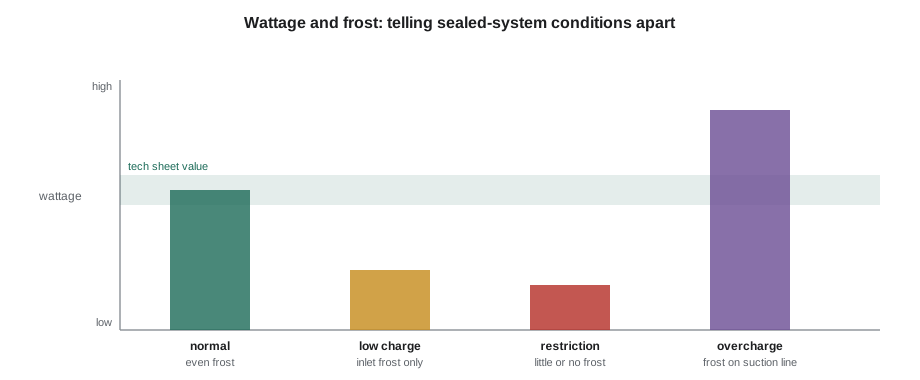
The compressor's current and the refrigerator's wattage tell a technician how hard the compressor is working. A compressor pumping a normal charge draws close to its rated running current. With too little refrigerant, or a restriction that starves the evaporator, it has less vapour to compress, and its current and wattage are low. With too much refrigerant, or with a condenser that cannot shed heat, the head pressure is high, and the current and wattage are high. A watt meter between the refrigerator and the receptacle reads the whole unit's power; a clamp meter on the compressor's supply lead reads its current alone.
The rated current is on the nameplate, and many tech sheets also give the expected compressor wattage after a set run time at a stated room temperature. Wattage is a better measure than current for small compressors, because the current changes little while the power factor changes. Compare like with like: measure after the compressor has run for at least 10 to 15 minutes, with the doors closed and the fans running, and note the room temperature.
Worked problem
Reading the wattage
A 2014 bottom-freezer, R-134a, is warm in both sections. Its condenser is clean, both fans run and the evaporator is not frosted up. The tech sheet gives a running wattage of about 110 W after 15 minutes at 21 °C (70 °F). After 20 minutes in a 22 °C (72 °F) kitchen, a watt meter reads 72 W. The evaporator has frost only on its first few passes. What does the reading suggest?
Show solution
- Expected: about 110 W. Measured: 72 W.
- Ratio: 72 ÷ 110 = 0.65, so the compressor is drawing about 65 in 100 of its expected power.
- Low wattage means the compressor has little vapour to compress: the system is starved.
- Frost on only the first passes of the evaporator is the classic pattern of a low charge: the little refrigerant there is boils away near the inlet.
Answer: Low wattage with partial frost points to a low charge, which means a leak. A restriction would also give low wattage, but usually with little or no frost and a cold spot at the drier or capillary inlet.
Frost patterns
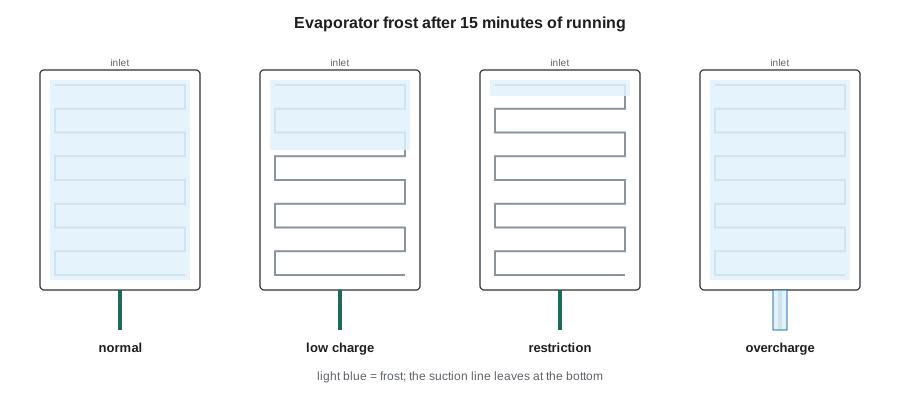
The evaporator's frost is the clearest picture of where the refrigerant is boiling. On a correctly charged, running system, after the compressor has run for 10 to 15 minutes, the whole evaporator, including its last pass and the accumulator, is cold and carries a light, even frost. With a low charge, the refrigerant boils away early, so frost covers only the inlet end and the rest of the coil is bare and warmer. With a restriction, very little refrigerant reaches the evaporator at all, so it may have no frost or only a little frost at the very inlet. With an overcharge, liquid passes right through the evaporator, and frost or sweat continues out along the suction line toward, and sometimes onto, the compressor.
To see the frost pattern on a frost-free refrigerator, remove the evaporator cover after the system has run for a while. If the coil is packed solid with frost from a defrost failure, the pattern cannot be read, so fix the defrost fault and let the unit run first. On a chest freezer with a bonded evaporator, the frost line on the liner walls gives the same picture: frost all over the inside means a good charge; frost only near where the capillary enters, with dry walls elsewhere, means a low charge.
Temperatures and touch
Lesson 4 described what each part of the sealed system should feel like. In diagnosis, the readings that matter most are the condenser, the drier and the suction line. A low charge leaves the condenser only slightly warm, because there is little refrigerant condensing in it, and the suction line warm at the compressor. A restriction also leaves the suction line warm, but often makes a clear cold spot at the point of restriction: the drier outlet cold and sweating if the drier is blocked, as in Dee's September 15 case, or the condenser holding most of the charge and feeling warmer near its outlet. An overcharge or a condenser that cannot shed heat makes the condenser hot and the suction line cold or frosty.
Contact thermometers or clamp-on temperature probes give numbers, but a careful hand is quick and useful too. Work methodically: discharge line, condenser inlet and outlet, drier inlet and outlet, capillary along its length where it can be reached, evaporator, suction line at the compressor.
Sounds
Sound helps as well. A working refrigerator with a capillary tube makes a faint hiss or gurgle at the evaporator as the refrigerant enters it, often more noticeable just after the compressor starts. With a low charge, that sound can become a louder, continuous gurgle or a sputter, because a mix of vapour and liquid is entering the capillary. With a complete restriction, the sound at the evaporator stops altogether. Listening at the evaporator, with the freezer door open for a moment and the fan stopped, is a quick test that costs nothing.
Telling the faults apart
The main sealed-system conditions have distinct patterns. Read them together, not one clue at a time.
| Condition | Wattage or current | Evaporator frost | Condenser | Suction line at compressor | Other signs |
|---|---|---|---|---|---|
| Normal | Near tech sheet value | Even to outlet | Warm | Near room | Faint hiss at evaporator |
| Low charge (leak) | Low | Inlet end only | Slightly warm | Warm | Gurgle; oil stain at a leak |
| Restriction | Low | Little or none | Cool to slightly warm | Warm | Cold spot or sweat at drier or capillary inlet; no hiss |
| Overcharge | High | Whole coil and beyond | Hot | Cold or frosty | Usually after a previous repair |
| Inefficient compressor | Low | Partial | Barely warm | Warm | Pressures equalize quickly after shutdown |
A low charge always means a leak, because the refrigerant in a sealed system has nowhere else to go. Before condemning the system, look for the leak: oily stains at joints, on the evaporator or around the compressor; damage from a tool, a mover or a customer chipping ice; and corrosion on aluminum tubing. An electronic leak detector suited to the refrigerant helps. On an R-600a system, the detector must be one rated for hydrocarbon refrigerants, and its alarm means the area must be ventilated and every ignition source kept away, as lesson 10 explains.
A restriction and an inefficient compressor can look alike, because both give low wattage and a starved evaporator. The difference shows when the compressor stops. With a restriction, the high side and low side take a long time to equalize, because the refrigerant must seep through the blockage; a technician may hear the evaporator continue to hiss for a long time after shutdown, or none at all if the blockage is complete. With an inefficient compressor, the pressures equalize quickly because the refrigerant leaks back through the worn valves. Confirming either usually means fitting access valves and reading pressures, which is done only when the sealed system is going to be opened for repair anyway.
When to open the system
The manufacturers' service instructions generally say that access valves are fitted only when the diagnosis is complete and a sealed-system repair has been decided on, because every access point is a possible leak. Once access valves are on, the system has been opened in effect, and the repair must include a new drier, evacuation and a weighed charge. That decision must also be made with the customer, because the repair cost often approaches the value of the refrigerator. On a unit under the maker's warranty, the maker's procedure and authorization come first.
In Ontario, fitting an access valve to a system containing a halocarbon such as R-134a, recovering the refrigerant and recharging it are work that requires an ODP card. On an R-600a system, no ODP card is required, but the maker's flammable-refrigerant procedure applies in full. Kiran observes and helps with sealed-system work until he has his card.
Building the diagnosis on the call
A sealed-system diagnosis is built from several readings taken in a sensible order, not from one clue. A practical sequence on a warm refrigerator, once the controls, condenser, fans and defrost have been ruled out, is: note the room temperature and the section temperatures after the doors have been closed for a while; feel or measure the discharge line, the condenser, the drier and the suction line; read the compressor current or the unit's wattage after at least 10 to 15 minutes of running; remove the evaporator cover and look at the frost pattern; listen at the evaporator; and look for oil stains and damage. Write each reading down as you take it. When the readings agree on one condition, the diagnosis is sound. When they disagree, something else is going on, and the next step is to recheck the things that were ruled out earlier.
History helps as much as readings. A refrigerator that has had a sealed-system repair before is more likely to be overcharged or restricted than one that has never been opened. One that was recently moved or delivered may have had a tube damaged or oil displaced. One that cooled for years and lost its cooling slowly over weeks has probably leaked. One that stopped cooling suddenly, with the compressor still running, may have a restriction or a compressor that has stopped pumping. Ask the customer when the problem started, whether it came on suddenly or gradually, and whether anything happened to the refrigerator recently.
Finally, think about the decision the diagnosis leads to. On an older refrigerator, a sealed-system fault often means replacement, and the technician's job is to give the customer a clear, honest explanation and a fair choice. On a newer one under warranty, it means the maker's procedure and authorization. On a valuable built-in, it may mean a worthwhile repair. In every case the customer deserves to know what was found, how certain the diagnosis is and what each option would cost.
Common mistakes
MistakeCalling for a recharge on a warm refrigerator without checking the condenser, fans and defrost.
InsteadRule out the rest first; they cause most warm-refrigerator calls.
MistakeReading wattage straight after the compressor starts.
InsteadLet it run 10 to 15 minutes with doors closed, and note the room temperature.
MistakeReading frost on an evaporator that is packed from a defrost failure.
InsteadFix defrost and let the unit run before judging the pattern.
MistakeAdding refrigerant to a low charge.
InsteadA low charge means a leak; find and repair it, then weigh in the nameplate charge.
MistakeFitting access valves to look around.
InsteadFit them only when a sealed-system repair has been decided.
MistakeUsing an ordinary leak detector on an R-600a system.
InsteadUse a detector rated for hydrocarbon refrigerants, with no spark or arc.
Summary and key terms
- Rule out power, controls, condenser, fans, defrost and doors before suspecting the sealed system.
- Low wattage means a starved system: low charge, restriction or inefficient compressor.
- High wattage means high head: overcharge or a condenser that cannot shed heat.
- Frost only at the evaporator inlet points to a low charge; little or no frost points to a restriction.
- Frost along the suction line points to an overcharge.
- A cold or sweating spot at the drier or capillary inlet points to a restriction.
- A low charge always means a leak.
- Access valves are fitted only once a sealed-system repair has been decided.
- Low charge
- Less refrigerant than the nameplate charge, always caused by a leak.
- Overcharge
- More refrigerant than the nameplate charge, usually from an earlier repair.
- Starved evaporator
- An evaporator receiving too little refrigerant, from a low charge or a restriction.
- Head pressure
- The pressure on the high side of the system, in the condenser.
- Equalize
- For the high and low side pressures to become equal after the compressor stops.
- Inefficient compressor
- A compressor that runs but pumps poorly, usually because of worn valves.
- Watt meter
- A meter that plugs between the appliance and the receptacle and reads its power.
- Access valve
- A valve fitted to a process tube or line so the sealed system can be connected to gauges, recovery or charging equipment.
Practice problems
Work each problem on paper first, then reveal the answer to check.
What should be checked before suspecting the sealed system?
Show answer
Power and controls, the condenser and its fan, the evaporator fan, defrost and the doors.
A compressor draws 72 W where the tech sheet says 110 W. What fraction is that?
Show answer
About 65 in 100: the system is starved.
What frost pattern goes with a low charge?
Show answer
Frost only on the first passes near the evaporator inlet.
How can a restriction be told from an inefficient compressor?
Show answer
After shutdown, a restriction equalizes slowly; an inefficient compressor equalizes quickly.
What does a low charge always mean?
Show answer
There is a leak.
Lesson quiz · 5 questions
Score 60% or more to complete this lesson.
Create a free account to save your progress, take quizzes and earn a certificate.