
APP-210 · Lesson 3 of 12 · 24 min
Compressors and start components
▶ Video coming soon A video version of this lesson is on the way.
Hiro started the second Tuesday night, November 3, with a compressor sitting on the bench and a question. "This one came out of a fridge that clicked every few minutes and never cooled. Dee replaced the start relay and it still clicked. Is the compressor dead?" Kiran remembered Dee's August case file from APP-120, where a clicking refrigerator had an open PTC start relay, and said he would read the windings before he decided anything. Hiro smiled. "Good. Most compressors that get condemned are fine. Most of the time it's the parts bolted to the side of them." The readings that night showed that this compressor really was finished, with a winding shorted to its shell, and the lesson was in learning how to prove it.
The compressor is the heart of the sealed system and its most expensive part. It is also hermetic: the motor and the pump are sealed together inside a welded steel shell, cooled by the returning suction vapour, and the technician cannot repair anything inside it. What the technician can test and replace are the start and protection components mounted on the outside, at the terminal block. This lesson covers how household compressors are built, how they start, how to test them and their start parts, and how to tell a failed compressor from a failed relay or overload. The APP-120 course covered capacitors, PTC relays and winding resistance in general; here they are applied to refrigerators.
How a household compressor is built
Most household refrigerators use a small reciprocating compressor: a piston in a cylinder, driven by a crankshaft from a single-phase induction motor, all mounted on springs inside the shell to reduce noise and vibration. The suction line enters the shell and the vapour fills it, cooling the motor windings before the piston draws it in. The discharge line leaves from the pump through an internal muffler. Oil in the bottom of the shell lubricates the bearings. Rotary compressors, with a rolling piston in a cylinder, are used in some models.
Many newer refrigerators use variable-speed compressors. These have a permanent-magnet motor driven by an inverter board that changes the speed to match the load: slow and quiet most of the time, faster after the door has been open or the unit has been loaded. A few makers use linear compressors, where a magnet drives the piston back and forth directly, with no crankshaft. Variable-speed and linear compressors cannot be started directly from the line; they are run only by their inverter board, and they are tested by the board's diagnostics and the manufacturer's procedure, which APP-320 covers. The rest of this lesson deals with the fixed-speed compressors that still make up most of the units in service.
The terminals and the windings
A fixed-speed compressor has three terminal pins in a sealed glass or ceramic header on the side of the shell: common (C), start (S) and run (R). Inside, a run winding connects C to R and a start winding connects C to S. The start winding has finer wire and a higher resistance than the run winding. Measuring between the three pins in pairs identifies them: the highest reading is from S to R, both windings in series; the lowest is C to R, the run winding; and the middle reading is C to S. The S to R reading should equal C to R plus C to S.
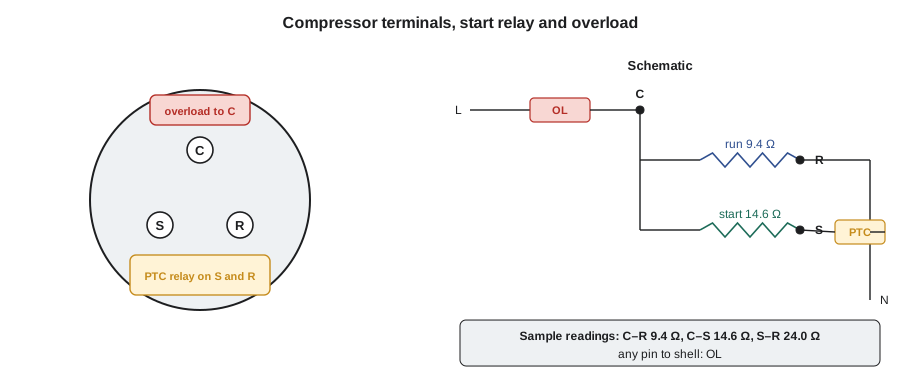
Winding resistances for household compressors are typically a few ohms to a few tens of ohms, depending on the size and voltage of the motor, and the tech sheet or compressor data gives the expected values. A winding that reads OL is open. A winding that reads far below its expected value has shorted turns. Any reading between a pin and the compressor shell, other than OL on a meter's highest resistance range, means a winding is grounded, and that compressor must be replaced. Before measuring to the shell, scrape a small spot clean of paint on a tube or the base so the meter makes good contact.
Worked problem
Identifying the pins
A replacement compressor's terminals are not marked. Kiran measures between the three pins: pin 1 to pin 2 reads 14.6 Ω, pin 2 to pin 3 reads 24.0 Ω and pin 1 to pin 3 reads 9.4 Ω. Which pin is which, and are the readings consistent?
Show solution
- The highest reading, 24.0 Ω between pins 2 and 3, is start to run, through both windings. So pin 1, the one not in that pair, is common.
- From common, the lower reading is to run: pin 1 to pin 3 is 9.4 Ω, so pin 3 is run.
- The higher reading from common is to start: pin 1 to pin 2 is 14.6 Ω, so pin 2 is start.
- Check: C to R plus C to S = 9.4 + 14.6 = 24.0 Ω, which equals the S to R reading.
Answer: Pin 1 is common, pin 2 is start and pin 3 is run, and the readings add up correctly.
How the compressor starts
A single-phase motor needs help to start turning. In most fixed-speed refrigerator compressors that help comes from the start winding, which is switched in for a fraction of a second while the motor gets up to speed and then switched out. The device that does the switching is the start relay. In older refrigerators it is a current relay, a small coil in series with the run winding that pulls its contacts closed while the starting current is high and drops them open as the current falls. In most refrigerators of the last thirty years it is a PTC relay, sometimes combined with a run capacitor.
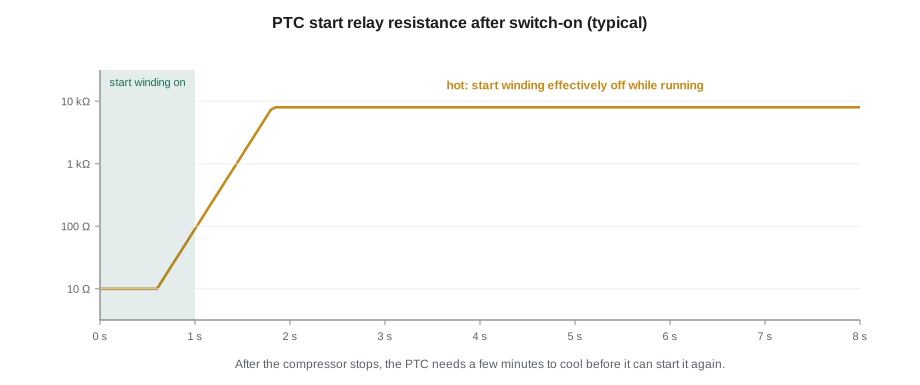
A PTC, positive temperature coefficient, relay is a ceramic disc whose resistance is low when cold, typically a few ohms to around twenty, and rises steeply as it heats. At start, the cold PTC passes current to the start winding. Within a second or so that current heats the PTC, its resistance rises to thousands of ohms and the start winding is effectively switched off. The PTC stays hot, and switched off, while the compressor runs. After the compressor stops, the PTC needs a few minutes to cool before it can start the compressor again, which is one reason a refrigerator that has just been switched off and on may not restart straight away.
Some refrigerators add a run capacitor across the start winding, giving a permanent split capacitor arrangement that runs more efficiently. A few, particularly some freezers and older or larger units, use a start capacitor with a current relay. APP-120 covered how to discharge and test capacitors; the same rules apply here. On any start device, use the exact part the parts catalogue lists for the compressor, because a relay sized for a different compressor can fail to start it or overheat its start winding.
The overload protector
The overload protector is a bimetal switch, usually a disc, mounted on the compressor shell and wired in the line to the common terminal. It opens when it is heated by too much current, by a hot shell or by both, and recloses when it cools. It protects the motor when the compressor cannot start, when the voltage is low, when the condenser is clogged and the head pressure is high, or when the compressor is overheating. The overload is a protector, not a control: when it trips, something made it trip.
The click a customer hears every few minutes in a refrigerator that is not cooling is usually the overload. The compressor tries to start, cannot, draws its locked-rotor current, and the overload opens. A few minutes later the overload cools, closes and the cycle repeats. The cause may be the start relay, a failed capacitor, a low supply voltage, a seized compressor or, after a power interruption, a compressor trying to start against high pressure before it has had time to equalize. On a refrigerator with a fan-cooled condenser, a dead condenser fan can also make the compressor overheat and trip the overload once it is running.
| Part | Good reading (power off) | Failed | Typical symptom |
|---|---|---|---|
| Run winding (C to R) | Matches the data, a few to a few tens of Ω | OL or far too low | Compressor will not start; overload clicks |
| Start winding (C to S) | Higher than C to R, matches the data | OL or far too low | Hums and clicks off |
| Any pin to shell | OL | Any reading | Trips the breaker or GFCI; replace the compressor |
| PTC relay (S to R terminals) | A few Ω to about 20 Ω when cold | OL, or rattles when shaken | Clicks every few minutes, no cooling |
| Overload (its two terminals) | Near 0 Ω when cool | OL when cool | Compressor never tries to start |
Running current and locked-rotor current
Two currents describe a compressor's health. Running current, measured with a clamp meter on the line to the compressor once it has run for a few minutes, is usually a little over 1 A for a household refrigerator on 120 V and rises with the load. Locked-rotor current, the current the motor draws when it cannot turn, is many times higher, often 5 to 10 A or more for a household unit. A compressor that draws locked-rotor current for a second or two and then trips its overload did not start. A compressor that starts and draws a steady running current near its rating is working electrically, whatever else may be wrong with the sealed system.
If the compressor will not start, test the start parts first. Unplug the refrigerator, remove the relay and overload, and read them and the windings. If the windings read correctly and there is no reading to the shell, the relay and overload are the likely culprits. Many manufacturers and parts suppliers sell a compressor test cord that applies power directly to C, S and R with a momentary start button, which can prove whether the compressor runs; use it only on fixed-speed compressors, only as the manufacturer allows, and never on a variable-speed or linear compressor.
Worked problem
A compressor that clicks but does not start
On the bench compressor from Hiro's November 3 session, Kiran read C to R as 9.6 Ω, C to S as 14.1 Ω and S to R as 23.7 Ω. Between C and a cleaned spot on the shell, his meter read 180 kΩ on the megohm range. The PTC relay read 7 Ω cold and the overload read 0.2 Ω. What is wrong?
Show solution
- Windings: 9.6 + 14.1 = 23.7 Ω, matching S to R. The windings are continuous.
- Relay and overload: both read normally cold.
- Pin to shell: any reading other than OL means the winding insulation has failed. 180 kΩ is a leakage path to the shell.
- A grounded winding cannot be repaired, and the compressor would trip a GFCI or breaker, or put the cabinet at risk of becoming live if the ground were missing.
Answer: The compressor has a grounded winding and must be replaced, even though its windings read correctly end to end.
Replacing a compressor means opening the sealed system, recovering the refrigerant, brazing or connecting new lines, replacing the filter-drier, evacuating and weighing in a new charge, as lesson 10 explains. On many refrigerators it costs a large share of the price of a new unit, so the repair-or-replace decision, covered in APP-410, has to be discussed with the customer before any work starts.
Noise, starting and the customer's view
A compressor makes some noise all the time it runs: a steady hum, the faint tick of the valves and, on a variable-speed unit, a pitch that changes with speed. Customers notice new noises, and lesson 11 covers how to tell normal from abnormal. Three compressor-related noises are worth knowing now. A loud knock or bang when the compressor stops can mean a broken internal mounting spring, which is not repairable. A buzz followed by a click every few minutes is a compressor failing to start. And a rattle at the back of the machine compartment is often the drain pan, a loose tube touching the cabinet or the condenser fan, not the compressor at all.
Common mistakes
MistakeCondemning a compressor because the refrigerator clicks.
InsteadTest the windings, the relay and the overload first; the start parts fail far more often.
MistakeForgetting to measure from each pin to the shell.
InsteadA grounded winding can read correctly end to end; always check to a clean spot on the shell.
MistakeRestarting a compressor immediately after it stops.
InsteadGive the PTC and the pressures a few minutes; a quick restart may click off on the overload.
MistakeFitting a universal relay to save a trip.
InsteadUse the start device listed for that compressor; the wrong one can fail to start it or damage the start winding.
MistakeUsing a test cord on a variable-speed compressor.
InsteadVariable-speed and linear compressors run only from their inverter; use the maker's test procedure.
MistakeTreating an overload trip as the fault.
InsteadThe overload protects the motor; find what made it trip.
Summary and key terms
- Household compressors are hermetic; only the outside start and protection parts can be serviced.
- S to R is the highest reading and equals C to R plus C to S; C to R, the run winding, is the lowest.
- Any reading from a pin to the shell means a grounded winding and a failed compressor.
- PTC relays read low when cold and switch the start winding out as they heat; they need a few minutes to cool.
- The overload opens on excess current or heat; repeated clicking means the compressor is not starting.
- Running current is usually a little over 1 A on 120 V; locked-rotor current is many times higher.
- Variable-speed and linear compressors are driven by an inverter board and tested with the maker's procedure.
- A compressor replacement is a major repair that needs a repair-or-replace discussion first.
- Hermetic compressor
- A motor and pump sealed together in a welded shell, cooled by the suction vapour.
- Common, start and run
- The three terminals of a single-phase compressor motor, marked C, S and R.
- PTC relay
- A start device whose ceramic disc has low resistance when cold and very high resistance when hot.
- Current relay
- A start relay whose coil, in series with the run winding, closes the start contacts while the starting current is high.
- Overload protector
- A bimetal device on the compressor that opens on excess current or heat.
- Locked-rotor current
- The current a motor draws when its rotor cannot turn, many times its running current.
- Grounded winding
- A winding whose insulation has failed so that it has a path to the compressor shell.
- Variable-speed compressor
- A compressor whose speed is changed by an inverter board to match the cooling load.
Practice problems
Work each problem on paper first, then reveal the answer to check.
Which pair of compressor pins gives the highest resistance reading?
Show answer
Start to run, through both windings in series.
C to R reads 9.4 Ω and C to S reads 14.6 Ω. What should S to R read?
Show answer
24.0 Ω.
What does any reading from a pin to the shell mean?
Show answer
The winding is grounded and the compressor must be replaced.
Why may a refrigerator not restart immediately after being switched off?
Show answer
The PTC relay must cool and the pressures must equalize.
Why must a compressor test cord never be used on a variable-speed compressor?
Show answer
Variable-speed compressors are run only from their inverter board.
Lesson quiz · 5 questions
Score 60% or more to complete this lesson.
Create a free account to save your progress, take quizzes and earn a certificate.