
APP-210 · Lesson 10 of 12 · 24 min
Sealed system repair and recharging
▶ Video coming soon A video version of this lesson is on the way.
Dee's case file from Tuesday, September 29 was a warranty job and the one Hiro used to close the November 10 session. A 2021 bottom-freezer, R-600a, 62 g on the nameplate, had slowly lost its cooling over three weeks. Its wattage was low, the evaporator frosted only on its first passes, and when Dee removed the cover, a hydrocarbon leak detector alarmed at a pitted spot on the aluminum evaporator tubing, below the accumulator. The manufacturer authorized a sealed-system repair under its warranty and sent its procedure: replace the evaporator assembly, fit a new filter-drier, join the tubes with the mechanical connectors it supplied, with no brazing on site, evacuate and weigh in 62 g of R-600a. Dee did the work in the customer's kitchen with the window open, a fan blowing out of it and the gas range switched off at its valve. "On a hydrocarbon unit," she wrote, "the procedure is the repair. You follow it word for word."
A sealed-system repair opens the refrigerant loop. It is the most demanding repair in appliance service and the one with the strictest rules, because it involves pressure, refrigerant that must not be released unlawfully, flammable gas on newer units, and contamination that can ruin the repaired system within weeks. This lesson walks through the steps of a sealed-system repair in order: preparation, access, recovery or removal of the refrigerant, the repair itself, the filter-drier, evacuation, charging and checking. The refrigerant handling courses covered recovery equipment and the law; here those rules are applied to the household refrigerator. Every maker publishes its own sealed-system procedures, and those procedures, together with the regulations, always come first.
Before the system is opened
Confirm the diagnosis, as lesson 9 explained, and agree the repair and its cost with the customer, or obtain the maker's authorization on a warranty unit. Read the nameplate for the refrigerant and its charge. Get the maker's procedure for that model and the parts it specifies: the filter-drier, any connectors, the replacement component and the refrigerant. Plan the work area. For any sealed-system repair the area should be well lit and well ventilated, with room for the equipment. For a flammable refrigerant it must be ventilated to the outdoors, with no ignition sources: no smoking, no candles, no running gas appliances or open flames, and no electrical tools that spark. The refrigerator is unplugged, preferably at the breaker, and its capacitors are discharged. A dry-powder extinguisher is kept close.
The tools must suit the refrigerant. For R-600a, the recovery machine, if one is used, and the vacuum pump must be rated for flammable refrigerants, because older equipment has switches and motors that can spark. The leak detector must be rated for hydrocarbons. The scale must read in grams, accurately, because household charges are small. Hoses should be short, with low-loss fittings, because a long hose can hold a noticeable fraction of a 60 g charge.
Getting access
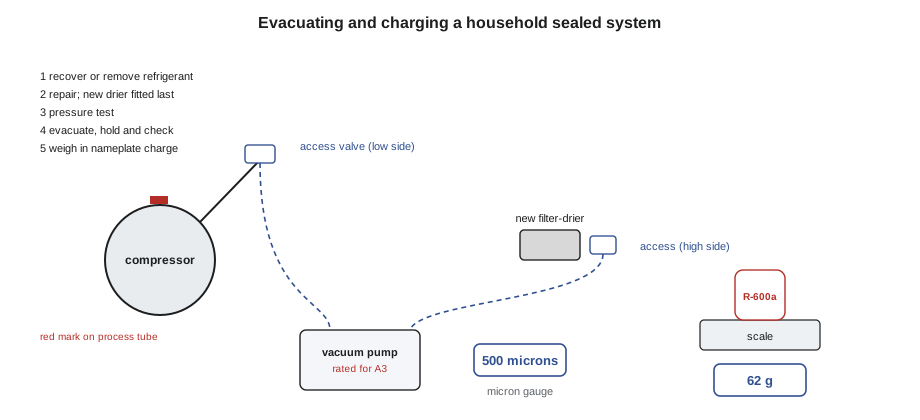
A household sealed system has no service valves, only process tubes: short stubs of tube at the compressor, and sometimes at the drier, through which the factory evacuated and charged the system before pinching and sealing them. To get access, the technician fits an access valve to a process tube. A piercing valve clamps around the tube and pierces it with a needle; it is quick but is generally used only for recovery, because it can leak if left in place, and it is removed when the tube is cut. A brazed or mechanically connected access valve, fitted after the tube is cut cleanly, is used for evacuation and charging, and is removed or permanently sealed at the end of the job, as the maker directs.
Fit access to both the high side and the low side where the maker's procedure calls for it, usually the compressor's process tube on the low side and a point at the drier on the high side. Access on both sides speeds evacuation and charging and lets the technician confirm that the whole system, not just one side, has been evacuated.
Removing the refrigerant
For R-134a, R-12 and other halocarbons, the refrigerant must be recovered into a recovery cylinder by a person holding an ODP card, using recovery equipment, and must not be released. Ontario's refrigerant rules under O. Reg. 463/10 prohibit releasing halocarbons and require recovery when equipment is serviced or disposed of. The recovered refrigerant is weighed, recorded and either reused in the same unit where the rules allow or returned for reclaim or destruction. For R-600a, the maker's procedure states how the refrigerant is removed. Some makers allow a hydrocarbon charge to be released slowly outdoors through a hose run well away from windows, doors, air intakes and ignition sources; others call for recovery with equipment rated for flammable refrigerants. Follow the procedure for that model.
Worked problem
How much must be recovered?
Before a compressor replacement on a 2009 R-134a top-freezer with 142 g on the nameplate, Hiro recovers the refrigerant. The compressor does not run. He recovers 131 g. The refrigerant rules in Ontario prohibit releasing halocarbons. How much of the charge has he recovered, and what about the rest?
Show solution
- Recovered fraction: 131 ÷ 142 = 0.92, or about 92 in 100.
- Some refrigerant is always left dissolved in the compressor oil and in the hoses, which is why the recovery machine draws the system down into a vacuum.
- The aim in Ontario is to recover the refrigerant fully, drawing the system down with the recovery equipment, not to reach a set fraction and stop.
Answer: He has recovered about 92 in 100 of the nameplate charge; the system should be drawn down with the recovery equipment until no more can be recovered, as the rules intend.
Making the repair
With the refrigerant out, the component is replaced. On R-134a and R-12 systems, joints are usually brazed. A slow flow of dry nitrogen is passed through the tubes while brazing so that the inside does not oxidize and form scale that would later block the capillary. Tubes are cut with a tube cutter, never a saw, so no chips enter the system. Aluminum evaporator tubes and mixed copper-aluminum joints need the connectors or special methods the maker specifies, because ordinary brazing cannot join them reliably. Before applying heat to any part of a system that has held refrigerant, confirm that it is empty and open to air, because heating a pressurized or charged part, including a compressor that still holds refrigerant in its oil, is dangerous.
On R-600a and other flammable-refrigerant systems, makers generally do not allow tubes to be opened with heat and many do not allow brazing at all in the field. Tubes are opened by cutting with a tube cutter, and joints are made with the mechanical, crimped or press-fit connectors the maker supplies, commonly the Lokring type. If the procedure does allow brazing, it states how the system is to be purged with nitrogen beforehand and checked with a hydrocarbon detector so that no flammable gas remains. A compressor removed from a hydrocarbon system may still hold refrigerant in its oil, so its tubes are plugged or crimped, never heated.
The filter-drier and system cleanliness
Every sealed-system repair includes a new filter-drier of the type specified, fitted last, just before evacuation, with its caps removed only at that moment. Moisture is the enemy: it freezes at the capillary outlet, reacts with the oil and refrigerant to form acid and sludge, and corrodes the system from inside. A system left open to the air for more than the few minutes needed to make the joints should be considered contaminated, and on a compressor burnout, where the old compressor's motor has burned and left acid and carbon in the system, the maker's procedure for cleaning the system or replacing more components must be followed.
Before evacuation, the repaired system is pressure tested for leaks, usually with dry nitrogen at the pressure the maker specifies, and every joint checked with soap solution or an electronic detector. A leak found at this stage costs minutes; a leak found after charging costs the whole job.
Evacuation
Evacuation removes the air and moisture from the system with a vacuum pump. The depth of the vacuum is measured with an electronic micron gauge, because the gauges on a manifold cannot read the very low pressures involved. A common target is 500 microns of mercury or lower, held for a period after the pump is isolated to show that the system is tight and dry; makers give their own values, and some call for lower targets. If the reading rises quickly after the pump is isolated and keeps rising, there is a leak; if it rises a little and then levels off, moisture is still boiling off and evacuation should continue.
| Reading after isolating the pump | What it means | Action |
|---|---|---|
| Stays at or below the target | System is tight and dry | Proceed to charging |
| Rises, then levels off above the target | Moisture still boiling off | Continue evacuating, then retest |
| Rises steadily and keeps rising | Leak | Find and repair the leak, pressure test, evacuate again |
| Cannot reach the target at all | Leak, wet system or poor pump and hose setup | Check hoses and pump oil; pressure test |
Charging by weight
Household refrigerators are always charged by weight, to the nameplate value, never by pressure or by feel. The charge is small, and a few grams too much or too little shows clearly in the system's performance. Place the refrigerant cylinder on an accurate digital scale, zero it, purge the hose with refrigerant as the procedure allows, open the valve, and let the scale count down the charge. On a capillary system the charge is usually introduced as liquid or vapour as the maker directs, often into the high side with the compressor off, then the remainder into the low side with it running. Allow for the refrigerant left in the hose: with a small charge, a hose that holds a few grams matters.
Worked problem
Weighing in a small charge
Dee's September 29 repair calls for 62 g of R-600a. Her charging hose, short and with low-loss fittings, holds about 2 g of refrigerant when full, which stays in the hose after charging. How much must leave the cylinder, and what is the charge in ounces?
Show solution
- Charge needed in the system: 62 g.
- Refrigerant left in the hose: about 2 g.
- Weight to leave the cylinder: 62 + 2 = 64 g.
- In ounces: 62 g ÷ 28.35 g per oz = about 2.19 oz.
Answer: About 64 g must leave the cylinder so that 62 g, about 2.2 oz, ends up in the system.
After charging, the access valves are closed and removed, or the process tubes are crimped and sealed, as the maker directs. Pinch-off tools and crimp seals are designed for this. On a flammable-refrigerant system, the red process-tube marking and every label must be restored. Check every joint and seal once more with the leak detector.
Checking the repair and recording it
Run the refrigerator and confirm it is working: the compressor wattage settles near the tech sheet value after the system has stabilized, the evaporator frosts evenly to its outlet, the condenser is warm and the suction line is near room temperature at the compressor. The cabinet takes several hours to pull down to temperature, so a follow-up call or a check the next day is often arranged. Record the job: the refrigerant type, the amount recovered or removed and how, the amount charged, the components replaced, the leak test results and the technician's certification number where the rules require it. The record protects the customer, the company and the technician.
Ontario's rules require records of refrigerant recovered and charged, and service tags or records on equipment, by the certified technician. Penfold keeps them in its job system against each invoice, and Dee's September 29 record lists 62 g of R-600a charged, which as a hydrocarbon needed no ODP entry, and the maker's warranty claim number.
After the repair: what the customer should know
A refrigerator that has had a sealed-system repair needs time to pull down, often several hours for the freezer and longer for a fully loaded fresh food section. Tell the customer to keep the doors closed as much as possible, to keep perishable food in a cooler until the sections are back to temperature, and to call if the refrigerator is not cold by the next day. Explain that the repair carries Penfold's labour warranty and, on a warranty unit, the maker's coverage, and leave the invoice with the work described in plain words.
Common mistakes
MistakeOpening a sealed system before agreeing the repair with the customer or maker.
InsteadConfirm the diagnosis and get approval first; the repair is costly.
MistakeUsing a vacuum pump or recovery machine not rated for flammable refrigerants on R-600a.
InsteadUse equipment rated for A3 refrigerants; older equipment can spark.
MistakeBrazing on a hydrocarbon system without the maker's procedure.
InsteadMost makers require mechanical connectors and no heat; follow the procedure exactly.
MistakeBrazing without nitrogen flowing.
InsteadFlow dry nitrogen to stop scale forming inside the tubes.
MistakeCharging by pressure or by feel.
InsteadWeigh in the exact nameplate charge on an accurate scale.
MistakeReading the vacuum with manifold gauges.
InsteadUse an electronic micron gauge and a decay test.
Summary and key terms
- Confirm the diagnosis, agree the repair and get the maker's procedure and parts before opening the system.
- Ventilate, remove ignition sources and use equipment rated for flammable refrigerants on R-600a.
- Access is through process tubes, with piercing valves for recovery and proper access valves for charging.
- Halocarbons must be recovered by a certified technician; R-600a is removed as the maker directs.
- R-134a joints are brazed with nitrogen flowing; R-600a joints usually use the maker's mechanical connectors.
- Fit a new filter-drier last, pressure test, then evacuate to a typical 500 microns or the maker's value.
- Charge by weight to the nameplate value, allowing for the hose.
- Check the running system, restore every label and keep the required records.
- Process tube
- A short stub of tube on the compressor or drier through which the factory evacuated and charged the system.
- Piercing valve
- A clamp-on valve that pierces a tube to give temporary access, mainly for recovery.
- Recovery
- Removing refrigerant from a system into a cylinder so that it is not released.
- Micron gauge
- An electronic gauge that measures deep vacuum in microns of mercury.
- Vacuum decay test
- Isolating the pump after evacuation and watching whether the vacuum holds.
- Mechanical connector
- A crimped or press-fit fitting that joins tubes without heat, often required on hydrocarbon systems.
- Compressor burnout
- A compressor motor failure that leaves acid and carbon in the system.
- Charging by weight
- Adding the exact nameplate charge measured on a scale.
Practice problems
Work each problem on paper first, then reveal the answer to check.
What must be fitted new on every sealed-system repair?
Show answer
A filter-drier of the type the maker specifies.
Why is nitrogen flowed through tubes while brazing?
Show answer
To stop oxide scale forming inside the tubes.
What does a vacuum reading that rises and keeps rising after the pump is isolated mean?
Show answer
There is a leak.
A charge of 62 g is needed and the hose holds 2 g. How much must leave the cylinder?
Show answer
64 g.
How is a household refrigerator charged?
Show answer
By weight, to the exact nameplate charge.
Lesson quiz · 5 questions
Score 60% or more to complete this lesson.
Create a free account to save your progress, take quizzes and earn a certificate.