
APP-210 · Lesson 4 of 12 · 21 min
Condensers, evaporators and capillary tubes
▶ Video coming soon A video version of this lesson is on the way.
Dee's case file from Tuesday, September 15, sat in the binder that Hiro handed round on November 3. A 2009 top-freezer, R-134a, 128 g on the nameplate, was warm in both sections. The compressor ran all the time. The condenser coil in the machine compartment was clean and its fan ran. Inside the freezer, behind the back panel, the evaporator had a thin band of frost on its first few passes and was bare and close to room temperature everywhere else. The suction line at the compressor was warm. Dee's note read: "Frost only at inlet, suction warm, current low. Restriction or low charge. Capillary end of drier ice cold to the touch, sweating. Restriction at drier." She had replaced the filter-drier, and the refrigerator had been cooling ever since. "Read the coils and the tubes," Hiro said. "They'll tell you where the refrigerant is and where it isn't."
The heat exchangers and the metering device are the parts of the sealed system that a technician can see, touch and measure from outside, and their temperatures and frost patterns are the best clues to what is going on inside. This lesson covers the kinds of condensers used in household appliances, the evaporators, the capillary tube and its heat exchanger, and the filter-drier, how each works and fails, and what each looks and feels like when it is working correctly. Lesson 9 brings these clues together into a diagnosis.
Fan-cooled condensers
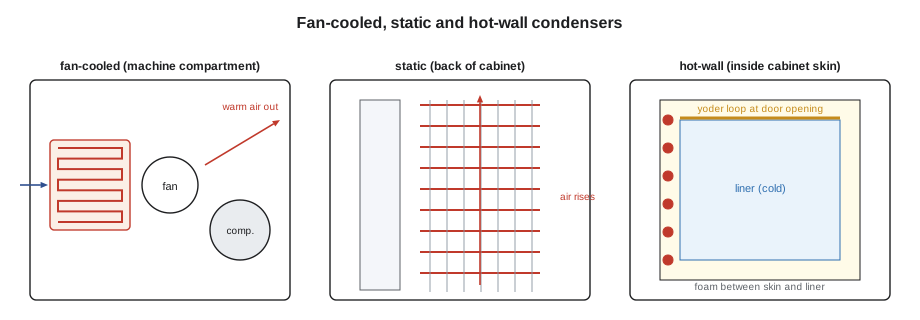
Most refrigerators made in the last twenty years have a fan-cooled condenser in the machine compartment. It is a compact coil of tubes with thin fins, or a coil of wire-wound tube, with a small fan that pulls room air through it and pushes the warm air out the back or the front grille. The same fan usually cools the compressor and blows across the drain pan to evaporate defrost water. Because the coil is compact and the fins are close together, it collects dust, lint and pet hair quickly, and a clogged condenser is one of the most common causes of poor cooling and high energy use.
A working fan-cooled condenser feels warm, and the air leaving it is noticeably warmer than the room, typically by 5 to 10 °C (10 to 20 °F) when the compressor has been running. The discharge line from the compressor to the condenser is hot. If the condenser fan has stopped, the coil gets hot instead of warm, the compressor runs long, the overload may trip, and the cabinet warms up. Clean the coil with a condenser brush and a vacuum, from the direction the manufacturer recommends, and check that the fan blade spins freely and the motor runs. Kiran's November 13 lead call, an open fan motor and a clogged coil, is the standard example.
Static and hot-wall condensers
A static condenser cools by natural convection, with no fan. The classic type is the wire-and-tube grid on the back of older refrigerators and many compact units: a serpentine tube with steel wires welded across it, standing a few centimetres from the cabinet so air can rise through it. Static condensers need the clearance behind and above the unit that the instructions call for, because without it the warm air has nowhere to go.
A hot-wall or skin condenser is a tube bonded to the inside of the outer cabinet wall, under the foam insulation, so the cabinet sides act as the condenser surface. Chest freezers and many upright freezers use them, and some refrigerators have part of the condenser in the cabinet walls as well as a coil in the machine compartment. A hot-wall condenser is invisible and needs no cleaning, but it has two consequences. The cabinet walls are warm, which is normal; and if a hot-wall condenser tube leaks, the leak is inside the foam, where it cannot be reached. Most makers treat a leak in a hot-wall condenser as non-repairable; some approve bypassing it with an external condenser.
Many freezers and some refrigerators also run a loop of the warm discharge or condenser tube around the door opening, just behind the front of the cabinet. This is often called a yoder loop or anti-sweat loop. It keeps the face of the cabinet slightly warm so moisture does not condense on it where the gasket seals. If the yoder loop leaks, the leak is again inside the foam. If a freezer's door frame is sweating or frosting, the loop may not be getting warm refrigerant, which points to a low charge or a restriction upstream.
Evaporators
Frost-free refrigerators and freezers use a finned evaporator behind a panel in the freezer, with a fan to blow air across it. The evaporator is usually aluminum tube with aluminum fins, though some are copper or steel. Refrigerant enters at one end, from the capillary tube, and leaves through the suction line at the other, usually through an accumulator, a small chamber at the outlet that catches any liquid that has not yet boiled. On a correctly charged, working refrigerator the whole evaporator is cold and lightly and evenly frosted after it has run for a while, including the last pass before the accumulator.
Manual-defrost freezers and compact refrigerators use plate or bonded evaporators: tube bonded to the liner or to an aluminum plate, or roll-bond plates made of two sheets of aluminum with the refrigerant passages pressed between them. Frost builds on these surfaces in use and must be defrosted by switching the unit off. Customers sometimes chip ice off with a knife or screwdriver and puncture the plate, which lets the refrigerant out. A punctured roll-bond or bonded evaporator is very rarely worth repairing.
Aluminum evaporators can also corrode. Moisture, cleaning chemicals and contact with copper or steel can pit them over the years, and a pinhole leak in an aluminum evaporator is a common cause of a slow loss of charge. Dee's September 29 case file, in lesson 10, was a 2021 R-600a bottom-freezer under warranty with exactly that fault.
The capillary tube
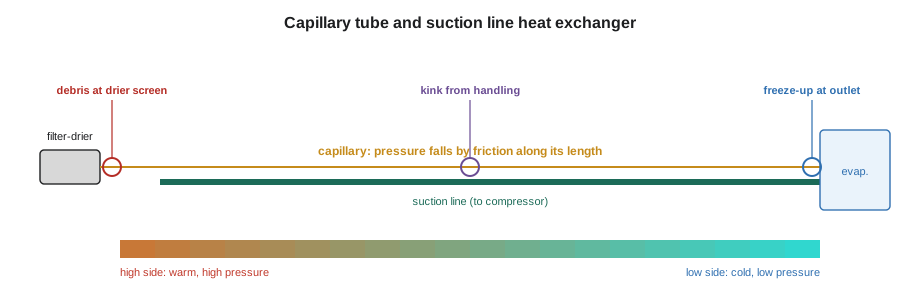
The capillary tube is the metering device. It is a length of copper tube with a very small bore, typically between about 0.6 mm and 1 mm (0.024 and 0.04 in) inside diameter, and often between 2 m and 4 m (6 and 13 ft) long, coiled and run along or inside the suction line. Its length and bore are chosen by the maker for that system and that charge. The capillary has no moving parts. It meters refrigerant by friction: the longer and narrower it is, the less refrigerant it passes at a given pressure difference.
Because it is so narrow, the capillary is easily blocked. Moisture in the system can freeze at the cold outlet of the capillary, where it enters the evaporator, and stop the flow until it thaws, giving a refrigerator that cools, warms, cools and warms again. Debris, sludge from burned oil or wax from the wrong oil can partly block it anywhere along its length. And a kink, from careless handling during a repair or a move, can pinch it. A blocked capillary stops cooling almost completely: the evaporator gets little or no refrigerant, the compressor runs with low current, and the refrigerant collects in the condenser.
The capillary tube is never cut or bent to change its length or shape. When a capillary tube is blocked, the manufacturer's procedure is followed, which usually means replacing the filter-drier and the capillary tube, or the evaporator with its capillary attached as an assembly.
The filter-drier
The filter-drier sits between the condenser outlet and the capillary inlet. It is a short copper or steel canister holding a desiccant, a material that absorbs moisture, and a fine screen. It removes any moisture left in the system after manufacture or repair and catches debris before it reaches the capillary. A restriction at the drier screen shows as a temperature drop across the drier: the outlet is noticeably colder than the inlet, and may sweat or frost, as in Dee's September 15 case. A drier that is cold and sweating on a running refrigerator is a strong clue to a restriction.
Every time the sealed system is opened, the filter-drier is replaced. The new drier must be the type the manufacturer specifies for the refrigerant: driers with a desiccant suited to R-134a are not interchangeable with ones made for R-600a or R-12 in every case, and the parts catalogue lists the correct one. A drier left open to the air absorbs moisture within minutes, so it stays capped until the moment it is fitted.
Worked problem
Temperature drop across a drier
On Dee's September 15 call, she measured the tube temperature 25 mm (1 in) before the drier at 34 °C (93 °F) and the capillary just after the drier at 9 °C (48 °F). In a refrigerator with an unrestricted drier, the tube temperature changes by only a degree or two across it. What does the reading show?
Show solution
- Drop across the drier: 34 − 9 = 25 °C.
- A normal drier changes the temperature by only a degree or two.
- A 25 °C drop means the refrigerant is expanding at the drier, not at the capillary outlet: the screen is restricted.
Answer: The drier screen is restricted. The repair is to recover the charge, replace the drier, evacuate and weigh in the nameplate charge.
What the coils feel like
With some practice, a technician can learn a great deal from the temperature of each part by touch and with a contact thermometer. On a working refrigerator after it has run steadily for some minutes: the discharge line is hot, the condenser is warm and evenly warm, the drier is warm, the capillary is warm where it leaves the drier and cools along its length, the evaporator is cold and evenly frosted to its outlet, and the suction line at the compressor is near room temperature, sometimes slightly cool. Changes from this pattern tell their own stories, and lesson 9 sets them out together.
| Part | Normal | Low charge | Restriction | Clogged condenser or failed fan |
|---|---|---|---|---|
| Condenser | Warm | Slightly warm | Cool or slightly warm | Hot |
| Filter-drier | Warm, same both ends | Warm | Cold or sweating at outlet if restricted there | Hot |
| Evaporator frost | Even to the outlet | Only on the first passes | Little or none | Even but cabinet warms |
| Suction line at compressor | Near room temperature | Warm | Warm | Near room or slightly cool |
| Compressor current | Near rating | Below rating | Below rating | Above rating |
Cleaning condensers properly
Cleaning a fan-cooled condenser is one of the most valuable things a technician can do on a routine call, and it is worth doing well. Unplug the refrigerator first, because the condenser fan can start without warning and its blade can cut fingers. Remove the toe grille at the front or the cover at the back, depending on where the maker gives access. Use a long, narrow condenser brush to loosen the dust between the coils and fins, working in the direction of the fins so they are not bent, and a vacuum to pick it up. On some models, the condenser is reached only from the back and the refrigerator must be pulled out.
Look at the condenser fan blade at the same time. Dust packed on its leading edges reduces its airflow, and a blade that has been striking debris may be chipped or loose on its shaft. Check that the airflow path is complete: many machine compartments have a foam seal or a divider that separates the cool air coming in from the warm air going out, and if that divider is missing, the fan recirculates its own warm air and the condenser runs hot even when it is clean. Refit every cover and divider the maker installed.
Customers with pets, and homes under renovation, can clog a condenser within months. Showing the customer where the grille is and how to vacuum it, or suggesting a cleaning visit once or twice a year, prevents many repeat calls. A clean condenser also lowers the compressor's running current and the refrigerator's energy use, so cleaning before taking current or wattage readings gives a truer picture of the sealed system, as lesson 9 explains.
Common mistakes
MistakeLeaving the condenser unchecked on a warm-refrigerator call.
InsteadClean the coil and check the fan first; it is quick and very often the fault.
MistakeChipping ice off a plate evaporator with a tool.
InsteadDefrost by switching off; a punctured plate is rarely repairable.
MistakeBending or cutting a capillary tube to make it fit.
InsteadNever alter a capillary; replace it, or the assembly, as the maker directs.
MistakeReusing the old filter-drier after opening the system.
InsteadReplace the drier every time, with the type listed for the refrigerant.
MistakeLeaving a new drier uncapped on the bench.
InsteadKeep it sealed until the moment it is fitted; it absorbs moisture quickly.
MistakeAssuming a leak in a hot-wall condenser can be found and brazed.
InsteadIt is inside the foam; follow the maker's guidance, which is often to replace the unit.
Summary and key terms
- Fan-cooled condensers clog with dust and need cleaning; their fan also cools the compressor and the drain pan.
- Static and hot-wall condensers use natural convection; hot-wall tubes are inside the cabinet walls.
- A yoder loop of warm tube around the door opening stops the cabinet face sweating.
- A working evaporator is evenly frosted to its outlet.
- The capillary meters by friction; freeze-ups happen at its outlet and debris collects at its inlet.
- A cold or sweating drier outlet on a running unit points to a restriction at the drier.
- The filter-drier is replaced every time the system is opened.
- Temperature and frost patterns are the main clues from outside the sealed system.
- Fan-cooled condenser
- A compact condenser coil in the machine compartment cooled by a small fan.
- Static condenser
- A condenser cooled by natural air movement, with no fan.
- Yoder loop
- A loop of warm refrigerant tube behind the front of the cabinet that keeps the door opening from sweating.
- Accumulator
- A small chamber at the evaporator outlet that holds liquid refrigerant until it boils.
- Roll-bond evaporator
- Two aluminum sheets with refrigerant passages pressed between them, used as a plate evaporator.
- Restriction
- A partial or complete blockage in the sealed system, usually at the drier or capillary.
- Freeze-up
- Ice formed from moisture in the refrigerant, usually at the capillary outlet, that blocks flow.
- Desiccant
- The moisture-absorbing material inside a filter-drier.
Practice problems
Work each problem on paper first, then reveal the answer to check.
How much warmer than the room is the air leaving a working fan-cooled condenser, typically?
Show answer
About 5 to 10 °C (10 to 20 °F).
Why is a leak in a hot-wall condenser hard to repair?
Show answer
The tube is inside the foam insulation of the cabinet wall.
Where does a moisture freeze-up usually form?
Show answer
At the capillary outlet, where it enters the evaporator.
What does a cold, sweating filter-drier outlet on a running refrigerator suggest?
Show answer
A restriction at the drier screen.
What does an evenly frosted evaporator, right to its outlet, suggest?
Show answer
The system is correctly charged and refrigerant is flowing normally.
Lesson quiz · 5 questions
Score 60% or more to complete this lesson.
Create a free account to save your progress, take quizzes and earn a certificate.