
APP-210 · Lesson 12 of 12 · 25 min
Refrigerator service case studies
▶ Video coming soon A video version of this lesson is on the way.
On Saturday, November 14, Kiran rode with Dee on Penfold's Saturday on-call van. Fenna had booked three refrigeration calls before closing the office on Friday, all of them "not cooling" or close to it, and Dee had told Kiran the night before what she wanted from him: "You run the diagnosis on all three. Talk me through it as you go. I'll stop you if you're about to do something wrong, and I'll handle anything that opens a sealed system." This lesson follows the three calls in order. Each one uses the methods from the earlier lessons, and each ends differently: a replacement recommended, a repair made and a fix that needed no tools at all.
As you read each case, notice the order of the work: listen to the customer, look and measure before touching, rule out the simple causes, then narrow down with readings until the cause is proven. Watch too for what Dee insists on in each one: the right test for the part, safe practice around the refrigerant, a clear explanation to the customer and a record of what was found and done.
Call 1: a chest freezer that stopped freezing
The first call, at 8:30, was Gwendolyn Rusk's basement chest freezer in Westmount, on the Hamilton Mountain. It was a 2011 model, R-134a, 85 g on the nameplate, and its contents were starting to soften. Mrs. Rusk had moved the most important things to her kitchen freezer the evening before. Inside the chest, Kiran's probe read −6 °C at the centre after he had let the lid stay closed for ten minutes. The compressor was running and, Mrs. Rusk said, had not stopped for two days.
Kiran worked through the list from lesson 9. The freezer had power and its mechanical thermostat was calling for cooling. It had no fans and a hot-wall condenser, so there was nothing to clean. The lid gasket passed the paper test all the way round. The compressor ran with a steady hum and no clicking. Then he read the outside of the sealed system. The cabinet sides, which on a working chest freezer feel distinctly warm, were barely above room temperature. Inside, a patch of frost covered the liner wall near the corner where the capillary entered, and the rest of the walls were bare. And the watt meter read 58 W, where the label on the compressor compartment gave a rated current that, with Penfold's notes for that model, put normal running power at about 95 W.
Worked problem
Reading the chest freezer
The chest freezer draws 58 W against about 95 W expected. Frost covers only one corner near the capillary inlet. The hot-wall condenser is barely warm. The thermostat is calling, the compressor runs and the gasket seals. What do the readings point to, and why is the repair unlikely to be worth making?
Show solution
- Wattage ratio: 58 ÷ 95 = 0.61, so the compressor draws about 61 in 100 of normal power: the system is starved.
- Frost at the inlet only: the small amount of refrigerant left boils away close to where it enters.
- A barely warm condenser: little refrigerant is condensing, so there is little heat to reject.
- Together these are the low-charge pattern, which means a leak. In a chest freezer both the evaporator and the condenser are bonded inside the foam, so a leak is almost certainly out of reach.
Answer: A low charge from a leak inside the cabinet walls. Finding and repairing it would cost more than a new freezer, so replacement is the sensible recommendation.
Dee agreed with the diagnosis and with Kiran's recommendation, and they explained it together. A 15-year-old freezer with a leak inside its walls was not worth a sealed-system repair, and a new, more efficient one would cost less than the repair and use much less energy. Mrs. Rusk ordered a replacement that morning for delivery the following week. Penfold would collect the old freezer on Monday, November 16, and Dee would recover whatever refrigerant remained before it went to Quarrington, as the rules require. The invoice was the service call only, 95 dollars plus tax.
With HST at 13 in 100, the invoice was 95 × 1.13 = 107.35 dollars. Kiran's notes recorded the readings, the low-charge diagnosis, the recommendation, the customer's decision and the planned collection.
Call 2: a French-door refrigerator with a warm fresh food section
At 10:45 they reached Arturo Pellegrino's house in Dundas. His 2020 French-door refrigerator, R-600a, 58 g on the nameplate, had a fresh food section reading 9 °C on its own display and a freezer reading −17 °C. Kiran's probes, after the doors had been closed for twenty minutes, agreed within a degree. The freezer was close to target; the fresh food section was far too warm.
Kiran recognized the pattern from lesson 5: cold was being made but not delivered to the fresh food section. The flapper flipped into place and the doors were level. He entered the board's service mode from the tech sheet and commanded the evaporator fan on: it started, but the air from the fresh food duct outlet was barely cool. With the refrigerator unplugged and the freezer's rear panel removed, the reason was plain. The evaporator was packed solid with white frost, and so was the opening to the fresh food duct. Before going any further, Dee passed her hydrocarbon leak detector slowly over the evaporator and tubing, as she does every time she opens an R-600a evaporator compartment. It stayed silent.
Frost that thick means defrost has failed, so Kiran followed lesson 6. He plugged the refrigerator in, forced a defrost from the service mode and put his clamp meter on the defrost heater lead. It read 0 A. He unplugged the unit again and read the heater, a glass-tube type rated 400 W at 120 V: OL. The defrost thermistor, still on the frozen evaporator, read within the tech sheet's table for its temperature, and the board had powered the heater circuit when commanded, as a later voltage check at the heater connector confirmed. The heater had failed open.
Worked problem
The defrost heater
The heater is rated 400 W at 120 V. What should it read, and what current should a new one draw during a forced defrost?
Show solution
- Resistance: R = V² ÷ P = 120² ÷ 400 = 14,400 ÷ 400 = 36 Ω.
- The old heater read OL, so it is open.
- Current: I = P ÷ V = 400 ÷ 120 = 3.33 A.
- After the new heater was fitted, the forced-defrost clamp reading was 3.3 A, which matches.
Answer: The heater should read 36 Ω and draw about 3.3 A. The old one was open; the new one is correct.
Kiran fitted a new heater from the van stock, then had to clear the frost before the refrigerator could cool properly. He reached for the steamer from the van, not a heat gun, and Dee nodded: on a hydrocarbon refrigerator, a hot element near the evaporator is the one thing never to bring in. He melted the frost from the evaporator and the duct, sponged out the water, checked that the defrost drain ran freely with a cup of warm water and refitted the drain clip. With the panel back on and the refrigerator running, he forced a second defrost to confirm the 3.3 A reading, cancelled it, and checked that the fan was now pushing cold air into the fresh food section.
The invoice was the 95 dollar service call plus Penfold's 150 dollar flat rate for a defrost heater, 245 dollars before tax, or 245 × 1.13 = 276.85 dollars with HST. Fenna would call Mr. Pellegrino on Monday to confirm that the fresh food section had come down to temperature overnight.
Call 3: an ice maker that would not keep up
The last call, at 1:30, was Bea Ivers's 2017 side-by-side in Waterdown. The booking said "ice maker not working", but when Kiran asked, Ms. Ivers said the ice maker was making a little ice, small cubes, and the water dispenser had become slow over the last month or two. Kiran checked the freezer, which read −18 °C, and saw a half-full bin of small, thin cubes. Then he looked for the water filter: it was in the top of the fresh food section, and its date label read October of the previous year.
Remembering Dee's October 6 case file, Kiran ran the dispenser into a measuring jug for 30 seconds with the old filter in, then fitted the bypass plug and repeated it. He also fitted a pressure gauge at the inlet valve's supply connection, with the supply turned off for a moment to do it, to rule out low house pressure.
Worked problem
Filter or pressure?
With the old filter, the dispenser delivered 260 mL (8.8 fl oz) in 30 s. With the bypass plug, it delivered 760 mL (25.7 fl oz) in 30 s. The supply pressure at the valve read 380 kPa (55 psi) static. The installation instructions give a range of about 140 to 820 kPa (20 to 120 psi). What is the cause?
Show solution
- Flow with the old filter: 260 ÷ 30 = 8.7 mL/s.
- Flow with the bypass: 760 ÷ 30 = 25.3 mL/s.
- Ratio: 8.7 ÷ 25.3 = 0.34, so the old filter passes only about a third of the flow.
- The supply pressure, 380 kPa, is well inside the 140 to 820 kPa range, so the house supply is not the problem.
Answer: The clogged filter is restricting the flow to both the dispenser and the ice maker, which is why the cubes were small. A new filter is the fix.
Kiran fitted a new certified filter from the van, ran the dispenser to flush it as the instructions direct, and then forced a harvest from the ice maker's test point. The next fill was full, and the new cubes, when they dropped twenty minutes later, were the normal size. He explained to Ms. Ivers that the ice maker itself had been fine all along, showed her the filter reminder on the display and wrote the date on the new filter.
The invoice was the 95 dollar service call and the 55 dollar filter, 150 dollars before tax, or 150 × 1.13 = 169.50 dollars with HST.
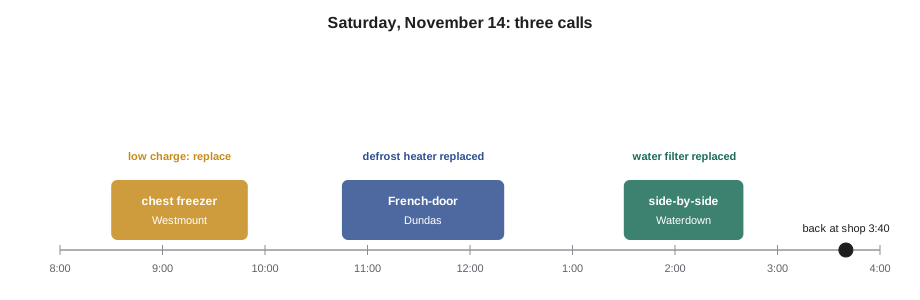
What the three calls had in common
None of the three calls began with a part. Each began with the customer's account and with measurements: temperatures in the cabinet after the doors had been closed, the condition of the coils and the frost, current or wattage, flow and pressure. Each time, Kiran ruled out the simple causes before moving to the next layer, and each time the cause was proven before anything was replaced. The chest freezer was not condemned until its wattage, its frost pattern and its condenser temperature all agreed. The defrost heater was not replaced until a forced defrost showed no current and the heater read open. The ice maker was not touched at all, because the timed flow and the pressure reading put the fault in the filter.
Each call also kept safety in view. Dee checked the French-door's evaporator compartment with a hydrocarbon detector before work started there, and the frost was melted with a steamer. Nobody opened a sealed system, and the one refrigerant job of the day, the recovery from the chest freezer before disposal, was planned for a certified technician with the right equipment. And each call ended with a clear explanation to the customer and a record of what had been found.
| Call | Complaint | Key readings | Cause | Outcome |
|---|---|---|---|---|
| 1, chest freezer | Not freezing | Wattage 61 in 100 of normal; inlet frost only; cool condenser | Low charge from a leak inside the walls | Replacement recommended; recovery before disposal |
| 2, French-door | Fresh food warm | Evaporator packed with frost; 0 A in forced defrost; heater OL | Defrost heater open | Heater replaced; frost cleared with a steamer |
| 3, side-by-side | Small ice, slow water | Flow a third of bypass flow; pressure in range | Clogged water filter | Filter replaced and flushed |
On the drive back, Dee asked Kiran what he would have done differently. He said he would have read the chest freezer's condenser temperature before the wattage, because it was quicker. She agreed, and added one thing of her own: on the second call, he should have looked at the drain before he started steaming, so he knew whether the frost had come from a failed heater alone or from a drain problem as well. They reached the shop at 3:40. Kiran's ODP course is booked for Saturday, December 5, and the next course in his program, APP-220, moves on to washers and dryers.
Common mistakes
MistakeStarting with a part because the booking named it.
InsteadStart with the customer and measurements; the third call's ice maker was fine.
MistakeCondemning a sealed system on one clue.
InsteadWait until wattage, frost and condenser temperature agree.
MistakeReplacing a defrost heater without a forced-defrost current check.
InsteadMeasure the current first; it splits the circuit into heater side and control side.
MistakeUsing a heat gun to clear frost on an R-600a refrigerator.
InsteadUse a steamer, and check the compartment with a hydrocarbon detector.
MistakeLeaving without confirming the repair.
InsteadForce a defrost or harvest, check the airflow or fill, and arrange a follow-up.
MistakeSkipping the explanation and the record.
InsteadExplain the cause to the customer and record the readings, the cause and the work.
Summary and key terms
- Every call starts with the customer's account and with measurements, not with a part.
- Low wattage, inlet-only frost and a cool condenser together mean a low charge and a leak.
- A leak inside the foam of a chest freezer is rarely worth repairing.
- A warm fresh food section with a cold freezer, and a packed evaporator, mean a defrost failure.
- A forced defrost with a clamp meter quickly tells heater faults from control faults.
- A timed flow with and without the filter, and a pressure reading, locate water supply faults.
- Safe practice around R-600a means a hydrocarbon detector and no heat sources near the evaporator.
- Each call ends with confirmation, a clear explanation and a record.
- Saturday on-call
- A rota in which a technician covers urgent calls outside normal weekday hours.
- Pull down
- The time a refrigerator takes to bring its cabinet down to temperature after starting or loading.
- Flat rate
- A fixed price for a common repair, covering parts and labour.
- Hydrocarbon leak detector
- An electronic detector rated for flammable refrigerants such as R-600a.
- Steamer
- A hand-held steam cleaner used to melt frost safely.
- Forced harvest
- Starting an ice maker cycle on demand to test the motor, heater and fill.
- Repair or replace
- The decision, with the customer, whether a repair is worth its cost compared with a new appliance.
- Follow-up call
- A later call to confirm that a repaired appliance is working as expected.
Practice problems
Work each problem on paper first, then reveal the answer to check.
On call 1, what three readings agreed on a low charge?
Show answer
Low wattage, frost only near the capillary inlet and a barely warm condenser.
Why was replacement recommended for the chest freezer?
Show answer
The leak was inside the foam, and a repair would cost more than a new freezer.
What resistance should a 400 W, 120 V heater read?
Show answer
36 Ω.
On call 3, how did Kiran rule out low house pressure?
Show answer
He measured the supply pressure at the inlet valve: 380 kPa (55 psi), inside the range.
What tool did Kiran use to clear the frost on the R-600a refrigerator?
Show answer
A hand-held steamer, not a heat gun.
Lesson quiz · 5 questions
Score 60% or more to complete this lesson.
Create a free account to save your progress, take quizzes and earn a certificate.