
AERO-450 · Lesson 11 of 12 · 28 min
Drone regulations in Canada
The Vertical Flight group cannot finish the wildfire aircraft's design without knowing how it will be allowed to fly. Rachel Oduya, who spent a decade with Transport Canada before joining Borealis Aerospace, runs a two-day workshop on Canadian drone rules for the group, with Hélène and Sam, who will become the first company pilots for the drone. She starts with a warning that applies to every lesson she gives: rules change, the version in force on the day of the flight is the one that counts, and the regulator's own pages are the place to check it. The rules described here are those in force in late 2026.
How drone rules are built
Crewed aviation is regulated mainly by certifying things: the aircraft gets a type certificate, the pilot a licence, the operator an operating certificate. Applying that model to every small drone would make them impossible to use, so regulators everywhere have adopted a risk-based approach. Low-risk operations, small drones flown within sight, away from people and below crewed traffic, are allowed under general operating rules with a simple pilot certificate and no aircraft certification. As the risk rises, through flight near or over people, in controlled airspace, beyond visual line of sight or with heavier aircraft, the rules require more: better pilot training, aircraft that meet design standards, operator organizations with procedures, and case-by-case approval. The two quantities that drive the risk are the harm a drone can do if it hits the ground, set by its size, speed and the people below, and the chance of meeting a crewed aircraft, set by the airspace and altitude.
Canada: Part IX of the Canadian Aviation Regulations
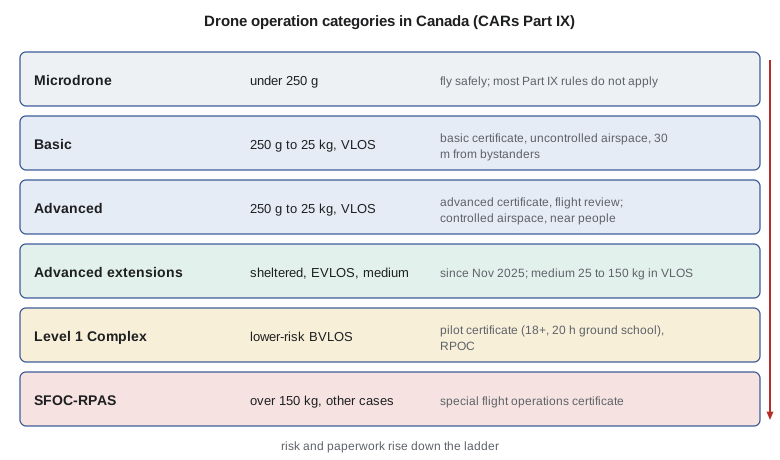
Canadian rules for remotely piloted aircraft systems (RPAS) are in Part IX of the Canadian Aviation Regulations, in force since June 2019 and substantially extended in 2025. They apply to drones of 250 g up to 150 kg flown within visual line of sight, and, since 4 November 2025, to certain lower-risk operations beyond visual line of sight. Drones under 250 g, microdrones, are largely outside Part IX, although their pilots must not fly them recklessly, and since April 2025 they need a special flight operations certificate to fly at advertised events. Drones of 250 g or more must be registered with Transport Canada and marked with their registration number; the registration fee became 10 dollars in April 2025.
Basic and advanced operations
Within visual line of sight, Canada has two categories. Basic operations need a basic pilot certificate, earned by passing an online exam at age 14 or older. The pilot must fly in uncontrolled airspace, keep at least 30 m horizontally from bystanders, never fly over bystanders, stay at or below 122 m (400 ft) above ground, and keep clear of aerodromes: at least 5.6 km from airports and 1.9 km from heliports. Advanced operations need an advanced pilot certificate: a harder exam, a flight review with a flight reviewer, and a minimum age of 16. Advanced pilots may fly in controlled airspace with an RPAS flight authorization from NAV CANADA, near aerodromes under defined procedures, and closer to or over bystanders if the drone has the right safety declaration. Under Standard 922, RPAS Safety Assurance, manufacturers declare that their drones meet technical requirements for operations near people (within 30 m but more than 5 m), over people, or in controlled airspace. Pilots must keep their knowledge current, completing a recency activity within the previous 24 months, and must carry their certificate and the drone's registration.
The rules for both categories also require a site survey before flight, pre-flight checks, a plan for emergencies, and specific weather and lighting limits; flight at night is allowed if the drone carries lighting that keeps it visible. Pilots must report any incident in which someone is seriously injured or killed, or in which the drone collides with a crewed aircraft, and they must not fly near emergency operations, including forest fires, unless they are working for the responders.
The November 2025 changes
The 2025 amendments, which took effect on 4 November 2025, opened three new kinds of operation to advanced pilots and created a new certificate for beyond-visual-line-of-sight work. Sheltered operations let a small drone fly close to a structure, such as a tower, building or bridge, staying more than 30 m from uninvolved people, no more than 30 m above the structure and less than 61 m (200 ft) from it horizontally. The structure shelters the operation from crewed aircraft, which rarely fly that close to obstacles. Extended visual line of sight (EVLOS) lets a small drone fly beyond the pilot's own sight in uncontrolled airspace if a trained visual observer, who also holds an RPA pilot certificate, keeps it in view, with everything within 2 nautical miles (about 3.7 km) of the pilot, the observer and the control station, and more than 30 m from uninvolved people. Medium drones, from 25 kg to 150 kg, may now fly within visual line of sight under the rules rather than by special certificate, provided the drone has been declared safe for the operation.
The new Level 1 Complex Operations pilot certificate covers lower-risk beyond-visual-line-of-sight flights. The pilot must be at least 18, complete at least 20 hours of ground school, pass the exam for advanced and Level 1 Complex operations, and pass a flight review. The operation must be in uncontrolled airspace, below 122 m, away from aerodromes, and at least 1 km from populated areas, which Transport Canada defines by population density; small drones may also fly over sparsely populated areas, defined as more than 5 but no more than 25 people per square kilometre, under extra conditions. The operator must also hold an RPAS operator certificate (RPOC), showing policies and procedures suited to the size and complexity of its operations, and the drone must have a pre-validated declaration for the operation. Transport Canada introduced fees with these changes, including 50 dollars for the Level 1 Complex exam, 125 dollars for the pilot certificate, 125 dollars for the RPOC and 1200 dollars for a pre-validated declaration.
Special flight operations certificates
Anything outside these categories needs a special flight operations certificate for RPAS (SFOC-RPAS). That includes drones over 150 kg, beyond-visual-line-of-sight operations that do not fit Level 1 Complex, such as in controlled airspace or over populated areas, flights above 122 m without a sheltering structure, and advertised events with microdrones. An SFOC application includes a description of the operation and a risk assessment, and since November 2025 it carries a fee set by complexity: 20 dollars for very low, 75 for low, 900 for medium and 2000 for high complexity. Government emergency response organizations are exempt from the fee. Transport Canada's risk assessment process for SFOCs uses the same principles as the international method described below.
The SORA approach to risk
For operations that need case-by-case approval, the international reference is the Specific Operations Risk Assessment (SORA), developed by the Joint Authorities for Rulemaking on Unmanned Systems (JARUS), a group of national authorities, and updated as version 2.5 in 2024. SORA is widely used in Europe and has influenced risk assessment elsewhere. It works in a fixed sequence. The applicant describes the concept of operations. The intrinsic ground risk class (GRC) comes from the drone's size and speed and the population density below. Mitigations reduce it: strategic ones, such as sheltering or restricting the area, and effects-reducing ones, such as a parachute that lowers impact energy. The air risk class (ARC) comes from the airspace, altitude and the chance of meeting crewed aircraft, and it can be lowered by strategic measures. The final ground and air risk classes then give a specific assurance and integrity level (SAIL), from I to VI, which sets how robustly the operator must meet a list of operational safety objectives covering the aircraft, the crew, the procedures and the organization.
# SORA-lite: an illustrative ground and air risk screen in the style of the JARUS SORA method.
# The tables are simplified for teaching; a real assessment uses the current official tables and guidance.
import math
dims   = [1, 3, 8, 20, 40]                     # maximum characteristic dimension (m)
speeds = [25, 35, 75, 120, 200]                # matching maximum speed (m/s)
# rows: population density bands (people per km^2); columns: size/speed classes
grc_table = [("controlled ground area", 0,       [1, 1, 2, 3, 3]),
             ("under 5",                5,       [2, 3, 4, 5, 6]),
             ("under 50",               50,      [3, 4, 5, 6, 7]),
             ("under 500",              500,     [4, 5, 6, 7, 8]),
             ("under 5,000",            5000,    [5, 6, 7, 8, 9]),
             ("under 50,000",           50000,   [6, 7, 8, 9, 10])]
sail = {"a": [1, 2, 3, 4, 5, 6], "b": [2, 2, 3, 4, 5, 6], "c": [4, 4, 4, 4, 5, 6], "d": [6, 6, 6, 6, 6, 6]}
roman = ["I", "II", "III", "IV", "V", "VI"]
def intrinsic_grc(dim, vmax, density, controlled=False):
    col = next(i for i in range(5) if dim <= dims[i] and vmax <= speeds[i])
    if controlled: return grc_table[0][2][col]
    for name, limit, row in grc_table[1:]:
        if density < limit: return row[col]
    return None                                  # too dense for this screen
def sail_level(grc, arc):
    if grc > 7: return "outside the screen"
    return roman[sail[arc][max(grc, 2) - 2] - 1]
cases = [("Larkspur mapping over forest, far from towns", 2.7, 25, 3,   False, -1, "b"),
         ("Larkspur over farmland near a village",        2.7, 25, 40,  False, -1, "b"),
         ("Quadcopter inspecting a line near a suburb",   0.9, 18, 400, False, -2, "c"),
         ("Quadcopter inside a fenced substation",        0.9, 18, 0,   True,   0, "a")]
print("operation                                        iGRC  mitigations  final GRC  ARC  SAIL")
for name, dim, v, dens, ctl, mit, arc in cases:
    g = intrinsic_grc(dim, v, dens, ctl)
    gf = max(1, g + mit)
    print(f"  {name:46s}  {g:3d}      {mit:+d}          {gf:3d}       {arc}    {sail_level(gf, arc)}")
print()
# why size and speed matter: kinetic energy at impact
for name, m, v in (("250 g camera drone at 15 m/s", 0.25, 15), ("6 kg quadcopter at 15 m/s", 6, 15),
                   ("6 kg quadcopter falling from 120 m (drag-limited, about 30 m/s)", 6, 30),
                   ("11 kg Larkspur cruising at 22 m/s", 11, 22)):
print(f" {name:62s} kinetic energy {0.5*m*v*v:7.0f} J")operation iGRC mitigations final GRC ARC SAIL Larkspur mapping over forest, far from towns 3 -1 2 b II Larkspur over farmland near a village 4 -1 3 b II Quadcopter inspecting a line near a suburb 4 -2 2 c IV Quadcopter inside a fenced substation 1 +0 1 a I 250 g camera drone at 15 m/s kinetic energy 28 J 6 kg quadcopter at 15 m/s kinetic energy 675 J 6 kg quadcopter falling from 120 m (drag-limited, about 30 m/s) kinetic energy 2700 J 11 kg Larkspur cruising at 22 m/s kinetic energy 2662 J
The code uses simplified tables in the spirit of SORA; a real assessment uses the current official tables and guidance. The Larkspur mapping flight over forest far from towns, with a parachute as mitigation, reaches SAIL II, a level that a small, well-organized operator can meet. Over farmland near a village it moves up a ground risk class but stays at SAIL II. The quadcopter inspecting a line near a suburb is small, but the dense airspace near the suburb puts it in air risk class c, which drives it to SAIL IV, a demanding level. Inside a fenced substation, a controlled ground area with segregated airspace, it reaches SAIL I. The second block shows why size and speed matter so much: a 250 g camera drone at 15 m/s carries 28 J, while the 11 kg Larkspur at 22 m/s carries 2.7 kJ, a hundred times more.
# Which Canadian operation category does each flight fall into? (simplified decision aid, Part IX of the CARs)
def category(mass_kg, vlos, near_people_m, controlled_airspace, populated_km=None, sheltered=False):
    if mass_kg < 0.25: return "microdrone: most Part IX rules do not apply; fly safely"
    if mass_kg > 150: return "special flight operations certificate (SFOC-RPAS) required"
    if not vlos:
        if controlled_airspace: return "BVLOS in controlled airspace: SFOC-RPAS required"
        if populated_km is not None and populated_km >= 1.0:
            return "lower-risk BVLOS: Level 1 Complex pilot certificate and an RPAS operator certificate (RPOC)"
        if mass_kg <= 25: return "small drone BVLOS near or over sparsely populated area: Level 1 Complex + RPOC, extra conditions"
        return "medium drone BVLOS within 1 km of a populated area: SFOC-RPAS required"
    if mass_kg > 25: return "medium drone in VLOS: advanced pilot certificate, drone declared for the operation"
    if sheltered and near_people_m >= 30: return "sheltered operation near a structure: advanced pilot certificate"
    if controlled_airspace or near_people_m < 30: return "advanced operation: advanced certificate, NAV CANADA authorization if controlled, Standard 922 declaration for people"
    return "basic operation: basic pilot certificate, registered drone, uncontrolled airspace, 30 m from bystanders"
flights = [("Quadcopter, 6 kg, mapping a farm, 100 m from people", 6, True, 100, False, None, False),
           ("Quadcopter, 6 kg, inspecting a tower, road 40 m away", 6, True, 40, False, None, True),
           ("Quadcopter, 6 kg, near the Winnipeg airport", 6, True, 200, True, None, False),
           ("Larkspur, 11 kg, wildfire mapping 25 km from the pilot", 11, False, 5000, False, 8.0, False),
           ("Larkspur, 11 kg, BVLOS past a hamlet 400 m away", 11, False, 400, False, 0.4, False),
           ("Spray drone, 60 kg, in sight over a field", 60, True, 200, False, None, False)]
for name, *args in flights:
print(f"{name}\n -> {category(*args)}")Quadcopter, 6 kg, mapping a farm, 100 m from people
-> basic operation: basic pilot certificate, registered drone, uncontrolled airspace, 30 m from bystanders
Quadcopter, 6 kg, inspecting a tower, road 40 m away
-> sheltered operation near a structure: advanced pilot certificate
Quadcopter, 6 kg, near the Winnipeg airport
-> advanced operation: advanced certificate, NAV CANADA authorization if controlled, Standard 922 declaration for people
Larkspur, 11 kg, wildfire mapping 25 km from the pilot
-> lower-risk BVLOS: Level 1 Complex pilot certificate and an RPAS operator certificate (RPOC)
Larkspur, 11 kg, BVLOS past a hamlet 400 m away
-> small drone BVLOS near or over sparsely populated area: Level 1 Complex + RPOC, extra conditions
Spray drone, 60 kg, in sight over a field
-> medium drone in VLOS: advanced pilot certificate, drone declared for the operationThe second program applies Canadian categories to example flights. Mapping a farm in sight at a distance from people is a basic operation. Inspecting a tower with a road 40 m away is a sheltered operation for an advanced pilot. A flight near Winnipeg James Armstrong Richardson International Airport is in controlled airspace and needs an advanced certificate and a flight authorization from NAV CANADA. Larkspur's wildfire mapping, 25 km from the pilot over forest, is lower-risk BVLOS under a Level 1 Complex certificate and an RPOC; passing a hamlet 400 m away brings extra conditions, and for some routes an SFOC. A 60 kg spraying drone in sight is a medium drone operation for an advanced pilot, with a declaration for the aircraft. The aid is deliberately simple and leaves out many conditions; in practice Rachel checks every operation against the regulations themselves.
Wildfires, emergencies and privacy
Wildfire operations have special rules. The Canadian Aviation Regulations restrict all aircraft from flying within 5 nautical miles of a forest fire area below 3000 ft above ground unless they are working with the fire management agency, and Transport Canada's message to the public is simple: if you fly, we can't. Unauthorized drones near fires have repeatedly grounded firefighting aircraft. Larkspur will fly only as part of the provincial wildfire service's operation, under its air operations plan, with deconfliction from water bombers and helicopters by altitude, time and area. Drone operators must also respect privacy law, trespass and nuisance rules, and provincial and municipal restrictions on take-off and landing sites, which aviation rules do not override. Data from mapping and inspection flights may include images of people and property and must be handled accordingly.
Worked problem
Category for an inspection near a building
Sam plans to inspect the roof of a six-storey building in a city with the 6 kg quadcopter, flying no more than 20 m above the roof and within 40 m of the building, with the street below closed to the public. Which Canadian category applies?
Show solution
- The drone is between 250 g and 25 kg: small RPAS.
- Within 30 m above and 61 m horizontally of a structure, more than 30 m from uninvolved people: a sheltered operation.
- If the building is in controlled airspace, a NAV CANADA authorization is also needed.
Answer: A sheltered operation flown by an advanced pilot, with airspace authorization if required.
Worked problem
Population density and Level 1 Complex
Larkspur's route passes a cottage area with about 40 cottages in 2 km², occupied on summer weekends by about 3 people each. Is it sparsely populated?
Show solution
- Density: \(40 \times 3 / 2 = 60\) people per km².
- Sparsely populated means more than 5 and no more than 25 per km².
- At 60 per km² the area counts as populated.
Answer: Not sparsely populated on summer weekends: the route must stay at least 1 km away or the flight needs an SFOC.
Worked problem
Impact energy of Larkspur
Larkspur loses power at 22 m/s and its parachute opens, reducing its descent speed to 5 m/s. By what factor does the impact energy fall compared with striking the ground at its cruise speed?
Show solution
- Without parachute: \(\tfrac{1}{2} \times 11 \times 22^{2} = 2662\ \mathrm{J}\).
- With parachute: \(\tfrac{1}{2} \times 11 \times 5^{2} = 138\ \mathrm{J}\).
- Ratio: \(2662/138 = 19\).
Answer: About 19 times less energy, which is why a parachute counts as a ground risk mitigation.
Common mistakes
MistakeA drone under 250 g can fly anywhere in Canada.
InsteadMicrodrone pilots must still fly safely and away from aircraft and emergency operations, and need an SFOC for advertised events.
MistakeA basic certificate lets a pilot fly anywhere below 122 m.
InsteadBasic operations are limited to uncontrolled airspace, 30 m from bystanders and away from aerodromes.
MistakeLevel 1 Complex means any BVLOS flight is allowed.
InsteadOnly lower-risk BVLOS: uncontrolled airspace, below 122 m, away from aerodromes and populated areas, with an RPOC.
MistakeAviation rules override local privacy and land-use rules.
InsteadThey govern flight safety; privacy, trespass and land-use rules still apply.
Summary and key terms
- Canada regulates drones of 250 g to 150 kg under Part IX of the Canadian Aviation Regulations.
- Basic operations need a basic certificate and stay in uncontrolled airspace, 30 m from bystanders and below 122 m.
- Advanced operations allow controlled airspace with NAV CANADA authorization and flight near or over people with Standard 922 declarations.
- Since November 2025, advanced pilots may fly sheltered, EVLOS and medium-drone operations, and the Level 1 Complex certificate with an RPOC allows lower-risk BVLOS away from populated areas.
- Other operations need an SFOC-RPAS, now with fees.
- SORA-style risk assessment combines ground risk, air risk and mitigations into an assurance level.
- Wildfire, privacy and local rules also apply.
- RPAS
- Remotely piloted aircraft system: the aircraft, its control station and links.
- Basic operation
- Small RPAS flight in uncontrolled airspace, away from bystanders, by a basic pilot.
- Advanced operation
- Small RPAS flight in controlled airspace or near people, by an advanced pilot with a suitably declared drone.
- Sheltered operation
- Flight close to a structure that shelters it from crewed aircraft.
- EVLOS
- Extended visual line of sight, using trained visual observers.
- Level 1 Complex
- Canadian certificate and rules for lower-risk BVLOS operations.
- RPOC
- RPAS operator certificate, required for BVLOS operations.
- SFOC-RPAS
- Special flight operations certificate for operations outside the standard rules.
- SAIL
- Specific assurance and integrity level, the output of a SORA assessment.
Practice problems
Work each problem on paper first, then reveal the answer to check.
What is the maximum altitude for basic and advanced operations?
Show answer
122 m (400 ft) above ground level, unless sheltered or authorized by SFOC.
What three things does a Level 1 Complex pilot need besides the exam?
Show answer
Age 18, at least 20 hours of ground school and a flight review.
Which certificate does a BVLOS operator need in addition to the pilot certificate?
Show answer
An RPAS operator certificate (RPOC).
In the SORA screen, why did the suburb inspection reach SAIL IV?
Show answer
Its air risk class c, from dense low-altitude airspace near a suburb, drives the assurance level up.
Why do aviation authorities restrict drones near wildfires?
Show answer
Unauthorized drones force firefighting aircraft to stop operations.
Lesson quiz · 5 questions
Score 60% or more to complete this lesson.
Create a free account to save your progress, take quizzes and earn a certificate.