
AERO-450 · Lesson 2 of 12 · 27 min
Momentum theory
The first job Tamarack Air Medical gives the Vertical Flight group is a question from its chief pilot. On summer afternoons, crews have found that their light twins struggle to lift off from a hospital helipad with a full medical team and a patient, and a junior pilot asked why a helicopter that hovers easily in winter needs nearly all its power in July. Élise asks Arjun to answer from first principles, starting with the simplest model of a rotor there is. Momentum theory treats the rotor as a disk that adds momentum to the air passing through it, without asking how the blades do it. It gives the minimum power any rotor can need, and it explains hover, climb, descent and density effects in a few lines of algebra.
The actuator disk
The model, developed by William Rankine for ship propellers in 1865 and extended by Robert Froude in 1889, replaces the rotor with an infinitely thin actuator disk of area \(A\). Air passes through the disk, which raises its pressure by a uniform jump \(\Delta p = T/A\). Four assumptions make the analysis simple: the flow is steady, incompressible, inviscid and one-dimensional, with uniform velocity across each cross-section of a single streamtube that passes through the disk; the wake does not rotate; and far upstream and far downstream the static pressure equals the ambient pressure.
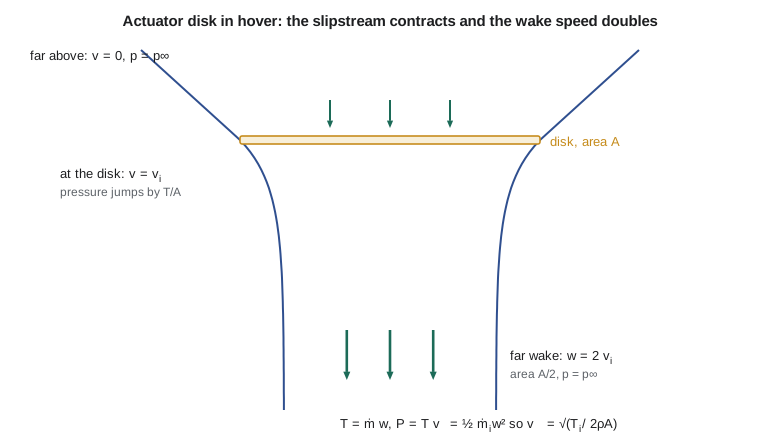
Apply the three conservation laws to the streamtube in hover. Mass is conserved, so the mass flow \(\dot m = \rho A v_i\) is the same at every section, where \(v_i\) is the induced velocity at the disk. Momentum: the air starts at rest far above and leaves at speed \(w\) in the far wake, so the thrust equals the rate of change of momentum, \(T = \dot m w\). Energy: the power delivered to the air equals the gain in kinetic energy per second, \(P = \tfrac{1}{2}\dot m w^{2}\). The power is also the thrust times the velocity through the disk, \(P = T v_i\). Equating the two expressions for power gives
Half of the final velocity is added above the disk, where the air is sucked in, and half below it. Because the far-wake velocity is twice the disk velocity, continuity says the wake area is half the disk area: the slipstream contracts to about 71 per cent of the rotor diameter. Substituting \(w = 2v_i\) and \(\dot m = \rho A v_i\) into \(T = \dot m w\) gives the hover results
These are the most important equations in rotorcraft engineering. They say that hover power rises as the 1.5 power of weight, so a 10 per cent heavier helicopter needs about 15 per cent more power, and as the inverse square root of density and disk area.
Figure of merit
No real rotor reaches the ideal power. The blades have profile drag, the inflow is not uniform, the wake swirls, and the tips lose lift as air spills around them. The figure of merit compares the ideal power with the actual power for the same thrust:
The last form uses the nondimensional thrust and power coefficients \(C_T = T/(\rho A (\Omega R)^2)\) and \(C_P = P/(\rho A (\Omega R)^3)\), where \(\Omega R\) is the tip speed. Good modern helicopter rotors reach a figure of merit of 0.75 to 0.80 at their design thrust; small drone propellers reach 0.5 to 0.65 because their low Reynolds number raises profile drag. Figure of merit is a fair way to compare rotors only at the same disk loading, because a lightly loaded rotor has a small ideal power, so its profile losses take a larger share and its figure of merit falls even if it uses less power in absolute terms.
# Momentum theory for the medevac light twin's main rotor: hover, climb, descent and figure of merit.
import math
g = 9.81
def isa_density(h):                       # ISA troposphere, h in m
    T = 288.15 - 0.0065 * h
    return 1.225 * (T / 288.15) ** 4.2559
m, R = 3000.0, 5.5                        # mass (kg) and rotor radius (m)
A = math.pi * R**2; T = m * g
rho = 1.225
vh = math.sqrt(T / (2 * rho * A))         # hover induced velocity
Pid = T * vh
print(f"Disk area {A:.2f} m^2, thrust {T/1000:.2f} kN, disk loading {T/A:.0f} N/m^2")
print(f"Hover induced velocity v_h = {vh:.2f} m/s, far-wake velocity 2 v_h = {2*vh:.2f} m/s")
print(f"Ideal hover power {Pid/1000:.1f} kW")
for FM in (0.60, 0.70, 0.75):
    print(f"  figure of merit {FM:.2f}: actual rotor power {Pid/FM/1000:.1f} kW")
print()
print("Climb and descent (thrust = weight, sea level). Positive V_c = climb.")
print("  V_c m/s   v_i/v_h   P_induced+climb kW   note")
for Vc in (10, 5, 2.5, 0, -2.5, -5, -10, -15, -25, -35):
    x = Vc / vh
    if x >= 0:
        vi = vh * (-x / 2 + math.sqrt(x * x / 4 + 1)); note = "momentum theory valid"
    elif x <= -2:
        vi = vh * (-x / 2 - math.sqrt(x * x / 4 - 1)); note = "windmill brake state"
    else:
        # momentum theory has no solution for -2 < Vc/vh < 0; use an empirical fit to flight-test data
        vi = vh * (1.0 - 1.125*x - 1.372*x**2 - 1.718*x**3 - 0.655*x**4); note = "vortex ring region (empirical)"
    P = T * (Vc + vi) / 1000
    print(f"  {Vc:6.1f}   {vi/vh:7.3f}   {P:15.1f}        {note}")
print()
f = lambda x: x + (1.0 - 1.125*x - 1.372*x**2 - 1.718*x**3 - 0.655*x**4)
lo, hi = -2.0, -1.0                        # bisection for the ideal autorotation point x + v_i/v_h = 0
for _ in range(60):
    mid = (lo + hi) / 2
    if f(mid) > 0: hi = mid
    else: lo = mid
print(f"Ideal autorotation (P = 0) needs V_c + v_i = 0: V_c/v_h = {mid:.3f}, a descent rate of {-mid*vh:.1f} m/s")
print()
print("Ideal hover power against density altitude (same thrust)")
for h in (0, 1000, 2000, 3000):
    r = isa_density(h)
print(f" {h:5d} m rho = {r:.3f} kg/m^3 v_h = {math.sqrt(T/(2*r*A)):.2f} m/s P_ideal = {T*math.sqrt(T/(2*r*A))/1000:.1f} kW")Disk area 95.03 m^2, thrust 29.43 kN, disk loading 310 N/m^2
Hover induced velocity v_h = 11.24 m/s, far-wake velocity 2 v_h = 22.49 m/s
Ideal hover power 330.9 kW
figure of merit 0.60: actual rotor power 551.5 kW
figure of merit 0.70: actual rotor power 472.7 kW
figure of merit 0.75: actual rotor power 441.2 kW
Climb and descent (thrust = weight, sea level). Positive V_c = climb.
V_c m/s v_i/v_h P_induced+climb kW note
10.0 0.650 509.3 momentum theory valid
5.0 0.802 412.5 momentum theory valid
2.5 0.895 369.7 momentum theory valid
0.0 1.000 330.9 momentum theory valid
-2.5 1.200 323.3 vortex ring region (empirical)
-5.0 1.354 301.0 vortex ring region (empirical)
-10.0 1.714 272.9 vortex ring region (empirical)
-15.0 2.063 241.3 vortex ring region (empirical)
-25.0 0.626 -528.7 windmill brake state
-35.0 0.364 -909.7 windmill brake state
Ideal autorotation (P = 0) needs V_c + v_i = 0: V_c/v_h = -1.777, a descent rate of 20.0 m/s
Ideal hover power against density altitude (same thrust)
0 m rho = 1.225 kg/m^3 v_h = 11.24 m/s P_ideal = 330.9 kW
1000 m rho = 1.112 kg/m^3 v_h = 11.80 m/s P_ideal = 347.3 kW
2000 m rho = 1.006 kg/m^3 v_h = 12.40 m/s P_ideal = 365.0 kW
3000 m rho = 0.909 kg/m^3 v_h = 13.05 m/s P_ideal = 384.1 kWThe first block confirms the numbers from lesson 1: an induced velocity of 11.2 m/s, a far wake at 22.5 m/s, and an ideal power of 331 kW. At a typical figure of merit of 0.70, the main rotor needs 473 kW. The tail rotor, gearbox and accessories add another 10 to 15 per cent, which lesson 6 includes.
Climb
In a vertical climb at speed \(V_c\), the air arrives at the disk at \(V_c\) relative to the rotor and leaves the far wake at \(V_c + w\). Repeating the analysis gives a quadratic for the induced velocity, whose physical root is
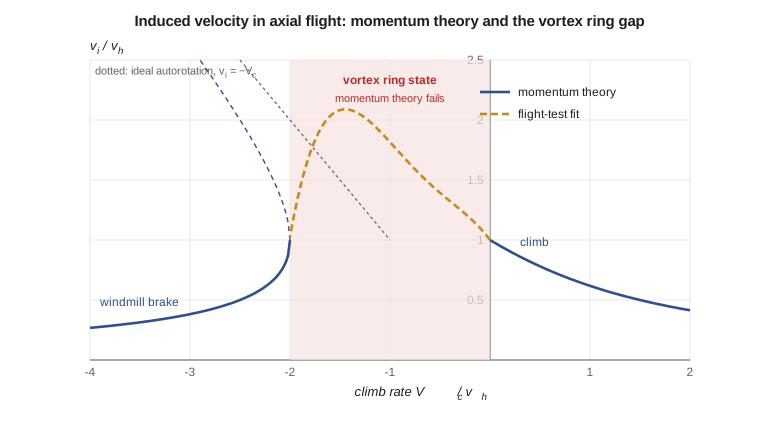
Climbing reduces the induced velocity, because the rotor is working on air that already has a downward speed relative to it. The power is \(P = T(V_c + v_i)\): the climb power \(TV_c\) plus a smaller induced power. In the code output, a 5 m/s climb needs 413 kW of ideal power instead of 331 kW, an increase of 82 kW, while the pure work against gravity is \(TV_c = 147\) kW. The rotor gets 65 kW back through the lower induced velocity. For small climb rates the extra power is about half of \(TV_c\), which is why helicopter climb performance is better than a simple energy argument suggests.
Descent and the vortex ring state
In descent the air approaches the rotor from below. When the descent is fast, faster than about twice the hover induced velocity, the rotor acts like a windmill: the flow through the disk is upward everywhere and the rotor extracts energy from the air. Momentum theory again has a valid solution, called the windmill brake state:
Between hover and a descent rate of \(2v_h\), the rotor pushes air down while the aircraft moves down through it. There is no single streamtube with a defined direction: air recirculates up around the tips and down through the disk again, forming a doughnut-shaped vortex ring around the rotor. Momentum theory has no solution in this region. The flow is unsteady, thrust fluctuates, vibration rises, and the induced velocity increases so much that adding power may not stop the descent. This is the vortex ring state, sometimes called settling with power. It has caused many accidents, particularly during steep, slow approaches to confined landing sites with a heavy load, which is exactly the kind of approach an air ambulance makes to a hospital pad.
Since theory fails, engineers use empirical curves fitted to wind tunnel and flight data. The code uses a commonly quoted quartic fit for \(-2 < V_c/v_h < 0\). It shows the induced velocity rising to about twice the hover value near a descent rate of \(1.3v_h\), about 15 m/s for the medevac twin. The danger zone is usually quoted as descent rates of about 0.3 to 1.5 times the hover induced velocity with low forward speed, which for this helicopter means roughly 3 to 17 m/s (600 to 3300 ft/min) at airspeeds below about 15 to 20 knots. Pilots avoid it by keeping some forward speed during steep approaches and by limiting descent rates when slow. The recovery taught for decades is to lower the collective and fly forward out of the disturbed air; another technique, the Vuichard recovery, uses tail rotor thrust and lateral cyclic to move sideways into clean air with less height loss.
Autorotation
If both engines fail, the rotor can still produce thrust using energy from the descending air. The ideal power is zero when \(V_c + v_i = 0\): the air passes through the disk with no net energy added or removed. The code finds this point on the empirical curve at a descent rate of about 1.78 times \(v_h\), 20 m/s for the medevac twin in a vertical descent. Real autorotation needs more, because the rotor must also overcome profile drag, and in practice pilots autorotate with forward speed, which reduces the descent rate substantially: lesson 6 shows that a helicopter descends most slowly at about its minimum-power speed. At the bottom, the pilot flares to trade forward speed for reduced descent rate and uses the rotor's stored kinetic energy to cushion the landing. Autorotation is why a helicopter with a failed engine is not doomed, and why rotor inertia matters in design.
Density altitude: the July problem
The answer to the chief pilot's question is in the last block of the code. Ideal hover power varies as \(\rho^{-1/2}\), so at a density altitude of 2000 m the same helicopter needs 10 per cent more ideal power than at sea level. Density altitude is the altitude in the standard atmosphere that has the same density as the actual air. On a hot day, the density is lower than standard for the elevation, so the density altitude is higher than the field elevation. At the same time the engines produce less power in thin, hot air, because their mass flow falls. Power required rises and power available falls, and the margin between them, which a pilot needs to lift off with a full load, shrinks from both sides. Lesson 6 turns this into hover ceiling charts.
Worked problem
Hover power at a hot hospital pad
A hospital pad near Winnipeg is at an elevation of 239 m. On a 30 °C afternoon the density altitude is about 1500 m, where \(\rho = 1.058\ \mathrm{kg/m^3}\). By how much does the medevac twin's ideal hover power exceed the sea-level standard value?
Show solution
- Ideal power scales as \(\rho^{-1/2}\).
- \(\sqrt{1.225/1.058} = 1.076\).
- \(331 \times 1.076 = 356\ \mathrm{kW}\).
Answer: About 7.6 per cent more, 356 kW of ideal power. With a figure of merit of 0.7 and transmission losses, the real increase is about 40 kW at the engines.
Worked problem
Figure of merit from test data
In a tethered hover test at sea level, Sam Littlechild holds the medevac twin at 2950 kg while the engine torque gauges show a main rotor shaft power of 455 kW. What is the figure of merit?
Show solution
- \(T = 2950 \times 9.81 = 28\,940\ \mathrm{N}\).
- \(P_{\text{ideal}} = T^{3/2}/\sqrt{2\rho A} = 28\,940^{1.5}/\sqrt{2 \times 1.225 \times 95.03} = 4.923 \times 10^{6} / 15.26 = 322.7\ \mathrm{kW}\).
- \(\text{FM} = 322.7/455 = 0.709\).
Answer: A figure of merit of 0.71, typical for a production helicopter rotor.
Worked problem
Vortex ring danger band
Using the rule of thumb that the vortex ring state lies between descent rates of 0.3 and 1.5 times the hover induced velocity, find the band for a 6 kg inspection quadcopter with four 0.381 m propellers.
Show solution
- Disk loading 129 N/m² (lesson 1), so \(v_h = \sqrt{129/2.45} = 7.3\ \mathrm{m/s}\).
- Band: \(0.3 \times 7.3 = 2.2\) to \(1.5 \times 7.3 = 11\ \mathrm{m/s}\).
Answer: About 2 to 11 m/s. Drones meet the vortex ring state too; flight controllers limit vertical descent rate, often to 3 to 5 m/s, for this reason.
Common mistakes
MistakeDoubling the rotor area halves hover power.
InsteadHover power scales with \(A^{-1/2}\), so doubling the area cuts ideal power by only 29 per cent.
MistakeA rotor in vertical climb needs extra power equal to \(TV_c\).
InsteadThe induced velocity falls in a climb, so for small climb rates the extra power is only about half of \(TV_c\).
MistakeAdding power always arrests a descent.
InsteadIn the vortex ring state extra power can feed the recirculation; the escape is to gain forward or sideways speed into clean air.
MistakeA higher figure of merit always means a rotor uses less power.
InsteadFigure of merit compares rotors only at the same disk loading; a larger, lightly loaded rotor can need less power yet have a lower figure of merit.
Summary and key terms
- Momentum theory models a rotor as an actuator disk adding momentum to one streamtube.
- In hover the far-wake velocity is twice the induced velocity, which is \(\sqrt{T/(2\rho A)}\), and the ideal power is \(T^{3/2}/\sqrt{2\rho A}\).
- The figure of merit measures how close a real rotor comes to this ideal, typically 0.7 to 0.8 for helicopters and lower for small propellers.
- Climbing reduces the induced velocity; fast descent puts the rotor in the windmill brake state.
- Between hover and a descent rate of about twice the induced velocity lies the vortex ring state, where momentum theory fails and thrust becomes erratic.
- Ideal autorotation occurs where the descent velocity cancels the induced velocity.
- Hover power varies as the inverse square root of density, so hot, high conditions raise power required as engine power falls.
- Actuator disk
- An idealized rotor that adds a uniform pressure jump to the flow passing through it.
- Induced velocity
- The velocity added to the air at the rotor disk by the rotor.
- Figure of merit
- Ideal hover power divided by actual hover power at the same thrust.
- Thrust coefficient
- \(C_T = T/(\rho A(\Omega R)^2)\).
- Windmill brake state
- Fast descent in which air flows up through the rotor and the rotor extracts energy.
- Vortex ring state
- Descent condition in which the rotor re-ingests its own wake, giving unsteady and reduced thrust.
- Autorotation
- Flight with the rotor driven by air flowing up through it, with no engine power.
- Density altitude
- The standard-atmosphere altitude with the same air density as the actual conditions.
Practice problems
Work each problem on paper first, then reveal the answer to check.
What is the slipstream diameter far below a hovering rotor of radius 5.5 m?
Show answer
The area halves, so the diameter is \(11/\sqrt{2} = 7.8\ \mathrm{m}\).
By how much does ideal hover power rise if gross weight rises by 10 per cent?
Show answer
\(1.1^{1.5} = 1.154\): about 15 per cent.
What is \(v_i/v_h\) in a climb at \(V_c = v_h\)?
Show answer
\(-0.5 + \sqrt{0.25 + 1} = 0.618\).
Why does momentum theory fail between hover and \(V_c = -2v_h\)?
Show answer
The flow through the disk and the far flow point in opposite directions, so no single streamtube with a defined direction exists.
A rotor has \(C_T = 0.006\) and \(C_P = 0.00048\). What is its figure of merit?
Show answer
\(0.006^{1.5}/\sqrt{2}/0.00048 = 0.685\).
Lesson quiz · 5 questions
Score 60% or more to complete this lesson.
Create a free account to save your progress, take quizzes and earn a certificate.