
AERO-450 · Lesson 8 of 12 · 26 min
Electric propulsion and batteries
Teresa Nakamura has spent two years on the hybrid-electric powertrain of the Petrel 19 commuter, and she warns the Vertical Flight group that batteries are the part of a drone that most often disappoints. The datasheet says one thing, the cold says another, and the aircraft's power demand says a third. the provincial wildfire service wants to fly at night in spring and autumn, when temperatures in the boreal forest east of Lake Winnipeg can be well below freezing, and a provincial power utility inspects lines in winter. Before the wildfire aircraft is sized, Teresa asks Arjun to build a battery model for the inspection quadcopter that includes discharge rate, internal resistance and temperature, and to test it against the bench.
The electric powertrain
An electric vertical-lift powertrain has four links: the battery, which stores energy chemically; the power electronics, which convert the battery's direct current into the alternating current each motor needs; the motor, which converts electrical power into shaft power; and the rotor, which converts shaft power into thrust. Each link has an efficiency. For a small drone, a typical chain is about 0.95 for the speed controller, 0.85 for the motor and 0.6 for the propeller's figure of merit in hover, so only about half the battery's power ends up as ideal hover power. For an eVTOL, larger motors and inverters reach 0.95 or better each, and well-designed rotors reach a figure of merit near 0.75.
The motors are almost all permanent-magnet synchronous machines, often called brushless DC motors in drone use. Their efficiency depends on load: copper losses grow with the square of current, iron losses with speed. Small drone motors are cooled by the propeller's own airflow, so they overheat if run at high power for long without forward speed or in hot weather. Larger aircraft motors use liquid or forced-air cooling and have high torque density, often in outer-rotor or axial-flux designs that drive the rotor directly without a gearbox. The supply voltage of eVTOL systems is typically several hundred to about 800 volts, which keeps currents and cable mass manageable but brings high-voltage safety and insulation requirements, including in thin air, where electrical discharges occur more easily.
Lithium-ion cells
Nearly all electric aircraft use lithium-ion batteries. During discharge, lithium ions leave the graphite anode, cross a liquid electrolyte through a porous separator, and enter the metal oxide cathode, while electrons flow through the external circuit. The cell voltage depends on the chemistry and the state of charge: about 4.2 V when full, 3.6 to 3.7 V nominal, and 2.5 to 3.0 V at the cut-off, below which the cell is damaged. Lithium-polymer drone batteries are lithium-ion cells in a flexible pouch with a high power rating. Cylindrical cells such as the 21700 size (21 mm diameter, 70 mm long) offer good energy density and are easy to assemble into packs with robust thermal management.
Cell specific energy has risen steadily, from about 150 Wh/kg in the 1990s to 250 to 300 Wh/kg for good cells now; some new chemistries claim more, generally with trade-offs in power, life or safety. The pack is always worse than the cell: the case, cooling, wiring, busbars, battery management system and fire protection add 20 to 40 per cent to the mass, so pack-level values of 150 to 220 Wh/kg are typical. For comparison, jet fuel holds about 12 000 Wh/kg. Even allowing for the turbine's much lower efficiency, battery aircraft carry five to ten times less useful energy per kilogram, which is why electric flight today is short-range flight.
| Quantity | Lithium-ion cell | Pack (typical) | Jet fuel (for comparison) |
|---|---|---|---|
| Specific energy | 250 to 300 Wh/kg | 150 to 220 Wh/kg | About 12 000 Wh/kg |
| Efficiency to shaft | 0.85 to 0.92 (motor and inverter) | Same | 0.25 to 0.35 (small turboshaft) |
| Useful energy per kg | About 230 Wh/kg | 130 to 190 Wh/kg | About 3500 Wh/kg |
| Mass change in flight | None | None | Aircraft gets lighter |
Capacity, C-rate and Peukert's law
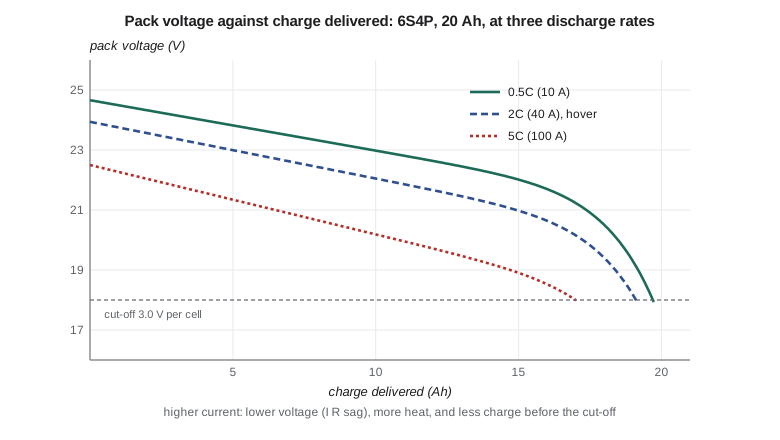
A cell's capacity is quoted in ampere-hours at a reference discharge rate. The C-rate expresses current as a multiple of capacity: a 5 Ah cell discharged at 5 A is at 1C and lasts about an hour, at 2C (10 A) about half an hour. Two effects make the delivered energy fall at high rates. First, internal resistance causes a voltage drop \(IR\) and dissipates \(I^{2}R\) as heat, so less of the stored energy reaches the load. Second, at high rates the electrochemistry cannot keep up: lithium concentration gradients build up in the electrodes, and the cell reaches its cut-off voltage with charge still inside it.
The second effect was first described for lead-acid batteries by Wilhelm Peukert in 1897. His empirical law relates run time to current:
where \(C\) is the rated capacity, \(H\) the rated discharge time and \(k\) the Peukert exponent. For lead-acid, \(k\) is about 1.1 to 1.3; for lithium-ion it is close to 1, typically 1.02 to 1.08, so the capacity loss with rate is much smaller. The law works poorly when temperature changes or when the cell heats up during discharge, so engineers use it as a first estimate and rely on measured discharge curves for design.
# Battery pack for the inspection quadcopter: C-rate, Peukert's law, voltage sag and cold-weather capacity.
import math
# 6S4P pack of 21700 lithium-ion cells (representative datasheet values)
cell_Ah, cell_V, cell_m, cell_R = 5.0, 3.6, 0.070, 0.016     # capacity, nominal V, mass (kg), DC resistance (ohm)
S, P = 6, 4
Ah, Vnom = cell_Ah * P, cell_V * S
R_pack = cell_R * S / P
m_pack = cell_m * S * P * 1.15                                 # 15 % for wiring, BMS, case
E = Ah * Vnom
print(f"Pack: {S}S{P}P, {Ah:.0f} Ah, {Vnom:.1f} V nominal, {E:.0f} Wh, {m_pack:.2f} kg, {E/m_pack:.0f} Wh/kg")
print(f"Pack resistance {R_pack*1000:.0f} mOhm")
print()
k = 1.05                                                       # Peukert exponent (lithium-ion is close to 1)
H = 1.0                                                        # rating time: capacity quoted at the 1C rate
print("Current   C-rate   Peukert runtime   effective Ah   terminal V   I^2R loss   power delivered")
for I in (10, 20, 38, 60, 109):
    t = H * (Ah / (I * H)) ** k                                # hours to empty at constant current I
    Veff = Vnom - I * R_pack
    print(f"  {I:4d} A   {I/Ah:5.2f}C     {t*60:6.1f} min      {I*t:6.2f}        {Veff:5.2f} V    {I**2*R_pack:6.1f} W    {I*Veff:7.0f} W")
print()
# constant-power hover: current rises as the voltage sags; iterate I = P / (Vnom - I R)
Phover = 853.0
I = Phover / Vnom
for _ in range(20): I = Phover / (Vnom - I * R_pack)
print(f"Hover at {Phover:.0f} W draws {I:.1f} A ({I/Ah:.2f}C) at {Vnom - I*R_pack:.2f} V")
print()
print("Cold soak (illustrative): usable capacity and resistance against cell temperature")
for T, cap, rmul in ((25, 1.00, 1.0), (10, 0.95, 1.4), (0, 0.88, 2.0), (-10, 0.78, 3.0), (-20, 0.65, 4.5)):
    Rt = R_pack * rmul
    disc = Vnom**2 - 4 * Rt * Phover
    if disc < 0:
        print(f"  {T:4d} C: pack cannot deliver {Phover:.0f} W"); continue
    It = (Vnom - math.sqrt(disc)) / (2 * Rt)
    Euse = E * cap * 0.80 * (Vnom - It * Rt) / Vnom
print(f" {T:4d} C: capacity x{cap:.2f}, R x{rmul:.1f}, current {It:5.1f} A, sag {It*Rt:4.2f} V, hover time {Euse/Phover*60:5.1f} min")Pack: 6S4P, 20 Ah, 21.6 V nominal, 432 Wh, 1.93 kg, 224 Wh/kg
Pack resistance 24 mOhm
Current C-rate Peukert runtime effective Ah terminal V I^2R loss power delivered
10 A 0.50C 124.2 min 20.71 21.36 V 2.4 W 214 W
20 A 1.00C 60.0 min 20.00 21.12 V 9.6 W 422 W
38 A 1.90C 30.6 min 19.37 20.69 V 34.7 W 786 W
60 A 3.00C 18.9 min 18.93 20.16 V 86.4 W 1210 W
109 A 5.45C 10.1 min 18.37 18.98 V 285.1 W 2069 W
Hover at 853 W draws 41.4 A (2.07C) at 20.61 V
Cold soak (illustrative): usable capacity and resistance against cell temperature
25 C: capacity x1.00, R x1.0, current 41.4 A, sag 0.99 V, hover time 23.2 min
10 C: capacity x0.95, R x1.4, current 42.3 A, sag 1.42 V, hover time 21.6 min
0 C: capacity x0.88, R x2.0, current 43.7 A, sag 2.10 V, hover time 19.3 min
-10 C: capacity x0.78, R x3.0, current 46.8 A, sag 3.37 V, hover time 16.0 min
-20 C: capacity x0.65, R x4.5, current 54.2 A, sag 5.85 V, hover time 11.5 minThe 6S4P pack, six cells in series and four in parallel, stores 432 Wh at 21.6 V and weighs about 1.9 kg, giving 224 Wh/kg at pack level. Its internal resistance is about 24 mΩ. At the hover current of 41 A, which is about 2C, the voltage sags by 1 V and the pack wastes 41 W as heat. At the short-term maximum of 109 A the sag is 2.6 V and the heat 285 W, which is why drone batteries get warm quickly in aggressive flight. The Peukert column shows that at 2C the pack delivers about 97 per cent of its rated charge and at 5.5C about 92 per cent.
Constant power, not constant current
A drone's motors demand power, not current. As the battery discharges and its voltage falls, the current rises to keep the power constant, which increases the \(IR\) drop, which lowers the voltage further. The code solves this loop for the 853 W hover demand: the current settles at 41.4 A rather than the 39.5 A a fixed voltage would give. Near the end of discharge the loop can run away, because the voltage curve is steep there; the current rises sharply, the cell heats and the voltage collapses. Flight controllers therefore land with a reserve, typically 20 to 30 per cent of capacity, and use voltage-under-load and current integration together to estimate the remaining energy.
Temperature
Cold is the battery's enemy. Lithium-ion internal resistance roughly doubles between 25 °C and 0 °C and may triple or more by −10 °C, and the available capacity falls as ion transport slows. The code's cold-soak table uses illustrative factors of that size. At 0 °C the hover time falls from 23 to 19 minutes, at −20 °C to under 12, and the voltage sag at −20 °C is almost 6 V, enough to trip a low-voltage warning on take-off. In practice the cell warms itself through its own \(I^{2}R\) losses during flight, which helps, but a battery that starts cold delivers poorly for the first few minutes. Operators keep batteries in heated cases and many drones have battery heaters. Charging a lithium-ion cell below about 0 °C is worse: lithium can plate onto the anode as metal, permanently reducing capacity and creating a safety hazard, so chargers and battery management systems prevent it.
Heat is a problem too. Above about 45 to 60 °C the cell ages rapidly, and at higher temperatures exothermic reactions in the electrodes and electrolyte can start a thermal runaway: the cell heats itself faster than it can lose heat, vents flammable gas, and may ignite and spread the failure to neighbouring cells. Aircraft batteries are designed to contain a single-cell runaway without propagation, a requirement drawn from the certification experience of lithium batteries in transport aircraft. For drones, good practice is to inspect for swelling, avoid crashes and punctures, store packs at partial charge, and charge them in fire-safe containers.
Life and state of health
A cell loses capacity and gains resistance with use. Typical drone packs reach 80 per cent of their original capacity after 200 to 500 cycles if discharged deeply and charged fast; eVTOL cells must manage over a thousand cycles at high power to be economic. Aging is fastest when the cell is held at high state of charge, high temperature or high C-rate. The battery management system estimates the state of charge and state of health of each cell group, balances the cells, and records the history. Operators track packs by serial number and retire them below a capacity threshold. Mission planning should always use end-of-life capacity, not the fresh value: an aircraft that just meets its endurance requirement when new will not meet it after a year.
Worked problem
C-rate of the hover current
The quadcopter's 20 Ah pack supplies 41.4 A in hover. What is the C-rate, and what current must each cell carry?
Show solution
- C-rate: \(41.4/20 = 2.07\mathrm{C}\).
- Four parallel strings share the current: \(41.4/4 = 10.4\ \mathrm{A}\) per cell.
Answer: About 2C, with 10.4 A per cell; a high-power 21700 cell rated for 25 A or more continuous is needed, with margin for the 109 A peaks (27 A per cell).
Worked problem
Peukert run time
Using \(k = 1.05\), how long does the 20 Ah pack last at a constant 60 A?
Show solution
- \(t = 1 \times (20/(60 \times 1))^{1.05} = (0.333)^{1.05}\ \mathrm{h}\).
- \(\ln 0.333 = -1.099\); \(\times 1.05 = -1.154\); \(e^{-1.154} = 0.315\ \mathrm{h}\).
Answer: 0.315 h, or 18.9 minutes, against 20 minutes at an ideal rate-independent capacity.
Worked problem
Winter mission planning
a provincial power utility plans an inspection at −10 °C. The battery is kept warm until launch, then cools during the flight; the engineers assume the average performance is midway between 0 °C and −10 °C. Using the code's table, what hover time should they plan, and with a 25 per cent landing reserve on top of the code's 80 per cent usable assumption, what working time remains?
Show solution
- Midway between 19.3 and 16.0 minutes: about 17.6 minutes of hover to the planned limit.
- Keep a further 25 per cent in reserve: \(0.75 \times 17.6 = 13.2\ \mathrm{min}\).
Answer: About 13 minutes of working time, little more than half the summer figure. Battery heaters and swaps are part of the winter plan.
Common mistakes
MistakeBattery energy is capacity times voltage, regardless of how fast it is used.
InsteadAt high rates internal resistance and polarization reduce the energy delivered, and cold makes it much worse.
MistakePeukert's law describes lithium-ion batteries as well as lead-acid.
InsteadLithium-ion has an exponent close to 1; temperature and resistance effects matter more and need measured curves.
MistakeA pack's specific energy equals that of its cells.
InsteadPackaging, cooling, wiring and electronics add 20 to 40 per cent mass.
MistakeCharging in the cold just takes longer.
InsteadCharging below about 0 °C can plate lithium metal, damaging the cell and creating a safety hazard.
Summary and key terms
- An electric powertrain chains battery, power electronics, motor and rotor efficiencies; small drones convert only about half the battery power into ideal hover power.
- Lithium-ion cells reach 250 to 300 Wh/kg and packs 150 to 220 Wh/kg, far below jet fuel even allowing for engine efficiency.
- C-rate expresses current relative to capacity.
- High rates lower delivered energy through internal resistance and polarization; Peukert's law with an exponent near 1.05 gives a first estimate.
- Drones draw constant power, so current rises as voltage falls, and flights end with a reserve.
- Cold raises resistance and cuts capacity; heat ages cells and can cause thermal runaway.
- Design must use end-of-life capacity.
- C-rate
- Discharge current as a multiple of rated capacity per hour.
- Internal resistance
- Resistance inside a cell that causes voltage sag and heating under load.
- Peukert exponent
- Empirical exponent describing loss of capacity at high discharge current.
- Cut-off voltage
- The minimum cell voltage below which discharge must stop.
- Specific energy
- Stored energy per unit mass, usually in Wh/kg.
- Thermal runaway
- Self-accelerating heating of a cell that can lead to venting and fire.
- Battery management system
- Electronics that monitor, balance and protect the cells and estimate state of charge and health.
- State of health
- A cell or pack capacity and resistance compared with its new condition.
Practice problems
Work each problem on paper first, then reveal the answer to check.
A 6S pack of cells at 3.6 V nominal has what nominal voltage?
Show answer
21.6 V.
What heat does a 24 mΩ pack dissipate at 60 A?
Show answer
\(60^{2} \times 0.024 = 86\ \mathrm{W}\).
Why do drones land with a reserve rather than at the cut-off voltage?
Show answer
Near empty the voltage drops steeply under constant power, current rises and the voltage can collapse.
Roughly how does internal resistance change from 25 °C to 0 °C?
Show answer
It about doubles.
Why should mission planning use end-of-life capacity?
Show answer
Capacity falls with cycles and age; a design sized to the fresh value will fail its requirement later.
Lesson quiz · 5 questions
Score 60% or more to complete this lesson.
Create a free account to save your progress, take quizzes and earn a certificate.