
AERO-340 · Lesson 6 of 12 · 27 min
Turboprops and turboshafts
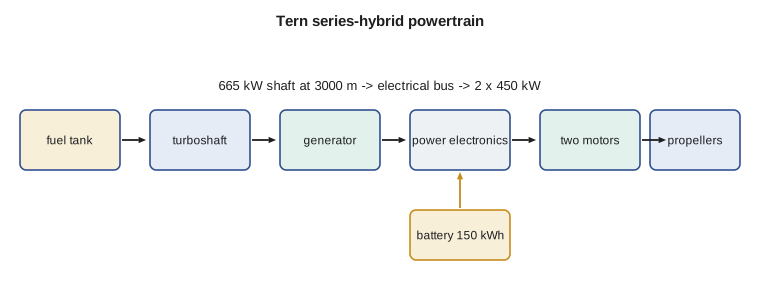
Take the turbofan idea to its limit and the fan becomes a propeller: an enormous, slow stream driven through a reduction gearbox. That is a turboprop, the engine of most regional airliners, many utility aircraft and the propeller-driven freighters that serve northern communities. Take away the propeller and deliver the power to a shaft for something else, a helicopter rotor, a pump, a generator, and it is a turboshaft. The Tern's range extender is a turboshaft of the second kind: it turns a generator that feeds the electrical bus, and the propellers are driven by electric motors. This lesson treats both, and Dr. Nakamura uses it to settle a question the Tern's customers keep asking: why not simply fit a conventional turboprop?
Turboprop architecture
A turboprop has a gas generator, a compressor, combustor and turbine on one spool, and usually a separate free power turbine that drives the propeller through a gearbox. The free turbine is not mechanically connected to the gas generator, so the propeller speed can be governed independently of the core speed, and the engine is easy to start because the starter turns only the gas generator. Many small turboprops use a reverse-flow layout, with the air entering at the back of the engine and flowing forward through the core, so that the hot section sits near the front and the exhaust leaves through stubs behind the propeller; this keeps the engine short and the hot parts easy to reach for inspection. Pratt & Whitney Canada, whose head office and main plant are in Longueuil, Quebec is one of the best known makers of this type of engine.
The reduction gearbox is essential. Small gas turbine shafts turn at 30 000 rpm or more, while propellers must turn at 1200 to 2000 rpm to keep their tips subsonic. Gearbox ratios of 10 to 20 are common, and the gearbox is one of the heaviest and most carefully inspected parts of the engine.
Shaft power, jet thrust and equivalent power
The power turbine extracts most but not all of the gas energy. The exhaust still leaves at some speed and gives a small residual thrust, typically 5 to 10 percent of the total at take-off. Turboprops are therefore rated in equivalent shaft power, which adds the residual thrust converted at an assumed propeller efficiency:
At zero speed the convention is to count about 1 kW for every 15 to 17 N of jet thrust instead, since the formula gives zero. Fuel use is quoted as power specific fuel consumption, kilograms of fuel per kilowatt-hour : around 0.27 to 0.35 kg/kWh for small engines and down to about 0.22 for the best large ones.
The cycle analysis follows the Brayton pattern. The gas generator turbine supplies exactly the compressor work; the pressure left at its exit expands through the power turbine to nearly ambient; and the power turbine's work is the engine's output. Because the propeller provides such a high propulsive efficiency, turboprops are the most efficient way to fly at speeds below about 600 km/h . Above that, propeller tip compressibility and the propeller's falling efficiency favour the turbofan.
The Tern's turboshaft
Arjun models the Tern's range extender at its rated point: 665 kW of shaft power at 3000 m and cruise speed. The cycle is modest by modern standards: a pressure ratio of 10 from a two-stage centrifugal compressor, a turbine inlet temperature of 1350 K, and component efficiencies typical of small engines, which suffer more from tip clearances and surface roughness than large ones.
# The Tern's range-extender turboshaft at 3000 m, and a comparison of two ways of turning its
# shaft power into thrust: through the generator, cables and motors (series hybrid) or through a
# gearbox straight to a propeller (conventional turboprop). Component efficiencies are illustrative.
cp, g, cpg, gg, LHV = 1005.0, 1.4, 1150.0, 1.33, 43.2e6
T0, p0, V0 = 268.65, 70.1e3, 105.0               # ISA 3000 m, cruise speed m/s
Tt0 = T0 + V0**2 / (2 * cp)
pr, Tt4, eta_c, eta_t, eta_pt, eta_b = 10.0, 1350.0, 0.78, 0.86, 0.87, 0.99
Tt3 = Tt0 * (1 + (pr ** ((g - 1) / g) - 1) / eta_c)
f = cp * (Tt4 - Tt3) / (eta_b * LHV - cpg * Tt4)          # fuel-air ratio
w_c = cp * (Tt3 - Tt0)
Tt45 = Tt4 - w_c / ((1 + f) * cpg)                         # gas generator turbine drives the compressor
pr_ggt = (1 - (Tt4 - Tt45) / (eta_t * Tt4)) ** (-gg / (gg - 1))
p45 = p0 * pr * 0.95 / pr_ggt                              # 5 percent burner pressure loss
pr_pt = p45 / (p0 * 1.05)                                   # free power turbine expands nearly to ambient
w_pt = eta_pt * cpg * Tt45 * (1 - pr_pt ** (-(gg - 1) / gg))
mdot = 665e3 / ((1 + f) * w_pt * 0.985)                     # 1.5 percent gearbox and accessory loss
fuel = f * mdot
print(f"core air {mdot:.2f} kg/s, fuel-air ratio {f:.4f}, fuel {fuel*3600:.0f} kg/h")
print(f"shaft power 665 kW, specific fuel consumption {fuel*3600/665:.3f} kg/kWh, thermal efficiency {665e3/(fuel*LHV):.3f}")
print(f"power turbine inlet {Tt45:.0f} K, pressure ratio across it {pr_pt:.2f}")
need = 571.0                                               # kW of propeller shaft power for cruise (Lesson 1)
chains = {'series hybrid (generator 0.96, electronics 0.97, cables 0.99, motor 0.95)': 0.96 * 0.97 * 0.99 * 0.95,
          'conventional turboprop (reduction gearbox 0.98)': 0.98}
print()
for name, eta in chains.items():
    P_eng = need / eta
    print(f"{name}\n   engine shaft power {P_eng:5.0f} kW -> fuel about {P_eng*fuel*3600/665:4.0f} kg/h (same specific consumption assumed)")
print(f"\na turboprop of the same core with 0.6 kN residual jet thrust at 105 m/s would have an equivalent power of {665 + 0.6*105/0.8:.0f} kW")core air 2.62 kg/s, fuel-air ratio 0.0183, fuel 172 kg/h shaft power 665 kW, specific fuel consumption 0.259 kg/kWh, thermal efficiency 0.322 power turbine inlet 1069 K, pressure ratio across it 2.97 series hybrid (generator 0.96, electronics 0.97, cables 0.99, motor 0.95) engine shaft power 652 kW -> fuel about 169 kg/h (same specific consumption assumed) conventional turboprop (reduction gearbox 0.98) engine shaft power 583 kW -> fuel about 151 kg/h (same specific consumption assumed) a turboprop of the same core with 0.6 kN residual jet thrust at 105 m/s would have an equivalent power of 744 kW
The program shows a core of 2.62 kg/s of air burning 172 kg/h of fuel for 665 kW, a specific fuel consumption of 0.259 kg/kWh and a thermal efficiency of 0.32. Then it compares the two powertrains at the 571 kW of propeller shaft power that Lesson 1 found for cruise. Through the series-hybrid chain, generator, power electronics, cables and motors with efficiencies of 0.96, 0.97, 0.99 and 0.95, the turboshaft must deliver 652 kW and burns about 169 kg/h. A conventional turboprop with a 98 percent gearbox would need only 583 kW and about 151 kg/h, roughly 11 percent less fuel at cruise.
That answers the customers' question honestly: on a long cruise leg, the hybrid loses about one-tenth to its conversion chain. The Tern's case rests elsewhere. The battery supplies take-off and climb power, so the turboshaft can be sized for cruise instead of for take-off, saving weight; on short regional hops, the 120 kWh of usable battery energy covers a large part of the trip; the motors give quiet, emission-free taxi and low-level flight near airports; and two electric motors fed from one bus make an engine failure on take-off easier to handle than with two separate turboprops. Whether the balance favours the hybrid depends on the route. Dr. Nakamura's group publishes both numbers, which is the right thing to do when customers will make decisions with them.
Turboshafts in helicopters
Helicopter engines are turboshafts that drive the main rotor through a large reduction gearbox. Their key design requirement is power-to-weight ratio and reliability, since a twin-engine helicopter must keep flying after one engine fails, and engines are often given short-duration emergency ratings for that case. Rotorcraft propulsion returns in the course on rotorcraft and unmanned aircraft.
| Engine type | Output | Typical fuel use | Best speed range |
|---|---|---|---|
| Piston | Shaft to propeller | 0.23 to 0.30 kg/kWh | up to about 350 km/h |
| Turboprop | Shaft to propeller plus small jet thrust | 0.22 to 0.35 kg/kWh | about 300 to 650 km/h |
| Turboshaft | Shaft to rotor, generator or pump | 0.22 to 0.35 kg/kWh | Helicopters, auxiliary and hybrid systems |
| Turbofan | Thrust | 14 to 19 mg/(N s) | about 600 km/h to high subsonic |
Worked problem
Equivalent power
A turboprop delivers 1100 kW to its propeller and 1.2 kN of residual jet thrust at 140 m/s. Taking a propeller efficiency of 0.80, find its equivalent power.
Show solution
- \(P_{eq} = 1100 + 1200 \times 140/0.80/1000 = 1100 + 210 = 1310\) kW.
Answer: 1310 kW equivalent ; the jet adds about 16 percent at this speed.
Worked problem
Specific fuel consumption
An engine burns 260 kg/h at 900 kW. Find its specific fuel consumption and thermal efficiency with a heating value of 43.2 MJ/kg.
Show solution
- \(\mathrm{SFC} = 260/900 = 0.289\) kg/kWh.
- \(\eta_{th} = 900 \times 3600/(260 \times 43\,200) = 3.24\times10^6/1.12\times10^7 = 0.288\).
Answer: 0.289 kg/kWh, a thermal efficiency of about 29 percent.
Worked problem
Gearbox ratio
A power turbine runs at 33 000 rpm and the propeller must turn at 1700 rpm. What gearbox ratio is needed, and what torque does the propeller shaft carry at 600 kW?
Show solution
- Ratio \(= 33\,000/1700 = 19.4\).
- Torque \(= P/\omega = 600\,000/(1700 \times 2\pi/60) = 600\,000/178 = 3370\) N m.
Answer: A ratio of about 19.4 and 3.4 kN m of torque, which is why the gearbox is heavy.
Propeller control and engine failure
A turboprop pilot controls power with a power lever that sets the gas generator's fuel flow and a condition or propeller lever that sets the propeller governor's speed. On the ground, the blades can be moved into beta range, a low or reverse pitch used for taxi and braking. If an engine fails in flight, its propeller must be feathered, turned edgewise to the airflow, otherwise the windmilling propeller creates large drag and a strong yawing moment that the rudder must balance. Most multi-engine turboprops have automatic feathering systems that act within seconds of a failure on take-off.
The Tern changes this picture. Its two motors are fed from one electrical bus, so a failure of the turboshaft does not stop either propeller: the battery takes over and both propellers keep turning, giving time to return or divert. A failure of one motor still leaves an asymmetric thrust case, and the Tern's motor controller feathers the failed propeller automatically, but the critical case for certification is different from a twin turboprop, and the engineering team has spent much effort agreeing the analysis with Transport Canada.
Worked problem
Feathering and drag
A windmilling propeller of 2.6 m diameter has a drag coefficient based on disc area of about 0.5; feathered, about 0.05. Find the drag in each case at 60 m/s and sea-level density.
Show solution
- Disc area \(= 5.31\) m²; dynamic pressure \(= 0.5 \times 1.225 \times 60^2 = 2205\) Pa.
- Windmilling: \(0.5 \times 2205 \times 5.31 = 5850\) N; feathered: 585 N.
Answer: Feathering cuts the drag by about 5 kN, the difference between climbing and descending after a failure on many twins (illustrative coefficients).
Turboprops remain the workhorses of short regional routes for a simple reason: on a 400 km trip, the time saved by a jet's higher speed is small, while the turboprop's fuel saving is large. Many airlines in Canada and the United States still fly regional turboprops on such routes, and new designs with hybrid or electric propulsion, like the Tern, are aimed at the same market.
Common mistakes
MistakeIgnoring the residual jet thrust of a turboprop.
InsteadIt adds several percent, which is why equivalent shaft power is quoted.
MistakeAssuming a series hybrid is automatically more efficient.
InsteadEach conversion loses a few percent; the benefits come from sizing, battery use and operations.
MistakeUsing constant specific fuel consumption at part power.
InsteadGas turbines are less efficient at low power; real SFC rises as power falls.
MistakeForgetting the gearbox in weight and maintenance estimates.
InsteadIt is one of the heaviest and most inspected parts of a turboprop.
Summary and key terms
- Turboprops drive propellers through a free power turbine and reduction gearbox, giving the highest propulsive efficiency at speeds below about 600 km/h; turboshafts deliver shaft power to rotors, pumps or generators.
- Output is quoted in shaft or equivalent shaft power and fuel use as power specific fuel consumption.
- The Tern's series hybrid loses about one-tenth to its conversion chain at cruise compared with a turboprop, and must earn that back through battery use, smaller turboshaft sizing and operational benefits.
- Turboprop
- A gas turbine driving a propeller through a reduction gearbox.
- Turboshaft
- A gas turbine delivering shaft power to a rotor, generator or other load.
- Free power turbine
- A turbine on its own shaft that drives the load, separate from the gas generator.
- Equivalent shaft power
- Shaft power plus residual jet thrust converted to power.
- Power specific fuel consumption
- Fuel mass flow per unit shaft power, usually in kg/kWh.
- Series hybrid
- A powertrain in which an engine drives only a generator and electric motors drive the propellers.
Practice problems
Work each problem on paper first, then reveal the answer to check.
What equivalent power does a turboprop with 800 kW shaft and 0.9 kN jet thrust at 120 m/s have, with propeller efficiency 0.8?
Show answer
About 935 kW.
In the program, raise the motor efficiency to 0.97. How much fuel does the hybrid need at cruise?
Show answer
About 165 kg/h.
Why do many small turboprops use reverse-flow layouts?
Show answer
A short engine with the hot section easy to reach for inspection.
Why is a free power turbine helpful for propeller control?
Show answer
The propeller speed can be governed independently of the gas generator speed.
Name one advantage the Tern's hybrid has over a turboprop on short routes.
Show answer
The battery can cover much of the trip, cutting fuel and noise near airports.
Above about what speed do turbofans become better than turboprops?
Show answer
About 600 to 650 km/h.
Lesson quiz · 5 questions
Score 60% or more to complete this lesson.
Create a free account to save your progress, take quizzes and earn a certificate.