
AERO-340 · Lesson 4 of 12 · 26 min
Ideal turbojet
The turbojet is the simplest jet engine and the one in which the cycle and the thrust are most directly linked: compressor, combustor, a turbine that drives the compressor and nothing else, and a nozzle that turns all the remaining energy into jet velocity. Pure turbojets have nearly vanished from civil aviation because, as Lesson 1 showed, their fast jets waste energy at subsonic speeds. They remain the best teaching model, because every later engine is a turbojet core with something added. Dr. Nakamura asks Arjun to build an ideal turbojet model at the Swift 900 cruise condition, Mach 0.80 at 12 500 m, as the base for the turbofan study in Lesson 5.
Stations and total quantities
Engine analysis uses standard station numbers: 0 for the free stream, 2 for the compressor face, 3 for the compressor exit, 4 for the turbine inlet, 5 for the turbine exit and 9 for the nozzle exit. It also uses total (stagnation) temperature and pressure, the values the flow would reach if brought to rest isentropically. Flight speed raises them before the air even reaches the engine:
At Mach 0.80 the ram temperature ratio is 1.128 and the ram pressure ratio 1.52. Ram compression is free work done by the aircraft's motion, and at supersonic speeds it becomes large enough that a ramjet needs no compressor at all.
The ideal turbojet equations
In the ideal engine every component is isentropic except the combustor, which adds heat at constant total pressure; the nozzle expands to ambient pressure; and the fuel mass is neglected in the momentum balance. Define the compressor temperature ratio \(\tau_c = \pi_c^{(\gamma-1)/\gamma}\) and the burner parameter \(\tau_\lambda = T_{t4}/T_0\). The turbine must supply exactly the compressor work, which fixes its temperature ratio:
The nozzle then turns what is left into velocity. In terms of the ambient speed of sound \(a_0\), the specific thrust and fuel-air ratio are
and the fuel consumption follows as \(S = f/(F/\dot m_0)\). The thermal efficiency of the ideal turbojet is that of the Brayton cycle with the total pressure ratio \(\pi_r\pi_c\):
These few lines are the core of parametric cycle analysis, the method engine companies use at the start of a design to map out which pressure ratios and temperatures are worth pursuing, before any component exists.
# Ideal turbojet: specific thrust and fuel consumption against compressor pressure ratio,
# at the Swift 900 cruise point (M 0.80, 12 500 m) and at sea-level static conditions.
import math
g, R, cp, hPR = 1.4, 287.05, 1005.0, 43.2e6
def turbojet(M0, T0, pi_c, Tt4):
    a0 = math.sqrt(g * R * T0); V0 = M0 * a0
    tau_r = 1 + (g - 1) / 2 * M0**2               # ram temperature ratio
    tau_l = Tt4 / T0                              # burner exit / ambient total-enthalpy ratio
    tau_c = pi_c ** ((g - 1) / g)
    tau_t = 1 - tau_r / tau_l * (tau_c - 1)       # turbine drives the compressor
    if tau_t <= 0: return None
    Ve_a0 = math.sqrt(2 / (g - 1) * tau_l / (tau_r * tau_c) * (tau_r * tau_c * tau_t - 1))
    Fs = a0 * (Ve_a0 - M0)                        # specific thrust, N per kg/s of air
    f = cp * T0 / hPR * (tau_l - tau_r * tau_c)   # fuel-air ratio
    S = f / Fs                                    # kg fuel per N per s
    eta_th = 1 - 1 / (tau_r * tau_c)
    eta_p = 2 * M0 / (Ve_a0 + M0) if M0 > 0 else 0
    return Fs, S * 1e6, f, eta_th, eta_p
T_cr = 216.65                                     # K, ISA above 11 km
print("cruise M 0.80 at 12 500 m, Tt4 = 1500 K")
print(" pi_c   F/mdot N s/kg   TSFC mg/(N s)    f      eta_th  eta_p")
for pc in (2, 5, 10, 15, 20, 30, 40):
    r = turbojet(0.80, T_cr, pc, 1500)
    if r: print(f"{pc:4d}      {r[0]:7.1f}        {r[1]:6.2f}      {r[2]:.4f}   {r[3]:.3f}   {r[4]:.3f}")
tau_c_opt = math.sqrt(1500 / T_cr) / (1 + 0.2 * 0.80**2)
print(f"pressure ratio for maximum specific thrust: {tau_c_opt ** 3.5:.1f}")
print("\nsea-level static, Tt4 = 1500 K")
for pc in (5, 10, 20):
    r = turbojet(0.0, 288.15, pc, 1500)
print(f"pi_c {pc:3d}: F/mdot {r[0]:6.1f} N s/kg, TSFC {r[1]:5.2f} mg/(N s)")cruise M 0.80 at 12 500 m, Tt4 = 1500 K pi_c F/mdot N s/kg TSFC mg/(N s) f eta_th eta_p 2 609.2 45.90 0.0280 0.273 0.437 5 783.9 33.03 0.0259 0.440 0.376 10 847.0 28.24 0.0239 0.541 0.358 15 863.0 26.15 0.0226 0.591 0.354 20 865.8 24.85 0.0215 0.623 0.353 30 857.7 23.17 0.0199 0.665 0.355 40 843.3 22.04 0.0186 0.691 0.359 pressure ratio for maximum specific thrust: 19.4 sea-level static, Tt4 = 1500 K pi_c 5: F/mdot 879.2 N s/kg, TSFC 27.61 mg/(N s) pi_c 10: F/mdot 956.1 N s/kg, TSFC 22.96 mg/(N s) pi_c 20: F/mdot 974.5 N s/kg, TSFC 19.62 mg/(N s)
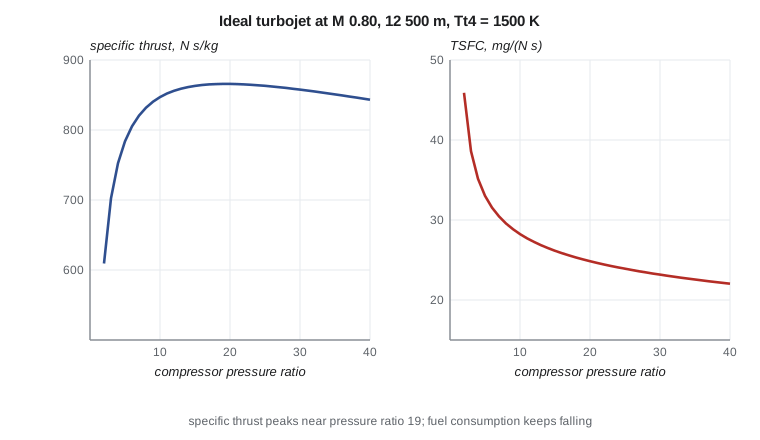
The program reproduces the Brayton trade from Lesson 3, now in thrust terms. Specific thrust peaks at 866 N s/kg near a compressor pressure ratio of 19, the value given by the closed-form optimum \(\tau_c = \sqrt{\tau_\lambda}/\tau_r\). TSFC keeps falling, from 46 mg/(N s) at a pressure ratio of 2 to 22 at 40, as the thermal efficiency rises from 0.27 to 0.69. The propulsive efficiency hardly changes, staying near 0.35, because the jet is always far faster than the aircraft: about 2.5 times the flight speed even at the best point. That flat, low propulsive efficiency is the turbojet's basic problem at subsonic speed.
At sea level and zero speed the specific thrust is higher, about 975 N s/kg at a pressure ratio of 20, because there is no ram drag and the ambient air is denser and warmer relative to the turbine temperature. Thrust lapse with speed and altitude is one of the main things an engine model must capture, because the aircraft's take-off, climb and cruise each need different thrusts and the engine must be sized for whichever is hardest.
Why specific thrust matters
Specific thrust sets engine size. The air mass flow needed for a thrust \(F\) is \(F\) divided by the specific thrust, and the inlet and fan diameters scale with the square root of the mass flow. A turbojet with 866 N s/kg needs only 4.2 kg/s of air for the Swift 900's 3.6 kN cruise thrust, a very small engine. But the same engine burns about 25 mg/(N s) at cruise, far more than the 16 to 17 of a modern turbofan. The turbofan of Lesson 5 trades away specific thrust, accepting a larger engine, to buy propulsive efficiency.
At supersonic speeds the trade reverses. The flight speed is high enough that a fast jet no longer wastes so much energy, and a small, high-specific-thrust engine has less drag. That is why supersonic aircraft use turbojets or low-bypass turbofans, often with afterburners that add a second combustor behind the turbine to raise jet temperature and thrust for short periods at a large cost in fuel.
| Parameter at Mach 0.80, 12 500 m | pi_c = 10 | pi_c = 20 | pi_c = 40 |
|---|---|---|---|
| Specific thrust, N s/kg | 847 | 866 | 843 |
| TSFC, mg/(N s) | 28.2 | 24.9 | 22.0 |
| Fuel-air ratio | 0.0239 | 0.0215 | 0.0186 |
| Thermal efficiency | 0.54 | 0.62 | 0.69 |
| Propulsive efficiency | 0.36 | 0.35 | 0.36 |
From ideal to real
The ideal model overstates performance. Real inlets lose a few percent of total pressure; compressors and turbines have efficiencies of 0.85 to 0.92; the combustor loses 3 to 5 percent of total pressure and does not burn every molecule of fuel; the turbine must also drive accessories and supply bleed air to the cabin and anti-ice systems; and the nozzle does not always expand to ambient. Non-ideal cycle analysis carries each of these losses through the same station-by-station calculation, with different gas properties on the hot side. The result is typically 20 to 30 percent less specific thrust and 10 to 20 percent more fuel consumption than the ideal model. The ideal model's value is that it shows the trends correctly and quickly.
Worked problem
Ram ratios
Find the ram temperature and pressure ratios at Mach 0.85.
Show solution
- \(\tau_r = 1 + 0.2 \times 0.85^2 = 1.1445\).
- \(\pi_r = 1.1445^{3.5} = 1.604\).
Answer: Total temperature is 14 percent above static and total pressure 60 percent above static.
Worked problem
Turbine temperature ratio
At Mach 0.80 and 216.65 K ambient, an ideal turbojet has \(\pi_c = 20\) and \(T_{t4} = 1500\) K. Find \(\tau_t\).
Show solution
- \(\tau_c = 20^{0.2857} = 2.354\), \(\tau_\lambda = 1500/216.65 = 6.924\), \(\tau_r = 1.128\).
- \(\tau_t = 1 - (1.128/6.924)(2.354 - 1) = 1 - 0.163 \times 1.354 = 0.779\).
Answer: The turbine takes about 22 percent of the turbine inlet total temperature to drive the compressor.
Worked problem
Mass flow for a thrust
An engine with specific thrust 850 N s/kg must give 3600 N. What air mass flow is needed, and what is the fuel flow if TSFC is 25 mg/(N s)?
Show solution
- \(\dot m_0 = 3600/850 = 4.24\) kg/s.
- \(\dot m_f = 25\times10^{-6} \times 3600 = 0.090\) kg/s = 324 kg/h.
Answer: About 4.2 kg/s of air and 324 kg/h of fuel, roughly half as much fuel again as a turbofan would need.
Thrust lapse and engine sizing
Specific thrust depends strongly on flight condition. As altitude rises, the air gets thinner, so the mass flow through a given engine falls roughly with the ambient pressure and the thrust falls with it, although the colder air partly compensates by raising \(\tau_\lambda\). As flight speed rises at fixed altitude, ram drag grows and specific thrust falls, but ram compression increases the mass flow per unit inlet area, so the installed thrust falls more slowly. Engine makers supply this information in performance decks, computer programs that return thrust and fuel flow for any altitude, Mach number, temperature and power setting.
An aircraft designer sizes the engine for its hardest requirement. For an airliner this is usually the top of climb, where the engine must still give enough thrust to climb at a minimum rate at cruise altitude; for a business jet it may be the take-off field length at a hot, high airport, or the one-engine-inoperative climb gradient. The Swift 900's sizing case, Arjun finds from the performance deck, is the top of climb at 12 500 m, where each engine must give 4.1 kN at Mach 0.78 to hold a residual climb rate of 1.5 m/s , 14 percent more than the cruise thrust.
Worked problem
Mass flow at altitude
An engine swallows 60 kg/s at sea level static. Roughly what mass flow does it take at 12 500 m and Mach 0.8, where the total pressure is 27.2 kPa and total temperature 244 K, if corrected flow stays the same?
Show solution
- Corrected flow \(\dot m\sqrt{\theta}/\delta\) is constant, so \(\dot m = 60 \times \delta/\sqrt{\theta}\).
- \(\delta = 27.2/101.3 = 0.268\); \(\theta = 244/288.15 = 0.847\); \(\dot m = 60 \times 0.268/0.920 = 17.5\) kg/s.
Answer: About 17.5 kg/s, under a third of the sea-level value, which is why cruise thrust is so much smaller than take-off thrust.
The ideal turbojet also shows why turbine inlet temperature is so valuable. At a fixed pressure ratio of 20, raising the turbine inlet temperature from 1500 to 1700 K raises the ideal specific thrust by more than 10 percent, so the same thrust comes from a smaller engine. The cost, again, is turbine cooling and life, the subject of Lesson 10.
Common mistakes
MistakeUsing static temperatures where total temperatures are needed.
InsteadComponent analysis works with total quantities; ram compression raises them before the inlet.
MistakeChoosing the pressure ratio for maximum specific thrust as if it also minimised fuel burn.
InsteadTSFC keeps falling well beyond the specific thrust peak.
MistakeExpecting a better cycle to fix a turbojet's subsonic fuel burn.
InsteadIts propulsive efficiency stays low because the jet is fast; that needs a bypass stream.
MistakeTreating ideal cycle numbers as engine data.
InsteadReal losses cut specific thrust by roughly a quarter and raise TSFC.
Summary and key terms
- The turbojet is a Brayton core whose turbine drives only the compressor, with the remaining energy accelerating the jet.
- Ideal cycle analysis uses ram, compressor and burner temperature ratios to give specific thrust, fuel-air ratio and TSFC.
- Specific thrust peaks at an intermediate pressure ratio while TSFC keeps improving, and propulsive efficiency stays low at subsonic speeds because the jet is fast.
- High specific thrust gives a small engine, which suits supersonic flight; subsonic aircraft trade it for a bypass stream.
- Total temperature
- The temperature reached if the flow is brought to rest adiabatically.
- Ram compression
- The rise in total pressure and temperature of the incoming air due to flight speed.
- Specific thrust
- Thrust per unit air mass flow, in N s/kg.
- Parametric cycle analysis
- Design-point analysis that maps engine performance against cycle choices before components exist.
- Burner parameter
- Turbine inlet total temperature divided by ambient temperature.
- Afterburner
- A combustor behind the turbine that raises jet temperature and thrust at high fuel cost.
Practice problems
Work each problem on paper first, then reveal the answer to check.
What compressor pressure ratio gives maximum specific thrust if tau_lambda = 7 and tau_r = 1.1?
Show answer
tau_c = sqrt(7)/1.1 = 2.405, so pi_c is about 21.6.
In the program, raise Tt4 to 1700 K. What happens to the peak specific thrust and its pressure ratio?
Show answer
Both rise, to about 975 N s/kg near a pressure ratio of 24.
Why is the ideal propulsive efficiency nearly constant with pressure ratio?
Show answer
The jet speed changes little near the peak and stays far above flight speed.
What is the thermal efficiency of an ideal turbojet with pi_c = 30 at Mach 0.8?
Show answer
About 0.67.
Why do supersonic aircraft prefer high specific thrust?
Show answer
A small engine has less drag and the fast jet wastes less at high flight speed.
What does an afterburner trade for extra thrust?
Show answer
Much higher fuel consumption.
Lesson quiz · 5 questions
Score 60% or more to complete this lesson.
Create a free account to save your progress, take quizzes and earn a certificate.