
AERO-340 · Lesson 1 of 12 · 26 min
Thrust and propulsive efficiency
Every aircraft engine does the same basic job. It takes in a stream of air, adds energy to it and throws it backwards faster than it arrived, and the reaction to that change of momentum pushes the aircraft forward. A propeller does it with a huge, gentle stream; a turbofan with a smaller and faster one; a rocket with no incoming air at all, only its own propellant thrown out at several kilometres per second. This course follows the propulsion group at Borealis Aerospace in Winnipeg through a year of engine work on two aircraft that earlier courses have already met: the Tern Block 2, the nine-seat commuter whose two electric motors are fed by a battery and a small turboshaft generator, and the Swift 900, the business jet study that cruises at Mach 0.80 and 12 500 m . The new head of propulsion and powerplant, Dr. Teresa Nakamura, has a habit of asking every new engineer the same first question: where does the thrust actually come from, and what does each newton cost?
Arjun Mehta, who finished his last co-op term in the high-speed group and has now joined the company as an engineer in training, is assigned to her group. His first job is to put numbers on that question for both aircraft, using nothing more than a control volume, the momentum equation and an energy balance. This lesson builds those tools.
Thrust from a control volume
Draw a control volume around the engine, with its boundary far enough away that the pressure on it is ambient except across the exhaust plane. Air enters at the flight speed \(V_0\) and leaves at the exhaust velocity \(V_e\). In steady flow the net force on the air equals the rate at which momentum leaves the volume minus the rate at which it enters. The engine pushes the air backwards; the air pushes the engine forwards with an equal force. For an air-breathing engine with air mass flow \(\dot m_0\) and fuel flow \(\dot m_f\), the installed thrust is
The first two terms are the momentum thrust: what leaves minus what came in. The term \(\dot m_0 V_0\) is often called ram drag, because it is the momentum the engine has to accept from the oncoming air before it can do anything with it. The last term is the pressure thrust, which appears only when the nozzle exit pressure \(p_e\) differs from the ambient pressure \(p_0\), as it does when a convergent nozzle is choked. Lesson 7 returns to it. Fuel adds only two or three percent to the mass flow of a jet engine, so for quick estimates \(F \approx \dot m (V_e - V_0)\).
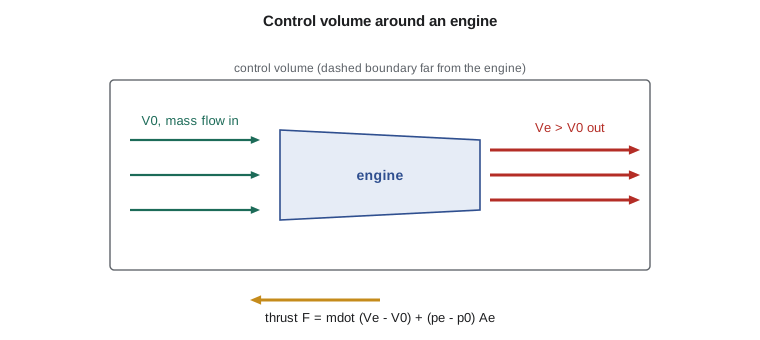
The same equation tells the whole story of engine design in one line. A given thrust can come from a small mass flow given a large velocity increase or from a large mass flow given a small one. Both produce the same force. They do not cost the same energy.
Three efficiencies
Energy enters the engine as fuel, at a rate \(\dot m_f\,h_{PR}\), where \(h_{PR}\) is the lower heating value of the fuel, about 43 MJ/kg for kerosene. Part of it becomes kinetic energy of the jet; the rest leaves as heat in the exhaust. Part of the jet's kinetic energy does useful work on the aircraft, the thrust power \(F V_0\); the rest is left behind in the air as a moving wake. Three efficiencies divide up the losses:
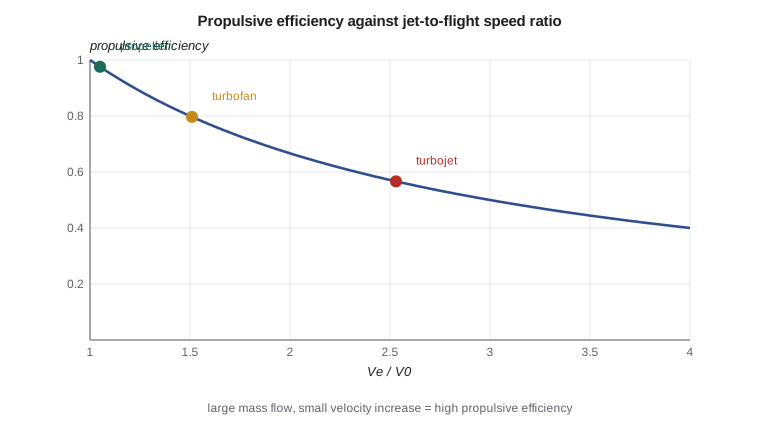
The thermal efficiency \(\eta_{th}\) measures how well the engine turns fuel energy into kinetic energy of the stream; it is a property of the thermodynamic cycle, the subject of Lessons 3 to 5. The propulsive efficiency \(\eta_p\) measures how much of that kinetic energy becomes useful work on the aircraft. With the simplified thrust, it reduces to a famous result, the Froude efficiency:
Propulsive efficiency depends only on the ratio of jet speed to flight speed. When the jet barely exceeds the flight speed, nearly all its kinetic energy goes into the aircraft and \(\eta_p\) approaches one; but then each kilogram of air gives very little thrust, so the engine must handle an enormous mass flow. When the jet is much faster than the aircraft, the engine can be small, but most of the energy is wasted in a fast wake that the aircraft leaves behind. Every propulsor is a compromise between these two extremes, and the history of aircraft engines is largely the story of moving to larger, slower streams as materials and engineering allowed.
Thrust specific fuel consumption
Engine buyers do not quote efficiencies; they quote fuel burn. For thrust engines the standard figure is the thrust specific fuel consumption, the fuel mass flow per unit of thrust:
In SI units it is usually given in milligrams per newton-second; in the United States and in most engine data sheets it appears in pounds of fuel per hour per pound of thrust. One mg/(N s) is about 0.0353 lb/(lbf h). A modern large turbofan at cruise is around 14 to 16 mg/(N s) ; a small business jet engine is a little higher; an older turbojet was around 25 to 30. The second form of the equation is worth remembering because it shows that TSFC rises with flight speed even when the engine is no less efficient: the same overall efficiency at higher speed means more fuel per newton, but each newton then does more work. Comparing engines at different speeds by TSFC alone is misleading.
For shaft engines, piston engines, turboprops and the Tern's generator turboshaft, the corresponding figure is the power specific fuel consumption, fuel per unit of shaft power, in kg/kWh . Lessons 2 and 6 use it.
# Thrust and efficiencies of three propulsors at their cruise points:
# the Tern's propellers, a turboprop of the same power and the Swift 900's turbofans.
def efficiencies(name, mdot, V0, Ve, fuel_kg_s, LHV=43.2e6):
    F = mdot * (Ve - V0)                          # net thrust, N (fuel mass and pressure thrust neglected)
    P_jet = 0.5 * mdot * (Ve**2 - V0**2)          # rate of kinetic energy added to the stream, W
    eta_p = F * V0 / P_jet                        # propulsive efficiency
    eta_p_froude = 2 / (1 + Ve / V0)              # the same result from the velocity ratio
    Q = fuel_kg_s * LHV if fuel_kg_s else None
    eta_th = P_jet / Q if Q else None
    eta_o = F * V0 / Q if Q else None
    print(f"{name}")
    print(f"  mass flow {mdot:7.1f} kg/s   V0 {V0:5.1f} m/s   Ve {Ve:5.1f} m/s   thrust {F/1000:6.2f} kN")
    print(f"  propulsive efficiency {eta_p:.3f} (Froude form {eta_p_froude:.3f})")
    if Q:
        print(f"  thermal efficiency {eta_th:.3f}   overall {eta_o:.3f}   TSFC {fuel_kg_s/F*1e6:5.1f} mg/(N s)")
    return F

V_tern = 105.0                                    # m/s, cruise at 3000 m
F1 = efficiencies("Tern propeller stream (one side)", 420.0, V_tern, 110.5, None)
F2 = efficiencies("Swift 900 turbofan (one engine, cruise M 0.80, 12 500 m)", 30.0, 236.0, 356.0, 0.060)
F3 = efficiencies("Same thrust from a small turbojet stream", 10.0, 236.0, 596.0, 0.110)
print(f"\nfor the same {F2/1000:.2f} kN, the turbojet stream burns {0.110/0.060:.2f} times as much fuel")
print(f"Tern total cruise thrust (two propellers) {2*F1/1000:.2f} kN, shaft power about {2*F1*V_tern/0.85/1000:.0f} kW at 85 percent propeller efficiency")Tern propeller stream (one side) mass flow 420.0 kg/s V0 105.0 m/s Ve 110.5 m/s thrust 2.31 kN propulsive efficiency 0.974 (Froude form 0.974) Swift 900 turbofan (one engine, cruise M 0.80, 12 500 m) mass flow 30.0 kg/s V0 236.0 m/s Ve 356.0 m/s thrust 3.60 kN propulsive efficiency 0.797 (Froude form 0.797) thermal efficiency 0.411 overall 0.328 TSFC 16.7 mg/(N s) Same thrust from a small turbojet stream mass flow 10.0 kg/s V0 236.0 m/s Ve 596.0 m/s thrust 3.60 kN propulsive efficiency 0.567 (Froude form 0.567) thermal efficiency 0.315 overall 0.179 TSFC 30.6 mg/(N s) for the same 3.60 kN, the turbojet stream burns 1.83 times as much fuel Tern total cruise thrust (two propellers) 4.62 kN, shaft power about 571 kW at 85 percent propeller efficiency
Arjun's program makes the trade concrete. One Tern propeller at cruise moves about 420 kg of air per second, adding only 5.5 m/s to it, for 2.31 kN of thrust at a propulsive efficiency of 0.97. The Swift 900's turbofan, treated here as a single averaged stream, moves 30 kg/s and adds 120 m/s for 3.60 kN at a propulsive efficiency of 0.80. The same thrust from a small turbojet stream of 10 kg/s needs a jet at 596 m/s, which drops the propulsive efficiency to 0.57. With the turbojet's somewhat lower thermal efficiency, it burns 1.83 times as much fuel for the same thrust. The overall efficiency of the turbofan stream, 0.33, is typical of a modern business jet engine at cruise.
The last line checks the Tern's power budget. Two propellers giving 4.62 kN in total at 105 m/s need about 571 kW of shaft power from the motors if the propellers are 85 percent efficient. The 97 percent in the momentum calculation is an ideal value that ignores blade drag and swirl; Lesson 2 adds those losses.
Installed thrust and the bookkeeping problem
An engine on a test stand gives its uninstalled thrust. On the aircraft, the inlet spills air around its lip, the nacelle has skin friction and the jet scrubs the wing or fuselage. Those effects are real forces, but whether they count as engine losses or airframe drag is a matter of accounting. The propulsion group and the aerodynamics group must agree on a thrust and drag bookkeeping system, so that every force is counted exactly once. Dr. Nakamura's rule for the Swift 900 is the common one: the engine maker guarantees uninstalled thrust and fuel flow at agreed conditions, the propulsion group calculates installation losses for the inlet and nozzle, and the aerodynamics group carries nacelle and pylon drag in its drag polar. For the Tern the bookkeeping is simpler but still needed, because the propeller slipstream washes over the wing and changes its lift and drag; that interaction belongs to neither group alone.
| Propulsor | Typical Ve/V0 at cruise | Propulsive efficiency | Typical use |
|---|---|---|---|
| Propeller | 1.03 to 1.10 | 0.85 to 0.90 after real losses | Commuters, trainers, regional turboprops |
| High-bypass turbofan | 1.3 to 1.6 | 0.75 to 0.85 | Airliners and business jets |
| Low-bypass turbofan | 1.8 to 2.5 | 0.55 to 0.70 | Older jets, supersonic designs |
| Turbojet | 2.5 and above | below 0.6 subsonic | Early jet airliners and supersonic research aircraft |
| Rocket | no incoming air | defined differently (Lesson 11) | Launch vehicles and spacecraft |
Worked problem
Thrust and propulsive efficiency
A turboprop's propeller moves 300 kg/s of air at a flight speed of 120 m/s and accelerates it to 128 m/s. Find the thrust and the ideal propulsive efficiency.
Show solution
- \(F = 300 \times (128 - 120) = 2400\) N.
- \(\eta_p = 2/(1 + 128/120) = 2/2.067 = 0.968\).
Answer: Thrust 2.4 kN , propulsive efficiency 0.97. Real propellers lose another 10 to 15 percent to blade profile drag and swirl.
Worked problem
TSFC and overall efficiency
An engine burns 0.065 kg/s of fuel with a lower heating value of 43.2 MJ/kg to give 3.8 kN at 230 m/s. Find the TSFC and the overall efficiency.
Show solution
- \(\mathrm{TSFC} = 0.065/3800 = 17.1\times10^{-6}\) kg/(N s) = 17.1 mg/(N s).
- \(\eta_o = F V_0/(\dot m_f h_{PR}) = 3800 \times 230/(0.065 \times 43.2\times10^6) = 874/2808 = 0.311\).
Answer: TSFC 17.1 mg/(N s) , overall efficiency 0.31.
Worked problem
Pressure thrust
A choked convergent nozzle has an exit area of 0.20 m² and an exit static pressure of 34 kPa where the ambient pressure is 18 kPa. How much pressure thrust does it give?
Show solution
- \((p_e - p_0)\,A_e = (34\,000 - 18\,000)\times 0.20 = 3200\) N.
Answer: 3.2 kN of pressure thrust. It is real thrust, but a nozzle that expanded the flow fully would usually give a little more in total, which is why large engines at cruise care about nozzle design.
Common mistakes
MistakeThinking thrust depends only on how fast the jet is.
InsteadThrust is mass flow times velocity change; a slow, large stream gives the same thrust as a fast, small one.
MistakeForgetting ram drag.
InsteadThe engine must accept the incoming air's momentum, so thrust falls with flight speed if the jet speed is fixed.
MistakeComparing TSFC of engines at different flight speeds.
InsteadTSFC rises with speed at constant efficiency; compare overall efficiency or mission fuel instead.
MistakeCounting nacelle drag in both the engine and the airframe.
InsteadAgree a thrust and drag bookkeeping system so each force is counted once.
Summary and key terms
- Thrust comes from the momentum change of the stream plus any pressure difference at the exit plane.
- Thermal efficiency measures conversion of fuel energy to jet kinetic energy; propulsive efficiency measures how much of that becomes useful work, and depends on the jet-to-flight speed ratio.
- Overall efficiency is their product and sets fuel burn, which engines quote as TSFC for thrust engines and power specific fuel consumption for shaft engines.
- Large, slow streams are efficient but need large propulsors; installation effects must be booked consistently between propulsion and aerodynamics.
- Momentum thrust
- The thrust from the change in momentum of the stream through the engine.
- Ram drag
- The incoming momentum the engine must accept, the term mass flow times flight speed.
- Pressure thrust
- Thrust from a difference between nozzle exit pressure and ambient pressure, times exit area.
- Propulsive efficiency
- Thrust power divided by the rate of kinetic energy added to the stream.
- Thermal efficiency
- Rate of kinetic energy added to the stream divided by the rate of fuel energy supplied.
- TSFC
- Thrust specific fuel consumption, fuel mass flow per unit thrust.
- Lower heating value
- Heat released by burning fuel when the water in the products stays as vapour.
Practice problems
Work each problem on paper first, then reveal the answer to check.
A stream of 50 kg/s is accelerated from 200 to 260 m/s. What is the thrust?
Show answer
3.0 kN.
What is the propulsive efficiency for that stream?
Show answer
2/(1 + 1.3) = 0.87.
Convert 16 mg/(N s) to lb/(lbf h).
Show answer
About 0.56 lb/(lbf h).
In the program, give the turbofan stream 40 kg/s and a jet speed that keeps the thrust at 3.6 kN. What happens to the propulsive efficiency?
Show answer
The jet speed falls to 326 m/s and the propulsive efficiency rises to about 0.84.
Why does a turbojet's TSFC rise with flight speed even at constant overall efficiency?
Show answer
TSFC equals flight speed divided by overall efficiency times heating value.
Which group should carry the drag of the engine nacelle?
Show answer
Whichever the bookkeeping system says, as long as it is counted exactly once; usually the aerodynamics group.
Lesson quiz · 5 questions
Score 60% or more to complete this lesson.
Create a free account to save your progress, take quizzes and earn a certificate.