
AERO-340 · Lesson 5 of 12 · 26 min
Turbofans and bypass ratio
The turbofan fixes the turbojet's weakness by adding a second, slower stream. A large fan at the front, driven by a low-pressure turbine behind the core, compresses a big mass of air that goes around the core instead of through it, the bypass stream. The core still runs a Brayton cycle, but most of its energy now goes into the fan instead of the core jet. The result is a much larger total mass flow with a lower average jet speed: higher propulsive efficiency and lower fuel burn. Every airliner and business jet flying today uses a turbofan. The Swift 900 study has two candidate engines, one with a bypass ratio of about 4 and one of about 6, and Dr. Kenji Watanabe, who leads the high-speed group, wants the propulsion group's view on which suits the aircraft better.
Bypass ratio and the two streams
The bypass ratio \(\alpha\) is the mass flow of the bypass stream divided by the mass flow through the core. Business jet engines run from about 3 to 6; large airliner engines from 8 to 12 or more; military fighter engines below 1. Each stream has its own nozzle in a separate-exhaust engine, the usual arrangement on larger engines, or the two are mixed before a common nozzle, common on business jets because mixing slightly improves efficiency and reduces noise.
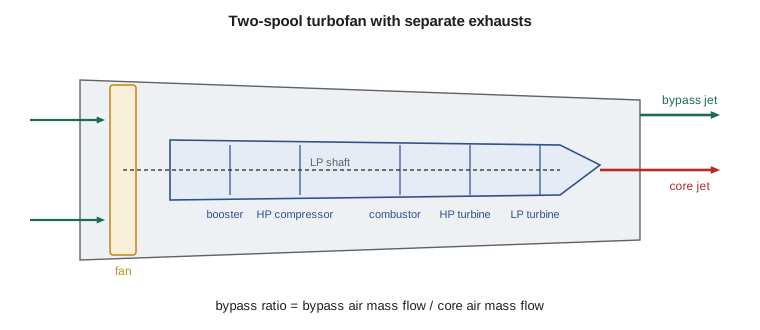
Most turbofans have two shafts, or spools. The high-pressure spool joins the high-pressure compressor and turbine, turning fast; the low-pressure spool joins the fan, any booster stages and the low-pressure turbine, turning slower because the fan's large diameter limits its tip speed. Some engines use three spools to let each compressor turn at its best speed, and geared turbofans put a reduction gearbox between the low-pressure turbine and the fan so that both can turn at their own best speeds. Gearing lets the fan grow larger and slower without making the low-pressure turbine slow and heavy.
The ideal turbofan
The ideal turbofan analysis extends the turbojet equations. The turbine must now drive both the compressor and the fan, so the turbine temperature ratio becomes
where \(\tau_f = \pi_f^{(\gamma-1)/\gamma}\) is the fan temperature ratio. The core jet velocity follows from the turbojet formula with this \(\tau_t\), and the bypass jet from the fan pressure ratio alone. The specific thrust per kilogram of total air is
The fuel-air ratio of the core is the same as in the turbojet. For each bypass ratio there is a best fan pressure ratio. Raising the fan pressure ratio puts more energy into the bypass stream and takes it from the core jet; the minimum fuel consumption comes, for an ideal engine, when the two jets have the same velocity. A fan pressure ratio that is too high leaves the core jet slow and the bypass jet fast; too low, the reverse.
# Ideal turbofan with separate exhausts (cycle analysis in the style of Mattingly):
# how bypass ratio changes specific thrust, fuel consumption and propulsive efficiency
# at the Swift 900 cruise point. Fan pressure ratio is chosen near its optimum for each bypass ratio.
import math
g, R, cp, hPR = 1.4, 287.05, 1005.0, 43.2e6
M0, T0 = 0.80, 216.65
a0 = math.sqrt(g * R * T0); V0 = M0 * a0
def turbofan(alpha, pi_c, pi_f, Tt4=1500):
    tr = 1 + (g - 1) / 2 * M0**2; tl = Tt4 / T0
    tc = pi_c ** ((g - 1) / g); tf = pi_f ** ((g - 1) / g)
    tt = 1 - tr / tl * (tc - 1 + alpha * (tf - 1))           # turbine drives compressor and fan
    if tt <= 0 or tr * tc * tt <= 1: return None
    v9 = math.sqrt(2 / (g - 1) * tl / (tr * tc) * (tr * tc * tt - 1))   # core exit, in units of a0
    v19 = math.sqrt(2 / (g - 1) * (tr * tf - 1))                        # bypass exit
    Fs = a0 / (1 + alpha) * (v9 - M0 + alpha * (v19 - M0))              # N per kg/s of total air
    f = cp * T0 / hPR * (tl - tr * tc)
    S = f / ((1 + alpha) * Fs)
    eta_p = 2 * M0 * ((v9 - M0) + alpha * (v19 - M0)) / ((v9**2 - M0**2) + alpha * (v19**2 - M0**2))
    return Fs, S * 1e6, eta_p, v9 * a0, v19 * a0
def best_fan(alpha, pi_c):
    best = None
    for k in range(101, 600):
        r = turbofan(alpha, pi_c, k / 100)
        if r and (best is None or r[1] < best[1][1]): best = (k / 100, r)
    return best
print("bypass  fan PR  F/mdot N s/kg  TSFC mg/(N s)  eta_p   core Ve m/s  bypass Ve m/s")
for alpha in (3, 4, 6, 8, 10, 12):
    pf, r = best_fan(alpha, 24)
    print(f"{alpha:5.0f}   {pf:5.2f}     {r[0]:7.1f}       {r[1]:6.2f}      {r[2]:.3f}     {r[3]:6.0f}       {r[4]:6.0f}")
mdot_needed = 3600 / best_fan(4, 24)[1][0]
print(f"\nan ideal engine of bypass ratio 4 needs {mdot_needed:.0f} kg/s of air for 3.60 kN at cruise;")
print("component losses roughly halve the real specific thrust, so the real engine swallows about twice that")bypass fan PR F/mdot N s/kg TSFC mg/(N s) eta_p core Ve m/s bypass Ve m/s
3 5.04 350.7 14.83 0.574 587 587
4 3.85 299.3 13.90 0.612 536 535
6 2.75 233.6 12.72 0.669 472 469
8 2.25 192.9 11.98 0.710 431 429
10 1.97 164.8 11.48 0.741 400 401
12 1.79 144.1 11.10 0.766 379 380
an ideal engine of bypass ratio 4 needs 12 kg/s of air for 3.60 kN at cruise;
component losses roughly halve the real specific thrust, so the real engine swallows about twice that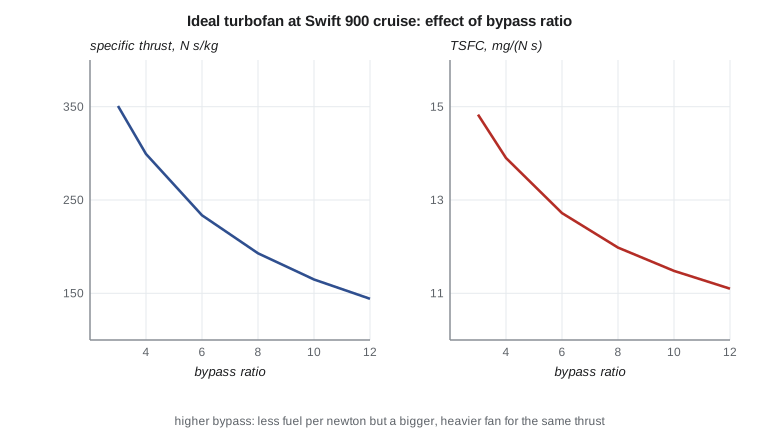
Arjun's program finds the best fan pressure ratio for each bypass ratio by searching for the lowest TSFC, and the result confirms the equal-velocity rule: at every bypass ratio the two jets leave within a few metres per second of each other. Going from a bypass ratio of 4 to 8 lowers the ideal TSFC from 13.9 to 12.0 mg/(N s), a 14 percent saving. The best fan pressure ratio falls from 3.85 to 2.25, and the specific thrust falls from 299 to 193 N s/kg, so the bypass-8 engine needs 55 percent more air for the same thrust. Propulsive efficiency rises from 0.61 to 0.71. Real engines are less efficient than these ideal numbers, but the trends are the same.
The last lines size the airflow. An ideal bypass-4 engine needs about 12 kg/s for the Swift 900's 3.6 kN cruise thrust; the real engine, with losses, needs about twice that, the 26 kg/s used in Lesson 7. Dr. Watanabe's question is therefore one of balance. The bypass-6 engine saves fuel, but its fan is about 20 percent larger in diameter, which means a heavier engine, more nacelle drag and harder installation under the Swift's low wing or on its rear fuselage. Arjun's recommendation, written up for the programme review, is that for a business jet flying about 400 hours a year the fuel saving of the larger engine does not repay its weight and drag on the typical 1500 km mission, and that bypass ratio 4 to 5 with a mixed exhaust is the better match.
Limits on bypass ratio
If higher bypass is always more efficient, why stop? Several things push back. The fan and nacelle get larger and heavier, and nacelle drag grows with the wetted area; at some bypass ratio the extra drag and weight cancel the propulsive gain. The low-pressure turbine must drive a larger fan at lower speed, so it needs more stages unless a gearbox is added. Ground clearance under a wing limits fan diameter, which is one reason recent airliners have raised landing gear or engines mounted forward and higher. And as the fan pressure ratio falls, the fan becomes harder to operate stably at low power, because the bypass nozzle is no longer choked and the fan's operating point moves toward stall; some designs consider variable-area nozzles or variable-pitch fans. Open rotors, unducted fans with effective bypass ratios of 30 or more, remove the nacelle altogether and are again being studied for future aircraft, with noise and installation as the main obstacles.
| Bypass ratio | Typical application | Typical cruise TSFC, mg/(N s) |
|---|---|---|
| below 1 | Fighter aircraft | above 22 |
| 3 to 6 | Business jets, older airliners | 17 to 19 |
| 8 to 12 | Current single-aisle and wide-body airliners | 14 to 16 |
| above 12 (geared or open rotor) | Engines now in service and in development | about 13 or below |
Worked problem
Bypass mass flow
An engine swallows 40 kg/s of air with a bypass ratio of 5. How much goes through the core?
Show solution
- Core flow \(= 40/(1 + 5) = 6.67\) kg/s; bypass flow \(= 33.3\) kg/s.
Answer: Only one-sixth of the air passes through the combustor.
Worked problem
Thrust from the two streams
At 236 m/s, a bypass stream of 21 kg/s leaves at 306 m/s and a core stream of 5 kg/s at 493 m/s. Ignoring pressure thrust, find the thrust from each and the total.
Show solution
- Bypass: \(21 \times (306 - 236) = 1470\) N.
- Core: \(5 \times (493 - 236) = 1285\) N.
- Total \(= 2755\) N.
Answer: 2.76 kN of momentum thrust. Lesson 7 adds the pressure thrust from the choked nozzles to reach the 3.6 kN cruise requirement.
Worked problem
Fuel saving
Moving from a TSFC of 18.0 to 16.8 mg/(N s) saves what fraction of fuel, and how much per 3-hour flight at an average thrust of 7.2 kN for two engines?
Show solution
- Saving \(= 1.2/18.0 = 6.7\) percent.
- Fuel at 18.0: \(18.0\times10^{-6} \times 7200 \times 10\,800 = 1400\) kg; at 16.8: 1306 kg.
Answer: About 94 kg of fuel per flight, or roughly 300 kg of CO₂, before counting any weight or drag penalty of the larger engine.
Mixed exhausts and noise
In a mixed-flow turbofan the hot core stream and cold bypass stream meet in a mixer, often a lobed ring that interleaves the two, before leaving through a common nozzle. Mixing a hot, fast stream with a cool, slower one at the same total pressure produces a little more thrust than expanding them separately, typically 1 to 3 percent, because it reduces the kinetic energy wasted in the faster jet. The mixer and the longer nacelle add weight, so mixing is most worthwhile on lower bypass engines like those of business jets, where the two streams differ most.
Bypass ratio also governs noise. Jet noise rises steeply with jet velocity, roughly with its eighth power, so the slower jets of high-bypass engines are much quieter. As jets have become quieter, fan noise, from the fan blades and their wakes striking the outlet guide vanes, has become the dominant source, controlled with acoustic liners in the nacelle, careful choice of blade and vane numbers and swept fan blades. Aircraft noise is certified against ICAO standards adopted by Transport Canada, and quieter engines also matter for community acceptance at airports like Winnipeg's.
Worked problem
Jet noise and velocity
Jet noise power varies roughly with the eighth power of jet velocity. By how many decibels does it fall if the jet velocity drops from 500 to 350 m/s?
Show solution
- Ratio \(= (350/500)^8 = 0.7^8 = 0.0576\).
- \(10\log_{10}(0.0576) = -12.4\) dB.
Answer: About 12 dB quieter, a large change that is one of the main reasons high-bypass engines replaced turbojets.
Common mistakes
MistakeAssuming the highest bypass ratio is always best.
InsteadFan weight, nacelle drag and installation limits set an optimum for each aircraft.
MistakeChoosing fan pressure ratio independently of bypass ratio.
InsteadEach bypass ratio has a best fan pressure ratio, near where the two jets have equal speed.
MistakeForgetting that low specific thrust needs more airflow.
InsteadThe engine and its nacelle must grow to swallow it.
MistakeThinking the core does most of the thrust in a high-bypass engine.
InsteadMost thrust comes from the fan stream; the core mainly drives the fan.
Summary and key terms
- A turbofan adds a bypass stream driven by a fan on the low-pressure spool, giving a large, slower total stream and higher propulsive efficiency.
- Bypass ratio is bypass flow over core flow.
- For each bypass ratio there is a best fan pressure ratio, near equal jet speeds.
- Higher bypass lowers fuel consumption and specific thrust together, so engines grow larger and heavier, and nacelle drag, weight, low-pressure turbine design and ground clearance set a practical limit.
- Geared fans and open rotors push the limit further.
- Bypass ratio
- Bypass stream mass flow divided by core mass flow.
- Spool
- A shaft joining a compressor and the turbine that drives it.
- Fan pressure ratio
- Total pressure ratio across the fan.
- Mixed exhaust
- An arrangement where bypass and core flows mix before a common nozzle.
- Geared turbofan
- A turbofan with a reduction gearbox between the low-pressure turbine and the fan.
- Open rotor
- An engine with large unducted fan blades and a very high effective bypass ratio.
Practice problems
Work each problem on paper first, then reveal the answer to check.
With a bypass ratio of 10 and 55 kg/s of total air, what is the core flow?
Show answer
5 kg/s.
In the program, fix the fan pressure ratio at 3.0 for every bypass ratio. What happens at bypass ratio 10?
Show answer
The program returns no result: the turbine cannot supply that much fan work, so there is no core jet left.
Why do the best jet speeds come out nearly equal?
Show answer
Moving energy between streams helps until their marginal propulsive efficiencies match, which happens at equal speeds.
Name two reasons airliner engines do not use bypass ratio 30.
Show answer
Nacelle drag and weight, and ground clearance; also low-pressure turbine size.
What does a gearbox in a geared turbofan allow?
Show answer
A slow, large fan with a fast, compact low-pressure turbine.
Why might a business jet choose a lower bypass ratio than an airliner?
Show answer
It flies fewer hours, so fuel savings are worth less against weight, drag and installation.
Lesson quiz · 5 questions
Score 60% or more to complete this lesson.
Create a free account to save your progress, take quizzes and earn a certificate.