
ACCT-460 · Lesson 3 of 12 · 28 min
Asset misappropriation I: cash, billing and payroll schemes
Asset misappropriation is the most common form of occupational fraud. Most cases are small, but some run for years and become large, and because they are committed by employees who understand the organization's systems, they can be hard to see in the normal flow of transactions. This lesson explains how the main cash, billing and payroll schemes work at a conceptual level, what traces they leave in the records, which red flags point to them, and which controls prevent or detect them. The aim is recognition and prevention. ACCT-240 introduced the expenditure and payroll cycles and their controls; here we look at those cycles through the eyes of an investigator.
A useful way to think about any asset misappropriation is to ask three questions. How does the asset leave the organization? How is the theft concealed in the records? And how does the perpetrator convert the asset to personal use? Every scheme answers these questions in some way, and each answer leaves evidence: a document that should not exist, a record that is missing, an entry that does not fit the pattern, or money that arrives somewhere it should not.
Cash schemes: skimming and larceny
Skimming is the theft of cash before it is recorded in the books. A cashier who sells goods and pockets the payment without ringing up the sale, or an employee who intercepts customer payments that arrive by mail and never posts them, is skimming. Because the receipt never enters the accounting system, there is no record to reconcile, which makes skimming hard to detect from the books alone. Its traces are indirect: sales or gross margins that are lower than expected for the inventory used, customer complaints that their payments were not credited, or lapping, in which one customer's payment is applied to another customer's account to hide an earlier theft, producing a chain of late postings.
Cash larceny is the theft of cash after it has been recorded. Taking money from a cash drawer or a deposit after the sale is rung up, or diverting part of a bank deposit, creates a difference between recorded cash and actual cash. Perpetrators conceal larceny by altering records, recording false voids or refunds, or delaying deposits so that shortages are covered by later receipts. Its traces include frequent voids and refunds by one employee, deposits that reach the bank later or in smaller amounts than the cash receipts journal shows, and reconciling items that persist.
Controls against cash schemes are among the oldest in accounting: segregating the handling of cash from the recording of cash, issuing prenumbered receipts, depositing receipts intact and daily, reconciling deposits to receipts records, using lockboxes or electronic payments so that employees never touch customer money, requiring supervisor approval for voids and refunds, and rotating duties. As fewer customers pay in cash and more payments are electronic, skimming has declined in many businesses, but it remains important in retail, hospitality and any setting where cash or cheques are still handled.
Billing schemes
Billing schemes cause the organization to pay invoices for goods or services it did not receive, or for more than it should. They are among the most costly forms of asset misappropriation because payments can be large and recurring, and because they pass through the normal payables process, which is designed to pay invoices efficiently. The main variants are shell company schemes, pass-through schemes, pay-and-return schemes and personal purchases on company accounts.
In a shell company scheme, an employee arranges for a fictitious or dormant company to be set up as a vendor, submits invoices in its name and causes them to be approved and paid. The company may exist legally, with a registered address and a bank account, but provides nothing of value. In a pass-through scheme, the shell company does buy real goods or services from a legitimate supplier, but resells them to the victim at a mark-up, with the employee pocketing the difference; the goods arrive, so receiving records look normal, but prices are inflated. In a pay-and-return scheme, an employee deliberately causes a legitimate vendor to be paid twice or overpaid, then asks for the refund to be sent in a way the employee can intercept. In personal purchase schemes, employees use company purchasing processes or cards to buy goods for themselves.
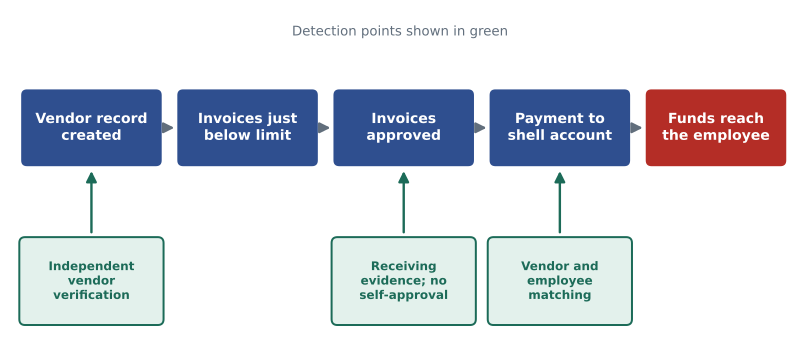
Shell company schemes depend on two weaknesses: the ability to add a vendor to the vendor master without independent verification, and the ability to get invoices approved without evidence that anything was received. When the same person can do both, the scheme becomes simple to run. Concealment usually relies on keeping each invoice below an approval threshold, describing the services vaguely (consulting, logistics, maintenance) so that no goods receipt is expected, and spreading payments over time so that no single period looks unusual.
The traces of a shell company scheme are many, which is why data analytics catch them well. The vendor may have a residential address, a mail drop or the same address, telephone number or bank account as an employee. It may have no website, no tax registration number or one that does not validate, and invoices with sequential numbers, suggesting that the victim is its only customer. Invoices may cluster just below approval limits, describe services without receiving evidence, and be approved by the same person each time. Payments may rise over time, and the vendor may have been created by an employee who also approves its invoices.
Payroll schemes
Payroll schemes cause the organization to pay wages it does not owe. In a ghost employee scheme, someone who does not work for the organization, either a fictitious person or a real person such as a relative or a former employee, is kept or placed on the payroll, and the pay goes to an account the perpetrator controls. Falsified wage schemes inflate the hours, rates or overtime of real employees. Commission schemes inflate the sales on which commissions are calculated, sometimes overlapping with revenue manipulation. Workers' compensation and benefit schemes involve false claims under employer-funded programs.
Ghost employees leave clear traces when payroll data are compared with other records. A ghost may be paid without appearing in the human resources master, or may appear there with missing information such as a social insurance or social security number that is invalid or shared, no tax withholding elections, no benefits enrolment and no vacation taken. The ghost's pay may go to a bank account that is also used by a real employee. Former employees who continue to be paid after their termination date are a related problem, sometimes fraud by a payroll clerk who redirects the pay, more often a control failure in which the termination was not processed on time.
Controls include separating the people who maintain the employee master file from those who process payroll and those who distribute pay, requiring human resources to authorize additions, changes and terminations, having managers review payroll registers for their departments, comparing payroll to the HR master and to time records each period, and periodically validating employees by asking them to confirm their identity and banking information directly.
Testing the vendor and employee masters at Saltmarsh Industrial Supply Ltd.
After the hotline report about logistics invoices, Corbett Lane Forensic LLP begins with the master files. Comparing the payroll register with the HR master, checking for shared bank accounts, and matching vendors to employee addresses and accounts are standard first steps, because they use data the company already has and produce short lists for follow-up. The program below runs the three tests on extracts that have been reduced to a few records for illustration; the real tests ran on the full files.
# Payroll and vendor master matching at Saltmarsh Industrial Supply (all data invented).
# Test 1: people paid through payroll who are not active in the HR master.
# Test 2: bank accounts shared by more than one payee.
# Test 3: vendors whose address or bank account matches an employee record.
import re

hr = {  # employee id: (name, status, home address, emergency contact address, bank account)
    "E104": ("A. Okafor",   "active",     "22 Birch Lane",      "22 Birch Lane",      "00311-8842"),
    "E117": ("R. Calloway", "active",     "9 Quarry Road",      "14 Ferncliff Drive", "00418-2290"),
    "E121": ("M. Tremblay", "active",     "301 Water St",     "301 Water St",     "00205-7713"),
    "E133": ("J. Singh",    "active",     "57 Elm Court",       "12 Oak Avenue",      "00311-9054"),
    "E140": ("P. Novak",    "terminated", "8 Wharf Road",       "8 Wharf Road",       "00522-1468"),
    "E152": ("L. Chen",     "active",     "4 Spruce Terrace",   "4 Spruce Terrace",   "00611-3305"),
}
payroll = [  # pay period, employee id, name, bank account, net pay
    ("2026-01-15", "E104", "A. Okafor",   "00311-8842", 2210.40),
    ("2026-01-15", "E117", "R. Calloway", "00418-2290", 2645.10),
    ("2026-01-15", "E121", "M. Tremblay", "00205-7713", 1980.75),
    ("2026-01-15", "E133", "J. Singh",    "00311-9054", 2390.00),
    ("2026-01-15", "E140", "P. Novak",    "00522-1468", 1875.20),
    ("2026-01-15", "E152", "L. Chen",     "00611-3305", 2120.60),
    ("2026-01-31", "E140", "P. Novak",    "00522-1468", 1875.20),
]
vendors = {  # vendor id: (name, address, bank account, date created)
    "V2031": ("Atlantic Fastener Co.",          "1200 Commerce Way",   "00907-5521", "2014-06-02"),
    "V2177": ("Coastal Safety Wholesale",       "88 Industrial Park",  "00733-1180", "2017-09-15"),
    "V2410": ("Northfield Logistics Services",  "14 Ferncliff Drive",  "00812-6634", "2022-03-28"),
    "V2415": ("Bayline Packaging",              "5 Dockside Road",     "00641-2207", "2022-05-11"),
}

def norm(addr):
    a = addr.lower()
    a = re.sub(r"\b(street|st)\b", "st", a)
    a = re.sub(r"\b(drive|dr)\b", "dr", a)
    a = re.sub(r"\b(road|rd)\b", "rd", a)
    return re.sub(r"[^a-z0-9 ]", "", a).strip()

print("Test 1: paid but not active in the HR master")
for period, eid, name, acct, net in payroll:
    status = hr.get(eid, (None, "missing"))[1]
    if status != "active":
        print(f"  {period}  {eid} {name:<12} status={status:<10} net pay {net:>9,.2f}")

print("\nTest 2: bank accounts used by more than one payee")
owners = {}
for eid, rec in hr.items():
    owners.setdefault(rec[4], set()).add(eid)
for vid, rec in vendors.items():
    owners.setdefault(rec[2], set()).add(vid)
shared = {a: o for a, o in owners.items() if len(o) > 1}
print("  none found" if not shared else "\n".join(f"  {a}: {sorted(o)}" for a, o in shared.items()))

print("\nTest 3: vendor address or bank account matching an employee record")
for vid, (vname, vaddr, vacct, created) in vendors.items():
    for eid, (ename, status, home, contact, eacct) in hr.items():
        hits = []
        if norm(vaddr) == norm(home): hits.append("home address")
        if norm(vaddr) == norm(contact): hits.append("emergency contact address")
        if vacct == eacct: hits.append("bank account")
        if hits:
print(f" {vid} {vname} (created {created}) matches {eid} {ename}: {', '.join(hits)}")Test 1: paid but not active in the HR master 2026-01-15 E140 P. Novak status=terminated net pay 1,875.20 2026-01-31 E140 P. Novak status=terminated net pay 1,875.20 Test 2: bank accounts used by more than one payee none found Test 3: vendor address or bank account matching an employee record V2410 Northfield Logistics Services (created 2022-03-28) matches E117 R. Calloway: emergency contact address
Two results need follow-up, and they turn out to be very different. The first test finds that a terminated employee, P. Novak, was paid for two pay periods after his termination. Inquiry shows that the termination form reached payroll three weeks late and that the net pay of 3,750.40 dollars was deposited to Novak's own account; he repaid it when asked. That is a control failure, not fraud, and the report will say so. The second test is more troubling. Northfield Logistics Services, created as a vendor on March 28, 2022, uses the same address as the emergency contact that R. Calloway, the accounts payable supervisor, recorded in his HR file. A shared address is not proof of anything; families share addresses, and so do people who rent office space. But together with the hotline report, it justifies examining every Northfield invoice, who created the vendor and who approved its payments.
The match on the emergency contact address illustrates why investigators look beyond the obvious fields. Many organizations compare vendor addresses with employees' home addresses, so a perpetrator may use a relative's address instead. HR records often hold that address in emergency contact or beneficiary fields that payables staff never see.
cheque tampering and electronic payment fraud
In cheque tampering schemes, an employee forges or alters a cheque drawn on the organization's account, or intercepts a legitimate cheque and changes the payee or amount. Concealment typically involves altering the cheque register or the bank reconciliation. As payments have moved to electronic funds transfers, similar schemes appear in a new form: an employee changes the bank account details of a legitimate vendor or employee in the master file to an account the employee controls, so that the next payment goes astray. Controls include positive pay arrangements with the bank, which match each presented cheque against the organization's list of issued cheques, independent review of bank reconciliations, and a strict process for changing vendor and employee banking details, with confirmation through a known telephone number and a report of all changes reviewed by someone outside payables. Lesson 4 returns to payment redirection by outside fraudsters.
Worked problem
Red flags or innocent explanation?
Analytics show that a vendor named Keel and Rudder Consulting has received 18 payments in two years for "advisory services", all approved by the same purchasing manager, with no contract on file. Its telephone number matches the work telephone of another employee. List the red flags, possible innocent explanations, and the next steps.
Show solution
- Red flags: vague services, no contract, a single approver and a telephone number shared with an employee.
- Possible innocent explanations: a former employee now consulting, a data entry error in the telephone field, or a legitimate supplier recommended by the employee.
- Next steps: obtain the vendor setup documents and who entered them; check corporate registry records for the company's directors; ask the business unit what services were received and look for deliverables; compare the employee's and vendor's other attributes.
- Do not interview the purchasing manager or the employee until the documentary work is done, to avoid alerting anyone and losing evidence.
Answer: The pattern justifies investigation, but each flag has possible innocent explanations, so the next step is quiet documentary work before any interviews.
Common mistakes
MistakeConcluding that a vendor-employee address match proves fraud.
InsteadTreat matches as leads, look for innocent explanations and gather documents before drawing conclusions.
MistakeComparing vendor addresses only with employees' home addresses.
InsteadInclude emergency contact, beneficiary and previous addresses, telephone numbers and bank accounts.
MistakeCalling every unpaid termination a ghost employee fraud.
InsteadDetermine where the pay went and why; late terminations are often control failures.
MistakeRelying on approval limits as a strong control.
InsteadAnalyse invoices clustered just below limits and split purchases, and require receiving evidence for services.
MistakeLetting payables staff change vendor bank details on request by email.
InsteadVerify changes through a known telephone number and have someone outside payables review a report of changes.
MistakeStarting with interviews.
InsteadStart with data and documents so that interviews can test explanations against evidence.
Summary and key terms
- Asset misappropriation schemes can be analysed by how the asset leaves, how the theft is concealed and how it is converted.
- Skimming steals cash before it is recorded; cash larceny steals it after recording.
- Billing schemes include shell companies, pass-throughs, pay-and-return and personal purchases.
- Shell company schemes exploit weak vendor setup and approval of invoices without receiving evidence.
- Ghost employee and falsified wage schemes show up when payroll is compared with HR and time records.
- Master file matching on addresses, telephone numbers and bank accounts produces focused leads.
- At Saltmarsh, a late termination was a control failure; Northfield's address match with an employee's emergency contact justified a full review.
- Skimming
- Theft of cash before it is recorded in the accounting records.
- Cash larceny
- Theft of cash after it has been recorded.
- Lapping
- Applying one customer's payment to another customer's account to conceal an earlier theft.
- Shell company
- A company with no real operations, used to submit invoices or receive payments.
- Pass-through scheme
- A billing scheme in which a shell company buys real goods and resells them to the victim at an inflated price.
- Ghost employee
- A person on the payroll who does not work for the organization.
- Vendor master file
- The file of approved vendors and their addresses, tax numbers and banking details.
- Positive pay
- A bank service that matches presented payments against the organization's list of issued payments.
Practice problems
Work each problem on paper first, then reveal the answer to check.
Give the three questions that help analyse any asset misappropriation.
Show answer
How does the asset leave, how is the theft concealed, and how is the asset converted to personal use?
Why is skimming harder to detect from the books than cash larceny?
Show answer
The receipt is never recorded, so there is no recorded amount to reconcile.
Explain the difference between a shell company scheme and a pass-through scheme.
Show answer
A shell company provides nothing; a pass-through buys real goods and resells them at an inflated price, so receiving records look normal.
List four red flags of a shell company vendor.
Show answer
Residential or mail-drop address, address or bank account shared with an employee, no tax number or website, sequential invoice numbers, invoices just below approval limits, vague services.
In the matching program, why was P. Novak's pay a control failure rather than fraud?
Show answer
The termination form reached payroll late, the pay went to Novak's own account and he repaid it.
Add a vendor with bank account 00311-9054 and rerun the program. What does Test 2 show?
Show answer
The account is shared by employee E133 and the new vendor.
Why does the program normalize addresses before comparing them?
Show answer
So that 'Drive' and 'Dr' or different punctuation do not hide a match.
Name three controls against ghost employees.
Show answer
Separate maintenance of the employee master from payroll processing, HR authorization of changes, manager review of payroll registers, periodic validation of employees.
What control helps prevent payment redirection through changed bank details?
Show answer
Verifying change requests through a known telephone number and independent review of a report of all changes.
Why should documentary work come before interviews?
Show answer
To avoid alerting suspects, protect evidence and allow interviews to test explanations against facts.
Lesson quiz · 5 questions
Score 60% or more to complete this lesson.
Create a free account to save your progress, take quizzes and earn a certificate.