
ACCT-460 · Lesson 1 of 12 · 29 min
The forensic accountant and professional standards
Auditing and Assurance I and II taught you how an auditor obtains reasonable assurance that financial statements are free of material misstatement, whether caused by error or by fraud. Forensic accounting starts from a different question. Instead of asking whether the statements as a whole are fairly presented, the forensic accountant asks what happened, how much it cost, who was involved and how it can be proved to the standard a court, a regulator, an insurer or a board requires. The work is narrower in scope and deeper in detail, and its end product is not an opinion on financial statements but findings that will be read, challenged and relied on by people deciding a dispute.
This course follows one invented organization from the first warning signs to the final report. Saltmarsh Industrial Supply Ltd. is a privately held distributor of industrial and marine safety equipment based in Halifax, Nova Scotia. It has 186 employees, bank lenders with financial covenants, and revenue of 84.6 million dollars in fiscal 2024 and a reported 91.2 million in fiscal 2025. Its external auditor is Pryce Dunmore LLP. In February 2026, two reports arrive on the company's ethics hotline: one says that fourth-quarter shipments to two distributors were made with side letters allowing returns, and another says that invoices from a logistics vendor never seem to match a delivery. The audit committee, through outside counsel, retains Corbett Lane Forensic LLP to investigate. Every person, company and figure in the case is invented, and the schemes are described only in enough detail to recognize, prevent and investigate them.
What forensic accountants do
The word forensic comes from the Latin forum, the public place where disputes were argued. Forensic accounting is accounting performed with the expectation that it may be examined in an adversarial setting. The field has two broad branches. Investigative accounting looks into suspected fraud, corruption, theft, money laundering and other misconduct, usually for a board, an audit committee, a regulator, an insurer or law enforcement. Litigation support, sometimes called dispute advisory, quantifies losses and analyses financial evidence in civil disputes such as breach of contract, shareholder disputes, insurance claims, matrimonial cases, personal injury and business valuation disagreements. Many engagements combine the two: an investigation that finds a theft is often followed by a claim to recover the loss, and the investigator's work becomes evidence.
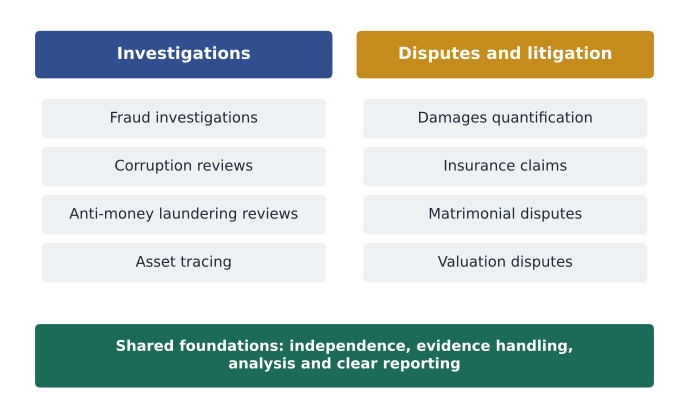
Forensic accountants work in many settings. Large and mid-sized public accounting firms have forensic practices that serve corporate clients and law firms. Boutique firms specialize in investigations or in damages. Police services, securities regulators, tax authorities and financial intelligence units employ forensic accountants to build cases. Banks and insurers employ them to investigate customer and claims fraud. Large companies have internal investigations groups, often within internal audit or the legal department. Whatever the setting, the same habits matter: scepticism without presumption of guilt, careful handling of evidence, analysis that can be reproduced by someone else, and writing that a judge or juror can follow.
How forensic work differs from an audit
An audit and a forensic engagement use many of the same tools, such as inspection of documents, confirmation, analytics and inquiry, but they differ in purpose, scope, evidence and output. The auditor works to a materiality threshold and samples; the forensic accountant often examines every transaction in a defined population, because a single 4,600 dollars invoice may be the one that proves intent. The auditor issues a standardized opinion; the forensic accountant writes a report tailored to the questions asked, and may have to defend it under oath. The auditor's relationship with the client is continuing; the forensic engagement is usually a single matter with a defined end. The auditor's responsibility for fraud, discussed in ACCT-331, is to obtain reasonable assurance that the statements are free of material misstatement due to fraud; the forensic accountant's responsibility is to answer specific questions about specific conduct.
| Feature | Financial statement audit | Forensic engagement |
|---|---|---|
| Question | Are the statements fairly presented? | What happened, how, by whom, and what did it cost? |
| Scope | Whole statements, using materiality | Defined allegations, accounts, people or periods |
| Testing | Risk-based, often sampling | Often the entire population for the matter |
| Standard of proof in mind | Reasonable assurance | The standard of the forum: balance of probabilities or beyond reasonable doubt |
| Output | Standardized auditor's report | Report of findings, expert report or testimony |
| Audience | Shareholders and other users | Board, counsel, court, regulator, insurer |
| Relationship | Recurring | Usually a single matter |
One consequence of these differences is that forensic accountants must be careful with words. An auditor may write that an account appears misstated. A forensic accountant who writes that an employee committed fraud has reached a legal conclusion that belongs to a court. Professional standards in both countries direct the practitioner to report facts, analyses and opinions within their expertise, and to avoid opinions on guilt, intent or credibility, which are for the trier of fact. In the Saltmarsh Industrial Supply Ltd. matter, Corbett Lane Forensic LLP may conclude that 106 invoices from one vendor have no supporting evidence of services received and that the vendor is linked to an employee; whether that employee committed fraud is for a court, and the report must be worded accordingly.
Professional standards and credentials
In Canada, the reference for investigative and forensic accounting work is CPA Canada's Standard Practices for Investigative and Forensic Accounting Engagements, developed in the mid-2000s by the profession's forensic accounting alliance and still the benchmark that practitioners and courts look to. The Standard Practices address acceptance and independence, planning and scoping, the gathering and preservation of evidence, analysis, reporting and the role of the expert witness. They sit alongside the code of professional conduct of the provincial CPA body to which the practitioner belongs, which governs integrity, objectivity, due care, confidentiality and conflicts of interest. Education in the field grew out of a diploma program that the University of Toronto replaced in September 2017 with a Master of Forensic Accounting, still offered in 2026. Practitioners may also hold the Certified Fraud Examiner (CFE) credential of the Association of Certified Fraud Examiners (ACFE), and some hold US credentials when they work across the border.
Several principles run through the standards in both countries. The first is independence and objectivity: a forensic accountant who is, or appears to be, an advocate for the client loses the value of the work. The second is competence: matters often require knowledge of an industry, a computer system or a body of law, and the practitioner must either have it or bring in people who do. The third is evidence: findings must rest on evidence that has been gathered lawfully, preserved, and documented so that another qualified person could reach the same results. The fourth is reporting: reports should state the scope and limitations of the work, the information relied on, the methods used and the findings, without overstatement.
Accepting the engagement
Before accepting a forensic engagement, the firm considers whether it has the competence and resources, whether the scope is clear, who the client is, and above all whether any relationship creates a conflict of interest. Conflicts matter more in forensic work than in most advisory work, because the opposing party will look for any reason to argue that the forensic accountant is biased. A firm that has done consulting for the person under investigation, audited the company's financial statements, or acts for the insurer that will pay the claim may be unable to act, or may need informed consent from the parties and safeguards such as separate teams.
For the Saltmarsh Industrial Supply Ltd. matter, Corbett Lane Forensic LLP runs a conflict check against the names of all parties known so far: the company, the vendor, the employees named in the hotline reports, the external auditor and the company's insurer, Harrow Mutual Insurance, which issued a commercial crime policy that may respond to an employee theft. The program below normalizes names so that abbreviations and legal suffixes do not hide a match.
# Conflict check before accepting a forensic engagement (all names invented).
# Parties to the matter are compared with the firm's client and relationship lists
# after normalizing names, so "Saltmarsh Industrial Supply" matches "SALTMARSH IND. SUPPLY".
import re

SUFFIXES = r"\b(ltd|inc|llc|llp|corp|corporation|limited|co|company)\b"
ABBREV = {"ind": "industrial", "intl": "international", "svcs": "services", "mfg": "manufacturing"}

def norm(name):
    n = name.lower().replace("&", " and ")
    n = re.sub(r"[^a-z0-9 ]", " ", n)
    n = re.sub(SUFFIXES, " ", n)
    words = [ABBREV.get(w, w) for w in n.split()]
    return " ".join(words)

parties = ["Saltmarsh Industrial Supply", "Northfield Logistics Services",
           "R. Calloway", "Pryce Dunmore LLP", "Harrow Mutual Insurance"]
firm_relationships = [
    ("SALTMARSH IND. SUPPLY", "tax compliance client, 2019-2021"),
    ("Pryce Dunmore", "referral source; no engagement"),
    ("Harrow Mutual Insurance Co.", "current client: fidelity claims reviews"),
    ("Bayline Packaging Inc.", "audit client of an affiliated office"),
]
print(f"{'Party':<34}{'Match in firm records':<30}Relationship")
for p in parties:
    hits = [(r, d) for r, d in firm_relationships if norm(r) == norm(p)]
    if not hits:
        print(f"{p:<34}{'-':<30}none")
    for r, d in hits:
print(f"{p:<34}{r:<30}{d}")Party Match in firm records Relationship Saltmarsh Industrial Supply SALTMARSH IND. SUPPLY tax compliance client, 2019-2021 Northfield Logistics Services - none R. Calloway - none Pryce Dunmore LLP Pryce Dunmore referral source; no engagement Harrow Mutual Insurance Harrow Mutual Insurance Co. current client: fidelity claims reviews
The check finds three relationships. The tax compliance work for the company ended in 2021 and was not related to the matters under investigation; the firm documents it and considers it a manageable relationship that it discloses to counsel. The referral relationship with the auditor involves no engagement. The current engagement with Harrow Mutual is more serious: if Corbett Lane Forensic LLP quantifies the employee theft for the company, the insurer will review that quantification to decide what to pay, and the firm cannot appear on both sides. The firm discloses the relationship to counsel and to the insurer, confirms that its claims review team for Harrow Mutual will have no access to this matter, and records that it will not act for the insurer on any claim arising from it. If either party had objected, the firm would have declined.
Who is the client, and why counsel retains the forensic accountant
In investigations, the client is often not the person who seems to be paying. The audit committee of Saltmarsh Industrial Supply Ltd. engages outside counsel, and counsel retains Corbett Lane Forensic LLP. This structure is common for two reasons. First, it places the investigation under the direction of the board's independent members rather than management, some of whom may be implicated. Second, it helps protect the work under legal privilege.
In Canada, communications between a lawyer and client for the purpose of legal advice are protected by solicitor-client privilege, and documents created for the dominant purpose of existing or reasonably contemplated litigation are protected by litigation privilege. A forensic accountant retained by counsel to help counsel give legal advice, or in contemplation of litigation, can fall within these protections, but privilege is fragile: it can be waived by sharing reports with third parties such as auditors or regulators, and courts look at the substance of the relationship, not the wording of the engagement letter.
The engagement letter therefore names counsel as the client, describes the forensic accountant's role as assisting counsel, sets out the scope (here: the vendor billing allegation, the revenue cutoff allegation and any related matters found in the course of the work), records the independence and conflict assessment, and addresses confidentiality, data protection and the handling of evidence. It also sets the fee basis. Fees must never depend on the findings or on the outcome of litigation, because a contingent fee would destroy the appearance of objectivity; the standards in both countries prohibit it for expert work.
Worked problem
Can the firm act?
A forensic firm is asked by a company's lawyer to investigate the company's controller for suspected theft. The firm's advisory group designed the company's purchasing controls two years ago. Should the firm accept?
Show solution
- Identify the relationship: the firm designed controls that the alleged theft may have circumvented.
- Consider the threat: the firm may be reluctant to find that its own design was weak, a self-review threat, and the opposing party will argue bias.
- Consider safeguards: a separate team, disclosure to counsel and the company, and a scope that excludes evaluating the design work.
- Decide: if the control design is likely to be central to the matter, decline; if peripheral, accept with disclosure and safeguards, and document the reasoning.
Answer: It depends on how central the earlier work is. If the investigation must assess why the controls failed, the self-review threat is too great and the firm should decline.
Ethics in practice
Forensic accountants face ethical pressures that auditors rarely meet. Clients and counsel may want findings that support their case. The subject of an investigation may be a colleague's friend. Evidence may be obtained in ways that breach privacy law or the subject's rights. The professional codes in both countries require integrity and objectivity, and they forbid misrepresenting facts or allowing others to override professional judgment. In practice this means telling counsel early when the evidence does not support the theory, refusing to omit inconvenient facts from a report, documenting the work so it can be reproduced, and keeping personal views about the people involved out of the analysis.
Confidentiality is equally important. Investigations involve personal information about employees, customers and third parties, and reputations can be damaged by rumour. Investigators share information only on a need-to-know basis, store data securely, and follow the privacy law that applies to the organization, which differs between the two countries and is discussed in lesson 9. Saltmarsh Industrial Supply Ltd.'s investigation team will include two forensic accountants, a data analyst and a digital forensics specialist; the hotline reporters' identities are known only to the audit committee chair and outside counsel.
Common mistakes
MistakeCalling the subject a fraudster in the report.
InsteadReport facts and analysis; whether conduct amounts to fraud is for the court or tribunal.
MistakeAccepting the engagement because the conflict seems small.
InsteadRun a full conflict check on all parties, disclose relationships and decline if safeguards cannot address the threat.
MistakeLetting management, who may be implicated, direct the investigation.
InsteadHave the board or audit committee, usually through counsel, direct the work.
MistakeAgreeing to a fee tied to the amount recovered.
InsteadUse time-based or fixed fees; contingent fees impair objectivity and are prohibited for expert work.
MistakeAssuming privilege protects everything the forensic accountant writes.
InsteadStructure the retainer carefully, limit sharing and get counsel's advice before giving reports to auditors or regulators.
MistakeTreating the work as a larger audit.
InsteadDefine questions, examine the whole relevant population and write for a forum that will test every step.
Summary and key terms
- Forensic accounting answers specific questions about specific conduct and is prepared for scrutiny in an adversarial setting.
- The field has two branches, investigations and litigation support, and many matters combine them.
- Canadian practitioners follow CPA Canada's Standard Practices for Investigative and Forensic Accounting Engagements and their provincial code of conduct.
- Independence, competence, sound evidence and careful reporting run through the standards in both countries.
- Conflict checks cover every known party, and some relationships require the firm to decline.
- Engagements are often directed by the audit committee through outside counsel, partly to protect privilege.
- Fees must not depend on findings or outcomes, and opinions on guilt or intent are left to the trier of fact.
- Litigation privilege
- Protection for documents created for the dominant purpose of existing or reasonably contemplated litigation.
- Standard Practices for Investigative and Forensic Accounting Engagements
- The Canadian profession's standards for forensic accounting work.
- Forensic accounting
- Accounting work prepared with the expectation that it may be examined in an adversarial or legal setting.
- Investigative accounting
- Forensic work that examines suspected fraud, corruption, theft or other misconduct.
- Litigation support
- Forensic work that quantifies losses and analyses financial evidence in disputes.
- Trier of fact
- The judge, jury, arbitrator or tribunal that decides the facts of a matter.
- Conflict check
- A search of the firm's relationships for any connection to the parties in a proposed engagement.
- Certified Fraud Examiner (CFE)
- A credential of the Association of Certified Fraud Examiners for anti-fraud professionals.
- Contingent fee
- A fee that depends on the result of the work or the outcome of a matter; prohibited for expert work.
Practice problems
Work each problem on paper first, then reveal the answer to check.
Give three differences between an audit and a forensic engagement.
Show answer
Purpose (opinion on statements versus answers to specific questions), testing (sampling to materiality versus entire populations), and output (standardized report versus tailored findings or expert testimony). Others: audience, relationship, standard of proof.
Why do forensic accountants avoid stating that someone committed fraud?
Show answer
Fraud requires a legal finding about intent, which belongs to the trier of fact; standards limit practitioners to facts and opinions within their expertise.
In the conflict check program, why are names normalized before comparison?
Show answer
So that differences in case, punctuation, abbreviations and legal suffixes do not hide a match, such as SALTMARSH IND. SUPPLY and Saltmarsh Industrial Supply.
Add 'Bayline Packaging Inc.' to the list of parties and rerun the check. What does the firm find?
Show answer
A match with its affiliated office's audit client, which the firm must evaluate as a possible conflict.
Why does the relationship with Harrow Mutual Insurance matter?
Show answer
The insurer will review the firm's loss quantification to decide a claim; acting for both sides would impair objectivity, so the firm discloses it and separates the teams.
Why is the investigation directed by the audit committee through counsel?
Show answer
Independence from management who may be implicated, and protection of the work under legal privilege.
Name two ways privilege can be lost.
Show answer
Sharing the report with third parties such as auditors or regulators, or the forensic accountant doing ordinary business work rather than assisting counsel.
What should a forensic accountant do if the evidence does not support counsel's theory?
Show answer
Tell counsel promptly and report the findings as they are, without omission or overstatement.
Why are contingent fees prohibited for expert work?
Show answer
A fee that depends on the outcome gives the expert a financial interest in the result and destroys the appearance of objectivity.
List four people or organizations whose names should be in a conflict check for an employee theft matter.
Show answer
The employer, the employee, any related companies or vendors, the employer's insurer, the external auditor, opposing counsel.
Lesson quiz · 5 questions
Score 60% or more to complete this lesson.
Create a free account to save your progress, take quizzes and earn a certificate.