
ACCT-460 · Lesson 11 of 12 · 28 min
Litigation support, damages and expert witness work
Many forensic engagements end in a dispute: a claim to recover stolen money, an insurance claim, a breach of contract action, a shareholder dispute, a matrimonial case or a personal injury claim. Forensic accountants support these disputes in two main ways. As consulting experts, they help counsel understand the financial issues, analyse the other side's evidence and prepare questions. As testifying or expert witnesses, they give independent opinion evidence to a court or tribunal in a written report and, if required, in oral testimony. This lesson covers the legal setting, the rules that govern expert evidence in each country, the main methods for quantifying damages, and the practical work of reports and testimony.
The legal setting
Criminal cases are brought by the state and require proof beyond a reasonable doubt; civil cases are brought by private parties and are decided on the balance of probabilities, or preponderance of the evidence. The same conduct can lead to both. In the Saltmarsh Industrial Supply Ltd. matter, the company sues R. Calloway and G. Pellerin in a civil action to recover the 458,940 dollars paid to Northfield, plus interest and costs, and reports the matter to the RCMP or the local police service, which will decide independently whether to lay charges. The company also files a claim under its commercial crime policy with Harrow Mutual Insurance. If the insurer pays, it may take over the company's right to recover from Calloway and Pellerin, a principle called subrogation.
Recovery often depends on preserving assets before the defendants can move them. Courts can grant urgent orders, sometimes without notice to the defendant, freezing assets pending trial, if the plaintiff shows a strong case and a real risk that assets will be dissipated. Forensic accountants support such applications with evidence of the scheme and of the assets traced to it, like the analysis in lesson 9.
In Canada, freezing orders are known as Mareva injunctions, and orders requiring third parties such as banks to disclose information about a defendant's accounts are often sought alongside them, known as Norwich orders.
Expert evidence: duties and admissibility
An expert witness is allowed to give opinions, which ordinary witnesses generally cannot, because the expert has specialized knowledge that the court needs. That privilege comes with duties. In both countries, the expert's overriding duty is to the court, not to the party that retained and pays them: the expert must be independent, impartial and objective, must stay within their expertise, and must disclose the facts and assumptions relied on.
In Canada, the Supreme Court in R. v. Mohan (1994) set four threshold requirements for expert evidence: relevance, necessity in assisting the trier of fact, the absence of any exclusionary rule, and a properly qualified expert. In White Burgess Langille Inman v. Abbott and Haliburton Co. (2015), the Court confirmed that an expert who is unable or unwilling to fulfil the duty to give fair, objective and non-partisan evidence should be excluded at the threshold stage, and that judges have a further gatekeeping role weighing benefits against risks. Provincial rules of civil procedure require experts to acknowledge their duty to the court in writing and set out the contents of expert reports. Experts in civil cases in Canada generally give evidence through their reports and at trial, and are not usually examined before trial in the way parties are at examination for discovery.
For forensic accountants, the practical lessons are the same in both countries. Methods should be recognized in the profession and applied consistently; data and assumptions should be sourced and tested; alternative explanations should be considered and addressed; and the report should not stray into legal conclusions or into fields outside the expert's competence. An expert who appears to advocate for the client, who ignores contrary evidence or whose fee depends on the outcome will be attacked, and may be excluded.
Quantifying damages
Damages in commercial disputes aim to put the injured party in the position it would have been in but for the wrongful act. The core question is therefore always the comparison of the actual situation with a but-for scenario. Establishing the but-for scenario requires evidence and judgment, and most disputes between damages experts are about the but-for assumptions rather than the arithmetic.
Lost profits are the most common measure. Three methods are widely used. The before-and-after method projects the plaintiff's own performance before the damaging event into the damage period. The yardstick method uses comparable businesses, markets or locations unaffected by the event as the benchmark. The sales projection method builds the but-for scenario from forecasts, contracts or market data. Lost revenue is converted to lost profit by deducting the costs that would have been incurred to earn it, the incremental or variable costs, but not fixed costs that continued regardless. The analysis then considers mitigation (whether the plaintiff reduced its loss, or should have), causation (whether other factors, such as a recession, explain part of the decline), the treatment of past and future losses (past losses often attract prejudgment interest, future losses are discounted to present value), and taxes where relevant.
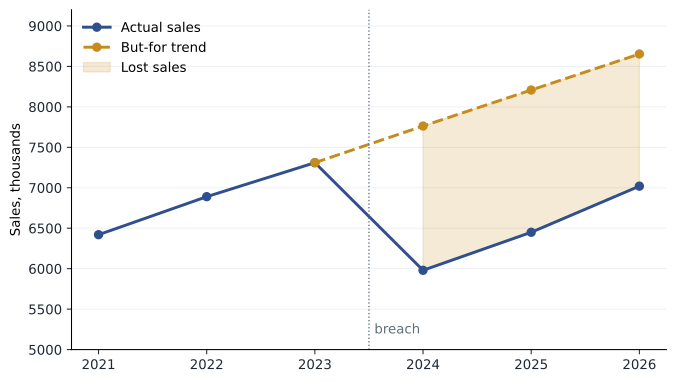
The program below applies the before-and-after method to an invented claim. Wexford Marine Electronics, a different client of Corbett Lane Forensic LLP, alleges that its main component supplier breached an exclusive supply agreement at the end of 2023, forcing it to source from more expensive and slower suppliers. Counsel asks for an estimate of lost profits for 2024 to 2026.
# Lost profits from a supplier's breach, before-and-after method (invented figures, thousands).
# But-for sales come from the trend before the breach; lost profit = lost sales x incremental margin.
hist = {2021: 6420, 2022: 6890, 2023: 7310}            # sales before the breach (actual)
actual_after = {2024: 5980, 2025: 6450, 2026: 7020}    # sales during the damage period (actual)
incremental_margin = 0.31        # contribution margin after variable costs saved on lost sales
rate = 0.09                      # discount rate for past losses is often zero (or prejudgment interest);
                                 # applied here only to the future year 2026, from the valuation date

# Linear trend fitted to the three pre-breach years.
xs, ys = list(hist), list(hist.values())
n = len(xs); mx = sum(xs) / n; my = sum(ys) / n
slope = sum((x - mx) * (y - my) for x, y in zip(xs, ys)) / sum((x - mx) ** 2 for x in xs)
butfor = {y: my + slope * (y - mx) for y in actual_after}
total = 0
print(f"Trend: {slope:,.0f} per year")
print(f"{'Year':<6}{'but-for':>9}{'actual':>9}{'lost sales':>12}{'lost profit':>13}{'present value':>15}")
for y in actual_after:
    lost = butfor[y] - actual_after[y]
    lp = lost * incremental_margin
    pv = lp / (1 + rate) if y == 2026 else lp
    total += pv
    print(f"{y:<6}{butfor[y]:>9,.0f}{actual_after[y]:>9,.0f}{lost:>12,.0f}{lp:>13,.0f}{pv:>15,.0f}")
print(f"\nLost profits claimed: {total:,.0f} thousand")
# Sensitivity: the margin assumption drives the answer.
for mgn in (0.25, 0.31, 0.37):
    t = sum((butfor[y] - actual_after[y]) * mgn / ((1 + rate) if y == 2026 else 1) for y in actual_after)
print(f" incremental margin {mgn:.0%}: {t:,.0f}")Trend: 445 per year Year but-for actual lost sales lost profit present value 2024 7,763 5,980 1,783 553 553 2025 8,208 6,450 1,758 545 545 2026 8,653 7,020 1,633 506 465 Lost profits claimed: 1,562 thousand incremental margin 25%: 1,260 incremental margin 31%: 1,562 incremental margin 37%: 1,865
The trend in the three years before the breach implies but-for sales growing by about 445 thousand a year. Comparing that trend with actual sales gives lost sales of about 1.6 to 1.8 million a year, and applying an incremental margin of 31 per cent gives lost profits of about 1.56 million, with the 2026 amount discounted because part of that year was still in the future at the valuation date. The sensitivity lines show how much the answer depends on the margin: a range from 25 to 37 per cent moves the result from about 1.26 to 1.87 million. The opposing expert will test every assumption: whether three years is enough history to set a trend, whether the market grew as fast after 2023, whether Wexford mitigated its loss quickly enough, and whether part of the decline came from other causes. A well-prepared report addresses these questions before cross-examination does.
Other common engagements
Business interruption claims under property insurance use similar but-for analysis, measured over the period of restoration defined in the policy. Fidelity and crime claims, like Saltmarsh Industrial Supply Ltd.'s claim to Harrow Mutual, require the insured to prove the loss caused by employee dishonesty, usually with a proof of loss supported by the investigation; policies often have deductibles, limits and exclusions, and may not cover the cost of the investigation itself unless a specific extension applies. In shareholder and partnership disputes, forensic accountants value interests and analyse whether controlling parties diverted value. In matrimonial cases, they determine income for support purposes, value businesses and pensions, and trace assets that one spouse may have hidden; support is calculated under guidelines that differ between the two countries and among provinces and states. Business valuation methods are covered in the finance courses (FIN-301); in disputes, the valuation date, the standard of value and the treatment of minority and marketability discounts are frequent sources of disagreement.
Economic loss in personal injury and fatality claims
Claims for injury or death include the present value of lost earnings, the cost of future care and other financial losses. The forensic accountant projects the earnings the person would have had but for the injury, deducts the earnings they can still achieve, applies contingencies for life events such as illness, unemployment and early retirement, and discounts the future losses to the present. The discount rate has an enormous effect over long periods, as the program below shows for an invented claimant.
# Present value of future lost earnings in a personal injury claim (invented figures).
# The result depends heavily on the discount rate, which some jurisdictions set by rule.
earnings = 58000          # annual pre-injury earnings in today's dollars
residual = 21000          # earnings capacity after the injury
years = 22                # working years remaining
contingency = 0.12        # deduction for ordinary life contingencies (illustrative)
def pv(rate):
    return sum((earnings - residual) / (1 + rate) ** t for t in range(1, years + 1)) * (1 - contingency)
print(f"Annual loss {earnings - residual:,} for {years} years, less {contingency:.0%} contingencies")
for r in (0.0, 0.015, 0.025, 0.035):
print(f" real discount rate {r:>5.1%}: present value {pv(r):>11,.0f}")Annual loss 37,000 for 22 years, less 12% contingencies real discount rate 0.0%: present value 716,320 real discount rate 1.5%: present value 606,294 real discount rate 2.5%: present value 545,882 real discount rate 3.5%: present value 493,842
Moving the real discount rate from zero to 3.5 per cent reduces the present value of the same loss from about 716 thousand to about 494 thousand. Because the rate matters so much and is hard to predict, some jurisdictions set it by rule.
In Canada, several provinces prescribe discount rates for future pecuniary losses in legislation or rules of court, so that experts in those provinces apply the prescribed rates rather than debating them; for example, British Columbia's regulation under the Law and Equity Act has set separate rates for future earnings and future care costs, and Ontario's Rules of Civil Procedure set rates linked to bond yields. The rates change from time to time, so the expert must confirm the rule in force at the date of the report.
Reports and testimony
An expert report should state the expert's qualifications, the instructions received, the questions addressed, the documents and information relied on, the facts and assumptions, the methods used, the analysis and the opinions, with the reasons for each, and any limitations. It should acknowledge the duty to the court where rules require it. It should be written for a judge who is not an accountant: plain language, clear schedules that tie to sources, and charts that summarize without exaggerating. Drafts and communications with counsel may be disclosable, so the expert should keep communications professional and should not let counsel write or edit the substance of the opinions.
Testimony follows a pattern. In direct examination, the expert explains qualifications, methods and opinions in response to questions from the retaining counsel. In cross-examination, opposing counsel tests the expert's independence, qualifications, assumptions, data and consistency, often with documents the expert has not seen or with the expert's earlier writings. Good expert witnesses prepare thoroughly, listen to each question, answer only what is asked, concede valid points, explain without arguing, and never guess. Judges and juries tend to trust experts who are candid about the limits of their analysis.
Worked problem
Responding to a cross-examination point
In cross-examination about the Wexford report, opposing counsel shows that the industry grew only 2 per cent a year after 2023, while the expert's but-for trend implies about 6 per cent. How should the expert respond?
Show solution
- Listen to the question and confirm the source and scope of the industry data.
- Acknowledge the difference candidly rather than defending the original number at all costs.
- Explain the basis of the trend: Wexford's own pre-breach growth, its contracts and its market share gains, if those were analysed.
- If the report considered alternative scenarios, refer to them; if not, state that applying the industry rate would reduce the estimate, and by roughly how much if the expert can calculate it reliably.
Answer: Concede the point where valid, explain the basis of the original assumption and the effect of the alternative, and avoid advocacy.
Common mistakes
MistakeActing as an advocate for the client in an expert report.
InsteadRemember that the duty is to the court: be independent, impartial and objective.
MistakeLetting counsel draft the opinions.
InsteadCounsel may comment on clarity, but the substance must be the expert's own.
MistakeDeducting all costs, including fixed costs, from lost revenue.
InsteadDeduct only the incremental costs that would have been incurred to earn the lost revenue.
MistakeIgnoring mitigation and other causes of the decline.
InsteadAddress mitigation and alternative causes in the analysis.
MistakeChoosing a discount rate without checking the jurisdiction's rules.
InsteadConfirm any prescribed rate or accepted method in the jurisdiction at the report date.
MistakeGuessing during cross-examination.
InsteadAnswer only what is known; say so when the answer requires further analysis.
Summary and key terms
- Forensic accountants act as consulting experts or as testifying experts with an overriding duty to the court.
- Civil and criminal proceedings use different standards of proof; asset freezing orders help preserve recoveries.
- Mohan (1994) and White Burgess (2015) set the Canadian threshold for expert evidence, including independence and impartiality.
- Damages compare the actual situation with a but-for scenario; most disputes are about the assumptions.
- Lost profits use before-and-after, yardstick or projection methods, deducting incremental costs and addressing mitigation and causation.
- Economic loss in personal injury claims is very sensitive to the discount rate, which some jurisdictions prescribe.
- Reports must be clear, sourced and limited to the expert's field; testimony must be candid and prepared.
- Mareva injunction
- A Canadian court order freezing a defendant's assets pending trial.
- Examination for discovery
- Pre-trial questioning of parties under oath in Canadian civil litigation.
- Expert witness
- A witness permitted to give opinion evidence because of specialized knowledge, with a duty to the court.
- Consulting expert
- An expert who advises counsel without testifying.
- But-for scenario
- The position the injured party would have been in without the wrongful act.
- Before-and-after method
- Estimating lost profits by projecting the plaintiff's pre-event performance into the damage period.
- Yardstick method
- Estimating lost profits by comparison with similar unaffected businesses or markets.
- Incremental margin
- Revenue less the costs that vary with it; used to convert lost revenue to lost profit.
- Mitigation
- Steps an injured party takes, or should take, to reduce its loss.
- Subrogation
- An insurer's right, after paying a claim, to pursue recovery from the party who caused the loss.
Practice problems
Work each problem on paper first, then reveal the answer to check.
What is the difference between a consulting expert and a testifying expert?
Show answer
A consulting expert advises counsel privately; a testifying expert gives independent opinion evidence to the court.
To whom does an expert witness owe their overriding duty?
Show answer
To the court.
Name the three methods for estimating lost profits.
Show answer
Before-and-after, yardstick and sales projection.
Why are fixed costs usually not deducted from lost revenue?
Show answer
They would have been incurred anyway, so they do not reduce the profit lost on the missing sales.
In the lost profits program, what is the total claimed, and what range does the margin sensitivity give?
Show answer
About 1,562 thousand; about 1,260 to 1,865 thousand for margins of 25 to 37 per cent.
Change the incremental margin to 0.28 and rerun. What is the new total?
Show answer
About 1,411 thousand.
In the economic loss program, how much does the present value fall between rates of 0 and 3.5 per cent?
Show answer
From about 716,320 to about 493,842, a fall of about 222,000.
Why do some jurisdictions prescribe discount rates?
Show answer
The rate has a large effect and is hard to predict; prescribing it reduces disputes and inconsistency.
What is subrogation, and how could it arise in the Saltmarsh matter?
Show answer
The insurer's right to pursue recovery after paying; if Harrow Mutual pays the crime claim it may pursue Calloway and Pellerin.
Give three behaviours of an effective expert witness under cross-examination.
Show answer
Listen carefully, answer only what is asked, concede valid points, explain without arguing, never guess.
Lesson quiz · 5 questions
Score 60% or more to complete this lesson.
Create a free account to save your progress, take quizzes and earn a certificate.