
ACCT-460 · Lesson 2 of 12 · 28 min
Fraud theory and the cost of fraud
Lesson 1 described what forensic accountants do. This lesson asks why people commit fraud, how frauds are classified, and how much they cost. These questions are not academic. A theory of why fraud happens tells an organization where to put its controls, and a classification of schemes tells an investigator which records to examine first. Cost estimates explain why boards fund fraud prevention, and they give investigators a sense of what is typical, so that unusual patterns stand out.
Fraud has a legal meaning that differs in detail between jurisdictions, but the common core is dishonest deception that causes, or risks causing, a loss to another person or a gain to the deceiver. In Canada, fraud under the Criminal Code requires a dishonest act (deceit, falsehood or other fraudulent means) and deprivation, which includes putting someone's economic interests at risk. In the United States, fraud is defined in many federal and state statutes, such as the mail and wire fraud statutes, and in the common law tort of fraud, which requires a knowingly false representation of a material fact, reliance and damage. For forensic accountants, the practical point is that fraud involves intent, and intent is proved by evidence of what people knew and did, not by numbers alone.
The fraud triangle
The most widely taught model of why people commit fraud comes from the American criminologist Donald Cressey, who interviewed people imprisoned for embezzlement in the 1940s and 1950s. He concluded that trusted persons violate trust when three conditions come together. First, they have a financial problem they feel they cannot share, which later writers broadened to pressure or incentive. Second, they see an opportunity to solve the problem secretly by violating the trust placed in them. Third, they are able to rationalize the conduct in a way that preserves their view of themselves as honest people, for example by thinking that they are only borrowing the money, that the company owes them, or that everyone does it.
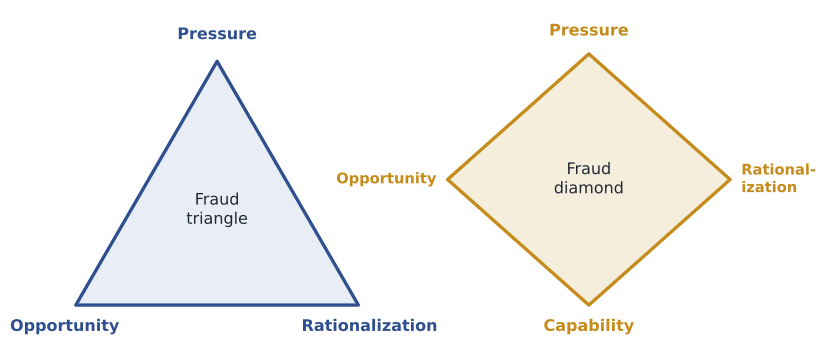
The triangle is useful because each side suggests a response. Organizations can do little about employees' personal pressures, though employee assistance programs and fair compensation help. They can do a great deal about opportunity, through segregation of duties, approval limits, reconciliations, surprise audits and data analytics. They can influence rationalization through culture: clear codes of conduct, leaders who model integrity, and consistent consequences when misconduct is found. Auditing standards in both countries use the triangle directly: the auditor's risk assessment considers incentives and pressures, opportunities and attitudes or rationalizations, as ACCT-331 discussed.
The triangle also has limits. Cressey's model described individual employees who embezzled; it fits less well with frauds planned from the start, with collusion among several people, or with executives who manipulate financial statements to meet targets. Critics also note that rationalization is hard to observe before the fact, and that the model can encourage a focus on bad individuals rather than on the conditions an organization creates.
Extensions: the fraud diamond, the fraud scale and MICE
Several extensions address these limits. The fraud diamond, proposed by David Wolfe and Dana Hermanson in 2004, adds capability: the personal traits and position that allow someone to exploit an opportunity. A person who understands the payables system, has authority to override a control, can lie convincingly and handles stress well is more capable of committing and concealing a fraud than someone with the same opportunity but less skill or nerve. The diamond explains why many large frauds are committed by long-serving, trusted, competent employees and executives.
The fraud scale, associated with Steve Albrecht and colleagues in the 1980s, replaces rationalization with personal integrity and presents the three factors as weights on a balance: high pressure and opportunity with low integrity tip the scale toward fraud. The MICE model describes motivations: money, ideology, coercion and ego. It is often used for corruption and insider threats, where a person may act out of belief, because they are being pressured or blackmailed, or for the satisfaction of beating the system, not only for money. Each model is a lens, not a law; investigators use them to generate hypotheses about who might have acted and why, and then test the hypotheses against evidence.
In the Saltmarsh Industrial Supply Ltd. matter, the hotline reports point to two very different patterns. The vendor allegation, if true, looks like a classic triangle case: an employee with access to the vendor master and to payment approval, perhaps under financial pressure, using a shell company. The revenue allegation looks like an incentive case at a senior level: fourth-quarter sales pushed out with side letters, perhaps to meet a bonus target or a bank covenant. The models suggest different questions: who could create a vendor and approve its invoices, and who benefits if fourth-quarter revenue is higher.
The fraud tree
The Association of Certified Fraud Examiners (ACFE) classifies occupational fraud, meaning fraud committed by people against the organizations that employ them, into three main categories, often drawn as a tree. Corruption covers conflicts of interest, bribery, illegal gratuities and economic extortion. Asset misappropriation covers theft of cash and other assets, including skimming, cash larceny, fraudulent disbursements such as billing, payroll, expense reimbursement and cheque tampering schemes, and the misuse or theft of inventory and other assets. Financial statement fraud covers intentional misstatement of financial statements, usually to overstate performance or position, but sometimes to understate it, for example to reduce taxes or depress the price in a buyout.
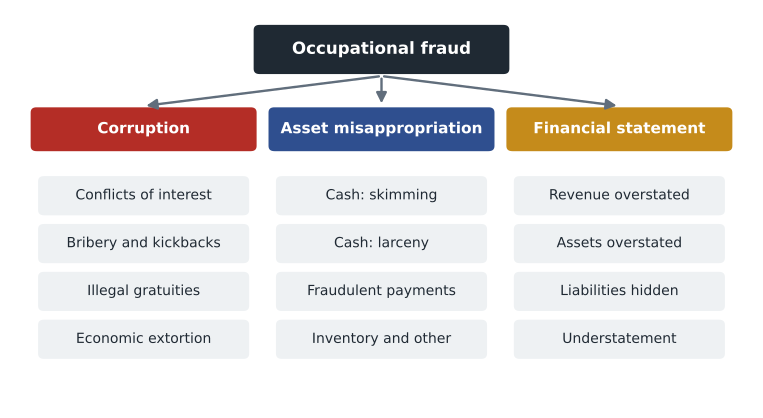
The categories overlap. A purchasing manager who takes kickbacks from a supplier is committing corruption, but the company's loss shows up as inflated purchase prices, which looks like a billing problem. A sales executive who inflates revenue to earn a bonus is committing financial statement fraud that also misappropriates assets, the bonus. The tree is mainly a way to organize thinking and data: each branch has typical red flags, typical records to examine and typical controls, and lessons 3 to 7 of this course work through them.
How much fraud costs
The best-known source of data on occupational fraud is the ACFE's report to the nations, published every two years from cases reported by certified fraud examiners. The edition released on May 12, 2026, Occupational Fraud 2026, analysed 2,402 cases from 143 countries. Its headline findings, as reported at release, include the following.
| Measure | Occupational Fraud 2026 (ACFE) |
|---|---|
| Cases analysed | 2,402 from 143 countries |
| Median loss per case | 104,000 US dollars (average about 1.46 million) |
| Cases with losses above 1 million US dollars | about 20 per cent |
| Median duration before detection | 12 months |
| Share detected by tips | 43 per cent, more than half of tips from employees |
| Estimated loss to fraud | about 5 per cent of revenue each year |
| Asset misappropriation | about 90 per cent of cases, median loss about 100,000 |
| Corruption | about 45 per cent of cases, median loss about 150,000 |
| Financial statement fraud | about 6 per cent of cases, median loss about 1 million |
Three patterns in these data have stayed stable over many editions. Asset misappropriation is by far the most common scheme but has the smallest typical loss. Financial statement fraud is rare but by far the most costly per case. And tips, mostly from employees, detect more frauds than any other method, ahead of internal audit, management review and external audit. Reports from summaries of the 2026 edition also show that losses grow with duration, that organizations with controls such as surprise audits and formal reporting channels tend to have lower losses and faster detection, and that most perpetrators showed at least one behavioural red flag, such as living beyond their means, financial difficulties or an unusually close relationship with a vendor or customer, before they were caught.
These data come with caveats that a forensic accountant should state whenever citing them. The cases are those investigated by CFEs who chose to respond to a survey, not a random sample of all frauds, so undetected frauds are missing by definition, and large or interesting cases may be over-represented. Losses are those known at the time of reporting. The 5 per cent of revenue figure is a median estimate by respondents, not a measured quantity, and applying it to a single organization gives an order of magnitude, not a forecast. With those caveats, 5 per cent of Saltmarsh Industrial Supply Ltd.'s 91.2 million dollars of reported revenue would be about 4.6 million a year, which helps explain why a board might spend a fraction of that on prevention and detection.
Looking at a firm's own case data
Forensic practices often keep their own statistics on closed matters, which can be more relevant to their clients than global surveys. The program below summarizes 30 invented closed matters from a forensic firm's files, using the same measures as the ACFE report.
# Summary of 30 closed occupational fraud matters in a forensic firm's files (invented data).
# Each case: (scheme category, loss in thousands of dollars, months until detection, how detected)
import statistics as st
from collections import Counter

cases = [
    ("asset misappropriation", 38, 9, "tip"), ("asset misappropriation", 112, 14, "tip"),
    ("asset misappropriation", 21, 5, "management review"), ("asset misappropriation", 64, 11, "internal audit"),
    ("asset misappropriation", 437, 46, "tip"), ("asset misappropriation", 15, 4, "account reconciliation"),
    ("asset misappropriation", 92, 18, "tip"), ("asset misappropriation", 48, 12, "by accident"),
    ("asset misappropriation", 133, 20, "internal audit"), ("asset misappropriation", 27, 7, "management review"),
    ("asset misappropriation", 205, 26, "tip"), ("asset misappropriation", 56, 10, "account reconciliation"),
    ("asset misappropriation", 74, 13, "tip"), ("asset misappropriation", 9, 3, "document examination"),
    ("asset misappropriation", 160, 24, "external audit"), ("asset misappropriation", 33, 8, "tip"),
    ("corruption", 150, 15, "tip"), ("corruption", 480, 30, "tip"), ("corruption", 95, 12, "internal audit"),
    ("corruption", 260, 22, "tip"), ("corruption", 71, 9, "management review"), ("corruption", 1200, 36, "tip"),
    ("corruption", 118, 16, "by accident"), ("corruption", 340, 19, "internal audit"),
    ("financial statement fraud", 1900, 24, "tip"), ("financial statement fraud", 850, 18, "external audit"),
    ("financial statement fraud", 3100, 30, "internal audit"), ("financial statement fraud", 640, 14, "tip"),
    ("asset misappropriation", 44, 9, "tip"), ("corruption", 210, 20, "management review"),
]
print(f"Matters: {len(cases)}   median loss: {st.median(c[1] for c in cases):,.0f}k   "
      f"median months to detection: {st.median(c[2] for c in cases):.0f}")
print(f"\n{'Category':<28}{'cases':>6}{'median loss (k)':>17}{'median months':>15}")
for cat in ("asset misappropriation", "corruption", "financial statement fraud"):
    sub = [c for c in cases if c[0] == cat]
    print(f"{cat:<28}{len(sub):>6}{st.median(c[1] for c in sub):>17,.0f}{st.median(c[2] for c in sub):>15.0f}")
print("\nHow the frauds were detected:")
for how, n in Counter(c[3] for c in cases).most_common():
    print(f"  {how:<24}{n:>3}  {n/len(cases):6.1%}")
# Longer schemes cost more: compare losses for schemes found within 12 months and after.
early = [c[1] for c in cases if c[2] <= 12]; late = [c[1] for c in cases if c[2] > 12]
print(f"\nMedian loss, detected within 12 months: {st.median(early):,.0f}k ({len(early)} cases)")
print(f"Median loss, detected after 12 months: {st.median(late):,.0f}k ({len(late)} cases)")Matters: 30 median loss: 115k median months to detection: 14 Category cases median loss (k) median months asset misappropriation 17 56 11 corruption 9 210 19 financial statement fraud 4 1,375 21 How the frauds were detected: tip 14 46.7% internal audit 5 16.7% management review 4 13.3% account reconciliation 2 6.7% by accident 2 6.7% external audit 2 6.7% document examination 1 3.3% Median loss, detected within 12 months: 41k (12 cases) Median loss, detected after 12 months: 235k (18 cases)
The firm's small data set shows the same shape as the global data: asset misappropriation is most common with the lowest median loss, financial statement fraud is rarest with the highest, and tips detect the most cases. The comparison of early and late detection is the most important line for prevention. The median loss for schemes found within 12 months is a small fraction of the median for schemes that ran longer, because most schemes grow over time: perpetrators who are not caught tend to take more. The Saltmarsh Industrial Supply Ltd. vendor allegation, if confirmed, would fall in the second group, since the vendor was created in March 2022.
Worked problem
Choosing the right model
A long-serving finance director with no financial difficulties is found to have booked fictitious year-end sales for three years so that the company met targets that triggered management bonuses and protected a bank covenant. Which fraud model best fits, and what controls does it suggest?
Show solution
- Pressure in the classic sense (a personal financial problem) seems absent, so the plain triangle fits poorly.
- Incentive and capability fit well: bonuses and covenant pressure created a motive, and the director had the position, knowledge and authority to override controls.
- The fraud diamond, with its capability element, therefore explains the case better; MICE adds that ego and the desire to be seen as successful may have played a role.
- Controls follow: board and audit committee oversight of year-end adjustments, independent review of revenue cutoff, compensation design that does not reward short-term revenue alone, and a hotline that staff trust.
Answer: The fraud diamond fits best because capability and position, combined with incentives, explain how a trusted senior person committed and concealed the fraud.
Common mistakes
MistakeTreating the fraud triangle as a test that proves or disproves fraud.
InsteadUse fraud models to generate hypotheses and identify risks, then test them against evidence.
MistakeAssuming only people with money problems commit fraud.
InsteadConsider incentives, capability, ideology, coercion and ego, especially for senior staff.
MistakeQuoting the 5 per cent of revenue estimate as a measured loss for one company.
InsteadPresent it as a survey-based order of magnitude with its limitations.
MistakeIgnoring scheme overlap, for example treating kickbacks only as a purchasing variance.
InsteadClassify by conduct and loss, and follow the evidence across branches of the fraud tree.
MistakeFocusing only on individual bad actors.
InsteadExamine the conditions, such as weak controls, targets and culture, that allowed the fraud.
MistakeConcluding that tips are unreliable because some are vague or false.
InsteadTriage tips, investigate credible ones and protect reporters; tips detect more fraud than any other method.
Summary and key terms
- Fraud involves dishonest deception and intent, which is proved by evidence of knowledge and conduct.
- Cressey's fraud triangle links pressure, opportunity and rationalization; organizations act mainly on opportunity and culture.
- The fraud diamond adds capability; the fraud scale emphasizes personal integrity; MICE describes motives beyond money.
- The ACFE fraud tree classifies occupational fraud as corruption, asset misappropriation and financial statement fraud.
- The ACFE's Occupational Fraud 2026 report analysed 2,402 cases, with a median loss of 104,000 US dollars and a median duration of 12 months.
- Tips detect about 43 per cent of frauds, more than any other method, and longer schemes cost more.
- Survey data have limits: they cover detected, reported cases and give orders of magnitude, not forecasts.
- Occupational fraud
- Fraud committed by people against the organizations that employ them.
- Fraud triangle
- Cressey's model in which pressure, opportunity and rationalization together lead trusted persons to commit fraud.
- Fraud diamond
- An extension of the triangle that adds the perpetrator's capability.
- Rationalization
- The reasoning that allows a person to see dishonest conduct as acceptable.
- MICE
- A model of motives: money, ideology, coercion and ego.
- Fraud tree
- The ACFE's classification of occupational fraud into corruption, asset misappropriation and financial statement fraud.
- Asset misappropriation
- Theft or misuse of an organization's cash, inventory or other assets.
- Financial statement fraud
- Intentional misstatement or omission of amounts or disclosures in financial statements.
Practice problems
Work each problem on paper first, then reveal the answer to check.
Name the three elements of the fraud triangle and one control that addresses each.
Show answer
Pressure (employee assistance, fair pay), opportunity (segregation of duties, reconciliations, analytics) and rationalization (culture, codes, consistent consequences).
What does the fraud diamond add, and why does it matter for senior staff?
Show answer
Capability; senior staff have the knowledge, authority and confidence to exploit opportunities and conceal schemes.
According to Occupational Fraud 2026, which scheme category is most common and which is most costly per case?
Show answer
Asset misappropriation is most common; financial statement fraud is most costly per case.
Give two limitations of the ACFE survey data.
Show answer
It covers only detected cases reported by responding CFEs, not a random sample, and losses and the 5 per cent estimate are respondents' figures.
In the case-file program, what are the median losses for schemes detected within and after 12 months?
Show answer
About 41 thousand within 12 months and about 235 thousand after 12 months.
Change the detection method of the 1,200 thousand corruption case to 'internal audit' and rerun. What happens to the tip share?
Show answer
Tips fall from 14 to 13 of 30 cases, about 43.3 per cent.
Why might a firm's own case data be more useful to its clients than global data?
Show answer
It reflects the industries, regions and sizes of organization the firm actually serves.
Which branch of the fraud tree does a kickback scheme belong to, and how might it appear in the accounts?
Show answer
Corruption; it may appear as inflated purchase prices or unnecessary purchases.
What two very different fraud patterns do the hotline reports at Saltmarsh suggest?
Show answer
An employee billing scheme through a shell vendor, and senior-level revenue manipulation through side letters.
Why is intent central to fraud, and how is it usually proved?
Show answer
Fraud requires dishonesty; intent is inferred from evidence of knowledge and conduct such as concealment, false documents and statements.
Lesson quiz · 5 questions
Score 60% or more to complete this lesson.
Create a free account to save your progress, take quizzes and earn a certificate.