
ACCT-460 · Lesson 12 of 12 · 28 min
Capstone: fraud risk management, whistleblowing and the investigation report
This final lesson brings the Saltmarsh Industrial Supply Ltd. investigation to a close and steps back to the question every board asks afterwards: how do we stop this from happening again? It covers the reconstruction of the case timeline, the structure of the investigation report, fraud risk management frameworks, whistleblowing programs and the protections for whistleblowers in each country, and the remediation plan that Saltmarsh Industrial Supply Ltd. adopts. It also draws together the course's main lessons about the forensic accountant's role.
Reconstructing the timeline
A chronology is one of the most useful tools in any investigation. Placing documents, data and statements on a single timeline reveals sequences that no single source shows, highlights gaps, and exposes contradictions between what people said and what records show. Chronologies are built throughout the investigation and are often attached to the report. The program below sorts a selection of events from the Northfield workstream.
# Reconstructing a timeline from documents and interview notes (invented events).
# Sorting sources by date exposes gaps and contradictions to raise in the next interview.
events = [
    ("2026-03-12", "interview", "Calloway says he never met anyone from Northfield"),
    ("2022-03-28", "vendor master", "Northfield created; request entered under Calloway's user ID"),
    ("2022-03-21", "corporate registry", "Northfield registered; director G. Pellerin, 14 Ferncliff Drive"),
    ("2026-01-29", "email", "Calloway asks AP clerk to hold Northfield invoices during the audit"),
    ("2022-04-14", "payment", "first Northfield payment, 4,605"),
    ("2026-02-20", "hotline", "report H-26-006: logistics invoices with no matching delivery"),
    ("2018-05-02", "HR file", "Calloway lists G. Pellerin at 14 Ferncliff Drive as emergency contact"),
    ("2026-03-19", "interview", "Pellerin says Calloway set up the company and handles its bank card"),
]
prev = None
for d, src, what in sorted(events):
    gap = ""
    if prev:
        y1, m1, _ = map(int, prev.split("-")); y2, m2, _ = map(int, d.split("-"))
        months = (y2 - y1) * 12 + (m2 - m1)
        gap = f"(+{months} mo)" if months >= 6 else ""
    print(f"{d}  {src:<19}{what} {gap}")
    prev = d
claims = [e for e in events if e[1] == "interview"]
print(f"\nInterview statements to test against documents: {len(claims)}")2018-05-02 HR file Calloway lists G. Pellerin at 14 Ferncliff Drive as emergency contact 2022-03-21 corporate registry Northfield registered; director G. Pellerin, 14 Ferncliff Drive (+46 mo) 2022-03-28 vendor master Northfield created; request entered under Calloway's user ID 2022-04-14 payment first Northfield payment, 4,605 2026-01-29 email Calloway asks AP clerk to hold Northfield invoices during the audit (+45 mo) 2026-02-20 hotline report H-26-006: logistics invoices with no matching delivery 2026-03-12 interview Calloway says he never met anyone from Northfield 2026-03-19 interview Pellerin says Calloway set up the company and handles its bank card Interview statements to test against documents: 2
The chronology shows that Calloway had listed G. Pellerin at 14 Ferncliff Drive as his emergency contact almost four years before Northfield was registered at that address, that the vendor was created under Calloway's user ID a week after registration, and that the first payment followed two weeks later. It also places his request to hold Northfield invoices during the audit a month before the hotline report, and shows that his statement that he never met anyone from Northfield is contradicted by his own HR file and by Pellerin's account a week later. The forensic accountant reports these facts and contradictions; whether they show dishonesty is for the court in the civil action.
The outcome of the Saltmarsh Industrial Supply Ltd. investigation
Corbett Lane Forensic LLP delivers its report to outside counsel in June 2026. Its principal findings, summarized here from the invented case, are as follows.
| Matter | Findings | Amount |
|---|---|---|
| Northfield Logistics Services | 106 invoices from April 2022 to January 2026, all below the approval limit; no evidence that any services were received; vendor created under the AP supervisor's user ID; vendor linked to him through its director and address; funds traced to property and investments associated with him | 458,940 |
| Year-end shipments to two distributors | Shipments in December 2025 made with side letters giving unconditional return rights and payment on resale; letters not given to accounting or the auditors; 1.9 million returned in early 2026 | Revenue overstated by 2.4 million; pre-tax income by about 610 thousand |
| Keel and Rudder Consulting | Consultancy owned by the spouse of a purchasing employee; conflict not declared; some services real but billed at rates well above market | Overbilling under review |
| Duplicate payments to suppliers | Two invoices paid twice after re-keying | 20,154.10, recovered as credits |
| Payroll and expenses | Two pay periods paid after a termination (repaid); one duplicate expense claim | 3,750.40 and 486.50 |
After receiving the report, the company acts on its own decisions, informed by counsel. It ends R. Calloway's employment and continues its civil claim against him and Pellerin, supported by a freezing order obtained in April 2026; it files a proof of loss with Harrow Mutual Insurance; and it gives the police a copy of the evidence they request. It restates its fiscal 2025 financial statements with Pryce Dunmore LLP, informs its lenders and obtains a covenant waiver, and the board ends C. Varga's employment; Varga disputes the board's conclusions and has started a wrongful dismissal claim, which the company is defending. The Keel and Rudder matter leads to a recovery demand and a new conflict-of-interest declaration process. None of these decisions are made by the forensic accountants, whose role is to establish the facts.
Writing the investigation report
Investigation reports vary with the forum and audience, but good reports share a structure and a tone. They are written for readers who may not be accountants, who will rely on the report to make decisions, and who may be opposing parties looking for weaknesses.
| Section | Content |
|---|---|
| Introduction | Who engaged the investigator, through whom, and the questions to be answered |
| Scope and limitations | What was and was not examined, periods, access restrictions, reliance on others |
| Sources | Documents, data, interviews and other information relied on |
| Approach | Methods, tests and analyses performed, including thresholds and judgments |
| Findings | Facts established, with references to the evidence, organized by question |
| Quantification | Amounts, how they were calculated and any ranges or alternatives |
| Observations on controls | Weaknesses that allowed the conduct, if within scope |
| Appendices | Chronology, schedules, data descriptions, list of documents |
Findings should be stated as facts with sources: "The vendor record was created on March 28, 2022 under user ID RCALLOWAY (document 14)", not "Calloway created a fake vendor". Opinions within the forensic accountant's expertise, such as the amount of a loss, are clearly identified as opinions with reasons. Conclusions about intent, credibility or guilt are left to the trier of fact. Exculpatory evidence, explanations offered by the subject and matters that could not be resolved are reported alongside the evidence that supports the allegations. Before the report is issued, a second senior professional reviews it against the evidence, often line by line. These habits make reports more persuasive, not less, because a reader who sees that the investigator considered every side is more likely to accept the findings.
Fraud risk management
Investigations deal with fraud after it happens; fraud risk management aims to prevent it and to detect it early. The most widely used framework is the Fraud Risk Management Guide published jointly by the Committee of Sponsoring Organizations of the Treadway Commission (COSO) and the ACFE, whose second edition appeared in 2023. It is built on five principles aligned with the COSO internal control framework: fraud risk governance, in which the board and senior management set expectations and assign responsibility; fraud risk assessment, which identifies specific schemes and the risks of each; fraud control activities, preventive and detective, including data analytics; fraud investigation and corrective action, with a process for reports, investigations and consequences; and fraud risk management monitoring, which evaluates whether the program works and improves it.
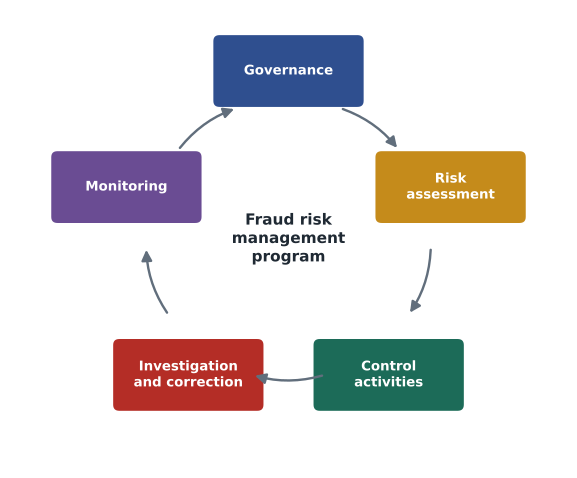
A fraud risk assessment considers how each scheme could occur in the organization, how likely it is, how much harm it could do, which controls address it and how well, and what residual risk remains. It should involve people who understand the processes and should include management override as a risk in its own right. Saltmarsh Industrial Supply Ltd.'s audit committee asks Corbett Lane Forensic LLP to facilitate a fraud risk assessment as part of the remediation. The program below scores six schemes before and after the planned remediation, using the team's assessments of likelihood, impact and control effectiveness.
# Fraud risk assessment for Saltmarsh after the investigation (invented ratings, 1 to 5 scales).
# Inherent score = likelihood x impact; residual applies the assessed effectiveness of controls.
risks = [  # (scheme, likelihood, impact, control effectiveness 0-1 before, after remediation)
    ("Fictitious vendor billing",           4, 4, 0.20, 0.75),
    ("Revenue cutoff and side agreements",  3, 5, 0.30, 0.70),
    ("Expense reimbursement abuse",         4, 2, 0.40, 0.70),
    ("Payroll: ghost or terminated staff",  2, 3, 0.50, 0.80),
    ("Supplier kickbacks in purchasing",    3, 4, 0.25, 0.60),
    ("Payment redirection by email fraud",  4, 4, 0.35, 0.85),
]
print(f"{'Scheme':<38}{'inherent':>9}{'residual before':>17}{'residual after':>16}")
for name, l, i, before, after in sorted(risks, key=lambda r: -(r[1] * r[2] * (1 - r[3]))):
    inh = l * i
    print(f"{name:<38}{inh:>9}{inh * (1 - before):>17.1f}{inh * (1 - after):>16.1f}")
tb = sum(l * i * (1 - b) for _, l, i, b, _ in risks)
ta = sum(l * i * (1 - a) for _, l, i, _, a in risks)
print(f"\nTotal residual score: {tb:.1f} before remediation, {ta:.1f} after")Scheme inherent residual before residual after Fictitious vendor billing 16 12.8 4.0 Revenue cutoff and side agreements 15 10.5 4.5 Payment redirection by email fraud 16 10.4 2.4 Supplier kickbacks in purchasing 12 9.0 4.8 Expense reimbursement abuse 8 4.8 2.4 Payroll: ghost or terminated staff 6 3.0 1.2 Total residual score: 50.5 before remediation, 19.3 after
Before remediation, fictitious vendor billing carries the highest residual score, followed by revenue cutoff and side agreements and by payment redirection, which is included even though Saltmarsh Industrial Supply Ltd. has had no such loss, because the risk is high for any company with electronic payments. The planned controls cut the total residual score from 50.5 to 19.3. The numbers are judgments, and their value lies less in the precise scores than in the discussion they force about which schemes matter most and which controls are worth funding.
Saltmarsh Industrial Supply Ltd.'s remediation plan includes segregating vendor master maintenance from payables and approval; requiring independent verification of new vendors, including registry and bank account checks and a match against employee data; requiring receiving evidence or a business-unit confirmation for service invoices; monthly analytics on payments, duplicates, thresholds and vendor-employee matches, reviewed by the controller; a contracts process that prohibits side agreements and requires sales terms to be approved by finance; a revenue cutoff review by finance for the last month of each quarter; annual conflict declarations; call-back verification of all bank detail changes; a revised bonus plan that rewards collected revenue and profitability rather than shipments alone; and an outsourced internal audit function reporting to the audit committee.
Whistleblowing programs and protections
Tips detect more fraud than any other method, so the design of the channels through which people report concerns matters greatly. Effective programs offer several channels (telephone, web, email, in person), allow anonymous reporting with a way to communicate with anonymous reporters, are available to employees, contractors, suppliers and customers, route reports independently of the people who may be implicated, protect reporters from retaliation, and report statistics to the audit committee. Summaries of the ACFE's 2026 data indicate that organizations with formal reporting mechanisms detect frauds faster and suffer lower losses than those without them, and that many small organizations still lack such channels. Saltmarsh Industrial Supply Ltd. had a hotline, which worked as designed in this case; both reports reached the audit committee chair directly.
In Canada, whistleblower protection is a patchwork. The Criminal Code makes it an offence for an employer to retaliate against an employee who provides information about an offence to law enforcement. Securities regulators protect whistleblowers who report securities law violations, and the Ontario Securities Commission's whistleblower program, launched in 2016, can pay awards of up to 5 million dollars for tips that lead to sanctions. Federal public servants are protected under the Public Servants Disclosure Protection Act, and some provinces have similar laws for their public sectors, but private-sector protection depends largely on employment law and on the organization's own policies.
Award programs create an incentive to report externally rather than internally, which some companies resist. The better response is an internal program that people trust: one that acknowledges reports, investigates them properly, protects reporters and tells them, in general terms, what happened. Organizations should never attempt to identify anonymous reporters or discourage reports to regulators; doing so may be unlawful and destroys trust.
Looking back on the course
The Saltmarsh Industrial Supply Ltd. case touched most of the topics in this course: fraud theory to understand motive and opportunity, scheme knowledge to recognize what the hotline reports described, analytics to measure the scheme and find related matters, evidence and interviewing to establish facts, tracing to follow the money, legal knowledge to work within the rules, damages and recovery to turn findings into results, and fraud risk management to prevent recurrence. Across all of them, the forensic accountant's value lies in independence, rigour and clarity: answering the questions asked, with evidence that others can verify, in language that decision makers can understand.
Worked problem
Wording a finding
A draft report says: "Calloway set up Northfield as a fake company and stole 458,940 from Saltmarsh, lying about it in his interview." Rewrite it as a forensic finding.
Show solution
- Separate facts from conclusions: the creation record, the registry filing, the payments, the absence of receiving evidence, the links and the tracing are facts.
- State the amount as the total of payments to the vendor, with the period and number of invoices.
- Report the interview statement and the evidence that contradicts it, without characterizing it as a lie.
- Leave theft and dishonesty to the court.
Answer: Suggested wording: "Between April 2022 and January 2026, Saltmarsh paid Northfield Logistics Services 458,940 on 106 invoices. We found no evidence that Northfield provided services. The vendor record was created under Mr. Calloway's user ID. In interview, Mr. Calloway stated that he had never met anyone from Northfield; Northfield's director, his brother-in-law, stated that Mr. Calloway asked him to register the company and holds its bank card."
Common mistakes
MistakeWriting conclusions about guilt or lying in the report.
InsteadState facts with sources, identify opinions within expertise and leave intent to the trier of fact.
MistakeOmitting the subject's explanations or exculpatory evidence.
InsteadReport them alongside the evidence supporting the allegations.
MistakeTreating fraud risk scores as precise measurements.
InsteadUse them to structure judgment and prioritize controls.
MistakeDesigning a hotline that routes all reports to management.
InsteadRoute reports independently, especially those implicating senior staff.
MistakeTrying to identify anonymous reporters.
InsteadProtect reporters and communicate through the hotline system; retaliation may be unlawful.
MistakeStopping at the investigation.
InsteadFollow through with remediation, monitoring and a fraud risk assessment.
Summary and key terms
- A chronology combining documents, data and statements reveals sequences, gaps and contradictions.
- The Saltmarsh investigation quantified 458,940 paid to Northfield, a 2.4 million revenue overstatement, a conflict-of-interest matter and smaller recoveries.
- Decisions on employment, litigation, insurance and restatement are the organization's, informed by the forensic findings.
- Investigation reports state scope, sources, approach, findings and quantification, with facts sourced and intent left to the forum.
- The COSO and ACFE Fraud Risk Management Guide (2nd edition, 2023) sets five principles from governance to monitoring.
- Fraud risk assessments prioritize schemes and controls; Saltmarsh's plan cut its residual score from 50.5 to 19.3.
- Whistleblower protection in Canada is a patchwork of Criminal Code, securities and public-sector rules; the OSC program pays awards of up to 5 million.
- OSC whistleblower program
- The Ontario Securities Commission program that can pay awards for tips leading to sanctions.
- Chronology
- A time-ordered list of events drawn from documents, data and statements.
- Exculpatory evidence
- Evidence that tends to show that a person did not commit the alleged act.
- Fraud risk assessment
- A structured evaluation of how frauds could occur, their likelihood and impact, and how well controls address them.
- Residual risk
- The risk that remains after controls are considered.
- Fraud Risk Management Guide
- The COSO and ACFE framework of five principles for managing fraud risk.
- Whistleblower
- A person who reports suspected wrongdoing to the organization or to authorities.
- Retaliation
- Adverse action against a person for reporting wrongdoing or cooperating with an investigation.
Practice problems
Work each problem on paper first, then reveal the answer to check.
What does the chronology reveal about Calloway's interview statement?
Show answer
It is contradicted by his own HR file, which listed Pellerin at the same address years earlier, and by Pellerin's account.
Change the gap threshold in the chronology program from 6 to 1 month and rerun. What appears?
Show answer
More gaps are marked, including the one-month gap between the January email and the February hotline report.
List the main sections of an investigation report.
Show answer
Introduction, scope and limitations, sources, approach, findings, quantification, observations on controls, appendices.
Why should exculpatory evidence be included in a report?
Show answer
Completeness and objectivity; it makes findings more credible and is required by the duty of fairness.
Name the five principles of the COSO and ACFE Fraud Risk Management Guide.
Show answer
Governance, risk assessment, control activities, investigation and corrective action, monitoring.
In the risk program, which scheme has the highest residual score before remediation?
Show answer
Fictitious vendor billing, at 12.8.
Raise the after-remediation effectiveness for supplier kickbacks to 0.80 and rerun. What is the new total residual after remediation?
Show answer
About 16.9.
Give four elements of an effective whistleblowing program.
Show answer
Multiple channels, anonymity with two-way communication, independent routing, protection from retaliation, reporting to the audit committee.
Why should organizations not discourage reports to regulators?
Show answer
It may be unlawful, and it destroys trust in the internal program.
Name four controls in Saltmarsh's remediation plan.
Show answer
Segregated vendor maintenance, independent vendor verification, receiving evidence for services, monthly analytics, ban on side agreements, quarter-end cutoff review, conflict declarations, call-back verification, revised bonus plan, outsourced internal audit.
Lesson quiz · 5 questions
Score 60% or more to complete this lesson.
Create a free account to save your progress, take quizzes and earn a certificate.