
ACCT-431 · Lesson 3 of 12 · 26 min
Group audits II: component auditors, consolidation and reporting
Lesson 2 set the scope of the Tamarack group audit: full audits of parent operations, distribution and the Mexican subsidiary, specified procedures at the snacks subsidiary, and analytical procedures on the equity-method investee. Most of that work will be done by Hollis Ward's own teams, but the Mexican subsidiary will be audited by a local firm, Ortega Ruiz y Asociados, which also performs the statutory audit required in Mexico. This lesson covers how the group engagement team evaluates and directs a component auditor, how it audits the consolidation, and how the auditor's report on the group statements deals with the work of others.
Understanding the component auditor
Before using a component auditor, the group engagement team must determine whether that auditor understands and will comply with the ethical requirements relevant to the group audit, including independence, and whether the auditor has the competence and capabilities needed, including enough time and resources. These are not formalities. Inspection findings repeatedly show group teams accepting a one-line confirmation of independence from a component auditor that, on examination, held investments in the client or provided prohibited services.
The independence requirements that apply are those of the group audit, not only local rules. For Tamarack, a Canadian reporting issuer, the Mexican firm must comply with the independence rules in the CPA codes that apply to Hollis Ward, which follow the IESBA Code for listed entities. Hollis Ward sends a questionnaire that asks specific questions about non-audit services, fees, relationships with management and financial interests, rather than a general confirmation.
Competence covers knowledge of the auditing standards and the group's financial reporting framework, industry experience and, for the Tamarack audit, an understanding of the conversion from Mexican Financial Reporting Standards to the group framework. The group team can gather evidence from previous experience with the firm, inspection reports by its regulator, discussions with the component engagement partner, and the firm's membership in a network that applies common quality management. A component auditor that operates in a jurisdiction with active independent audit oversight, and whose recent inspection results are good, gives more comfort than one whose work has never been inspected.
Direction, supervision and review
The revised standards emphasize that component auditors are part of the engagement team, so the group engagement partner is responsible for their direction, supervision and the review of their work. The depth of involvement depends on the component's risks, the auditor's competence and the group team's previous experience. For a component with significant risks, such as Tamarack's Mexican plant, which carries risks of inventory valuation and revenue cut-off, the group team is expected to be closely involved in the component auditor's risk assessment and in the response to significant risks.
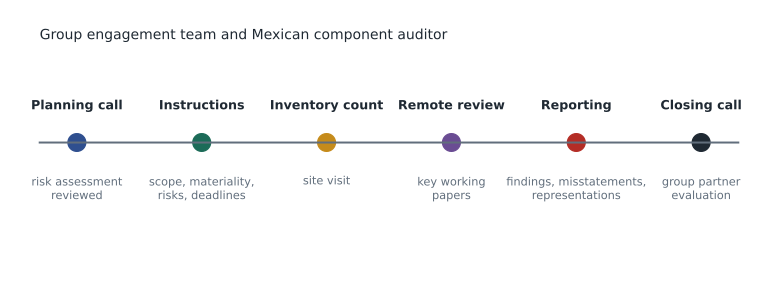
| Stage | Group team involvement for Mexico |
|---|---|
| Planning | Joint planning call; group team reviews the component auditor's risk assessment and planned responses to significant risks |
| Instructions | Written instructions covering scope, component performance materiality of 578,000, clearly trivial of 70,000, risks, independence requirements, reporting deadlines and required deliverables |
| Fieldwork | Senior manager visits Monterrey for the inventory count and to review key working papers on site |
| Remote review | Group team reviews working papers on revenue cut-off and inventory provisions through a secure portal |
| Completion | Component auditor sends a memorandum of findings, a summary of misstatements, control deficiencies and representations; closing call with the group partner |
Instructions should be specific about what the component auditor must report. Typically they include: confirmation of compliance with ethical and independence requirements; the work performed and conclusions; misstatements above the clearly trivial threshold, corrected and uncorrected; deficiencies in internal control; non-compliance with laws and regulations; indications of fraud or suspected fraud; related parties and related party transactions; events or conditions that may cast doubt on going concern; and significant matters discussed with management. Reporting deadlines should leave the group team time to evaluate the results before the group report is dated.
Review of the component auditor's working papers is a judgment. It is expected where the group team is responsible for direction and supervision and a component carries significant risks, and the standards contemplate that it may be done remotely through technology rather than by travel. What matters is that the group team obtains evidence on how the component auditor responded to the risks, not only the conclusions.
Auditing the consolidation
The consolidation process combines the components' financial information into the group statements. It is a frequent source of error because many adjustments are made at head office, often manually, by a small team at year end. The group engagement team must understand the process, including group-wide controls over it, and design procedures to respond to the risks it creates. Typical risks include incomplete elimination of intercompany transactions and balances, unrealized profit in inventory bought from other group companies, incorrect foreign currency translation, inconsistent accounting policies at components, and manual consolidation journals posted without review.
Intercompany balances should agree between counterparties, after allowing for items in transit. The program reconciles Tamarack's main intercompany pairs at December 31, 2026, translating the Mexican subsidiary's peso payable at the closing rate, and then checks the translation of the Mexican income statement and net assets.
# Intercompany reconciliation at December 31, 2026 (invented balances, thousands of dollars).
# Mexican balances are recorded in pesos and translated at the closing rate.
closing_rate = 0.0560          # dollars per peso at year end (illustrative)
trivial = 70

pairs = [   # (counterparty A, A's receivable, counterparty B, B's payable as recorded by B)
    ("Parent -> Distribution", 18_420, "dollars", 18_420),
    ("Parent -> Mexico", 6_150, "pesos", 109_700),       # Mexico records its payable in pesos
    ("Distribution -> Snacks", 2_960, "dollars", 2_745),
    ("Mexico -> Parent", 1_380, "dollars", 1_380),
    ("Snacks -> Parent", 870, "dollars", 702),
]
explained = {"Distribution -> Snacks": ("Goods in transit shipped Dec 30", 215)}

print(f"{'Pair':<24}{'Receivable':>11}{'Payable':>10}{'Difference':>12}  Status")
for pair, recv, cur, pay in pairs:
    pay_dollars = pay * closing_rate if cur == "pesos" else pay
    diff = recv - pay_dollars
    if abs(diff) <= trivial:
        status = "within clearly trivial"
    elif pair in explained and abs(diff - explained[pair][1]) <= trivial:
        status = "explained: " + explained[pair][0]
    else:
        status = "INVESTIGATE"
    print(f"{pair:<24}{recv:>11,.0f}{pay_dollars:>10,.0f}{diff:>12,.0f}  {status}")

# Translation check for Mexico's income statement and balance sheet (pesos in thousands).
avg_rate = 0.0565
revenue_mxn, pretax_mxn, net_assets_mxn = 1_026_500, 72_570, 523_000
print(f"\nMexico revenue at average rate: {revenue_mxn * avg_rate:,.0f}")
print(f"Mexico pre-tax income at average rate: {pretax_mxn * avg_rate:,.0f}")
print(f"Mexico net assets at closing rate: {net_assets_mxn * closing_rate:,.0f}")
wrong = revenue_mxn * closing_rate
print(f"Revenue if the closing rate were used in error: {wrong:,.0f} (difference {wrong - revenue_mxn*avg_rate:,.0f})")Pair Receivable Payable Difference Status Parent -> Distribution 18,420 18,420 0 within clearly trivial Parent -> Mexico 6,150 6,143 7 within clearly trivial Distribution -> Snacks 2,960 2,745 215 explained: Goods in transit shipped Dec 30 Mexico -> Parent 1,380 1,380 0 within clearly trivial Snacks -> Parent 870 702 168 INVESTIGATE Mexico revenue at average rate: 57,997 Mexico pre-tax income at average rate: 4,100 Mexico net assets at closing rate: 29,288 Revenue if the closing rate were used in error: 57,484 (difference -513)
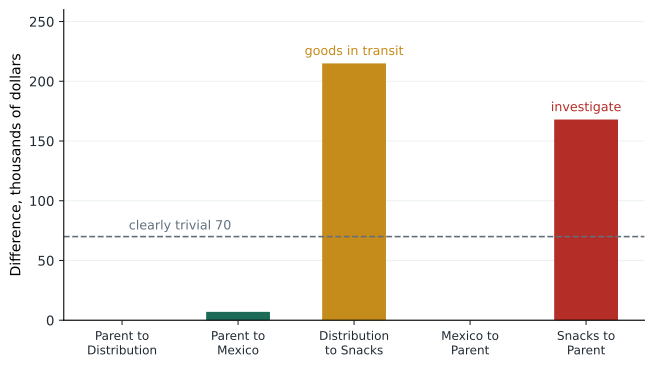
Three pairs agree within the clearly trivial threshold. The distribution-to-snacks difference of 215,000 dollars is explained by goods shipped on December 30 and received in January, which the team verifies by examining the shipping documents and the January receiving report, and then confirms that the inventory is included in the consolidated statements once and only once. The snacks-to-parent difference of 168,000 dollars has no explanation yet and is above clearly trivial, so the team investigates; it turns out to be a management fee charged by the parent in December that the snacks subsidiary did not record. Because the parent recorded income and receivable, the elimination still nets to zero on consolidation, but the snacks subsidiary's own statements are misstated, which matters for its standalone reporting and for the specified procedures there.
Translation follows the group framework. Income and expense items of the foreign operation are translated at average rates for the period, where averages approximate the actual rates, and assets and liabilities at the closing rate, with the difference recognized in other comprehensive income. The last lines of the program show that using the closing rate for Mexican revenue in error would change revenue by about half a million dollars this year, because the peso moved only slightly between the average and the year end; in a year with a large currency movement the same error could be material.
Accounting policy alignment needs its own procedures. The Mexican subsidiary's local books follow Mexican Financial Reporting Standards, and head office converts them in the consolidation package with adjustments for leases, inventory costing and employee benefits. The group team tests the conversion adjustments directly, because the component auditor's statutory work addresses the local framework, not the group framework, unless the instructions require otherwise.
Evaluating the work and communicating findings
At the end, the group engagement team evaluates whether sufficient appropriate evidence has been obtained from the work at components, the consolidation and group-level procedures. It accumulates misstatements from all sources, including those reported by component auditors, and evaluates them against group materiality, considering both their individual size and their total. It considers whether control deficiencies reported by component auditors are deficiencies of group-wide controls that need to be communicated to group management and those charged with governance.
The group team must also communicate with group management and those charged with governance about the group audit: an overview of the work to be performed at components; the nature of the group team's involvement with component auditors; concerns about the quality of a component auditor's work; any limitations on the group audit; and fraud or suspected fraud involving group or component management. For Tamarack, the audit committee receives a scoping summary at planning and a report at completion that includes the Mexican findings and the unrecorded management fee.
The auditor's report on group financial statements
Under CAS 600 (Revised), the group engagement partner takes sole responsibility for the group audit opinion. The auditor's report on the group financial statements does not refer to a component auditor unless law or regulation requires it. If it does, the report must make clear that the reference does not reduce the group engagement partner's responsibility. This approach places the full burden on the group team to direct, supervise and review component work; there is no option to share responsibility by reference.
Whatever the reporting approach, the group auditor's responsibilities for planning and evaluating the overall audit remain. A group partner who signs an opinion without understanding how the work at a material foreign component was performed has not met them, whether or not the report mentions another firm.
Worked problem
An unexplained intercompany difference
The program shows a 168,000-dollar difference between the parent's receivable from snacks and the snacks subsidiary's payable. What should the group team do?
Show solution
- The difference exceeds the 70,000-dollar clearly trivial threshold, so it must be investigated.
- Obtain the detail of both balances and match the items; the unmatched item is a December management fee.
- Determine which side is wrong: the snacks subsidiary failed to record the fee.
- Consider the consolidated effect (nil after elimination) and the standalone effect on snacks; record a misstatement for the component and report it to management.
Answer: Investigate, identify the unrecorded management fee, and accumulate the misstatement for the snacks subsidiary while noting it eliminates on consolidation.
Common mistakes
MistakeAccepting a general independence confirmation from a component auditor.
InsteadAsk specific questions based on the independence rules that apply to the group audit.
MistakeSending generic instructions that do not mention the component's significant risks.
InsteadTailor instructions to the risks, materiality amounts, reporting requirements and deadlines.
MistakeRelying on the component auditor's statutory work for the group framework.
InsteadTest the conversion from the local framework to the group framework, or instruct the component auditor to do so.
MistakeIgnoring intercompany differences because they eliminate on consolidation.
InsteadInvestigate differences above clearly trivial; one side may be misstated and the cause may affect other balances.
MistakeTranslating foreign income at the closing rate.
InsteadUse average rates for income and expenses where they approximate actual rates, and closing rates for assets and liabilities.
MistakeReferring to a component auditor in a Canadian group audit report to share responsibility.
InsteadUnder CAS 600 the group partner takes sole responsibility; references are made only when law requires them.
Summary and key terms
- Component auditors are part of the engagement team; the group partner directs, supervises and reviews their work.
- Independence and competence of component auditors must be evaluated with specific evidence.
- Instructions specify scope, materiality, risks, required communications and deadlines.
- Involvement in a component with significant risks is close, including review of working papers, on site or remotely.
- The consolidation is audited for eliminations, translation, policy alignment and manual journals.
- Intercompany differences above clearly trivial are investigated even if they eliminate.
- Group teams communicate scoping, involvement and concerns to management and those charged with governance.
- Under CAS the group partner takes sole responsibility; the report does not refer to component auditors unless law requires it.
- Component auditor instructions
- Written communication from the group team setting out the work, materiality, risks, reporting and deadlines for a component.
- Consolidation adjustment
- An entry made at group level, such as an intercompany elimination or translation adjustment.
- Intercompany elimination
- Removal of transactions and balances between group entities so the group is presented as one entity.
- Unrealized intercompany profit
- Profit on goods sold between group entities that remain in inventory at the reporting date.
- Closing rate
- The exchange rate at the reporting date.
- Average rate
- An exchange rate approximating the rates on transaction dates during the period.
Practice problems
Work each problem on paper first, then reveal the answer to check.
List four items a component auditor should report to the group team.
Show answer
Misstatements above clearly trivial; control deficiencies; fraud or suspected fraud; going concern concerns. Others: non-compliance, related parties, independence confirmation.
Why did Hollis Ward send a questionnaire rather than accept a confirmation?
Show answer
Specific questions are more likely to reveal non-audit services, fees or relationships that impair independence.
In the program, which pairs need investigation?
Show answer
Only snacks to parent: 168,000 dollars, unexplained and above clearly trivial.
Change the closing rate to 0.0700 and rerun. What happens to the Mexico pair?
Show answer
The translated payable rises to about 7,679, creating a negative difference of about 1,529 to investigate, and net assets rise.
Why must the conversion from Mexican standards be tested?
Show answer
The statutory audit addresses the local framework, while the group statements use a different framework.
What is unrealized intercompany profit?
Show answer
Profit on goods sold between group companies that are still in inventory at the reporting date; it must be eliminated.
When may a Canadian group auditor refer to a component auditor in the report?
Show answer
Only when law or regulation requires it, with wording that the reference does not reduce the group auditor's responsibility.
What do group teams communicate to those charged with governance about component auditors?
Show answer
The nature of involvement, concerns about the quality of their work, limitations, and fraud involving component management.
Why is the consolidation a frequent source of error?
Show answer
Many adjustments are manual, made by a small team at year end, outside normal transaction controls.
What makes review of component working papers more necessary?
Show answer
Significant risks at the component, less experience with the component auditor, or concerns about its competence.
Lesson quiz · 5 questions
Score 60% or more to complete this lesson.
Create a free account to save your progress, take quizzes and earn a certificate.