
ACCT-431 · Lesson 10 of 12 · 25 min
Compilation engagements under CSRS 4200
At the bottom of the assurance ladder are engagements that provide no assurance at all. A practitioner helps management prepare financial statements or other financial information from the entity's records, and reports, or in some cases does not report, without expressing any conclusion on whether the information is fairly presented. These engagements are among the most common work in small practices, and they carry their own risks: users may assume that a professional accountant's name means the numbers have been checked, and practitioners can drift into making management's decisions for them. This lesson uses Larch Street Bakery, a small family bakery that Hollis Ward's small business group serves, and returns to Kestrel Landscaping from lesson 9.
The standards
In Canada, compilation engagements are performed under CSRS 4200, Compilation Engagements, effective for periods ending on or after December 14, 2021. It replaced the long-standing Section 9200, under which practitioners attached a brief notice to reader, commonly called an NTR, to compiled statements. CSRS 4200 applies whenever a practitioner is engaged to assist management in preparing and presenting financial information, including financial statements, a single statement or other historical financial information, without obtaining assurance. Firms performing compilations are subject to CSQM 1.
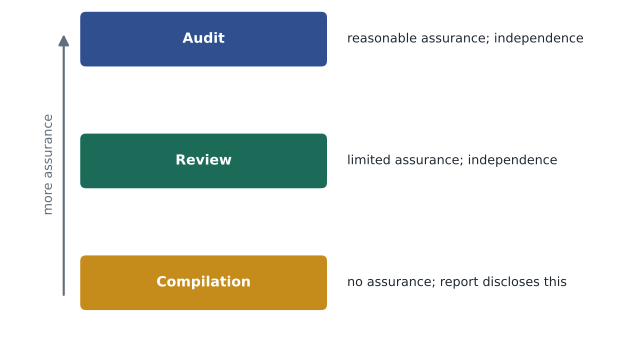
| Audit | Review | Compilation (CSRS 4200) | Management prepares alone | |
|---|---|---|---|---|
| Assurance | Reasonable | Limited | None | None |
| Report | Auditor's report | Review report | Compilation engagement report | None by a practitioner |
| Independence | Required | Required | Not required; lack of independence disclosed in the report | Not applicable |
| Evidence about amounts | Yes | Inquiry and analytics | No | No |
What the practitioner does
In a CSRS 4200 compilation, the practitioner: agrees the terms of the engagement with management, including the intended use of the compiled information and the basis of accounting; obtains an understanding of the entity's business and operations, its accounting system and records, and the basis of accounting; compiles the financial information using the records, documents, explanations and other information provided by management; discusses with management any significant judgments the practitioner helped make; reads the compiled information in light of the practitioner's understanding to consider whether it appears appropriate and not materially misstated; and obtains management's acknowledgment of its responsibility for the compiled information before the report is dated. The practitioner does not verify the accuracy or completeness of the information provided, test controls or seek evidence.
A key limit applies in both countries. If the practitioner becomes aware that information provided by management is incorrect, incomplete or otherwise unsatisfactory, or that the compiled statements are materially misstated or misleading, the practitioner must ask management to correct it, and if management refuses, withdraw from the engagement. A professional accountant must not be associated with information he or she knows or ought to know is false or misleading, even when no assurance is given.
Basis of accounting and the intended use
CSRS 4200 does not require compiled financial statements to follow a general purpose framework such as ASPE. Management may select a basis of accounting that suits the intended use, such as a cash basis, the historical cost basis used for tax filings, or ASPE with some departures. The compiled information must describe the basis in a note, and the practitioner's report refers to that note. Before accepting, the practitioner considers whether the intended use and users make the selected basis appropriate: statements compiled on a tax basis for the owner's tax filing raise little concern; the same statements given to a landlord evaluating a lease guarantee may mislead if the landlord expects ASPE.
Larch Street Bakery needs annual statements for its income tax filing and, this year, for a landlord who is considering extending its lease and wants to see two years of results. The owner, Mira Santos, keeps her books in an accounting package; Hollis Ward's staff accountant makes year-end adjustments for amortization, accrued payroll and inventory, and prepares the statements.
Choosing the engagement
The decision about which engagement to perform depends on the assurance users need, whether the practitioner prepares the statements, whether a report is wanted, and independence. The program encodes a simplified version of that decision for the four situations Hollis Ward meets with its small clients.
# Which engagement and report? A decision aid for small-entity financial statement work (Canada).
def engagement(assurance_needed, practitioner_compiles, independent, third_party_users):
    if assurance_needed == "limited":
        return "Review engagement under CSRE 2400", "review engagement report; independence required"
    if assurance_needed == "reasonable":
        return "Audit under CAS", "auditor's report; independence required"
    if practitioner_compiles:
        notes = ["compilation engagement report (no assurance)", "basis of accounting described in a note"]
        if not independent:
            notes.append("report must disclose that the practitioner is not independent")
        if third_party_users:
            notes.append("consider whether the basis of accounting suits the third party's needs")
        return "Compilation engagement under CSRS 4200", "; ".join(notes)
    return "Management prepares statements itself", "no engagement report"

cases = [
    ("Bank lender wants assurance on Kestrel's statements", "limited", False, True, True),
    ("Bakery owner needs statements for tax filing", None, True, True, False),
    ("Bakery: practitioner also keeps the books and has a family loan", None, True, False, True),
    ("Shareholder agreement requires an audit", "reasonable", False, True, True),
]
for label, a, comp, ind, tp in cases:
    kind, report = engagement(a, comp, ind, tp)
print(f"{label}\n -> {kind}: {report}")Bank lender wants assurance on Kestrel's statements -> Review engagement under CSRE 2400: review engagement report; independence required Bakery owner needs statements for tax filing -> Compilation engagement under CSRS 4200: compilation engagement report (no assurance); basis of accounting described in a note Bakery: practitioner also keeps the books and has a family loan -> Compilation engagement under CSRS 4200: compilation engagement report (no assurance); basis of accounting described in a note; report must disclose that the practitioner is not independent; consider whether the basis of accounting suits the third party's needs Shareholder agreement requires an audit -> Audit under CAS: auditor's report; independence required
For Kestrel, the bank wants assurance, so a review is required, and Hollis Ward must be independent. For the bakery's tax filing, a compilation engagement under CSRS 4200 is appropriate, with the basis of accounting described in a note. The third case raises independence. Hollis Ward's staff accountant keeps the bakery's books throughout the year, and one of the firm's partners has lent money to the owner's family. Independence is not required for a compilation, but CSRS 4200 requires the report to disclose that the practitioner is not independent; the firm must also be satisfied that the threats created by the loan and the bookkeeping do not compromise its objectivity in a way that would make the engagement inappropriate. Because the landlord will rely on the statements, the firm also considers whether the tax-based basis of accounting is appropriate for that use and discusses with the owner whether to compile a second set using ASPE.
The report
A CSRS 4200 report is titled Compilation Engagement Report and is addressed to management or as the engagement letter specifies. It identifies the compiled information, states that the practitioner compiled it based on information provided by management, refers to the note describing the basis of accounting, states that the practitioner did not perform an audit or review and was not required to verify the accuracy or completeness of the information, and therefore does not express an opinion or conclusion or provide any form of assurance. It warns readers that the compiled information may not be appropriate for their purposes. If the practitioner is not independent, the report says so. Each page of the compiled information refers to the report, often with the words Unaudited: see compilation engagement report.
Changing the level of service
Clients sometimes ask to change the engagement after it has started. A request to move from an audit or review to a compilation, for example because a lender has dropped its requirement for assurance, is acceptable if there is a reasonable justification, such as a genuine change in users' needs or a misunderstanding about the service required. It is not acceptable if the real reason is to avoid an expected modified opinion or conclusion, or because management has refused to provide information or representations the practitioner needs. A practitioner who agrees to the change does not refer in the new report to the original engagement or to procedures already performed, because doing so would imply an assurance the new engagement does not provide.
The reverse change, from a compilation to a review or audit, usually happens when a new user arrives, such as a buyer conducting due diligence or a lender for a larger facility. The practitioner must then satisfy the stricter requirements from the start of the period, which may be impossible for some matters: opening inventory that was never counted by anyone independent, for instance, can force a qualified opinion in the first audited year. Small business clients who expect to grow benefit from advice about this early, and the practitioner should explain in plain language, at acceptance and in the engagement letter, what each level of service does and does not provide. For Larch Street Bakery, Hollis Ward explains that if the landlord later insists on assurance, a review of the following year would be possible, but the current compiled statements would remain unreviewed.
Related services and responsibilities that never go away
Compilation engagements sit within a broader family of related services that also includes agreed-upon procedures engagements, covered in lesson 11. All of them share an important principle: the professional accountant's ethical obligations apply in full even when no assurance is given. The practitioner must be competent, must not accept an engagement for which the firm lacks the resources, must not assume management's responsibilities, and must not be associated with misleading information. Inspection findings in compilation practices often concern exactly these points: compiled statements with obvious errors, such as negative inventory or unbalanced equity reconciliations, that should have been caught by reading them, or practitioners who effectively ran the client's finances.
Compilation work also brings practical risks for small firms. Clients often provide incomplete records at the last minute; the practitioner must ask for what is missing rather than fill gaps with guesses presented as management's numbers. Year-end adjustments the practitioner proposes must be explained to and approved by management. And documentation should show the understanding obtained, the significant judgments discussed, the reading of the statements and management's acknowledgment, so that the file supports the report if questioned by a practice inspector, a lender or a court.
Worked problem
A compiled statement that looks wrong
While reading Larch Street Bakery's compiled balance sheet, the staff accountant notices that inventory is negative 4,200 dollars and the owner's equity does not reconcile with last year's closing balance plus income and drawings. What should the practitioner do?
Show solution
- Negative inventory and an equity difference indicate that the information is incorrect or incomplete.
- Even in a compilation, the practitioner must not be associated with information that appears materially misstated.
- Ask management for corrected information: an inventory count and an explanation of the equity difference.
- If management does not correct it, withdraw from the engagement.
Answer: Request corrections; if they are not made, withdraw rather than issue a report.
Common mistakes
MistakeAssuming a compilation report gives limited assurance.
InsteadA compilation provides no assurance; the report says so explicitly.
MistakeIssuing a compilation report on statements that appear obviously wrong.
InsteadRead the statements; request corrections and withdraw if management will not correct them.
MistakeIgnoring the intended use and users when accepting.
InsteadConsider whether the basis of accounting is appropriate for the users who will rely on the information.
MistakeTreating independence as irrelevant.
InsteadIndependence is not required, but a lack of it must be disclosed, and objectivity must not be compromised.
MistakeMaking year-end adjustments without management's approval.
InsteadDiscuss significant judgments with management and obtain its acknowledgment of responsibility.
MistakeUsing the old notice to reader (NTR) wording.
InsteadUse the CSRS 4200 Compilation Engagement Report.
Summary and key terms
- CSRS 4200 replaced the notice to reader for periods ending on or after December 14, 2021.
- Compilations provide no assurance and involve no verification of the information.
- The practitioner reads the compiled information and requests corrections when it appears misstated.
- A practitioner must withdraw rather than be associated with false or misleading information.
- The basis of accounting is described in a note and must suit the intended use.
- Independence is not required, but a lack of independence is disclosed.
- Management acknowledges its responsibility for the compiled information.
- Ethical obligations and quality management apply in full even without assurance.
- Compilation engagement report
- The CSRS 4200 report stating that the practitioner compiled the information and provides no assurance.
- Compilation engagement
- An engagement to assist management in preparing financial information without obtaining assurance.
- Related services
- Engagements such as compilations and agreed-upon procedures that provide no assurance.
- Basis of accounting
- The accounting principles management uses to prepare the compiled information.
- Association
- Connection of a practitioner's name with financial information, which creates professional responsibilities.
- Management's acknowledgment
- Management's confirmation of its responsibility for the compiled information.
Practice problems
Work each problem on paper first, then reveal the answer to check.
What level of assurance does a compilation provide?
Show answer
None.
What replaced the notice to reader (NTR) in Canada?
Show answer
CSRS 4200, Compilation Engagements.
What must the practitioner do if compiled statements appear materially misstated?
Show answer
Request corrections; if refused, withdraw.
In the program, which case requires independence?
Show answer
The review for Kestrel and the audit required by the shareholder agreement.
Change the third bakery case so that the practitioner is independent. What disappears from the report notes?
Show answer
The requirement to disclose that the practitioner is not independent.
Why does the landlord's use matter?
Show answer
The basis of accounting may not suit a user who expects general purpose statements.
Give two inspection findings common in compilation practices.
Show answer
Obvious errors not caught by reading the statements; practitioners assuming management responsibilities.
What must management acknowledge?
Show answer
Its responsibility for the compiled information, including the basis of accounting and the information provided.
Is the practitioner required to verify the bakery's inventory?
Show answer
No; a compilation involves no verification, though obviously wrong amounts must be questioned.
Why does documentation matter in a compilation?
Show answer
It supports the report against questions from inspectors, users or courts.
Lesson quiz · 5 questions
Score 60% or more to complete this lesson.
Create a free account to save your progress, take quizzes and earn a certificate.