
ACCT-331 · Lesson 7 of 12 · 30 min
Audit evidence and procedures
The auditor's opinion is only as good as the evidence behind it. Earlier lessons set the target: materiality tells the auditor what size of misstatement matters, and the risk assessment tells it where misstatements are likely. This lesson turns to the evidence itself: what management claims in its statements, what makes evidence sufficient and appropriate, which procedures produce it, and how the auditor uses analytics, data and the work of others. It also introduces the audit of accounting estimates and journal entry testing, two areas regulators cite again and again. The examples use Fairhaven's payroll, general ledger and inventory, setting up the detailed transaction-cycle work in lessons 9 and 10.
Management's assertions
When management presents financial statements, it implicitly makes assertions about the recognition, measurement, presentation and disclosure of each item. If the balance sheet shows inventory of 38,500, management is asserting that the inventory exists, that the company owns it, that all of it is included, that it is valued properly, and that it is properly classified and disclosed. The auditor uses assertions to think about the different kinds of misstatement that could occur, and designs procedures to obtain evidence about each relevant one.
| Assertion | Classes of transactions (income statement) | Account balances (balance sheet) |
|---|---|---|
| Occurrence / existence | Recorded transactions actually happened and relate to the entity | Assets, liabilities and equity exist |
| Completeness | All transactions that should be recorded are recorded | All assets, liabilities and equity that should be recorded are recorded |
| Accuracy / valuation and allocation | Amounts are recorded appropriately | Balances are included at appropriate amounts, with valuation adjustments recorded |
| Cut-off | Transactions are recorded in the correct period | (Tested through related transactions) |
| Classification | Transactions are recorded in the proper accounts | Balances are recorded in the proper accounts |
| Rights and obligations | The entity holds rights to assets; liabilities are its obligations | |
| Presentation | Transactions are appropriately aggregated, described and disclosed | Balances are appropriately aggregated, described and disclosed |
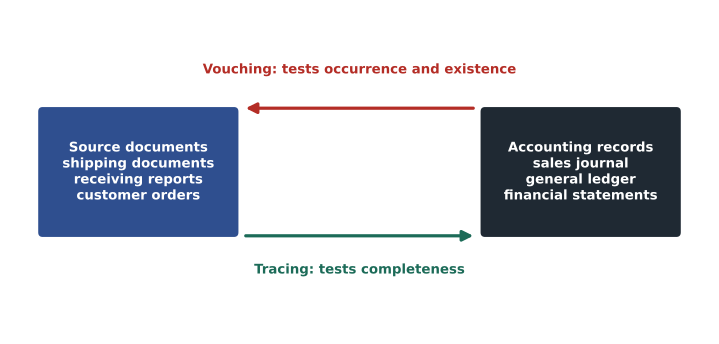
Direction matters. Tests that start from the recorded entries and go back to source documents (vouching) give evidence about occurrence or existence: did the recorded sale really happen? Tests that start from source documents and trace forward to the records (tracing) give evidence about completeness: was every shipment recorded? Overstatement of assets and revenue is usually the bigger risk, because management has more incentive to overstate them; for liabilities and expenses, understatement, and therefore completeness, is usually the greater concern.
Sufficient appropriate evidence
Auditing standards require sufficient appropriate audit evidence. Sufficiency is about quantity: how much evidence is needed depends on the assessed risk and on the quality of the evidence. Appropriateness is about quality: evidence must be relevant to the assertion being tested and reliable. Relevance depends on the direction of testing and the assertion; confirming a receivable with the customer gives good evidence of existence, but little about valuation, since a customer can confirm a debt it will never pay.
Reliability depends on the source and nature of the evidence and the circumstances in which it is obtained. Several generalizations hold, subject to exceptions.
- Evidence from independent sources outside the entity is more reliable than evidence from inside it.
- Evidence generated internally is more reliable when the related controls are effective.
- Evidence obtained directly by the auditor, such as observing a control, is more reliable than evidence obtained indirectly or by inference.
- Documentary evidence, on paper or electronic, is more reliable than oral evidence.
- Original documents are more reliable than photocopies, scans or other reproductions, whose reliability depends on the controls over their creation.
The auditor must also consider the reliability of information produced by the entity (IPE), such as a system-generated aging report. Before using a report, the auditor obtains evidence about its accuracy and completeness, for example by testing the report's logic or reconciling it to the general ledger. A beautifully analyzed report built on incomplete data provides no assurance.
CAS 500 sets out the requirements for audit evidence. The IAASB issued a revised ISA 500 in 2025, focusing on the auditor's evaluation of information intended to be used as evidence and on the use of technology; Canadian adoption as revised CAS 500 is expected to follow (as of October 2026).
Types of audit procedures
Auditors obtain evidence through a limited set of techniques, combined in different ways.
| Procedure | What it involves | Fairhaven example |
|---|---|---|
| Inspection of records or documents | Examining internal or external records | Reading the new bank loan agreement for covenants |
| Inspection of tangible assets | Physically examining assets | Test counts at the year-end inventory count |
| Observation | Watching a process or procedure being performed | Observing count teams follow count instructions |
| External confirmation | A direct written response from a third party | Bank confirmation; wholesale customer receivable confirmations |
| Recalculation | Checking the mathematical accuracy of documents or records | Recalculating depreciation on store fixtures |
| Reperformance | Independently executing a procedure or control | Reperforming the December bank reconciliation |
| Analytical procedures | Evaluating plausible relationships among data | Expectation of payroll from headcount and rates |
| Inquiry | Seeking information from knowledgeable people | Asking the merchandising director about slow-moving styles |
Substantive procedures fall into two broad groups. Tests of details examine individual transactions or balances: vouching sales to shipping documents, confirming receivables, counting inventory. Substantive analytical procedures develop an expectation of what a balance should be and compare it with the recorded amount. Analytics are usually more efficient for large volumes of transactions that are predictable over time, such as payroll, rent or interest. Tests of details are usually needed for balances that are not predictable, for significant risks, and for assertions such as existence and rights that analytics address poorly.
Substantive analytical procedures
A substantive analytical procedure has four steps. Develop an independent expectation, using data the auditor has tested or that comes from reliable sources. Define the difference that can be accepted without further investigation, which depends on materiality and the desired level of assurance. Compare the recorded amount with the expectation. Investigate significant differences by inquiry and corroborating evidence. The precision of the expectation determines how much assurance the procedure provides: an expectation based on disaggregated, independent, reliable data is far more persuasive than a comparison with last year's total.
# A substantive analytical procedure: expectation for store payroll expense (thousands of dollars)
headcount_avg = {2025: 590, 2026: 610}          # average employees, from HR records
wage_increase = 0.035                           # general increase effective January 1, 2026
payroll_2025 = 38_200                           # audited
recorded_2026 = 41_000                          # per the general ledger

avg_cost_2025 = payroll_2025 / headcount_avg[2025]
expected = headcount_avg[2026] * avg_cost_2025 * (1 + wage_increase)
diff = recorded_2026 - expected
threshold = 0.5 * 410                           # acceptable difference: half of performance materiality
print(f"Average cost per employee 2025: {avg_cost_2025:,.2f}")
print(f"Expected 2026 payroll: {expected:,.0f}")
print(f"Recorded 2026 payroll: {recorded_2026:,}")
print(f"Difference: {diff:,.0f}  (threshold {threshold:,.0f})")
print("Investigate the difference" if abs(diff) > threshold else "No further work needed")Average cost per employee 2025: 64.75 Expected 2026 payroll: 40,877 Recorded 2026 payroll: 41,000 Difference: 123 (threshold 205) No further work needed
The expectation, based on average headcount from tested HR records and the 3.5 per cent wage increase approved by the board, is within about 0.2 million of the recorded amount, inside the threshold of half of performance materiality. The auditor can conclude that payroll expense is not materially misstated, subject to the other payroll work described in lesson 10. If the difference had exceeded the threshold, the auditor would need an explanation from management corroborated by evidence, such as a one-time bonus approved in the board minutes, not simply management's word.
Data analytics and technology
Audit data analytics let auditors test 100 per cent of a population for particular characteristics, rather than sampling. A team can extract all of Fairhaven's 2026 sales invoices and compare them to shipping records automatically, match every purchase invoice to purchase orders and receiving reports, or list every journal entry posted by a senior user on a weekend. Analytics change how evidence is obtained, but not what the auditor must conclude: exceptions identified by an analytic still need investigation, and the auditor must still evaluate the reliability of the data and the tool. Firms increasingly use AI tools to read contracts or summarize documents; regulators expect firms to evaluate those tools under their quality management systems and auditors to review the output with the same scepticism as any other evidence (as of October 2026).
Journal entry testing
Because management override of controls is always a significant risk, every audit includes testing the appropriateness of journal entries recorded in the general ledger and other adjustments made in preparing the statements. The auditor understands the entity's process for recording entries, identifies characteristics of fraudulent entries, selects entries for testing (especially those made at the end of the period), and examines support for them. Common risk characteristics include entries by senior management or unexpected users, entries to unusual or seldom-used accounts, entries at the end of the period or after closing, round-number entries, and entries with little or no explanation.
# Journal entry testing: screening Fairhaven's general ledger for unusual entries
import random
random.seed(2026)
users = ["ap_clerk1", "ap_clerk2", "ar_clerk", "payroll", "controller", "cfo", "sys_batch"]
entries = []
for i in range(1, 2401):
    u = random.choice(users[:4] + ["sys_batch"] * 6)
    amt = round(random.lognormvariate(8, 1.4))
    day = random.randint(1, 365)
    entries.append({"id": i, "user": u, "amount": amt, "day": day, "weekend": day % 7 in (5, 6), "memo": "routine"})
# plant a few entries that the screens should catch
entries += [
    {"id": 2401, "user": "cfo", "amount": 250_000, "day": 365, "weekend": False, "memo": "reclass per CFO"},
    {"id": 2402, "user": "controller", "amount": 180_000, "day": 364, "weekend": True, "memo": "adjust reserve"},
    {"id": 2403, "user": "ap_clerk1", "amount": 99_000, "day": 200, "weekend": False, "memo": "routine"},
]
def flags(e):
    f = []
    if e["user"] in ("cfo", "controller"): f.append("senior user")
    if e["day"] >= 360: f.append("last week of year")
    if e["weekend"] and e["user"] != "sys_batch": f.append("manual weekend entry")
    if e["amount"] % 1000 == 0 and e["amount"] >= 50_000: f.append("large round amount")
    return f
hits = [(e, flags(e)) for e in entries if len(flags(e)) >= 2]
print(f"Entries screened: {len(entries)}")
print(f"Entries with two or more risk flags: {len(hits)}")
for e, f in hits:
print(f" JE {e['id']}: {e['amount']:>9,} by {e['user']:<10} day {e['day']}: {', '.join(f)}")Entries screened: 2403 Entries with two or more risk flags: 5 JE 950: 12,441 by ar_clerk day 362: last week of year, manual weekend entry JE 1240: 41,961 by ap_clerk2 day 363: last week of year, manual weekend entry JE 1858: 44,171 by ar_clerk day 363: last week of year, manual weekend entry JE 2401: 250,000 by cfo day 365: senior user, last week of year, large round amount JE 2402: 180,000 by controller day 364: senior user, last week of year, manual weekend entry, large round amount
The screen reduces 2,403 entries to a handful worth examining. For each, the auditor obtains the supporting documentation, considers the business rationale, and checks approval. An entry by the CFO on the last day of the year labelled "reclass per CFO" is not necessarily improper, but it is exactly the kind of entry the auditor must understand before signing.
Auditing accounting estimates
Accounting estimates, such as the allowance for doubtful accounts, inventory write-downs, warranty provisions, impairment of goodwill and fair values, combine subjectivity with incentive, and inspectors find problems with their audit more often than with any other area. CAS 540 (Revised), effective for periods beginning on or after December 15, 2019, requires the auditor to understand how management makes each estimate and to respond with one or more of three approaches.
- Test management's process: evaluate the method, test the significant assumptions and the data, and check the calculation.
- Develop an independent expectation or range, using the auditor's own model or assumptions, and compare it with management's estimate.
- Use events occurring up to the date of the auditor's report, such as subsequent collections of receivables or subsequent sales prices of inventory, which can provide strong evidence.
The auditor also evaluates whether there are indicators of management bias, such as estimates consistently at the end of a range that favours management's objectives. For Fairhaven, the inventory write-down is a significant risk. Lesson 10 develops a net realizable value test that uses January and February 2027 selling prices to check management's write-down.
Using the work of an expert and external confirmations
When the auditor uses an expert, such as a real estate appraiser to value a property, it evaluates the expert's competence, capabilities and objectivity, obtains an understanding of the field, agrees the scope of the work and evaluates the adequacy of the expert's findings, including the assumptions and data used. External confirmations, covered in detail in lesson 9, are a special category of evidence: a direct written response to the auditor from a third party is among the most reliable kinds of evidence, provided the auditor controls the process.
Worked problem
Choosing a procedure for each assertion
For Fairhaven's inventory of 38,500, match a procedure to existence, completeness and valuation.
Show solution
- Existence: select items from the inventory listing and locate them during the count (vouching from records to floor).
- Completeness: select items on the warehouse floor and trace them to the listing (tracing from floor to records).
- Valuation: compare cost with subsequent net selling prices for slow-moving styles and test the costing of finished goods.
Answer: Each assertion needs evidence in the right direction and of the right kind.
Worked problem
Reliability of evidence
Rank these for reliability: a customer's confirmation sent directly to the auditor; a customer statement provided by Fairhaven's accounts receivable clerk; the CFO's oral assurance that a balance is collectible.
Show solution
- The confirmation comes from an independent external source directly to the auditor.
- The customer statement is external in origin but passed through the client, so it could be altered.
- Oral evidence from management is the least reliable.
Answer: Confirmation, then the client-provided statement, then the oral assurance.
Common mistakes
MistakeTesting completeness by vouching from the ledger to documents.
InsteadCompleteness needs tracing from source documents to the records.
MistakeAssuming more evidence makes up for poor-quality evidence.
InsteadSufficiency cannot compensate for evidence that is irrelevant or unreliable.
MistakeUsing a client report without testing its accuracy and completeness.
InsteadTest information produced by the entity before relying on it.
MistakeAccepting management's explanation for an analytical difference without corroboration.
InsteadExplanations must be supported by evidence.
MistakeTreating a confirmed receivable as proof it is collectible.
InsteadConfirmation addresses existence, not valuation.
Summary and key terms
- Assertions describe the ways each item could be misstated: occurrence or existence, completeness, accuracy or valuation, cut-off, classification, rights and obligations, and presentation.
- Vouching tests occurrence; tracing tests completeness.
- Evidence must be sufficient (enough) and appropriate (relevant and reliable).
- External, direct, documentary and original evidence is generally more reliable.
- Substantive analytics need an independent expectation, an acceptable threshold and corroborated explanations.
- Journal entry testing responds to the risk of management override.
- Estimates are audited by testing management's process, developing an independent estimate, or using subsequent events.
- Assertion
- A representation by management about the recognition, measurement, presentation and disclosure of an item.
- Vouching
- Tracing from recorded entries back to source documents to test occurrence.
- Tracing
- Following source documents forward to the records to test completeness.
- Sufficient appropriate evidence
- Evidence that is enough in quantity and relevant and reliable in quality.
- Information produced by the entity
- Reports and data generated by the client and used by the auditor as evidence.
- Substantive analytical procedure
- Comparing a recorded amount with an independent expectation to obtain evidence.
- Test of details
- A substantive procedure examining individual transactions or balances.
- External confirmation
- Evidence obtained as a direct written response to the auditor from a third party.
- Journal entry testing
- Procedures to test entries for evidence of management override or fraud.
- Management bias
- A lack of neutrality by management in preparing information.
Practice problems
Work each problem on paper first, then reveal the answer to check.
Which assertion does vouching a sale to a shipping document address?
Show answer
Occurrence.
Which assertion is the main concern for accounts payable?
Show answer
Completeness.
Rerun the payroll analytic with 2026 average headcount of 630. Is the difference within the threshold?
Show answer
Expected about 42,217, a difference of about −1,217, so it must be investigated.
What is the threshold in the payroll analytic and how was it set?
Show answer
About 205, half of performance materiality of 410.
Rerun the journal entry screen requiring three flags. How many entries remain?
Show answer
Two: the CFO's 250,000 entry on day 365 (three flags) and the controller's 180,000 weekend entry on day 364 (four flags).
Give three characteristics of a potentially fraudulent journal entry.
Show answer
Senior or unexpected user, period-end timing, round amounts, unusual accounts or no explanation.
Why is an internally generated report less reliable than a bank confirmation?
Show answer
It is produced by the entity and could be incomplete or altered; a confirmation comes directly from an independent source.
Name the three approaches to auditing an estimate.
Show answer
Test management's process, develop an independent estimate or range, and use subsequent events.
Does a confirmation provide evidence about valuation of receivables?
Show answer
Little; it mainly addresses existence.
What must the auditor evaluate when using an expert?
Show answer
Competence, capabilities and objectivity, the scope of the work and the adequacy of findings.
Lesson quiz · 5 questions
Score 60% or more to complete this lesson.
Create a free account to save your progress, take quizzes and earn a certificate.