
ACCT-331 · Lesson 6 of 12 · 29 min
Internal control and the response to assessed risks
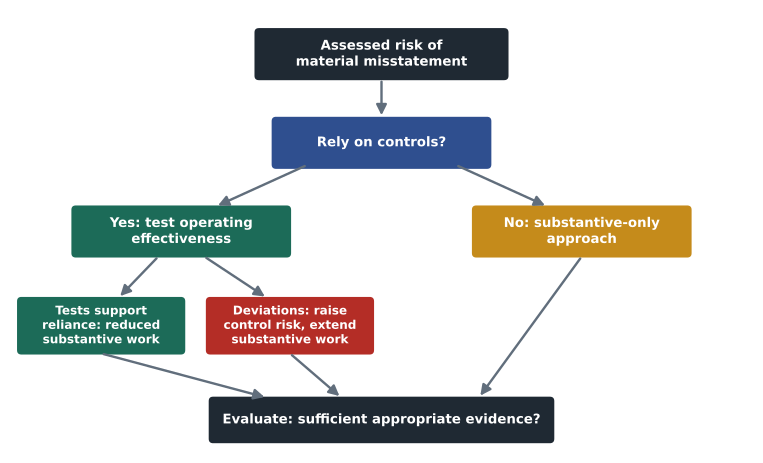
Once the auditor has assessed the risks of material misstatement, it must decide how to respond. A central choice is whether to rely on the client's internal controls. If controls are well designed and operate effectively, they reduce the risk that misstatements occur in the first place, and the auditor can do less substantive testing. If they are weak, or if testing them would cost more than it saves, the auditor relies on substantive procedures alone. ACCT-240 explained how controls are designed; this lesson looks at them from the auditor's side: how to understand them, how to test them, how to evaluate deficiencies, and how the results shape the nature, timing and extent of the rest of the audit.
The components of internal control
Most frameworks, including the COSO Internal Control – Integrated Framework (2013) used by most North American public companies, describe internal control in five components. The control environment is the foundation: the integrity and ethical values of management, the oversight provided by the board and audit committee, the organizational structure, commitment to competence and accountability. The entity's risk assessment process identifies and analyzes risks to reliable financial reporting, including fraud risk and the effect of significant changes. The information system and communication capture, process and report transactions and communicate responsibilities. Control activities are the policies and procedures that address specific risks, such as authorizations, reconciliations, segregation of duties and IT application controls. Monitoring activities, such as internal audit and management review, assess whether controls continue to operate.
CAS 315 (Revised 2019) requires the auditor to understand each component. For the control environment, risk assessment process, monitoring, and information system, the auditor evaluates whether they provide an appropriate foundation; for control activities, the auditor identifies the controls that address risks at the assertion level and evaluates their design and implementation.
The auditor documents its understanding through narratives, flowcharts and control matrices, and confirms it by performing a walkthrough: following one transaction from initiation to its recording in the general ledger, asking questions and inspecting documents and system records along the way. A walkthrough provides evidence that a control is designed appropriately and has been implemented, that is, put in place. It does not by itself show that the control operated effectively throughout the year.
IT general controls and application controls
Most of Fairhaven's transactions are processed by its enterprise resource planning (ERP) system, its point-of-sale system and the warehouse management system installed in July. Automated application controls in those systems, such as a three-way match of purchase order, receiving report and invoice, or a check that blocks a sales order above a customer's credit limit, can be highly reliable, because a computer applies the same logic every time. But they are only reliable if IT general controls (ITGCs) protect the systems: controls over access to programs and data, program changes, program development and computer operations. If anyone can change the credit limit table, the credit check means little.
| ITGC area | Example control | Risk if it fails |
|---|---|---|
| Access to programs and data | Quarterly review of user access; terminated users removed within one day | Unauthorized changes to prices, credit limits or vendor bank details |
| Program changes | Changes tested and approved before moving to production | Untested logic errors in pricing or inventory costing |
| Program development and conversion | Reconciliation of balances before and after data migration | Lost or duplicated inventory records |
| Computer operations | Monitoring of scheduled jobs and backups | Failed interfaces leave transactions unrecorded |
For the new warehouse system, the team plans to test the data conversion in July: whether opening quantities and costs in the new system agreed with the old system's closing balances, and whether the client investigated and resolved differences. Because the system changed during the year, the auditor must consider controls in both the old and the new systems for the periods each was in use. Data analytics now let auditors test entire populations of system data; CISSP-115 and other security courses cover the technical side of access controls, while this course stays with what the auditor must conclude about them.
Deciding whether to rely on controls
The auditor tests controls when it intends to rely on them to reduce substantive testing, or when substantive procedures alone cannot provide sufficient appropriate evidence, which is common where transactions are processed electronically with little or no paper trail. For high-volume, routine transactions such as retail sales through the point-of-sale system, relying on controls is usually efficient. For non-routine, judgmental items such as inventory obsolescence, substantive procedures are usually more effective.
Tests of controls provide evidence about operating effectiveness: whether the control operated as designed, consistently, throughout the period of reliance, and by people with the authority and competence to perform it. They include inquiry combined with other procedures, observation, inspection of documents for evidence of performance, and reperformance. Inquiry alone is never enough.
| Procedure | Example | Strength |
|---|---|---|
| Inquiry | Asking the credit manager how orders over the limit are handled | Weakest; never sufficient alone |
| Observation | Watching the receiving clerk count and record goods received | Good, but only for the moment observed |
| Inspection | Examining sales orders for the credit manager's approval | Good for controls that leave evidence |
| Reperformance | Independently performing the bank reconciliation the control requires | Strongest |
Sampling a control and evaluating the results
Controls that operate many times a year are usually tested on a sample. The required sample size depends on the confidence the auditor wants, the tolerable deviation rate (the maximum rate at which the control can fail and still be relied on), and the expected deviation rate. At 95 per cent confidence, a tolerable rate of 5 per cent and no expected deviations, the sample size is 59; lesson 8 shows where that figure comes from. The program below selects 59 of Fairhaven's 4,820 wholesale orders at random and evaluates two deviations found in credit approval.
# Evaluating a test of controls: credit approval on Fairhaven wholesale orders
import random
random.seed(331)
population = 4_820                     # wholesale orders in the year
n = 59                                 # sample size for 95% confidence, 5% tolerable rate, zero expected deviations
sample = sorted(random.sample(range(1, population + 1), n))
deviations = {sample[17]: "approved by sales rep, not credit manager", sample[44]: "no approval evidence"}
print(f"Sample of {n} orders from {population}; first ten order numbers: {sample[:10]}")
print(f"Deviations found: {len(deviations)}")
for k, why in deviations.items():
    print(f"  order {k}: {why}")
rate = len(deviations) / n
# Upper deviation limits at 95% confidence for n = 59 (from attribute sampling tables)
udl = {0: 0.050, 1: 0.079, 2: 0.104, 3: 0.127}
print(f"Sample deviation rate: {rate:.1%}")
print(f"Upper deviation limit at 95% confidence: {udl[len(deviations)]:.1%}")
print("Control can be relied on" if udl[len(deviations)] <= 0.05 else "Control cannot be relied on as planned; increase substantive testing")Sample of 59 orders from 4820; first ten order numbers: [185, 269, 284, 296, 298, 331, 332, 406, 667, 839] Deviations found: 2 order 1410: approved by sales rep, not credit manager order 3898: no approval evidence Sample deviation rate: 3.4% Upper deviation limit at 95% confidence: 10.4% Control cannot be relied on as planned; increase substantive testing
With two deviations, the upper deviation limit, the highest rate the auditor can say with 95 per cent confidence the population might contain, is about 10.4 per cent, above the tolerable rate of 5 per cent. The auditor cannot rely on the credit approval control as planned. It must assess control risk higher, increase substantive testing of receivables (more confirmations and more work on the allowance), and consider whether the deviations indicate a deficiency to communicate to management.
Not every control needs a large sample. Controls that operate less often require smaller samples: commonly 2 for a quarterly control, 2 to 5 for a monthly control, 5 to 15 for a weekly control and 20 to 40 for a daily control. Automated application controls may need testing only once, provided ITGCs operated effectively throughout the period, because a computer performs them identically each time.
Deficiencies in internal control
A deficiency exists when a control is designed, implemented or operated in a way that does not allow management or employees to prevent, or detect and correct, misstatements on a timely basis, or when a necessary control is missing. Deficiencies are graded by severity, considering the likelihood and magnitude of the misstatement that could result.
Under CAS 265, the auditor communicates significant deficiencies in internal control in writing to those charged with governance on a timely basis, and other deficiencies of sufficient importance to management. In addition, NI 52-109 requires the CEO and CFO of a reporting issuer to certify the design (and, for non-venture issuers, the operating effectiveness) of disclosure controls and procedures and internal control over financial reporting, and to disclose material weaknesses in the MD&A. Unlike the United States, Canada does not require an auditor's attestation on internal control; NI 52-109 certifications are management's alone (as of October 2026).
| Severity | Meaning | Communication |
|---|---|---|
| Deficiency | A control does not prevent or detect misstatements on a timely basis | To management if important enough |
| Significant deficiency | Important enough to merit the attention of those charged with governance | In writing to those charged with governance |
| Material weakness (term used in NI 52-109) | A deficiency such that there is a reasonable possibility a material misstatement will not be prevented or detected | Disclosed by management under NI 52-109; communicated by the auditor to governance |
Internal control reporting in Canada and the United States
For comparison: in the United States, Section 404(b) of the Sarbanes-Oxley Act requires the auditor of a larger public company to express an opinion on the effectiveness of internal control over financial reporting, in an integrated audit performed with the financial statement audit under PCAOB AS 2201. Canada chose not to adopt an equivalent requirement. Canadian companies that are also SEC registrants, cross-listed in the United States and above the size thresholds, must obtain a 404(b) audit for their US filings. For a purely Canadian listed company such as Fairhaven, the auditor's work on controls supports the financial statement opinion, and management's certifications under NI 52-109 stand alone.
The top-down approach used in a US integrated audit is still a useful way to think about controls in any audit: start at the financial statement level and entity-level controls, identify significant accounts and their relevant assertions, and test the controls that address the risks to those assertions. Where a controls-reliance strategy is efficient, Bramble Shaw follows the same logic for Fairhaven.
Nature, timing and extent of further procedures
The response to assessed risks is described in three dimensions. Nature is the type of procedure: tests of controls or substantive procedures, and among substantive procedures, analytics or tests of details, and which techniques (confirmation, inspection, recalculation). Timing is when procedures are performed: at an interim date or at year end; higher risks call for work at or near the year end. Extent is how much: sample sizes, the number of locations, the precision of analytics. As assessed risk rises, the auditor obtains more persuasive evidence by changing one or more of these: more reliable procedures, closer to year end, on larger samples.
Two further requirements apply regardless of the assessed risk. Every audit must include substantive procedures for each material class of transactions, account balance and disclosure, because the risk assessment is judgmental and controls have inherent limitations. And the auditor must agree the statements to the underlying records and examine material journal entries and adjustments made in preparing them.
Worked problem
Choosing a strategy for retail sales
Fairhaven's stores process about 1.2 million point-of-sale transactions a year, settled by card and cash. Should the auditor rely on controls?
Show solution
- Volumes are high and routine, and transactions are processed electronically with little paper.
- Substantive tests of details alone would be inefficient and might not give enough evidence.
- Test ITGCs over the point-of-sale system, automated controls over pricing, and daily cash and card reconciliations.
Answer: Yes. A controls-reliance strategy, supported by substantive analytics of sales by store, is efficient and effective.
Worked problem
Responding to a failed control test
The credit approval test found two deviations in 59. What changes in the audit plan?
Show solution
- Control risk for receivables valuation is assessed at maximum.
- The auditor extends substantive work: more confirmations, a detailed review of the aging and of subsequent cash receipts.
- The deficiency is evaluated for severity and communicated to management or governance.
Answer: Substantive testing of receivables increases, and the deficiency is reported.
Common mistakes
MistakeTreating a walkthrough as a test of operating effectiveness.
InsteadA walkthrough shows design and implementation; operating effectiveness needs tests over the period.
MistakeRelying on inquiry alone to test a control.
InsteadInquiry must be combined with observation, inspection or reperformance.
MistakeRelying on automated controls without testing ITGCs.
InsteadAutomated controls are reliable only if ITGCs over access and change operate effectively.
MistakeSkipping substantive procedures because controls are strong.
InsteadSubstantive procedures are required for every material class, balance and disclosure.
MistakeAssuming Canadian auditors issue an opinion on internal control.
InsteadCanada has no auditor attestation requirement; NI 52-109 certifications are management's.
Summary and key terms
- Internal control has five components: control environment, risk assessment, information and communication, control activities and monitoring.
- Walkthroughs confirm design and implementation; tests of controls show operating effectiveness.
- Automated controls depend on IT general controls over access, change, development and operations.
- A sample of 59 supports reliance at 95 per cent confidence and a 5 per cent tolerable rate if no deviations are found.
- Deficiencies are graded by likelihood and magnitude and communicated in writing when significant.
- NI 52-109 requires management certification; Canada has no auditor attestation on ICFR.
- Responses vary the nature, timing and extent of procedures; substantive procedures are always required for material items.
- NI 52-109
- The Canadian instrument requiring CEO and CFO certification of disclosure controls and ICFR.
- Control environment
- The tone, governance, structure and values that underpin internal control.
- Walkthrough
- Following a transaction from initiation to recording to confirm understanding of a process and its controls.
- IT general controls
- Controls over access, program change, development and operations that support application controls.
- Application control
- An automated or manual control over processing of specific transactions.
- Test of controls
- A procedure to evaluate the operating effectiveness of a control.
- Tolerable deviation rate
- The maximum rate of control deviations the auditor will accept and still rely on the control.
- Upper deviation limit
- The maximum population deviation rate at a given confidence level, based on sample results.
- Significant deficiency
- A deficiency important enough to merit the attention of those charged with governance.
- Material weakness
- A deficiency with a reasonable possibility that a material misstatement will not be prevented or detected on a timely basis.
- Nature, timing and extent
- The type, timing and amount of audit procedures.
Practice problems
Work each problem on paper first, then reveal the answer to check.
Name the five components of internal control.
Show answer
Control environment, risk assessment, information and communication, control activities and monitoring.
Does a walkthrough show that a control operated throughout the year?
Show answer
No; it shows design and implementation only.
Rerun the control-test program with one deviation. What is the conclusion?
Show answer
Upper deviation limit 7.9 per cent, still above 5 per cent, so the control cannot be relied on as planned.
With zero deviations in the sample of 59, what is the upper deviation limit?
Show answer
5.0 per cent, equal to the tolerable rate, so reliance is supported.
Why do automated controls need fewer test items?
Show answer
A computer applies the logic identically each time, provided ITGCs are effective.
What are the four ITGC areas?
Show answer
Access to programs and data, program changes, program development, and computer operations.
Rank inquiry, observation, inspection and reperformance from weakest to strongest.
Show answer
Inquiry, observation, inspection, reperformance.
Who certifies ICFR for a Canadian reporting issuer?
Show answer
The CEO and CFO under NI 52-109; there is no auditor attestation.
Give an example of changing the timing of procedures in response to higher risk.
Show answer
Performing receivables confirmations at year end instead of at an interim date.
Why must substantive procedures be performed even when controls are strong?
Show answer
Risk assessment is judgmental and controls have inherent limitations, including override.
Lesson quiz · 5 questions
Score 60% or more to complete this lesson.
Create a free account to save your progress, take quizzes and earn a certificate.