
ACCT-331 · Lesson 1 of 12 · 30 min
Assurance and the role of the auditor: Canadian standards and CPAB
Every day, investors, lenders, suppliers, employees and governments rely on financial statements prepared by people they will never meet. Management prepares those statements, and management also benefits when the numbers look good. An independent audit exists to close that gap. The auditor gathers evidence, forms an opinion on whether the statements are presented fairly in all material respects, and reports that opinion to the people who rely on them. This course follows a full audit from the first client meeting to the signed report. ACCT-211 and ACCT-212 taught you what the financial reporting standards require; ACCT-240 taught you how accounting systems and internal controls work. This course asks a different question: how does an outsider obtain enough evidence to say, with reasonable assurance, that someone else's statements are right? The answer draws on judgment, statistics, scepticism, ethics and law, and it is the core of the CPA profession's public-interest role.
Why audits are demanded
Three ideas explain why audits exist even where no law requires them. The first is agency theory. Shareholders and lenders (principals) hire managers (agents) to run the business, but the agents know more than the principals and may act in their own interest. Financial statements are the main way managers report on their stewardship, and an independent check on those statements reduces the agency cost of monitoring them. The second is information risk: the risk that the information used to make a decision is wrong. Users protect themselves against information risk by demanding a higher return, so a credible audit lowers the cost of capital. The third is the insurance view: auditors can be sued and carry professional liability insurance, so an audit also shifts some risk of loss from users to the auditor. Lesson 3 returns to that idea when it covers legal liability.
The information-risk argument can be made concrete. A lender that cannot rely on a borrower's statements will add a margin to the interest rate to cover the chance that the borrower is weaker than it looks. If an audit narrows that margin, the borrower may save more in interest than it pays in audit fees, before counting the benefit to shareholders, suppliers and anyone else who relies on the statements.
# Information risk: how an audit changes the interest rate a lender charges (illustrative)
loan = 46_000_000                 # Fairhaven's bank debt
spread_unaudited = 0.0325         # extra spread a lender might demand on unaudited statements
spread_audited = 0.0225           # spread on audited statements
audit_fee = 385_000               # proposed annual audit fee
saving = loan * (spread_unaudited - spread_audited)
print(f"Annual interest saved by audited statements: {saving:,.0f}")
print(f"Audit fee: {audit_fee:,.0f}")
print(f"Net benefit before other users are counted: {saving - audit_fee:,.0f}")Annual interest saved by audited statements: 460,000 Audit fee: 385,000 Net benefit before other users are counted: 75,000
The numbers are illustrative, but the logic holds for real companies: the audit is valuable because other people can rely on it. That is why the auditor's duty runs to users of the statements as a group, not just to the management team that negotiates the fee.
The running example: Fairhaven
Throughout this course we audit one invented company. Fairhaven Outdoor Gear Ltd. designs and sells outdoor clothing, tents and camping equipment through its own stores, an online shop and wholesale accounts with sporting goods chains. It is headquartered in Kelowna, British Columbia and its shares trade on the Toronto Stock Exchange. Its year end is December 31, 2026, and the audit firm, Bramble Shaw LLP, is planning that audit in the autumn of 2026. All amounts are in thousands of dollars unless stated otherwise, and all of them are invented for teaching.
| Item (thousands) | 2026 draft | 2025 audited | Change |
|---|---|---|---|
| Revenue | 184,000 | 168,000 | +9.5% |
| Cost of sales | 110,400 | 102,500 | +7.7% |
| Gross margin | 40.0% | 39.0% | +1.0 pts |
| Income before tax | 12,600 | 9,200 | +37.0% |
| Accounts receivable | 21,400 | 16,100 | +32.9% |
| Inventory | 38,500 | 31,200 | +23.4% |
| Total assets | 142,000 | 128,000 | +10.9% |
| Bank debt | 46,000 | 42,000 | +9.5% |
Even this short table raises questions an auditor would ask. Income before tax rose 37 per cent on a 9.5 per cent increase in revenue. Receivables grew more than three times as fast as revenue, and inventory more than twice as fast. These patterns may have perfectly good explanations, such as a large wholesale order shipped in December, but they are exactly the kind of signal that directs the auditor's attention. Lesson 4 turns them into a formal preliminary analysis.
Assurance and other engagements
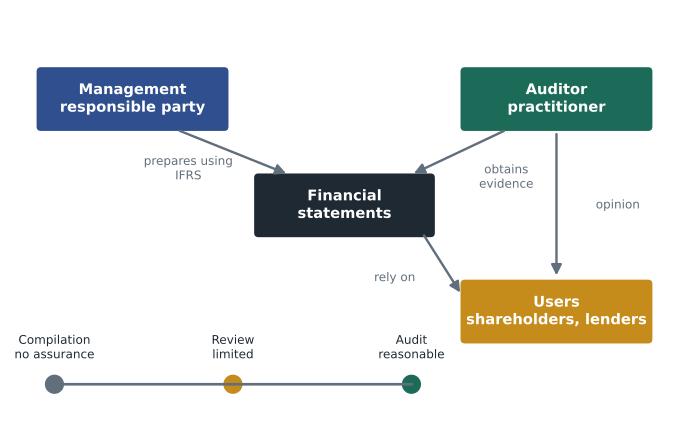
An audit is one kind of assurance engagement. In an assurance engagement, a practitioner obtains evidence about a subject matter that is the responsibility of another party, and expresses a conclusion designed to increase the confidence of intended users. Every assurance engagement has three parties: the practitioner, the responsible party (usually management) and the intended users. It also needs suitable criteria, such as IFRS or US GAAP for financial statements, against which the subject matter is measured.
Assurance comes in degrees. An audit provides reasonable assurance, a high but not absolute level, and the auditor expresses a positive opinion: the statements present fairly, in all material respects. A review provides limited assurance through mainly inquiry and analytical procedures, and the practitioner expresses a negative conclusion: nothing has come to our attention that causes us to believe the statements are not presented fairly. A compilation provides no assurance at all; the accountant helps management prepare the statements and says so.
In Canada, reviews of private-company statements follow CSRE 2400 and compilations follow CSRS 4200, which replaced the old notice-to-reader compilation framework for periods ending on or after December 14, 2021. ACCT-431 covers both in depth.
| Engagement | Level of assurance | Main procedures | Form of conclusion |
|---|---|---|---|
| Audit | Reasonable (high) | Risk assessment, tests of controls, substantive tests of details and analytics | Positive opinion |
| Review | Limited (moderate) | Inquiry and analytical procedures | Negative conclusion |
| Compilation | None | Assembling information provided by management | No conclusion; a report describing the work |
| Agreed-upon procedures | None (findings only) | Specific procedures agreed with the user | Factual findings |
Reasonable assurance and its limits
Reasonable assurance is a high level of assurance, but it is not a guarantee. Several inherent limitations mean an audit can never reduce the risk of a material misstatement to zero. Financial reporting involves estimates and judgment, such as the allowance for doubtful accounts or the write-down of slow-moving inventory, so even a perfect audit cannot make an estimate certain. The auditor tests samples rather than every transaction. Evidence is usually persuasive rather than conclusive. Management may collude with third parties to hide fraud, or override controls in ways that leave few traces. And the audit must be completed within a reasonable time and at a reasonable cost; users are not willing to pay for an audit that takes years.
The difference between what the public thinks an audit does and what auditing standards require is called the expectation gap. Many users believe an unmodified opinion means the company is financially healthy, that there is no fraud, or that every transaction was checked. None of these is true. The auditor's report itself, which lesson 12 examines line by line, tries to narrow the gap by describing the auditor's responsibilities in plain words, and both countries now require auditors of listed companies to describe the most significant matters in each audit.
Who sets the rules in Canada
In Canada, auditing standards are issued by the Auditing and Assurance Standards Board (AASB), an independent body overseen by the Auditing and Assurance Standards Oversight Council. The AASB adopts the International Standards on Auditing (ISAs) of the International Auditing and Assurance Standards Board (IAASB) as the Canadian Auditing Standards (CAS), with very few Canadian amendments. CAS 200, for example, corresponds to ISA 200. The standards are published in the CPA Canada Handbook – Assurance. Because Canada uses the international standards, a student who learns CAS has also learned the auditing framework used in more than 130 countries.
Licensing and oversight are separate from standard setting. Provincial CPA bodies license public accountants, set rules of professional conduct and run practice inspection programs for all firms. In addition, the Canadian Public Accountability Board (CPAB), created in 2003, regulates the firms that audit reporting issuers. National Instrument 52-108 Auditor Oversight requires a reporting issuer's auditor to be a participant in CPAB's oversight program and in good standing. CPAB inspects selected audit files each year, can impose requirements and restrictions on firms, and publishes its findings.
| Role | Canada | International |
|---|---|---|
| Auditing standards | AASB: Canadian Auditing Standards (CAS) | IAASB: ISAs |
| Quality management | CSQM 1 and CSQM 2 | ISQM 1 and ISQM 2 |
| Ethics and independence | Provincial CPA codes of professional conduct | IESBA Code |
| Oversight of public-company auditors | CPAB | National regulators (IFIAR) |
| Licensing | Provincial CPA bodies | National bodies |
What the regulators find
Audit regulators publish the results of their inspections, and the numbers show both progress and persistent problems. A finding means the inspectors concluded that the firm had not obtained sufficient appropriate evidence for an important part of its opinion, not necessarily that the financial statements were wrong.
# Inspection results reported by the two regulators (share of inspected audits with significant findings or Part I.A deficiencies)
cpab = {2023: 34, 2024: 24, 2025: 23}          # CPAB, all inspected files, per cent
pcaob_all = {2023: 46, 2024: 39}               # PCAOB, all inspected firms, per cent
pcaob_big4 = {2023: 26, 2024: 20}              # PCAOB, Big Four firms, per cent
print(f"{'Year':<6}{'CPAB':>8}{'PCAOB all':>12}{'PCAOB Big Four':>17}")
for y in (2023, 2024, 2025):
    a = cpab.get(y); b = pcaob_all.get(y); c = pcaob_big4.get(y)
    show = lambda v: f"{v}%" if v is not None else "n/a"
    print(f"{y:<6}{show(a):>8}{show(b):>12}{show(c):>17}")
drop = (cpab[2023] - cpab[2025]) / cpab[2023]
print(f"CPAB rate fell by {drop:.0%} of its 2023 level over two years")Year CPAB PCAOB all PCAOB Big Four 2023 34% 46% 26% 2024 24% 39% 20% 2025 23% n/a n/a CPAB rate fell by 32% of its 2023 level over two years
CPAB's 2025 annual report, published in March 2026, covered 120 inspected audit files: 23 per cent had significant findings, compared with 24 per cent in 2024 and 34 per cent in 2023. CPAB attributed the improvement partly to firms' new systems of quality management. From March 2026, CPAB also began publishing individual inspection reports for firms inspected after March 24, 2025, a significant step toward transparency (as of October 2026). Recurring themes include the audit of accounting estimates, revenue, and the work of component auditors on group audits.
Kinds of auditors
External auditors are independent public accountants engaged to report on financial statements; they are the focus of this course. Internal auditors are employees or contractors of the organization who evaluate risk management, control and governance for management and the audit committee. Their work follows the Institute of Internal Auditors' Global Internal Audit Standards, which took effect in January 2025. External auditors may use internal auditors' work in some circumstances, but they cannot hand over responsibility for the opinion. Government auditors examine public-sector organizations and programs, including value-for-money or performance audits that go well beyond financial statements.
At the federal level in Canada, the Office of the Auditor General of Canada audits the Government of Canada's financial statements and reports to Parliament on the performance of federal programs; each province has its own auditor general.
The audit process at a glance
Every audit, whatever its size, follows the same broad sequence. The auditor first decides whether to accept or continue with the client and agrees the terms of the engagement (lesson 4). Next comes planning and risk assessment: understanding the entity and its environment, setting materiality and identifying the risks of material misstatement (lessons 4 to 6). The auditor then designs and performs further audit procedures that respond to those risks: tests of controls and substantive procedures (lessons 6 to 10). Finally, the auditor completes the audit, evaluates the misstatements found and the overall presentation, and issues the report (lessons 11 and 12). Throughout, the auditor applies professional scepticism, documents the work and complies with ethical requirements (lesson 2).
| Phase | Main activities | Lessons |
|---|---|---|
| Acceptance and continuance | Ethics, independence, client integrity, engagement letter | 2, 4 |
| Planning and risk assessment | Understanding the entity, materiality, risks of material misstatement | 4, 5, 6 |
| Responding to risks | Tests of controls, substantive analytics, tests of details | 6 to 10 |
| Completion and reporting | Evaluating misstatements, going concern, subsequent events, the report | 11, 12 |
Worked problem
Choosing the right engagement
A small private supplier to Fairhaven needs financial statements for a $2 million bank line. The bank asks for limited assurance. The owner wants the cheapest option. Which engagement fits?
Show solution
- A compilation provides no assurance, so it does not meet the bank's requirement.
- An audit would provide reasonable assurance but costs more than the bank requires.
- A review under CSRE 2400 provides limited assurance through inquiry and analytical procedures.
Answer: A review engagement meets the bank's requirement at lower cost than an audit; the practitioner must still be independent.
Worked problem
Reading the inspection numbers
A classmate says that because 23 per cent of inspected files had significant findings, 23 per cent of public-company financial statements are wrong. Is that right?
Show solution
- Inspectors select files based on risk, so the sample is not representative of all audits.
- A finding means the evidence was insufficient, not that the statements were misstated.
- Some findings lead to restatements, but most do not.
Answer: No. The rate measures audit quality on a risk-based sample, not the error rate in financial statements.
Common mistakes
MistakeThinking an unmodified opinion guarantees the statements are error-free or the company is healthy.
InsteadAn audit gives reasonable, not absolute, assurance that the statements are free of material misstatement; it says nothing about future success.
MistakeTreating a review as a cheaper audit.
InsteadA review provides limited assurance from inquiry and analytics, with a negative-form conclusion; it is a different engagement.
MistakeAssuming Canadian auditors follow a uniquely Canadian set of standards.
InsteadCAS are the international ISAs adopted with very few changes.
MistakeConfusing internal and external auditors.
InsteadInternal auditors serve management and the audit committee; external auditors report independently to shareholders and other users.
MistakeReading regulators' finding rates as financial statement error rates.
InsteadFindings measure insufficient evidence on risk-selected files.
Summary and key terms
- An audit reduces information risk by giving users an independent opinion on management's statements.
- Agency theory, information risk and the insurance view explain the demand for audits.
- Assurance engagements involve a practitioner, a responsible party, intended users and suitable criteria.
- Audits give reasonable assurance, reviews limited assurance and compilations none.
- Inherent limitations, such as estimates, sampling and collusion, mean assurance is never absolute.
- In Canada the AASB issues CAS, provincial CPA bodies license auditors and CPAB oversees auditors of reporting issuers.
- An audit moves through acceptance, planning and risk assessment, responding to risks, and completion and reporting.
- CPAB
- The Canadian Public Accountability Board, which oversees auditors of Canadian reporting issuers.
- Assurance engagement
- An engagement in which a practitioner obtains evidence and expresses a conclusion to increase users' confidence in a subject matter.
- Reasonable assurance
- A high but not absolute level of assurance, provided by an audit.
- Limited assurance
- A moderate level of assurance, provided by a review, expressed in negative form.
- Information risk
- The risk that information used for a decision is materially wrong.
- Agency theory
- The view that monitoring is needed because agents (managers) may not act in principals' interests.
- Expectation gap
- The difference between what users expect of an audit and what auditors are required to do.
- Responsible party
- The party responsible for the subject matter, usually management.
- Suitable criteria
- Benchmarks, such as a financial reporting framework, used to evaluate the subject matter.
- Internal audit
- An independent, objective assurance and consulting activity within an organization.
- Inherent limitations
- Features of an audit, such as sampling and judgment, that prevent absolute assurance.
Practice problems
Work each problem on paper first, then reveal the answer to check.
Name the three parties in an assurance engagement.
Show answer
The practitioner, the responsible party and the intended users.
Rerun the information-risk program with an unaudited spread of 2.75 per cent. What is the net benefit?
Show answer
Saving 230,000 less fee 385,000 = −155,000; the audit would then be justified mainly by benefits to other users.
Why can an audit not provide absolute assurance?
Show answer
Estimates, sampling, persuasive rather than conclusive evidence, possible collusion or override, and time and cost constraints.
What form of conclusion does a review provide?
Show answer
A negative conclusion: nothing has come to the practitioner's attention suggesting the statements are not fairly presented.
Who issues the Canadian Auditing Standards, and on what are they based?
Show answer
The AASB; they are the IAASB's ISAs with very few amendments.
Which two Fairhaven balances grew much faster than revenue in the draft 2026 figures?
Show answer
Accounts receivable (+32.9 per cent) and inventory (+23.4 per cent).
What is the expectation gap? Give one example.
Show answer
The difference between public expectations and auditor responsibilities, for example believing every transaction was checked.
Can an external auditor rely on internal auditors' work to reduce responsibility for the opinion?
Show answer
No. The external auditor may use some of their work but remains solely responsible for the opinion.
Rerun the inspection program. By how much did the CPAB finding rate fall from 2023 to 2025, in percentage points?
Show answer
11 points, a 32 per cent reduction from the 2023 level.
In which phase of the audit does the auditor set materiality?
Show answer
Planning and risk assessment.
Lesson quiz · 5 questions
Score 60% or more to complete this lesson.
Create a free account to save your progress, take quizzes and earn a certificate.