
ACCT-331 · Lesson 5 of 12 · 28 min
Materiality and audit risk
An auditor cannot check everything, and does not need to. Users of financial statements do not care whether inventory is 38,500 thousand dollars or 38,497 thousand dollars; they care whether it is roughly right, close enough that their decisions would not change. Materiality is the concept that turns "roughly right" into a working threshold, and audit risk is the concept that tells the auditor how much evidence is enough. Together they let the auditor concentrate effort where a misstatement could matter and accept less evidence where it could not. This lesson sets materiality for the Fairhaven audit, explains the audit risk model, and introduces the significant risks and fraud risks that receive special attention throughout the rest of the course.
What materiality means
Misstatements, including omissions, are material if they, individually or in aggregate, could reasonably be expected to influence the economic decisions of users taken on the basis of the financial statements. Three ideas follow from that definition. First, materiality depends on users, assumed to have a reasonable knowledge of business and accounting and to study the statements diligently. Second, it has both quantitative and qualitative aspects; a small misstatement can be material because of its nature. Third, it applies to aggregates, so many small misstatements can add up to a material one.
Qualitative factors can make a small amount material. A misstatement that turns a loss into a profit, hides a breach of a debt covenant, affects management's bonus, conceals an illegal payment, or misstates a segment that analysts watch closely may matter more than its size suggests. In Fairhaven's case, any misstatement that would push income before tax below the 12 million bonus target, or breach the bank's debt-to-equity covenant, would be material whatever its size.
Setting overall materiality
Auditing standards do not prescribe a formula, but practice has converged on benchmarks and rules of thumb. The auditor chooses a benchmark that users focus on and applies a percentage. For a profitable commercial company, income before tax from continuing operations is the usual benchmark, typically at about 5 per cent. Where profit is volatile or close to zero, revenue (0.5 to 1 per cent) or total assets (1 to 2 per cent) may be more stable. For not-for-profit organizations, total expenses or revenues are common.
# Materiality for the Fairhaven audit (thousands of dollars)
benchmarks = {                       # benchmark: (amount, typical percentage range)
    "Income before tax": (12_600, (0.05, 0.05)),
    "Revenue":           (184_000, (0.005, 0.01)),
    "Total assets":      (142_000, (0.01, 0.02)),
    "Equity":            (64_400, (0.01, 0.02)),
}
print(f"{'Benchmark':<20}{'Amount':>10}{'Range of materiality':>24}")
for name, (amt, (lo, hi)) in benchmarks.items():
    rng = f"{amt * lo:,.0f}" if lo == hi else f"{amt * lo:,.0f} to {amt * hi:,.0f}"
    print(f"{name:<20}{amt:>10,}{rng:>24}")

overall = round(0.05 * 12_600)       # chosen benchmark: income before tax, 5 per cent
performance = round(overall * 0.65 / 10) * 10   # 65 per cent, rounded to the nearest 10
trivial = round(overall * 0.05 / 10) * 10       # clearly trivial threshold, about 5 per cent
print(f"Overall materiality: {overall}")
print(f"Performance materiality: {performance}")
print(f"Clearly trivial threshold: {trivial}")Benchmark Amount Range of materiality Income before tax 12,600 630 Revenue 184,000 920 to 1,840 Total assets 142,000 1,420 to 2,840 Equity 64,400 644 to 1,288 Overall materiality: 630 Performance materiality: 410 Clearly trivial threshold: 30
Because Fairhaven is a profitable listed company and its income before tax is a stable, closely watched figure, Bramble Shaw chooses income before tax at 5 per cent, giving overall materiality of 630 thousand dollars. The firm considers whether any users would be influenced by smaller amounts in particular classes of transactions or disclosures, such as related party transactions or directors' remuneration, and sets lower specific materiality for those.
CAS 320 deals with materiality in planning and performing an audit, and CAS 450 with evaluating misstatements identified during the audit.
Performance materiality and the clearly trivial threshold
If the auditor planned each test to find only misstatements greater than 630, several undetected misstatements just below that amount could together exceed it. To leave a margin for undetected and uncorrected misstatements, the auditor sets performance materiality below overall materiality, usually between 50 and 75 per cent of it. Lower percentages apply where the risk is higher, such as a first-year audit, a history of many misstatements, or weak controls. Bramble Shaw uses 65 per cent, giving performance materiality of 410. Performance materiality drives sample sizes and the precision of substantive analytics.
The auditor also sets a threshold below which misstatements are clearly trivial and need not be accumulated, commonly 3 to 5 per cent of overall materiality. For Fairhaven, that is 30. Any misstatement above 30 goes on the summary of misstatements, which lesson 11 evaluates at the end of the audit.
| Threshold | Amount | Use |
|---|---|---|
| Overall materiality | 630 | Evaluating whether the statements as a whole are fairly presented |
| Performance materiality | 410 | Planning the extent of testing; tolerable misstatement for most balances |
| Clearly trivial | 30 | Misstatements below this are not accumulated |
| Specific materiality: directors' remuneration | 50 | Lower threshold for a sensitive disclosure |
Materiality is revised if new information would have caused the auditor to set a different amount. If, for example, final income before tax came in at 9 million because of large year-end write-downs, the auditor would reconsider materiality and possibly extend testing.
The audit risk model
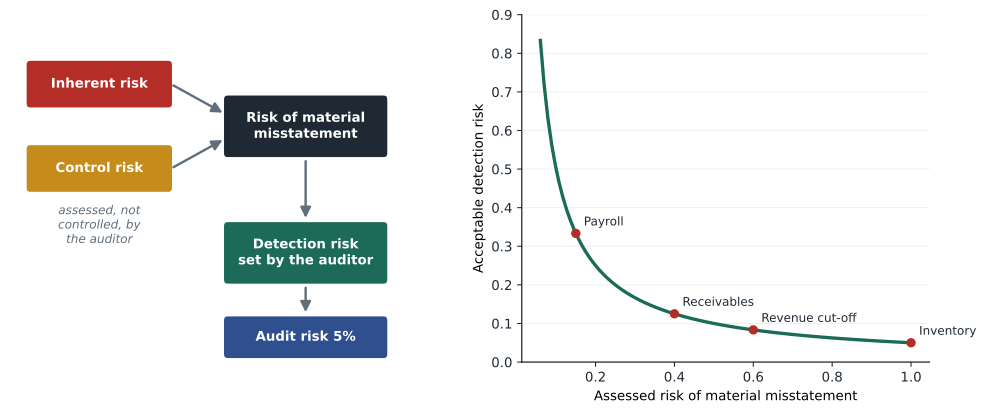
Audit risk is the risk that the auditor expresses an inappropriate opinion when the financial statements are materially misstated. It has two components. The risk of material misstatement (RMM) is the risk that the statements are materially misstated before the audit; it belongs to the entity and the auditor assesses it but cannot change it. Detection risk is the risk that the auditor's procedures will not detect a misstatement that exists; the auditor controls it through the nature, timing and extent of procedures.
The risk of material misstatement has two components at the assertion level. Inherent risk is the susceptibility of an assertion to misstatement before considering controls. Control risk is the risk that a misstatement will not be prevented, or detected and corrected, on a timely basis by the entity's internal control. The model is usually written as a product.
Rearranged, it tells the auditor the detection risk it can accept for a given level of audit risk and assessed inherent and control risks.
The model is a planning tool, not a precise calculation. Auditors rarely assign exact probabilities; most firms use categories such as high, moderate and low. But the logic matters: the higher the assessed risk of material misstatement, the lower the acceptable detection risk, and the more persuasive the substantive evidence the auditor must obtain. The program below applies the model to five areas of the Fairhaven audit.
# The audit risk model: what detection risk can the auditor accept for each balance?
AR = 0.05                                   # acceptable audit risk
areas = {                                   # area: (inherent risk, control risk)
    "Revenue cut-off":          (1.0, 0.6),
    "Inventory valuation":      (1.0, 1.0),
    "Receivables existence":    (0.8, 0.5),
    "Payroll expense":          (0.5, 0.3),
    "Property, plant and equipment": (0.4, 0.5),
}
print(f"{'Area':<32}{'IR':>5}{'CR':>5}{'RMM':>7}{'Acceptable DR':>15}  Substantive work")
for a, (ir, cr) in areas.items():
    rmm = ir * cr
    dr = min(AR / rmm, 1.0)
    level = "extensive" if dr < 0.10 else "moderate" if dr < 0.25 else "limited"
print(f"{a:<32}{ir:>5.1f}{cr:>5.1f}{rmm:>7.2f}{dr:>15.3f} {level}")Area IR CR RMM Acceptable DR Substantive work Revenue cut-off 1.0 0.6 0.60 0.083 extensive Inventory valuation 1.0 1.0 1.00 0.050 extensive Receivables existence 0.8 0.5 0.40 0.125 moderate Payroll expense 0.5 0.3 0.15 0.333 limited Property, plant and equipment 0.4 0.5 0.20 0.250 limited
For inventory valuation, inherent risk is high because of obsolescence and the new warehouse system, and the auditor plans not to rely on controls, so control risk is set at the maximum. Acceptable detection risk is 5 per cent: substantive procedures must do all the work. For revenue cut-off, the auditor plans to test controls over shipping and invoicing, and if those tests support a control risk of 0.6, acceptable detection risk is about 8 per cent, still requiring extensive work. Payroll, a routine, well-controlled process, can be audited mainly with substantive analytics.
Inherent risk factors and the spectrum of risk
CAS 315 (Revised 2019) asks the auditor to assess inherent risk on a spectrum, considering inherent risk factors: complexity, subjectivity, change, uncertainty, and susceptibility to misstatement due to management bias or fraud. A balance is higher on the spectrum when these factors increase the likelihood or the magnitude of a possible misstatement. Control risk is assessed separately; if the auditor does not plan to test controls, control risk is assessed at the maximum.
| Factor | Question | Fairhaven example |
|---|---|---|
| Complexity | Is the accounting or the process complicated? | Revenue with return rights and volume rebates |
| Subjectivity | Does the amount depend on judgment? | Inventory obsolescence; allowance for doubtful accounts |
| Change | Has something changed this year? | New warehouse management system in July |
| Uncertainty | Can the amount be measured precisely? | Warranty provision on tents |
| Bias or fraud | Is there incentive or opportunity to misstate? | Bonus target of 12 million in income before tax |
Significant risks
Some risks of material misstatement sit at the upper end of the spectrum. A significant risk is one for which the assessment of inherent risk is close to the upper end because of the likelihood and magnitude of a potential misstatement, or one that the standards require to be treated as significant. Two risks are presumed significant in every audit: the risk of management override of controls, which can never be rebutted, and the risk of fraud in revenue recognition, which can be rebutted only in rare cases, such as a company with a single, simple type of revenue.
For significant risks, the auditor must understand the related controls, cannot rely solely on evidence about controls from prior audits, and must perform substantive procedures that respond specifically to the risk; substantive analytics alone are not enough. These risks are also typically reported to those charged with governance and are candidates for discussion in the auditor's report as key or critical audit matters (lesson 12).
| Significant risk at Fairhaven | Why | Planned response (summary) |
|---|---|---|
| Fraud in revenue recognition (presumed) | Bonus pressure; year-end wholesale shipments with return rights | Cut-off testing either side of year end; confirmations; review of credit notes in January |
| Management override of controls (presumed) | Always present | Journal entry testing; review of estimates for bias; review of unusual transactions |
| Inventory valuation | Obsolescence judgment; new system; days on hand up | Testing the aging and the write-down; net realizable value testing on subsequent sales |
Assessing risk at two levels
Risks exist at two levels. Financial-statement-level risks are pervasive: they affect many assertions and cannot be tied to a single account. Weak tone at the top, a lack of competent accounting staff, going concern doubts and pressure to meet analysts' expectations are examples. The response is overall, such as assigning more experienced staff, increasing supervision, adding unpredictability to procedures or changing the timing of work. Assertion-level risks relate to specific classes of transactions, balances and disclosures, such as the existence of receivables or the valuation of inventory, and are addressed with specific further audit procedures. Lesson 6 develops those responses.
Worked problem
Choosing a benchmark when profit is volatile
Suppose Fairhaven's draft income before tax were only 1,200 because of a one-time restructuring charge of 11,400. Would 5 per cent of income before tax still make sense?
Show solution
- 5 per cent of 1,200 is 60, which would make materiality far smaller than the size of the business warrants.
- Income before normal one-time items, or an average of several years, better reflects what users focus on.
- Alternatively, use revenue: 0.5 per cent of 184,000 is 920.
Answer: Normalize income for the one-time charge (5 per cent of 12,600 = 630) or use a stable benchmark such as revenue, and document the reasoning.
Worked problem
Lower performance materiality
In its first year auditing a new client with many misstatements found by the predecessor, should Bramble Shaw use 65 per cent for performance materiality?
Show solution
- A first-year audit and a history of misstatements raise the risk that undetected misstatements add up.
- A lower percentage, such as 50 per cent, leaves a larger margin.
- That increases sample sizes and the precision of analytics.
Answer: No. The firm should use a lower percentage, nearer 50 per cent.
Common mistakes
MistakeTreating materiality as a purely numerical rule.
InsteadQualitative factors, such as covenants or bonus targets, can make small misstatements material.
MistakeUsing overall materiality to plan each test.
InsteadPlan with performance materiality so that undetected misstatements do not aggregate to a material amount.
MistakeThinking the auditor can change the risk of material misstatement.
InsteadThe auditor assesses RMM; it controls only detection risk.
MistakeConcluding that high control risk means testing controls more.
InsteadHigh assessed control risk means relying on substantive procedures, not testing controls.
MistakeRebutting the presumption of management override.
InsteadManagement override is always a significant risk; only the revenue fraud presumption can be rebutted, rarely.
Summary and key terms
- A misstatement is material if it could reasonably influence users' economic decisions; qualitative factors matter.
- Overall materiality for Fairhaven is 630 (5 per cent of income before tax of 12,600).
- Performance materiality (410) leaves a margin for undetected misstatements; the clearly trivial threshold is 30.
- Audit risk equals inherent risk times control risk times detection risk; the auditor controls only detection risk.
- The higher the risk of material misstatement, the more persuasive the substantive evidence required.
- Inherent risk factors are complexity, subjectivity, change, uncertainty and susceptibility to bias or fraud.
- Management override and revenue fraud are presumed significant risks.
- Materiality
- The magnitude or nature of a misstatement that could reasonably influence users' decisions.
- Performance materiality
- An amount below overall materiality used to plan testing and reduce aggregation risk.
- Clearly trivial
- A threshold below which misstatements need not be accumulated.
- Audit risk
- The risk of an inappropriate opinion when the statements are materially misstated.
- Inherent risk
- Susceptibility of an assertion to misstatement before considering controls.
- Control risk
- The risk that internal control will not prevent or detect and correct a misstatement.
- Detection risk
- The risk that the auditor's procedures will fail to detect a misstatement.
- Risk of material misstatement
- The combined inherent and control risk, assessed by the auditor.
- Significant risk
- An identified risk at the upper end of the spectrum of inherent risk.
- Management override
- Management's ability to circumvent controls that otherwise appear effective.
Practice problems
Work each problem on paper first, then reveal the answer to check.
What is overall materiality for Fairhaven, and how was it calculated?
Show answer
630: 5 per cent of income before tax of 12,600.
Rerun the materiality program using 60 per cent for performance materiality. What is it?
Show answer
380 (60 per cent of 630, rounded to the nearest 10).
With AR 5 per cent, IR 1.0 and CR 0.5, what is acceptable detection risk?
Show answer
0.10.
Rerun the risk program with payroll inherent risk of 0.8 and control risk of 0.8. What changes?
Show answer
RMM 0.64, acceptable DR about 0.078, so substantive work becomes extensive.
Give two qualitative factors that could make a small misstatement material for Fairhaven.
Show answer
Pushing income below the 12 million bonus target; breaching the debt covenant.
Why set performance materiality below overall materiality?
Show answer
To reduce the risk that undetected and uncorrected misstatements together exceed overall materiality.
Which two risks are presumed significant?
Show answer
Management override of controls and fraud in revenue recognition.
What does a financial-statement-level risk require?
Show answer
An overall response such as more experienced staff, more supervision and unpredictability.
Name the five inherent risk factors.
Show answer
Complexity, subjectivity, change, uncertainty and susceptibility to bias or fraud.
If final income before tax drops to 9,000, what should the auditor consider?
Show answer
Revising materiality (5 per cent would be 450) and extending testing.
Lesson quiz · 5 questions
Score 60% or more to complete this lesson.
Create a free account to save your progress, take quizzes and earn a certificate.