
ACCT-331 · Lesson 10 of 12 · 27 min
Auditing purchases, payables, inventory and payroll
Lesson 9 followed the money in: revenue, receivables and cash. This lesson follows it out: purchases of goods and services, the payables they create, the inventory they become, and the payroll that pays the people who make and sell it. The risks change direction. For revenue and assets, overstatement is the main worry; for expenses and liabilities, it is understatement, because management that wants to look profitable has every reason to leave costs out. Inventory sits in between, with existence and valuation risks of its own. For Fairhaven, inventory is the largest current asset, its valuation is a significant risk, and its count on December 31 is one of the most important days of the audit.
The purchases and payables cycle
The purchases cycle runs from a requisition through a purchase order, receipt of goods, a vendor invoice, approval for payment, and the disbursement. Key controls include approval of purchase orders within authority limits, a three-way match of purchase order, receiving report and invoice before payment, control over the vendor master file (especially changes to vendor bank details, a favourite target of payment fraud), segregation of purchasing, receiving, recording and payment, and monthly reconciliation of vendor statements to the payables ledger.
| Assertion | Risk | Key procedures |
|---|---|---|
| Completeness of payables | Invoices for goods received in December not recorded | Search for unrecorded liabilities; vendor statement reconciliations; receiving cut-off |
| Occurrence of expenses | Payments to fictitious vendors | Vendor master file analytics; vouch payments to purchase orders and receiving reports |
| Cut-off | Goods received in December recorded as January purchases | Examine receiving reports either side of year end |
| Classification | Repairs capitalized as property, plant and equipment | Review additions to fixed assets and repairs expense |
| Accuracy | Wrong quantities or prices paid | Three-way match testing; recalculation |
Searching for unrecorded liabilities
Because the main risk for payables is understatement, sampling the recorded payables balance gives little comfort: a liability that was never recorded cannot be selected from the list. Instead, the auditor looks outside the recorded balance. The search for unrecorded liabilities examines payments made after year end, and unpaid invoices received after year end, to see whether any relate to goods or services received before year end. The auditor also reviews receiving reports near year end, reconciles statements from major vendors to the ledger, reads board minutes and contracts for commitments, and asks management about accruals.
# Search for unrecorded liabilities: payments in January and February 2027 (thousands of dollars)
payments = [  # vendor, amount, date paid, date goods or services received, recorded in 2026 payables?
    ("Pacific Freight", 142, "2027-01-08", "2026-12-20", True),
    ("Summit Textiles", 318, "2027-01-15", "2026-12-28", False),
    ("Kelvin Utilities", 41, "2027-01-20", "2026-12-31", False),
    ("Northern Sign Co.", 22, "2027-01-22", "2027-01-10", False),
    ("Bramble Shaw LLP", 120, "2027-02-10", "2027-01-31", False),
    ("Orca Packaging", 64, "2027-02-03", "2026-12-15", True),
]
unrecorded = 0
for v, amt, paid, received, booked in payments:
    belongs = received <= "2026-12-31"
    if belongs and not booked:
        unrecorded += amt
        note = "UNRECORDED 2026 liability"
    elif belongs:
        note = "properly accrued"
    else:
        note = "2027 expense"
    print(f"{v:<20}{amt:>6}  received {received}: {note}")
print(f"Total unrecorded liabilities found: {unrecorded}")Pacific Freight 142 received 2026-12-20: properly accrued Summit Textiles 318 received 2026-12-28: UNRECORDED 2026 liability Kelvin Utilities 41 received 2026-12-31: UNRECORDED 2026 liability Northern Sign Co. 22 received 2027-01-10: 2027 expense Bramble Shaw LLP 120 received 2027-01-31: 2027 expense Orca Packaging 64 received 2026-12-15: properly accrued Total unrecorded liabilities found: 359
Two of the January payments relate to goods and services received in December but not recorded: a shipment of fabric from Summit Textiles and the December utilities bill, totalling 359 thousand. Both are misstatements for the summary of misstatements, and the auditor asks why the receiving clerk's report on December 28 did not trigger an accrual. The new warehouse system may be part of the answer, which links back to the IT risk identified in planning.
Inventory: existence and the physical count
When inventory is material, the auditor must attend the physical inventory count, unless impracticable, to observe the client's procedures, inspect the inventory and perform test counts. This is the main evidence of existence. Before the count, the auditor reviews the client's count instructions: whether count areas are clearly defined, whether teams of two count and recount, whether count tags are prenumbered and controlled, whether movements of goods are stopped or controlled during the count, and whether damaged or obsolete items are identified.
CAS 501 requires attendance at the physical count when inventory is material, along with procedures on the final inventory records.
During the count, the auditor makes test counts in two directions: from the floor to the count sheets (completeness) and from the count sheets to the floor (existence). The auditor records a sample of count tag numbers and quantities to trace into the final inventory listing later, and obtains cut-off information: the last receiving report and the last shipping document before the count. Goods in transit, consigned goods held for others and goods held at third-party warehouses need separate procedures, such as confirmations with the warehouse operator.
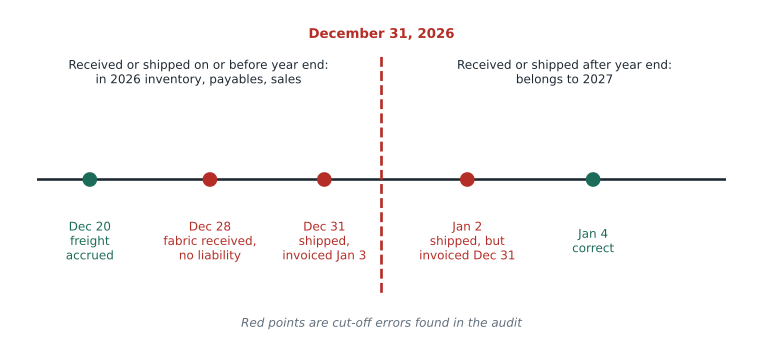
Because Fairhaven replaced its warehouse system in July, the auditor also tests the system's perpetual records. Before the year-end count, the team compares a sample of system quantities with floor counts at a mid-year roll-forward point and evaluates the data conversion. If the count reveals large differences between perpetual records and floor quantities, management must investigate and adjust, and the auditor considers whether controls over inventory movements are ineffective.
Inventory: valuation
Inventory is measured at the lower of cost and net realizable value. The auditor tests cost by examining supplier invoices for a sample of purchased items, testing the allocation of freight, duties and overheads, and checking the cost formula (first-in, first-out or weighted average). It tests net realizable value by comparing cost with estimated selling prices less costs to sell, using sales after year end where possible, because actual selling prices in January and February are strong evidence of what inventory on hand at December 31 was worth.
# Net realizable value test on slow-moving inventory styles (thousands of dollars)
styles = [  # style, units on hand, unit cost, average selling price Jan-Feb 2027, selling cost per unit
    ("Ridgeline 2-person tent", 4_200, 0.118, 0.199, 0.020),
    ("Alpine shell jacket (2024 season)", 9_800, 0.074, 0.069, 0.012),
    ("Trail runner shoe v3", 6_500, 0.052, 0.041, 0.009),
    ("Down vest (discontinued)", 3_100, 0.061, 0.038, 0.008),
    ("Camp stove", 2_900, 0.044, 0.079, 0.006),
]
total_writedown = 0
print(f"{'Style':<38}{'Cost':>8}{'NRV':>8}{'Write-down':>12}")
for name, units, cost, price, sell in styles:
    nrv_unit = price - sell
    c, n = units * cost, units * max(nrv_unit, 0)
    wd = max(c - n, 0)
    total_writedown += wd
    print(f"{name:<38}{c:>8.0f}{n:>8.0f}{wd:>12.0f}")
recorded = 260
print(f"Auditor's estimate of required write-down: {total_writedown:.0f}")
print(f"Write-down recorded by management: {recorded}")
print(f"Possible overstatement of inventory: {total_writedown - recorded:.0f}")Style Cost NRV Write-down Ridgeline 2-person tent 496 752 0 Alpine shell jacket (2024 season) 725 559 167 Trail runner shoe v3 338 208 130 Down vest (discontinued) 189 93 96 Camp stove 128 212 0 Auditor's estimate of required write-down: 393 Write-down recorded by management: 260 Possible overstatement of inventory: 133
Three of the slow-moving styles are selling below cost after year end. The auditor's estimate of the required write-down is about 0.39 million against the 0.26 million management recorded, a difference of about 0.13 million. The difference is a judgmental misstatement. Because inventory valuation is a significant risk, the auditor also evaluates management's process: how it identifies slow-moving styles, whether its assumptions about markdowns are consistent with experience, and whether the write-down was reduced from the prior year in a way that suggests bias toward the bonus target.
Payroll
Payroll is usually a large expense and a low-risk area for misstatement, because it is routine, well controlled and easy to predict. The main risks are fictitious ("ghost") employees, unauthorized changes to pay rates, and incorrect accruals for wages, vacation, bonuses and payroll taxes at year end. Controls include segregation of human resources (which hires and sets pay rates) from payroll processing and payment, approval of time records by supervisors, and review of payroll registers and reports of master file changes.
Because payroll is predictable, substantive analytics often provide much of the evidence, as lesson 7 showed: Fairhaven's payroll was within about 0.1 million of the expectation built from headcount and the wage increase. The auditor adds tests of details for the year-end accruals: the bonus accrual against the bonus plan and the board's approval, vacation pay against policy and records, and payroll tax remittances. Data analytics can test the whole employee master file for duplicate bank accounts, employees without tax numbers, employees paid after their termination date, or employees with the same address as a payroll clerk.
Fairhaven outsources payroll processing to a service organization. Bramble Shaw uses the service auditor's Type 2 report under CSAE 3416, which covers the design and operating effectiveness of controls at the service organization over a period, and tests the complementary user entity controls at Fairhaven, such as review of the payroll register.
Property, plant and equipment and other balances
The remaining balances are covered more briefly. For property, plant and equipment, the auditor focuses on additions and disposals during the year, because the opening balance was audited last year. It vouches significant additions to invoices and contracts, checks whether repairs were wrongly capitalized (or, in a company trying to look profitable, whether capital items were properly capitalized), recalculates depreciation analytically, and considers impairment indicators, such as underperforming stores. For debt, the auditor confirms balances and terms with lenders, reads loan agreements for covenants, and recalculates interest. For equity, it confirms share capital with the transfer agent and examines board approval of dividends and share issues. For leases, it tests the completeness of the lease population, because unrecorded store leases understate both right-of-use assets and liabilities.
| Balance | Main risk | Key procedure |
|---|---|---|
| Property, plant and equipment | Improper capitalization; impairment | Vouch additions; review repairs; assess store-level impairment indicators |
| Bank debt (46,000) | Covenant breach; classification | Confirm with the bank; recalculate covenants; check current portion |
| Leases | Unrecorded leases | Compare store list with lease schedule; review rent payments |
| Equity | Unauthorized issues | Confirm with transfer agent; read board minutes |
| Provisions (warranty) | Understatement; bias | Compare with claims history and subsequent claims |
Fairhaven's bank loan includes a covenant that debt must not exceed 0.75 times equity. On the draft figures, debt to equity is 46,000 / 64,400, or about 0.71. The misstatements found so far in this lesson and lesson 9 would reduce equity (through lower profit), so the auditor tracks how close the corrected ratio comes to the covenant. A breach could make the debt repayable on demand, require reclassification as current, and raise going concern questions, as lesson 11 discusses.
Worked problem
Choosing the right population for payables
An audit junior proposes testing payables by selecting a sample from the year-end payables listing and vouching each to invoices. What is wrong with the plan?
Show solution
- Vouching recorded payables tests existence, but the main risk for payables is completeness.
- Unrecorded liabilities cannot be selected from the listing.
- Instead, examine payments and invoices after year end, receiving reports near year end, and vendor statements.
Answer: The plan tests the wrong assertion; a search for unrecorded liabilities is needed.
Worked problem
Test count differences
At the Fairhaven count, the auditor test counts 40 Ridgeline tents on a tag that shows 400. What should happen?
Show solution
- Ask the count team to recount the location immediately with the auditor watching.
- If the correct count is 40, ensure the tag is corrected and consider whether other tags by the same team need recounting.
- Record the tag number and trace the corrected quantity to the final inventory listing.
Answer: The error is corrected at the count, and the auditor extends test counts if errors suggest a wider problem.
Common mistakes
MistakeSampling from recorded payables to test completeness.
InsteadSearch for unrecorded liabilities outside the recorded balance.
MistakeRelying on the inventory count without testing cut-off.
InsteadRecord the last receiving and shipping documents and test them against the records.
MistakeTesting cost but ignoring net realizable value.
InsteadInventory must be at the lower of cost and NRV; test subsequent selling prices.
MistakeTesting payroll mainly with tests of details.
InsteadPayroll is predictable; substantive analytics plus accrual testing are usually efficient.
MistakeIgnoring debt covenants when evaluating misstatements.
InsteadAdjustments can push a ratio past a covenant, with classification and going concern effects.
Summary and key terms
- For expenses and liabilities, completeness is the main risk.
- The search for unrecorded liabilities found 359 of unrecorded December costs at Fairhaven.
- The auditor attends the physical count to obtain evidence of inventory existence and performs test counts in both directions.
- Inventory valuation is tested against subsequent selling prices; Fairhaven's write-down appears about 133 too low.
- Payroll is usually tested with analytics, accrual testing and master file analytics; service auditor reports support outsourced processing.
- Property, debt, leases, equity and provisions each have specific procedures; covenants link misstatements to classification and going concern.
- Three-way match
- Matching the purchase order, receiving report and vendor invoice before payment.
- Search for unrecorded liabilities
- Examining post-year-end payments and invoices for liabilities that belong in the prior year.
- Vendor master file
- The record of approved vendors and their payment details.
- Test count
- An auditor's independent count of items during the client's physical inventory.
- Net realizable value
- Estimated selling price less estimated costs of completion and sale.
- Ghost employee
- A fictitious or former employee kept on the payroll to divert pay.
- Service auditor's report
- A report on controls at a service organization, used by user auditors.
- Complementary user entity controls
- Controls the user entity must operate for a service organization's controls to be effective.
- Debt covenant
- A condition in a loan agreement, such as a maximum debt-to-equity ratio.
- Goods in transit
- Goods shipped but not yet received, whose ownership depends on shipping terms.
Practice problems
Work each problem on paper first, then reveal the answer to check.
Which assertion is the main concern for accounts payable?
Show answer
Completeness.
Rerun the unrecorded-liabilities program with the Orca Packaging invoice not recorded. What is the total?
Show answer
423 (359 plus 64).
Rerun the NRV program with the down vest selling for 0.055. What is the write-down?
Show answer
Recompute: the vest write-down falls from about 96 to about 43; the total falls by about 53.
Why does the auditor test count in two directions?
Show answer
Floor to sheets tests completeness; sheets to floor tests existence.
What is a three-way match?
Show answer
Comparing the purchase order, receiving report and vendor invoice before payment.
Give two data analytics for payroll.
Show answer
For example duplicate bank accounts and payments after termination dates.
What is Fairhaven's debt-to-equity covenant and the draft ratio?
Show answer
Maximum 0.75; draft about 0.71.
What kind of report supports reliance on the payroll service organization?
Show answer
A CSAE 3416 Type 2 report.
Why focus on additions and disposals for property, plant and equipment?
Show answer
The opening balance was audited last year; changes carry the new risk.
What are the risks of unrecorded leases?
Show answer
Understated right-of-use assets and lease liabilities.
Lesson quiz · 5 questions
Score 60% or more to complete this lesson.
Create a free account to save your progress, take quizzes and earn a certificate.