
ACCT-240 · Lesson 9 of 12 · 25 min
IT general controls and application controls
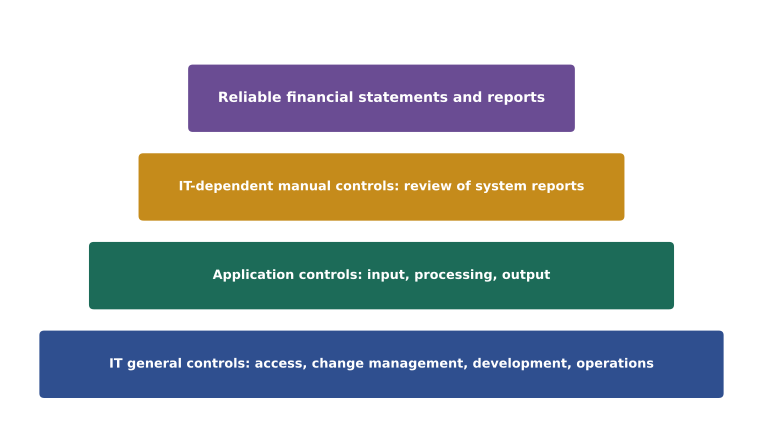
When an ERP calculates a three-way match or blocks an order over a credit limit, management and auditors want to rely on that automated control. They can only do so if they are confident the control works as designed and has kept working all year. That confidence comes from two layers of controls. Application controls are built into specific business applications and transactions: input edits, matching rules, calculations, approval workflows. IT general controls (ITGCs) are the broader controls over the IT environment that keep application controls working: who can access the system, how changes are made, how the system is operated and how data is backed up and recovered. If the general controls are weak, an automated control that worked in January may have been changed or bypassed by June, and nobody would know.
This lesson explains both layers, how they connect, and the basic logic auditors use to test them. The aim is not to make you an IT auditor (ACCT-331 and the CISSP courses go further), but to make you able to discuss controls with IT staff, read a control matrix, understand an auditor's findings and design sensible controls in your own processes.
IT general controls
ITGCs are usually grouped into four domains. Access to programs and data covers user provisioning and removal, authentication, role design, privileged access and periodic access reviews. Program change management covers how changes to software and configuration are requested, approved, tested, migrated to production and reviewed, including emergency changes. Program development or acquisition covers how new systems are selected, built, tested, converted and approved before going live. Computer operations covers job scheduling, monitoring, incident handling, backup and recovery. The domains map closely to COBIT's Build, Acquire and Implement and Deliver, Service and Support domains from lesson 8, and to ITIL practices such as change enablement and incident management (ITIL-140).
| ITGC domain | Key controls | What goes wrong without them |
|---|---|---|
| Access to programs and data | Role-based access; prompt removal of leavers; MFA; quarterly access reviews; restricted privileged and superuser accounts | Former employees or over-privileged users change data or bypass approvals |
| Program change management | Change requests approved; testing in a separate environment; separate developers from those who move changes to production; post-implementation review | An untested or unauthorized change alters calculations or disables controls |
| Program development and acquisition | Business case and approval; requirements including controls; user acceptance testing; data conversion reconciliation | A new system goes live without key controls or with incomplete data |
| Computer operations | Job scheduling and monitoring; incident management; backups tested by restoring; disaster recovery plan | Interfaces fail silently; data is lost; the business cannot recover |
Access controls deserve special attention because they are where ERP risks concentrate. Every user should have a unique account, so that actions can be traced; shared logins destroy accountability. Access should be granted by role, on the principle of least privilege, with approval from the business owner of the data. When people change jobs their old access should be removed, not just added to, a problem known as access creep. Privileged accounts, such as system administrators and ERP superusers who can do anything, should be few, monitored and used only when needed, ideally through a check-out process that logs each use. A quarterly access review, in which managers confirm that each person's access is still appropriate, catches what the other controls miss.
Change management protects the integrity of the programs and configuration. In a cloud ERP, the vendor controls much of the software code, so the customer's change management focuses on configuration: tax codes, approval limits, matching tolerances, posting rules and workflows. A change to the three-way match tolerance from 2 per cent to 20 per cent is a change to a key financial control and should go through the same request, approval, testing and logging process as a software change. Separating the people who make changes from the people who approve and move them into production prevents a single person from introducing an unauthorized change.
Application controls
Application controls operate within a specific process and are usually classified as input, processing and output controls. Input controls make sure that data entered is authorized, complete and accurate. Processing controls make sure that data is processed completely and correctly, without loss, duplication or unauthorized change. Output controls make sure that reports and files are complete, accurate and go only to the people entitled to them. Many application controls are automated, and well-designed ERPs include them as configuration options; others are manual reviews of system output.
| Control | How it works | Example |
|---|---|---|
| Field and format check | Rejects data of the wrong type or format | Letters in a quantity field |
| Range or limit check | Rejects values outside a set range | Hours worked above 80 in a week |
| Validity check | Compares input with master data | Supplier number must exist and be active |
| Completeness check | Requires mandatory fields | Invoice cannot post without a PO number |
| Reasonableness check | Flags values unusual for the context | Order quantity 100 times the customer's average |
| Check digit | A calculated digit detects keying errors in identifiers | Luhn digit on a customer or card number |
| Batch and hash totals | Totals compared before and after processing | Count, amount total and sum of account numbers for a batch of journal entries |
| Sequence check | Detects gaps or duplicates in numbered documents | Missing invoice numbers |
| Run-to-run reconciliation | Compares totals between processing steps or systems | Interface record counts from the online store to the ERP |
Batch controls are an old idea that remains useful whenever data moves between systems, such as an upload of bank transactions or a nightly interface from the online store. Before processing, the sender computes a record count, a financial total (such as the sum of amounts) and sometimes a hash total, which is a meaningless sum of a non-financial field such as account numbers, used only to detect changes. After processing, the receiver computes the same totals. If any total differs, records were lost, duplicated or altered. The code below shows both batch totals and the Luhn check digit, which detects most single-digit keying errors and transpositions of adjacent digits.
# Batch totals for an interface, and Luhn check digits (illustrative)
sent = [("1043", 6200.00), ("1077", 2900.00), ("1102", 1500.00), ("1188", 950.25)]
received = [("1043", 6200.00), ("1077", 2900.00), ("1120", 1500.00), ("1188", 950.25)]   # one id altered

def totals(batch):
    return len(batch), round(sum(a for _, a in batch), 2), sum(int(c) for c, _ in batch)
for label, b in (("sent", sent), ("received", received)):
    n, amount, hash_total = totals(b)
    print(f"{label:9s} count {n}  amount {amount:,.2f}  hash total {hash_total}")
print("Batch agrees" if totals(sent) == totals(received) else "Batch DIFFERS - investigate before posting")

def luhn_digit(number):
    total = 0
    for i, ch in enumerate(reversed(number)):
        d = int(ch)
        if i % 2 == 0:          # double every second digit starting from the right of the payload
            d = d * 2 - 9 if d > 4 else d * 2
        total += d
    return str((10 - total % 10) % 10)
def luhn_valid(full):
    return luhn_digit(full[:-1]) == full[-1]

base = "104377"
full = base + luhn_digit(base)
print(f"Customer id with check digit: {full}")
for keyed in (full, "1043787", "1034777"):
print(f" keyed {keyed}: {'valid' if luhn_valid(keyed) else 'rejected'}")sent count 4 amount 11,550.25 hash total 4410 received count 4 amount 11,550.25 hash total 4428 Batch DIFFERS - investigate before posting Customer id with check digit: 1043777 keyed 1043777: valid keyed 1043787: rejected keyed 1034777: rejected
The record count and amount total agree, but the hash total exposes the altered customer number, which would otherwise have posted $1,500 to the wrong account. In the Luhn example, a single wrong digit and a transposition of adjacent digits are both rejected at entry. Check digits are built into payment card numbers, many bank account and identification numbers, and they can be added to an organization's own customer and supplier numbers at little cost.
Testing controls
Auditors and internal reviewers test controls in two ways. A test of design asks whether the control, if it operates as described, would prevent or detect the risk: is the credit check applied to every order channel, does the duplicate check include normalized invoice numbers? A test of operating effectiveness asks whether it actually operated throughout the period. For manual controls this usually means selecting a sample of instances and inspecting evidence, such as signed reconciliations. For automated controls, the logic is different: a computer applies the same rule every time unless it is changed, so testing one instance of each scenario (for example, an order under the limit, an order over the limit and an order exactly at the limit) can be enough, provided the ITGCs show the program and configuration were not changed without control during the period. This is why weak ITGCs are so costly: they force auditors to test far more transactions.
Completeness and accuracy of the data used in controls is the other recurring issue. A manager who reviews an exception report is performing an IT-dependent manual control, and the review is only effective if the report includes every exception and calculates them correctly. Auditors call such data information produced by the entity (IPE), and they test it, for example by reconciling the report's population to the ledger or re-running its logic, as lesson 4 did for the aging report.
Worked problem
Effect of an ITGC failure
Ridgeback's auditor tested the ERP's three-way match in March and found it worked correctly with a 2 per cent tolerance. The access review then found that six AP clerks held a configuration role allowing them to change matching tolerances, and the system's change log had been switched off from May to August. What does this mean for reliance on the match control?
Show solution
- The March test shows the control was designed and operating then.
- Because six clerks could change tolerances and changes were not logged for four months, there is no evidence the tolerance stayed at 2 per cent all year.
- The auditor cannot rely on the automated control for the whole year on the basis of one test.
- Options: test more invoices across the year to see whether exceptions were caught, check the current setting and any evidence of changes, and treat the access and logging failures as ITGC deficiencies to report.
Answer: The ITGC failures prevent reliance on the automated control without much more substantive testing.
Organizations that outsource processing, such as payroll to a service provider or their ERP to a cloud vendor, still own the controls. They rely on the provider's controls report, in Canada usually a CSAE 3416 report (the Canadian equivalent of a SOC 1 report), to understand and evaluate the controls operated by the provider, and they must operate the complementary user entity controls the report lists, such as reviewing payroll registers and managing their own users' access.
Common mistakes
MistakeRelying on an automated control because it worked once.
InsteadReliance also requires effective ITGCs showing the logic was not changed without control.
MistakeRemoving new access but not old access when people change jobs.
InsteadReview access regularly to prevent access creep.
MistakeTreating configuration changes as outside change management.
InsteadTolerances, approval limits and tax codes are controls; change them only through approved, tested, logged changes.
MistakeTrusting an exception report without checking its completeness.
InsteadTest information produced by the entity before relying on a review of it.
MistakeAssuming outsourcing transfers responsibility for controls.
InsteadUse the provider's controls report and operate the complementary user entity controls.
Summary and key terms
- IT general controls cover access, change management, development and acquisition, and operations.
- Application controls cover input, processing and output for specific transactions.
- Access should follow least privilege, with unique accounts, prompt removal and periodic review.
- Configuration changes to controls need the same discipline as software changes.
- Batch, hash and check-digit controls detect lost, duplicated and altered data.
- Automated controls can be tested with few instances only if ITGCs are effective.
- Information produced by the entity must be tested for completeness and accuracy.
- IT general controls
- Controls over access, change, development and operations that support application controls.
- Application controls
- Controls built into specific applications to ensure input, processing and output are valid, complete and accurate.
- Least privilege
- Giving users only the access they need for their job.
- Access creep
- The build-up of unnecessary access as people change roles.
- Privileged account
- An account with broad system rights, such as an administrator.
- Hash total
- A sum of a non-financial field used to detect altered records.
- Check digit
- A digit calculated from an identifier to detect keying errors.
- Test of operating effectiveness
- Testing whether a control actually operated as designed during a period.
- Information produced by the entity
- Reports and data generated by the organization and used in controls or audits.
- Complementary user entity controls
- Controls the customer of a service provider must operate for the provider's controls to be effective.
Practice problems
Work each problem on paper first, then reveal the answer to check.
Name the four ITGC domains.
Show answer
Access to programs and data, program change management, program development and acquisition, computer operations.
Why are shared logins a problem?
Show answer
Actions cannot be traced to an individual, destroying accountability.
Give one input, one processing and one output control.
Show answer
Validity check on supplier number; run-to-run reconciliation; restricted distribution of payroll reports.
In the code example, which total revealed the problem?
Show answer
The hash total of customer numbers.
What keying errors does the Luhn check digit catch?
Show answer
Most single-digit errors and transpositions of adjacent digits.
Why can an automated control be tested with only a few instances?
Show answer
A computer applies the same logic every time unless changed, and ITGCs show it was not changed.
What is access creep and how is it controlled?
Show answer
Accumulating old access after role changes; controlled by removing old access and periodic access reviews.
Why is a change to the matching tolerance a control issue?
Show answer
The tolerance is part of a key financial control; widening it lets overcharges through.
What must a manager's exception report be tested for?
Show answer
Completeness and accuracy of the information it contains.
What report describes a payroll provider's controls in Canada?
Show answer
A CSAE 3416 report (equivalent to a SOC 1 report).
Lesson quiz · 5 questions
Score 60% or more to complete this lesson.
Create a free account to save your progress, take quizzes and earn a certificate.