
ACCT-240 · Lesson 8 of 12 · 25 min
Internal control frameworks: COSO, COBIT and Canadian certification
Lessons 5 to 7 described many individual controls: credit limits, three-way matches, reconciliations, separation of duties. Individual controls are only part of the picture. An organization needs a way to decide which risks matter, which controls address them, whether the controls are designed well and operating, and how to tell when something has changed. Internal control frameworks provide that structure. They give management, boards and auditors a common language for discussing control, and regulators use them as the benchmark for internal control over financial reporting (ICFR). This lesson covers the COSO Internal Control–Integrated Framework, the COSO Enterprise Risk Management framework, the COBIT framework for governance of information and technology, and the legal certification regimes for public companies.
Internal control is defined by COSO as a process, effected by an entity's board of directors, management and other personnel, designed to provide reasonable assurance regarding the achievement of objectives relating to operations, reporting and compliance. Three phrases in that definition matter. Internal control is a process, not a document or a one-time event. It is carried out by people at every level, not just the accounting department. And it provides reasonable assurance, not absolute assurance: controls cost money, people make mistakes, and two or more people working together (collusion) or a senior manager overriding controls can defeat even well-designed systems.
The COSO Internal Control–Integrated Framework
The Committee of Sponsoring Organizations of the Treadway Commission (COSO) is a joint initiative of five US professional bodies, including the American Institute of CPAs, the Institute of Internal Auditors and the Institute of Management Accountants. Its Internal Control–Integrated Framework, first published in 1992 and updated in 2013, is the most widely used internal control framework in the world, including by most Canadian and US public companies. The framework relates three categories of objectives (operations, reporting and compliance) to five components of internal control, which apply at every level of the organization, from the entity as a whole to individual divisions, processes and functions.
| Component | What it covers | Principles (summary) |
|---|---|---|
| Control environment | Tone at the top, integrity, board oversight, structure, competence, accountability | 1 to 5: commitment to integrity and ethics; independent board oversight; structures and authority; commitment to competence; accountability |
| Risk assessment | Identifying and analysing risks to objectives, including fraud risk and change | 6 to 9: clear objectives; identify and analyse risks; consider fraud risk; identify and assess significant change |
| Control activities | Policies and procedures that mitigate risks, including technology controls | 10 to 12: select and develop control activities; general controls over technology; deploy through policies and procedures |
| Information and communication | Quality information and internal and external communication | 13 to 15: use relevant, quality information; communicate internally; communicate externally |
| Monitoring activities | Ongoing and separate evaluations, and reporting of deficiencies | 16 to 17: conduct ongoing and separate evaluations; evaluate and communicate deficiencies |
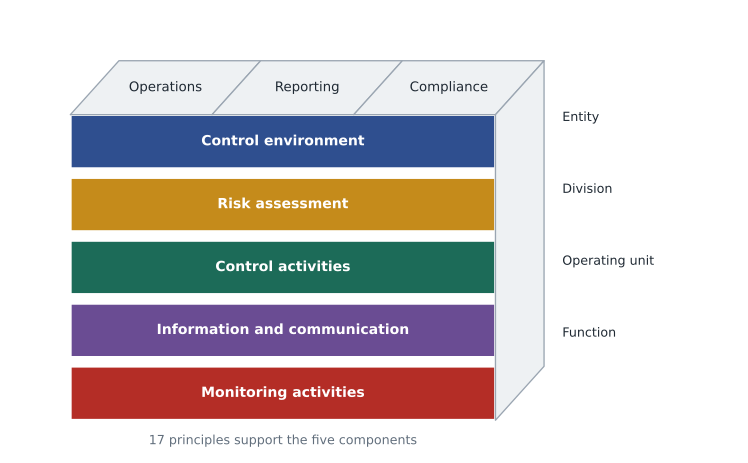
The control environment is the foundation. If senior management ignores the rules, overrides controls or pressures staff to hit targets at any cost, the most sophisticated control activities will fail. Evidence of a strong environment includes a code of conduct that is enforced, an independent audit committee that meets the auditors without management present, clear authority limits, competent finance staff and a whistleblower channel that people trust. Risk assessment asks what could go wrong with each objective, how likely and how serious it is, and what has changed; an ERP implementation, a new sales channel or a new country of operation all change the risk profile. Control activities are the specific actions that respond to risks, and they can be classified in several useful ways.
| Classification | Types | Ridgeback example |
|---|---|---|
| By timing | Preventive, detective, corrective | Credit limit block (preventive); duplicate payment report (detective); recovering an overpayment (corrective) |
| By method | Manual, automated, IT-dependent manual | Supervisor approves timesheets (manual); three-way match (automated); review of an exception report produced by the system (IT-dependent manual) |
| By nature | Authorization, segregation of duties, physical, reconciliation, review, documentation | Approval limits; separate cash handling and recording; locked high-value cage; bank reconciliation; review of manual entries; prenumbered documents |
| By level | Entity-level, process-level, IT general | Code of conduct; three-way match; access management |
Segregation of duties
Segregation of duties (SoD) is one of the most important control activities. The classic rule separates four functions for any transaction: authorization (approving it), recording (entering it in the books), custody (handling the assets) and reconciliation or review. If one person can both steal an asset and hide the theft in the records, the organization depends entirely on that person's honesty. In an ERP, SoD is enforced through access rights: roles define which transactions each user can perform, and an SoD rule set lists combinations that should not be held by one person, such as creating a supplier and approving payments to suppliers. Small organizations often cannot separate every duty, so they rely on compensating controls such as owner review of bank statements and payment registers.
# Ridgeback: checking user access against segregation-of-duties rules (illustrative)
conflicts = [("Create/change supplier", "Approve payment run", "fictitious supplier payments"),
             ("Enter supplier invoice", "Approve payment run", "paying own invoices"),
             ("Create/change employee", "Run payroll", "ghost employees"),
             ("Enter cash receipt", "Issue credit memo", "lapping and concealed theft"),
             ("Post manual journal entry", "Approve manual journal entry", "unapproved entries")]
access = {
    "jsmith (AP clerk)": {"Enter supplier invoice", "Create/change supplier"},
    "mlee (AR clerk)": {"Enter cash receipt", "Issue credit memo"},
    "rkaur (controller)": {"Approve payment run", "Approve manual journal entry", "Post manual journal entry"},
    "tnguyen (HR)": {"Create/change employee"},
    "dbrown (payroll)": {"Run payroll"},
}
found = 0
for user, rights in access.items():
    for a, b, risk in conflicts:
        if a in rights and b in rights:
            found += 1
            print(f"CONFLICT {user}: '{a}' + '{b}' -> risk of {risk}")
print(f"{found} conflicts found across {len(access)} users")CONFLICT mlee (AR clerk): 'Enter cash receipt' + 'Issue credit memo' -> risk of lapping and concealed theft CONFLICT rkaur (controller): 'Post manual journal entry' + 'Approve manual journal entry' -> risk of unapproved entries 2 conflicts found across 5 users
The check finds two conflicts. The AR clerk can both enter cash receipts and issue credit memos, the combination that makes lapping and concealed theft possible (lesson 5). The controller can post and approve manual journal entries, which defeats the approval workflow. Note that the AP clerk can create suppliers and enter invoices, which is not a listed conflict because the clerk cannot approve the payment run; it is still a concern worth adding to the rule set, since a clerk who can create a supplier and enter its invoices relies only on the payment approver to notice a fictitious supplier. Rule sets need regular review as roles change.
COSO ERM and COBIT
COSO also publishes Enterprise Risk Management–Integrating with Strategy and Performance (2017), a broader framework for managing risk across the whole organization, linked to strategy setting and performance. Internal control is part of ERM, but ERM goes further, asking how much risk the organization is willing to accept in pursuit of its goals (its risk appetite) and how risk considerations should shape strategy. In March 2026 COSO also issued guidance, Achieving Effective Internal Control Over Generative AI, that applies the five components to generative AI tools used in finance and other functions; lesson 12 returns to it.
COBIT, published by ISACA, is a framework for the governance and management of enterprise information and technology. The current version, COBIT 2019, sets out governance and management objectives grouped into five domains: Evaluate, Direct and Monitor (EDM), Align, Plan and Organize (APO), Build, Acquire and Implement (BAI), Deliver, Service and Support (DSS), and Monitor, Evaluate and Assess (MEA). Organizations use COBIT to structure IT governance and to define the IT general controls that support financial reporting, which lesson 9 covers. COBIT and COSO fit together: COSO principle 11 requires general controls over technology, and COBIT supplies the detail of what those controls should be.
Legal requirements for public companies
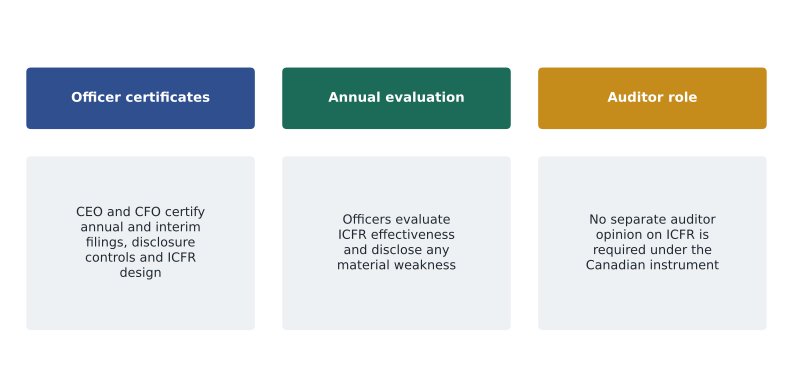
In Canada, National Instrument 52-109 Certification of Disclosure in Issuers' Annual and Interim Filings, often called CSOX, requires the chief executive and chief financial officers of non-venture reporting issuers to certify each quarter and year that the filings are accurate, that they have designed disclosure controls and procedures and internal control over financial reporting, and, annually, that they have evaluated the effectiveness of ICFR and disclosed any material weaknesses. Unlike the US rules, NI 52-109 does not require the external auditor to issue a separate opinion on ICFR. Venture issuers file basic certificates without the design and evaluation representations. The certifying officers must use a recognized framework, and most use COSO 2013.
Deficiencies are graded by severity. A control deficiency exists when a control's design or operation does not allow staff to prevent or detect misstatements on a timely basis. A significant deficiency is less severe than a material weakness but important enough to merit the attention of those responsible for oversight. A material weakness is a deficiency, or combination of deficiencies, that creates a reasonable possibility that a material misstatement of the financial statements will not be prevented or detected on a timely basis. Material weaknesses must be disclosed publicly, and they often lead to share price falls and costly remediation, which is why management invests heavily in documenting and testing controls.
Worked problem
Grading a deficiency
During Ridgeback's year-end review, the controller finds that bank reconciliations for the main operating account were not reviewed for four months while the reviewer was on leave, although they were prepared. No errors were found when the reconciliations were later reviewed. Ridgeback's materiality for the financial statements is $380,000, and the account handles about $3 million a month. How should the deficiency be assessed?
Show solution
- The control (independent review of the bank reconciliation) did not operate for four months, so there is a deficiency in operation.
- Consider what could have gone wrong: with $3 million a month passing through the account, an unreviewed reconciliation could hide errors or theft larger than materiality.
- Consider compensating controls: if the CFO reviewed bank statements and the payment register monthly, the risk is reduced.
- Without compensating controls, there was a reasonable possibility of an undetected material misstatement during those months, which points toward a significant deficiency or even a material weakness; the fact that no error occurred does not by itself reduce severity.
Answer: Severity depends on what could have happened, not what did; without compensating controls this gap is at least a significant deficiency.
Common mistakes
MistakeExpecting internal control to guarantee accurate statements.
InsteadInternal control gives reasonable, not absolute, assurance because of cost, error, collusion and override.
MistakeFocusing only on control activities.
InsteadAll five COSO components, starting with the control environment, must be present and functioning together.
MistakeIgnoring small-company limits on segregation of duties.
InsteadWhere duties cannot be split, use compensating controls such as owner review.
MistakeGrading a deficiency by whether an error actually occurred.
InsteadGrade by the reasonable possibility and size of a misstatement that could occur.
MistakeTreating COBIT and COSO as competing frameworks.
InsteadCOBIT supplies the IT detail that COSO principle 11 requires.
Summary and key terms
- Internal control is a process carried out by people that gives reasonable assurance about operations, reporting and compliance objectives.
- COSO 2013 has five components and 17 principles that must all be present, functioning and operating together.
- Control activities can be preventive, detective or corrective, and manual, automated or IT-dependent manual.
- Segregation of duties separates authorization, recording, custody and reconciliation; ERP access rules enforce it.
- COSO ERM links risk to strategy; COBIT 2019 structures governance of information and technology.
- NI 52-109 requires officer certification and evaluation of ICFR without a separate auditor opinion.
- Deficiencies are graded as control deficiencies, significant deficiencies or material weaknesses.
- NI 52-109
- The Canadian instrument requiring officer certification of disclosure controls and ICFR.
- Internal control
- A process designed to give reasonable assurance about operations, reporting and compliance objectives.
- COSO
- The Committee of Sponsoring Organizations of the Treadway Commission, publisher of the main internal control framework.
- Control environment
- The set of standards, processes and structures that set the tone for internal control.
- Segregation of duties
- Separating authorization, recording, custody and reconciliation among different people.
- Compensating control
- A control that reduces risk when a preferred control, such as segregation, is not possible.
- COBIT
- ISACA's framework for governance and management of enterprise information and technology.
- Material weakness
- A deficiency giving a reasonable possibility that a material misstatement will not be prevented or detected.
- Significant deficiency
- A deficiency less severe than a material weakness but important enough for oversight attention.
- Management override
- Senior managers bypassing controls, a limit on any control system.
- Risk appetite
- The amount of risk an organization is willing to accept in pursuit of its objectives.
Practice problems
Work each problem on paper first, then reveal the answer to check.
Why does internal control give only reasonable assurance?
Show answer
Because of cost limits, human error, collusion and management override.
Name the five COSO components.
Show answer
Control environment, risk assessment, control activities, information and communication, monitoring activities.
Give an example of a detective control at Ridgeback.
Show answer
The monthly duplicate payment report (also bank reconciliation, credit memo report).
What is an IT-dependent manual control?
Show answer
A manual review that relies on a system-generated report, such as reviewing an exception report.
Which four functions should segregation of duties separate?
Show answer
Authorization, recording, custody and reconciliation.
In the code example, which two conflicts were found?
Show answer
mlee can enter cash receipts and issue credit memos; rkaur can post and approve manual journal entries.
How does COBIT relate to COSO?
Show answer
COBIT provides the IT governance and general control detail that COSO principle 11 requires.
Does NI 52-109 require an auditor opinion on ICFR?
Show answer
No; officers certify and evaluate, but no separate auditor opinion is required.
Define a material weakness.
Show answer
A deficiency giving a reasonable possibility that a material misstatement will not be prevented or detected on time.
What compensating control might a small business use instead of full segregation of duties?
Show answer
Owner review of bank statements, payment registers and payroll changes.
Lesson quiz · 5 questions
Score 60% or more to complete this lesson.
Create a free account to save your progress, take quizzes and earn a certificate.