
ACCT-240 · Lesson 12 of 12 · 25 min
Emerging technologies and capstone: designing controls for procure-to-pay
Accounting systems keep changing. Robotic process automation copies data between systems without human keying; artificial intelligence reads invoices, drafts reconciliations and answers questions about the ledger; digital reporting formats make financial statements machine-readable; electronic invoicing networks replace paper and PDF; and distributed ledgers promise shared records between organizations. Each technology changes where errors and fraud can happen and what controls are needed. This lesson surveys them from a controls point of view and then brings the course together in a capstone: designing the controls for Ridgeback's procure-to-pay process.
Robotic process automation
Robotic process automation (RPA) uses software robots, or bots, that mimic a person's actions in user interfaces: logging in, copying fields, pasting into another system, clicking buttons. Finance teams use bots for repetitive, rule-based work such as downloading bank statements, posting standard journal entries, matching simple items and preparing routine reports. Bots are fast and consistent, but they do exactly what they are told, including the wrong thing, thousands of times. A bot that posts the same journal entry twice or keys into the wrong field because a screen layout changed can create errors at scale.
Controls over RPA follow the IT general controls of lesson 9. Each bot should have its own user account with least-privilege access, never a shared human login, so its actions are traceable and it cannot exceed its role. Bot logic is a program and should go through change management, with testing whenever the underlying systems change. Bots need monitoring and exception handling: a human reviews items the bot could not process, and record counts and control totals confirm that the bot processed everything it should. Segregation of duties applies to bots too: a bot that can both create suppliers and release payments is as dangerous as a person who can.
Artificial intelligence in accounting
Machine learning and generative AI are now built into many finance tools. Extraction models read invoices and receipts. Anomaly detection flags unusual journal entries or payments. Forecasting models predict cash flow. Generative AI assistants draft memos, summarize contracts, explain variances and answer questions about data. These tools can save time and find patterns humans miss, but they introduce new risks: models can be wrong in ways that are hard to see, generative tools can produce confident but false answers (often called hallucinations), outputs can change when a vendor updates the model, and sensitive data may be sent outside the organization.
In March 2026 COSO published Achieving Effective Internal Control Over Generative AI, which applies the five components of the 2013 framework (lesson 8) to generative AI across its life cycle rather than creating a new framework. Its themes are practical: inventory the AI uses in the organization, classify them by what they do (for example, extracting data, transforming it, posting entries or supporting judgments), assess risks such as prompt manipulation, opaque reasoning, model drift and frequent changes, and apply proportionate controls. For an accounting team the minimum expectations include human review of AI outputs that affect the financial statements, documentation of which tool and version produced a result, restrictions on entering confidential data into tools that are not approved, testing of accuracy on known cases before and after changes, and clear accountability: the accountant who uses an AI output remains responsible for it.
| Technology | Typical use | Key risks | Key controls |
|---|---|---|---|
| RPA bots | Copying data, standard postings, routine reports | Errors at scale; broken scripts; excess access | Own accounts, least privilege, change management, exception queues, control totals |
| Machine learning extraction | Reading invoices and receipts | Misread amounts or suppliers | Confidence thresholds, validation against PO and master data, sample review |
| Generative AI | Drafting, summarizing, explaining, answering questions | Hallucinations, data leakage, changing outputs | Approved tools, human review, version records, no confidential data in unapproved tools |
| E-invoicing | Structured invoices between trading partners | Fake invoices through compromised accounts; onboarding errors | Supplier onboarding verification, network access controls, matching |
| Blockchain | Shared ledgers between parties | Wrong data recorded permanently; key loss; smart contract errors | Validation before recording, key management, code review |
Digital reporting and e-invoicing
eXtensible Business Reporting Language (XBRL) tags each number in a financial report with a standard label from a taxonomy, such as the IFRS taxonomy, so that software can read it without retyping. Inline XBRL embeds the tags in a human-readable document. Canadian securities regulators ran a voluntary XBRL filing program from 2007, but as of October 2026 Canada does not require operating companies to file financial statements in XBRL through SEDAR+, unlike the United States, where the SEC requires inline XBRL. Canadian companies that also list in the US file XBRL with the SEC. Check the CSA's current position before relying on this.
Electronic invoicing sends invoices as structured data rather than paper or PDF, so they can be validated and matched automatically. Since April 2022 suppliers to the Government of Canada have been required to submit invoices electronically through the federal procurement platform. There is no general business-to-business e-invoicing mandate in Canada as of October 2026, although the CRA has studied the idea; Canadian companies selling into countries with mandates, such as several in Europe, may still need to send compliant e-invoices, often through the Peppol network.
Blockchain, or distributed ledger technology, keeps a shared, append-only record that several parties can verify without a central keeper. In accounting it has been piloted for intercompany transactions, supply chain tracking and trade finance, and it underlies crypto assets that some organizations now hold or accept. For control purposes, a blockchain makes recorded data hard to alter but does nothing to make it correct when entered, so validation before recording matters, and the private keys that control assets or approvals need strong custody controls. Accounting for crypto assets themselves is a separate topic covered in later financial accounting courses.
Capstone: designing controls for Ridgeback's procure-to-pay process
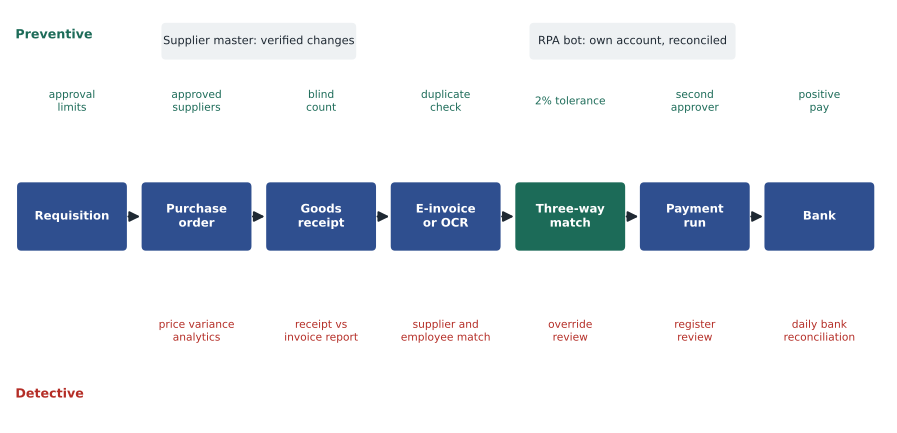
Ridgeback's controller has asked you to design the controls for procure-to-pay as the company adds e-invoicing from its largest suppliers and an RPA bot to download supplier statements. Bring together the course's tools: document the process (lesson 2), identify risks at each step (lessons 6 and 8), select preventive and detective controls including ITGCs and application controls (lesson 9), address cybersecurity and fraud (lesson 11), and consider the new technologies. A risk and control matrix (RCM) lists each risk, the controls that address it, whether each is preventive or detective and manual or automated, the owner and the frequency. A simple coverage check confirms that every significant risk has at least one preventive and one detective control and that no single person owns conflicting controls.
# Ridgeback procure-to-pay: risk and control matrix coverage check (illustrative)
risks = {"R1": ("Fictitious supplier created", 5), "R2": ("Supplier bank details changed fraudulently", 5),
         "R3": ("Invoice paid twice", 4), "R4": ("Paid for goods not received or wrong price", 4),
         "R5": ("Payment file altered before bank", 4), "R6": ("Bot posts or downloads incorrectly", 3)}
controls = [
    ("C1", "Supplier creation needs documents and master-data role approval", "R1", "P", "auto", "master data lead"),
    ("C2", "Monthly supplier-employee address and bank match", "R1", "D", "auto", "internal audit"),
    ("C3", "Bank change call-back on known number, second approver", "R2", "P", "manual", "AP supervisor"),
    ("C4", "Alert old contacts; first payment after change reviewed", "R2", "D", "manual", "treasury"),
    ("C5", "ERP duplicate check on supplier, amount, normalized invoice number", "R3", "P", "auto", "AP supervisor"),
    ("C6", "Three-way match with 2% tolerance, consumed receipts", "R4", "P", "auto", "AP supervisor"),
    ("C7", "Monthly duplicate-payment and price-variance analytics", "R3", "D", "auto", "internal audit"),
    ("C8", "Encrypted bank file transfer and positive pay", "R5", "P", "auto", "treasury"),
    ("C9", "Daily bank reconciliation reviewed", "R5", "D", "manual", "controller"),
    ("C10", "Bot has own least-privilege account; changes tested", "R6", "P", "auto", "IT"),
]
for rid, (name, score) in risks.items():
    types = {c[3] for c in controls if c[2] == rid}
    gap = [t for t, label in (("P", "preventive"), ("D", "detective")) if t not in types]
    flag = "OK" if not gap else "GAP: no " + " and no ".join("preventive" if g == "P" else "detective" for g in gap)
    print(f"{rid} (score {score}) {name:45s} {flag}")
owners = {}
for cid, desc, rid, kind, mode, owner in controls:
    owners.setdefault(owner, set()).add(rid)
print("AP supervisor owns controls for:", sorted(owners["AP supervisor"]))R1 (score 5) Fictitious supplier created OK R2 (score 5) Supplier bank details changed fraudulently OK R3 (score 4) Invoice paid twice OK R4 (score 4) Paid for goods not received or wrong price GAP: no detective R5 (score 4) Payment file altered before bank OK R6 (score 3) Bot posts or downloads incorrectly GAP: no detective AP supervisor owns controls for: ['R2', 'R3', 'R4']
The check shows two gaps. Risk R4 (paying for goods not received or at the wrong price) has a strong preventive control in the three-way match but no detective control on its own line; the monthly analytics (C7) cover price variances, so mapping C7 to R4 as well, or adding a review of match overrides, closes the gap. Risk R6, the bot, has preventive controls but nothing that detects a bad run; a daily reconciliation of the bot's record counts and totals to the source statements would close it. The owner listing shows the AP supervisor owns the bank change verification, duplicate check and three-way match. That is acceptable only if the supervisor cannot also enter invoices and release payment runs; otherwise the matrix needs to move one of those controls to treasury.
Worked problem
Completing the risk and control matrix
Using the coverage check, propose the two missing controls and assign owners consistent with segregation of duties, given that the AP supervisor approves exceptions but does not release payments, and treasury releases payments but cannot change suppliers.
Show solution
- For R4, map the monthly analytics (C7) to price variances and add a weekly review of three-way match overrides by the controller, who does not process invoices.
- For R6, add a daily reconciliation of the bot's downloaded statement count and totals to the supplier portals, reviewed by an AP analyst who does not maintain the bot.
- Confirm that the master data lead (C1), AP supervisor (C3, C5, C6) and treasury (C4, C8) hold no conflicting ERP roles, using the SoD check from lesson 8.
- Record frequency, evidence and owner for each control so that it can be tested (lesson 9).
Answer: Add an override review by the controller for R4 and a bot output reconciliation for R6, and confirm owners hold no conflicting access.
The capstone reflects the main message of the course. Reliable accounting information comes from well-designed systems: clean, well-structured data; documented processes; transaction cycles with preventive and detective controls; IT general controls that keep automated controls working; security and privacy practices that protect data and money; and governance that adapts as technology changes. The next courses build on this foundation: ACCT-341 applies data analytics to accounting data, and ACCT-331 and ACCT-431 apply controls knowledge in auditing.
Common mistakes
MistakeGiving a bot a shared human login.
InsteadEach bot needs its own least-privilege account so its actions are traceable.
MistakeAccepting AI-generated figures without review.
InsteadReview AI outputs that affect the statements, and record the tool and version used.
MistakeAssuming a blockchain record is correct because it cannot be changed.
InsteadValidate data before recording; immutability does not create accuracy.
MistakeBuilding a risk and control matrix with only preventive controls.
InsteadEach significant risk needs preventive and detective coverage.
MistakeAssigning conflicting controls to one owner.
InsteadCheck owners against segregation of duties rules.
Summary and key terms
- RPA bots act at scale and need accounts, least privilege, change control and monitoring.
- AI tools need inventories, human review, version records and data restrictions; COSO's 2026 guidance applies the five components to generative AI.
- Canada has no general XBRL mandate for operating companies; the SEC requires inline XBRL in the US.
- Federal government suppliers invoice electronically; there is no general B2B e-invoicing mandate in Canada.
- Blockchains resist alteration but do not ensure that recorded data is correct.
- A risk and control matrix maps each risk to preventive and detective controls with owners.
- Reliable information comes from data, processes, controls, security and governance working together.
- Robotic process automation
- Software bots that mimic human actions in user interfaces to perform rule-based tasks.
- Generative AI
- AI that produces text, images or other content in response to prompts.
- Hallucination
- A confident but false output from a generative AI model.
- Model drift
- A change in a model's accuracy or behaviour over time or after updates.
- XBRL
- eXtensible Business Reporting Language, a standard for tagging financial data.
- Inline XBRL
- XBRL tags embedded in a human-readable document.
- E-invoicing
- Exchanging invoices as structured data between trading partners.
- Peppol
- An international network and standards for e-invoicing exchange.
- Distributed ledger
- A shared, append-only record maintained by several parties.
- Risk and control matrix
- A table linking risks to controls, with type, owner and frequency.
Practice problems
Work each problem on paper first, then reveal the answer to check.
Why must each bot have its own account?
Show answer
So its actions are traceable and limited to its role.
Give two risks of generative AI in accounting.
Show answer
Hallucinated outputs and leakage of confidential data (also changing outputs after updates).
What does COSO's 2026 generative AI guidance do?
Show answer
It applies the five components of the 2013 framework to generative AI across its life cycle.
Must Canadian operating companies file XBRL on SEDAR+?
Show answer
No general requirement as of October 2026; check the CSA's current position.
What does immutability on a blockchain not guarantee?
Show answer
That the data recorded is correct.
In the capstone code, which risks had gaps?
Show answer
R4 lacked a detective control and R6 lacked a detective control.
Propose a detective control for the bot risk.
Show answer
Daily reconciliation of the bot's record counts and totals to the source, reviewed independently.
When is it acceptable for the AP supervisor to own three controls?
Show answer
When the supervisor cannot also enter invoices or release payment runs.
List the columns of a risk and control matrix.
Show answer
Risk, control, preventive or detective, manual or automated, owner and frequency (and evidence).
Which courses build on ACCT-240?
Show answer
ACCT-341 Data Analytics for Accountants, and ACCT-331 and ACCT-431 Auditing and Assurance.
Lesson quiz · 5 questions
Score 60% or more to complete this lesson.
Create a free account to save your progress, take quizzes and earn a certificate.