
ACCT-102 · Lesson 5 of 12 · 30 min
Job-order costing
When every product or service is different, each one must be costed separately. A furniture maker building a boardroom table to a customer's drawings, a print shop producing a wedding order, a law firm handling a case and a construction company building a warehouse all face the same problem: what did this particular job cost, and was it profitable? Job-order costing answers it by accumulating direct materials, direct labour and an applied share of overhead on a record for each job. This lesson applies job-order costing to Cedar Ridge's custom shop. It explains predetermined overhead rates, the flow of costs through the accounts, the treatment of underapplied and overapplied overhead, and the choice between plantwide and departmental rates. CON-300 and CON-310 apply the same logic to construction estimates and cost control; this lesson provides the general framework.
When to use job-order costing
Costing systems sit on a spectrum. At one end, job-order costing suits organizations that produce distinct, identifiable units or batches to customer specifications: custom furniture, aircraft, films, audits, hospital stays. At the other end, process costing (lesson 6) suits organizations that make large volumes of identical units in a continuous flow, such as Cedar Ridge's Classic chair line, a bakery or a refinery. Many companies use both: Cedar Ridge costs custom orders by job and standard chairs by process. Hybrid systems, sometimes called operation costing, track materials by batch while treating conversion costs as a process.
| Feature | Job-order costing | Process costing (lesson 6) |
|---|---|---|
| Products | Unique jobs or batches | Identical units in continuous flow |
| Cost accumulated by | Job | Department or process |
| Key document | Job cost sheet | Production cost report |
| Unit cost | Job cost ÷ units in the job | Department cost ÷ equivalent units |
| Cedar Ridge example | Boardroom table for a law firm | Classic chairs |
The job cost sheet and source documents
The heart of the system is the job cost sheet, a record (today usually a screen in the ERP system) for each job. It accumulates three kinds of cost. Direct materials come from materials requisitions, the documents authorizing the storeroom to release materials to a job. Direct labour comes from time tickets or digital time records, showing the hours each employee worked on each job. Manufacturing overhead is applied using a predetermined rate, because actual overhead for the year is not known until the year ends. The open job cost sheets together make up the work in process subsidiary ledger; completed jobs move to finished goods and then to cost of goods sold.
| Job CS-2614: boardroom table, Halberg Legal | Detail | Amount |
|---|---|---|
| Direct materials | Walnut slabs (requisition 4410) | $3,600 |
| Steel base and hardware (requisition 4418) | $600 | |
| Direct labour | 120 hours × $28 (time tickets, weeks 14 to 16) | $3,360 |
| Manufacturing overhead applied | 120 direct labour hours × $25 | $3,000 |
| Total job cost | $10,560 |
Predetermined overhead rates
Direct materials and direct labour can be traced to jobs as they are used, but overhead cannot. The custom shop's electricity, the foreman's salary and the depreciation on the wide-belt sander relate to all jobs together. Waiting until year end to divide actual overhead among jobs would be too late for pricing and would give seasonal distortions: heating costs in January would make winter jobs look more expensive than identical summer jobs. So overhead is applied using a predetermined overhead rate, set before the year begins.
The allocation base should be a cost driver that causes overhead to be incurred, such as direct labour hours in a labour-intensive shop or machine hours in an automated one. Cedar Ridge's custom shop budgets $150,000 of overhead for the year and 6,000 direct labour hours, giving a rate of $25 per direct labour hour. Each job is then charged $25 for every direct labour hour it uses. This approach, actual direct materials and direct labour plus overhead applied at a predetermined rate, is called normal costing.
# Custom shop: predetermined overhead rate and a job cost (illustrative)
budget_moh, budget_dlh = 150_000, 6_000
rate = budget_moh / budget_dlh

job = {"materials": [3_600, 600], "dl_hours": 120, "dl_rate": 28}
dm = sum(job["materials"])
dl = job["dl_hours"] * job["dl_rate"]
moh = job["dl_hours"] * rate
total = dm + dl + moh

print(f"Predetermined overhead rate: ${rate:.2f} per DL hour")
print(f"Job CS-2614  DM {dm:,}  DL {dl:,}  MOH {moh:,.0f}  total {total:,.0f}")
markup = 0.40
print(f"Quoted price at {markup:.0%} markup on cost: ${total * (1 + markup):,.0f}")Predetermined overhead rate: $25.00 per DL hour Job CS-2614 DM 4,200 DL 3,360 MOH 3,000 total 10,560 Quoted price at 40% markup on cost: $14,784
Worked problem
Pricing a job
Halberg Legal also asks for a quote on a matching credenza estimated to need $1,850 of materials and 45 direct labour hours at $28. Cedar Ridge prices custom work at cost plus 40 per cent. What should it quote?
Show solution
- Direct materials: $1,850.
- Direct labour: 45 × $28 = $1,260.
- Overhead applied: 45 × $25 = $1,125.
- Estimated job cost = $1,850 + $1,260 + $1,125 = $4,235.
- Quote = $4,235 × 1.40 = $5,929.
Answer: Quote about $5,930 before sales tax. Lesson 9 explains when accepting a price below full cost can still make sense.
The flow of costs through the accounts
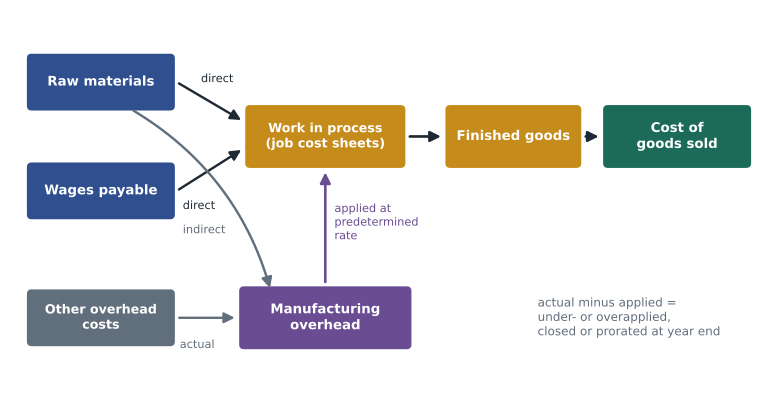
Job costing follows the flow of physical production. Materials are bought into raw materials inventory. When requisitioned, direct materials move to work in process and indirect materials to a manufacturing overhead control account. Factory labour is recorded the same way: direct labour to work in process, indirect labour to overhead. Other actual overhead costs, such as utilities and depreciation, are debited to manufacturing overhead as incurred. Overhead is applied to work in process at the predetermined rate, crediting manufacturing overhead. When a job is finished, its total cost moves from work in process to finished goods, and when it is delivered, from finished goods to cost of goods sold.
| Event | Debit | Credit | Amount (year) |
|---|---|---|---|
| Materials purchased on account | Raw materials | Accounts payable | $128,000 |
| Direct materials requisitioned | Work in process | Raw materials | $118,500 |
| Indirect materials requisitioned | Manufacturing overhead | Raw materials | $6,200 |
| Direct labour used | Work in process | Wages payable | $171,920 |
| Indirect labour | Manufacturing overhead | Wages payable | $58,400 |
| Other actual overhead (utilities, depreciation, insurance) | Manufacturing overhead | Various | $91,700 |
| Overhead applied (6,140 hours × $25) | Work in process | Manufacturing overhead | $153,500 |
| Jobs completed | Finished goods | Work in process | $420,600 |
| Jobs sold (at cost) | Cost of goods sold | Finished goods | $398,900 |
| Jobs sold (at selling price) | Accounts receivable | Sales | $571,000 |
Underapplied and overapplied overhead
Because the predetermined rate is based on estimates, applied overhead rarely equals actual overhead. If actual overhead exceeds applied overhead, overhead is underapplied (the manufacturing overhead account has a debit balance), and jobs have been undercosted. If applied exceeds actual, overhead is overapplied (a credit balance), and jobs have been overcosted. The difference arises because actual overhead spending differed from the budget, because actual activity differed from budgeted activity, or both.
Worked problem
Computing underapplied overhead
The custom shop incurred actual overhead of $156,300 and worked 6,140 direct labour hours. The predetermined rate was $25. Was overhead under- or overapplied?
Show solution
- Applied overhead = 6,140 × $25 = $153,500.
- Actual overhead = $156,300.
- Actual exceeds applied by $156,300 − $153,500 = $2,800.
- Overhead is underapplied by $2,800: the jobs were charged $2,800 too little.
- Causes: spending was $6,300 over the $150,000 budget, partly offset by 140 more hours than budgeted, which applied an extra 140 × $25 = $3,500.
Answer: Underapplied by $2,800.
At year end the balance must be cleared. If it is immaterial, the simplest approach is to close it to cost of goods sold: underapplied overhead increases cost of goods sold, overapplied overhead decreases it. If it is material, it is prorated among work in process, finished goods and cost of goods sold in proportion to the overhead applied in each (or to their total balances), which approximates what the job costs would have been had the actual rate been known.
# Disposing of underapplied overhead (illustrative)
underapplied = 156_300 - 6_140 * 25
applied_in = {"Work in process": 12_280, "Finished goods": 9_210, "Cost of goods sold": 132_010}
total = sum(applied_in.values())

print(f"Underapplied overhead: ${underapplied:,}")
print("Option 1: debit cost of goods sold", f"${underapplied:,}")
print("Option 2: prorate on applied overhead")
for acct, amt in applied_in.items():
    share = amt / total
print(f" {acct:<20}{share:>7.1%} ${underapplied * share:>8,.0f}")Underapplied overhead: $2,800 Option 1: debit cost of goods sold $2,800 Option 2: prorate on applied overhead Work in process 8.0% $ 224 Finished goods 6.0% $ 168 Cost of goods sold 86.0% $ 2,408
Under either option, the accounts end the year as if actual overhead had been charged. Proration keeps inventory closer to actual cost; closing everything to cost of goods sold is simpler and is acceptable when the amount is small. A large or persistent balance is a signal to managers that the budget or the allocation base needs attention. Note also that financial reporting frameworks require inventory to absorb fixed overhead based on normal capacity, so unusually low production should not inflate inventory cost; unallocated fixed overhead in that case is expensed (lesson 8 returns to this).
Plantwide versus departmental rates
A single plantwide rate is simple, but it can distort job costs when departments use different drivers. Cedar Ridge's custom shop has two departments. Machining, dominated by the CNC router and sanders, incurs overhead driven by machine hours. Finishing, where staff sand, stain and lacquer by hand, incurs overhead driven by labour hours. A job that spends many hours on the router but few in finishing should carry more machining overhead and less finishing overhead than a plantwide labour-hour rate would give it.
# Plantwide versus departmental rates for two jobs (illustrative)
budget = {"Machining": {"moh": 90_000, "base": 1_500, "unit": "machine hour"},
          "Finishing": {"moh": 60_000, "base": 4_000, "unit": "DL hour"}}
rates = {d: b["moh"] / b["base"] for d, b in budget.items()}
plantwide = 150_000 / 6_000          # per DL hour

jobs = {  # machine hours in Machining, DL hours (total and in Finishing)
    "CS-2614 table":     {"mh": 40, "dlh": 120, "fin_dlh": 70},
    "CS-2620 bookcases": {"mh": 6,  "dlh": 110, "fin_dlh": 95},
}
for d, r in rates.items():
    print(f"{d} rate: ${r:.2f} per {budget[d]['unit']}")
for name, j in jobs.items():
    pw = j["dlh"] * plantwide
    dept = j["mh"] * rates["Machining"] + j["fin_dlh"] * rates["Finishing"]
print(f"{name:<18} plantwide ${pw:>6,.0f} departmental ${dept:>6,.0f}")Machining rate: $60.00 per machine hour Finishing rate: $15.00 per DL hour CS-2614 table plantwide $ 3,000 departmental $ 3,450 CS-2620 bookcases plantwide $ 2,750 departmental $ 1,785
With departmental rates the table, which uses 40 router hours, carries $3,450 of overhead rather than $3,000, while the hand-finished bookcases carry $1,785 rather than $2,750. Under the plantwide rate, the bookcases subsidize the table. If Cedar Ridge priced from plantwide costs, it would tend to underprice machine-heavy work and overprice hand work, losing profitable hand-finishing orders to competitors while winning machine-heavy jobs that earn less than it thinks. Lesson 7 extends the idea from departments to activities.
Job costing in service organizations
Service firms use job costing for engagements, cases and projects. The main direct cost is professional labour, recorded through timesheets; materials are usually minor; and overhead (office rent, administrative staff, technology) is applied using a rate per professional hour. A consulting firm with $1.2 million of budgeted overhead and 24,000 budgeted billable hours applies $50 of overhead per hour. Comparing each engagement's cost with its fee shows which clients and services are profitable. Hospitals cost procedures in a similar way, and government contracts that reimburse costs specify which costs may be charged.
Federal government contracts in Canada that reimburse costs follow contract cost principles set out in Public Services and Procurement Canada's standard clauses (often referred to by the code 1031-2), which define allowable and unallowable costs and how indirect costs may be allocated. Contractors on such work need job-costing systems that can support these rules.
Worked problem
An engagement cost
A consulting engagement for Cedar Ridge uses 64 consultant hours at a loaded cost of $85 per hour and $900 of travel. The firm applies overhead at $50 per professional hour and billed $15,000. What was the engagement margin?
Show solution
- Direct labour: 64 × $85 = $5,440.
- Direct costs: travel $900.
- Overhead applied: 64 × $50 = $3,200.
- Total cost = $5,440 + $900 + $3,200 = $9,540.
- Margin = $15,000 − $9,540 = $5,460, or 36.4 per cent of the fee.
Answer: The engagement earned a margin of $5,460.
Common mistakes
MistakeApplying overhead using actual year-end overhead.
InsteadUse a predetermined rate so jobs can be costed and priced during the year.
MistakeCharging actual overhead costs directly to jobs.
InsteadDebit actual overhead to the overhead control account; charge jobs with applied overhead.
MistakeTreating underapplied overhead as a gain.
InsteadUnderapplied overhead means jobs were undercosted; it increases cost of goods sold or is prorated.
MistakeUsing direct labour hours as the base in an automated department.
InsteadChoose a base that drives the overhead, such as machine hours.
MistakeIgnoring a large, recurring overhead balance.
InsteadInvestigate the budget, the activity estimate and the allocation base.
Summary and key terms
- Job-order costing accumulates costs for distinct jobs on job cost sheets.
- Direct materials and direct labour are traced using requisitions and time records.
- Overhead is applied using a predetermined rate: budgeted overhead ÷ budgeted allocation base.
- Costs flow from raw materials and wages through work in process to finished goods and cost of goods sold.
- Underapplied or overapplied overhead is closed to cost of goods sold or prorated if material.
- Departmental rates using appropriate drivers give more accurate job costs than a single plantwide rate.
- Service firms use job costing for engagements, with professional labour as the main direct cost.
- Job-order costing
- A system that accumulates costs for each distinct job or batch.
- Job cost sheet
- A record of the direct materials, direct labour and applied overhead of a job.
- Materials requisition
- A document authorizing the release of materials to a job or to overhead.
- Time ticket
- A record of the hours an employee worked on each job.
- Predetermined overhead rate
- Budgeted overhead divided by the budgeted allocation base, set before the period.
- Allocation base
- The measure used to assign overhead to cost objects, such as labour or machine hours.
- Normal costing
- Costing with actual direct costs and overhead applied at a predetermined rate.
- Applied overhead
- Overhead charged to jobs using the predetermined rate.
- Underapplied overhead
- The excess of actual overhead over applied overhead.
- Overapplied overhead
- The excess of applied overhead over actual overhead.
Practice problems
Work each problem on paper first, then reveal the answer to check.
Budgeted overhead is $240,000 and budgeted machine hours are 8,000. Find the rate.
Show answer
$30 per machine hour.
A job uses $2,000 of materials, 30 labour hours at $26 and 12 machine hours. Using the $30 rate, find its cost.
Show answer
$2,000 + $780 + $360 = $3,140.
Actual overhead $245,000; actual machine hours 8,300. Under- or overapplied?
Show answer
Applied $249,000; overapplied by $4,000.
Record closing $4,000 overapplied overhead to cost of goods sold.
Show answer
Debit Manufacturing overhead 4,000; credit Cost of goods sold 4,000.
Why is a predetermined rate better than an actual monthly rate?
Show answer
It is available for pricing during the period and avoids seasonal swings in unit costs.
Which document supports direct labour charged to a job?
Show answer
Time tickets or digital time records.
Underapplied overhead of $10,000 is material; applied overhead is 10% in WIP, 15% in FG and 75% in COGS. Prorate it.
Show answer
WIP $1,000; FG $1,500; COGS $7,500.
Give a reason departmental rates can change a job's cost.
Show answer
Jobs use departments in different proportions, and each department's overhead has a different driver.
A law firm budgets $900,000 of overhead and 18,000 lawyer hours. What is the overhead charged to a 40-hour case?
Show answer
$50 per hour × 40 = $2,000.
Change the departmental program so Finishing overhead is $80,000. What happens to the bookcase job?
Show answer
The finishing rate becomes $20, so the bookcases carry 6 × 60 + 95 × 20 = $2,260.
Lesson quiz · 5 questions
Score 60% or more to complete this lesson.
Create a free account to save your progress, take quizzes and earn a certificate.