
ACCT-102 · Lesson 10 of 12 · 29 min
Budgeting and the master budget
A budget is a detailed plan, expressed in numbers, for acquiring and using resources over a period. It turns strategy into targets that people can act on: how many chairs to sell, how many to make, how much hardwood to buy, how many people to schedule, how much cash will be needed and when. It coordinates departments that would otherwise plan in isolation, communicates expectations, and provides the benchmark against which actual results are later compared. This lesson explains why organizations budget, how the master budget fits together, and how to prepare each schedule, using Cedar Ridge's chair line for next year. Lesson 11 then shows how budgets are used for control through flexible budgets and variances.
Why organizations budget
Budgeting forces planning: managers must think ahead about demand, capacity, staffing and financing rather than react to events. It coordinates activities: the production plan must match the sales forecast, and purchasing must match production. It communicates plans and priorities throughout the organization. It allocates resources among competing uses. It provides benchmarks for evaluating performance and spotting problems early. And it anticipates financing needs, so that a company can arrange a line of credit before cash runs short rather than after. Small businesses benefit as much as large ones; a simple cash budget is often the difference between surviving a seasonal dip and missing payroll.
| Budget type | Period and purpose |
|---|---|
| Operating budget | Next year, by month or quarter: sales, production, costs and income |
| Financial budget | Cash budget, budgeted balance sheet, capital expenditures |
| Capital budget | Long-term investments in equipment and facilities (FIN-201) |
| Continuous (rolling) budget | Always covers the next 12 months; a new month is added as each month ends |
| Strategic plan | Three to five years; broad goals that the annual budget implements |
Behavioural aspects: participation, slack and incentives
Budgets are about people as much as numbers. In top-down budgeting, senior managers set targets and pass them down; it is quick and aligned with strategy but can seem imposed and unrealistic to those who must meet it. In participative (bottom-up) budgeting, managers help set the budgets they will be held to; they know their operations best and are more committed to targets they helped set. The risk is budgetary slack: understating revenues or overstating costs to make targets easy. Most organizations combine the two, with negotiation between levels and review against history and benchmarks.
Targets should be challenging but achievable. Targets that are too easy waste potential; targets that are impossible demoralize staff and can encourage manipulation, such as the timing games described in lesson 1 or the overproduction described in lesson 8. Use-it-or-lose-it budgets, in which unspent funds are taken away and next year's budget is cut, encourage wasteful year-end spending. Zero-based budgeting, in which each activity's budget is justified from zero rather than from last year's amount, tackles that problem at the cost of more work; many organizations apply it selectively to discretionary costs. Rolling forecasts, updated quarterly, keep plans relevant when conditions change quickly, as they did during the input-cost and tariff swings of recent years.
The master budget
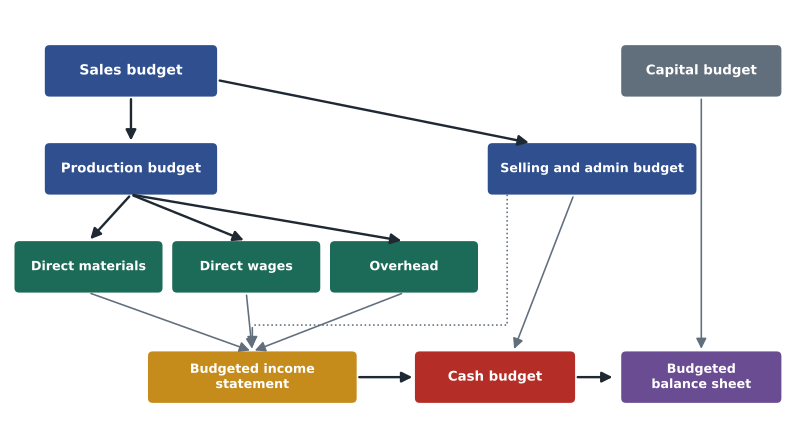
The master budget is the complete set of interrelated budgets for a period. It begins with the sales budget, because almost everything else depends on expected sales. The sales budget drives the production budget (for a manufacturer) or the merchandise purchases budget (for a retailer). Production drives the direct materials, direct labour and manufacturing overhead budgets. Together with the selling and administrative budget, these feed the budgeted income statement. The cash budget translates all of these into receipts and payments, and the budgeted balance sheet shows the expected financial position at the end of the period.
The sales forecast and sales budget
The sales forecast is the hardest and most important estimate in the budget. Cedar Ridge's sales manager combines last year's sales by quarter, orders already in hand from retailers, feedback from sales staff, planned price changes and promotions, economic indicators such as housing starts and consumer confidence, and the competitive situation. Statistical methods such as time series and regression (lesson 3, BUS-230 lesson 6) help, but judgement remains essential. The forecast for next year is 7,000 Classic chairs at $180, with a seasonal peak in the second quarter, when retailers stock up for spring and summer.
Production and materials budgets
The production budget determines how many units to make so that sales can be met and the planned ending inventory reached. Required production = budgeted sales + desired ending finished goods − beginning finished goods. Cedar Ridge keeps ending finished goods equal to 20 per cent of the next quarter's sales. The direct materials budget follows the same logic for raw materials: purchases = materials needed for production + desired ending raw materials − beginning raw materials. Cedar Ridge keeps hardwood equal to 10 per cent of the next quarter's needs, because lumber suppliers deliver within a few weeks.
# Cedar Ridge chair line: operating budgets by quarter (illustrative)
sales_units = [1_500, 2_000, 1_800, 1_700]
next_q1_sales, next_q1_production = 1_600, 1_700
price = 180
fg_pct, beg_fg = 0.20, 300              # ending FG = 20% of next quarter's sales
bf_per_chair, bf_price = 5, 12          # board feet of hardwood
rm_pct, beg_rm = 0.10, 800              # ending wood = 10% of next quarter's needs

sales = [u * price for u in sales_units]
fg_end = [fg_pct * u for u in sales_units[1:] + [next_q1_sales]]
production, beg = [], beg_fg
for u, end in zip(sales_units, fg_end):
    production.append(u + end - beg)
    beg = end

need = [p * bf_per_chair for p in production]
rm_end = [rm_pct * n for n in need[1:] + [next_q1_production * bf_per_chair]]
bf_bought, beg = [], beg_rm
for n, e in zip(need, rm_end):
    bf_bought.append(n + e - beg)
    beg = e
purchases = [b * bf_price for b in bf_bought]
dl_hours = [p * 1.5 for p in production]
dl_cost = [h * 20 for h in dl_hours]
var_moh = [h * 8 for h in dl_hours]

def row(label, xs):
    print(f"{label:<20}" + "".join(f"{x:>10,.0f}" for x in xs) + f"{sum(xs):>11,.0f}")

print(f"{'':<20}{'Q1':>10}{'Q2':>10}{'Q3':>10}{'Q4':>10}{'Year':>11}")
row("Sales (units)", sales_units)
row("Sales ($)", sales)
row("Production (units)", production)
row("Wood needed (bf)", need)
row("Wood purchased (bf)", bf_bought)
row("Wood purchases ($)", purchases)
row("DL hours", dl_hours)
row("DL cost ($)", dl_cost)
row("Variable overhead", var_moh)Q1 Q2 Q3 Q4 Year Sales (units) 1,500 2,000 1,800 1,700 7,000 Sales ($) 270,000 360,000 324,000 306,000 1,260,000 Production (units) 1,600 1,960 1,780 1,680 7,020 Wood needed (bf) 8,000 9,800 8,900 8,400 35,100 Wood purchased (bf) 8,180 9,710 8,850 8,410 35,150 Wood purchases ($) 98,160 116,520 106,200 100,920 421,800 DL hours 2,400 2,940 2,670 2,520 10,530 DL cost ($) 48,000 58,800 53,400 50,400 210,600 Variable overhead 19,200 23,520 21,360 20,160 84,240
Observe how inventory policies smooth the flow. Production in the first quarter (1,600 chairs) exceeds sales (1,500) to build stock ahead of the spring peak, and production in the fourth quarter (1,680) is below the 1,700 chairs sold as stock is drawn down. Over the year, production of 7,020 chairs slightly exceeds sales of 7,000 because the planned ending inventory for next year (320 chairs) is higher than this year's opening inventory (300). Hardwood purchases of about $421,800 for the year follow production with a small lead.
Labour, overhead and selling and administrative budgets
The direct labour budget converts production into hours and dollars: 1.5 hours per chair at $20. It tells the plant manager how many people to schedule each quarter; the second-quarter peak of 2,940 hours might be met with overtime or temporary staff, while a longer-term solution would smooth production more evenly. The manufacturing overhead budget has a variable part ($8 per direct labour hour) and a fixed part ($54,000 per quarter, of which $18,000 is depreciation, a non-cash cost). The selling and administrative budget has a variable part ($6 per chair sold) and a fixed part ($36,000 per quarter, including $3,000 of depreciation on office equipment and delivery vehicles).
| Budget | Variable part | Fixed part per quarter | Non-cash portion |
|---|---|---|---|
| Direct labour | 1.5 hours × $20 per chair produced | — | — |
| Manufacturing overhead | $8 per direct labour hour | $54,000 | $18,000 depreciation |
| Selling and administrative | $6 per chair sold | $36,000 | $3,000 depreciation |
The cash budget
The cash budget shows expected cash receipts and payments, the resulting cash balance, and any borrowing or repayment needed to keep cash above a minimum. It is often the most useful schedule for managers, because profitable companies can still run out of cash when sales are collected later than costs are paid, or when large capital purchases fall in one quarter. Cedar Ridge collects 70 per cent of each quarter's sales in the quarter and 30 per cent in the next; it pays for 60 per cent of hardwood purchases in the quarter and 40 per cent in the next. Wages and other cash costs are paid as incurred. Depreciation is excluded because it uses no cash. The company plans to replace its spray booth and dust collection system in the second quarter for $120,000 (lesson 9 analysed the booth), pays income tax instalments of $9,000 a quarter and plans a $20,000 dividend in the fourth quarter. It wants at least $30,000 of cash at all times and has a bank line of credit at 8 per cent a year (2 per cent a quarter), borrowed in multiples of $5,000.
# Cedar Ridge cash budget by quarter (illustrative; continues the operating budget)
sales = [270_000, 360_000, 324_000, 306_000]
purchases = [98_160, 116_520, 106_200, 100_920]
dl_cost = [48_000, 58_800, 53_400, 50_400]
var_moh = [19_200, 23_520, 21_360, 20_160]
var_sa = [9_000, 12_000, 10_800, 10_200]
fixed_moh_cash, fixed_sa_cash = 54_000 - 18_000, 36_000 - 3_000
capex = [0, 120_000, 0, 0]
dividends = [0, 0, 0, 20_000]
tax = [9_000] * 4
cash, ar, ap = 35_000, 81_000, 28_000
minimum, rate, loan = 30_000, 0.02, 0

for q in range(4):
    receipts = ar + 0.7 * sales[q]; ar = 0.3 * sales[q]
    wood = ap + 0.6 * purchases[q]; ap = 0.4 * purchases[q]
    interest = loan * rate
    payments = (wood + dl_cost[q] + var_moh[q] + fixed_moh_cash + var_sa[q]
                + fixed_sa_cash + capex[q] + dividends[q] + tax[q] + interest)
    available = cash + receipts - payments
    borrow = repay = 0
    if available < minimum:
        borrow = -(-(minimum - available) // 5_000) * 5_000
    elif loan:
        repay = min(loan, (available - minimum) // 5_000 * 5_000)
    loan += borrow - repay
    cash = available + borrow - repay
    print(f"Q{q + 1}: receipts {receipts:>9,.0f}  payments {payments:>9,.0f}  "
          f"borrow {borrow:>7,.0f}  repay {repay:>7,.0f}  interest {interest:>5,.0f}  "
f"ending cash {cash:>9,.0f} loan {loan:>7,.0f}")Q1: receipts 270,000 payments 241,096 borrow 0 repay 0 interest 0 ending cash 63,904 loan 0 Q2: receipts 333,000 payments 401,496 borrow 35,000 repay 0 interest 0 ending cash 30,408 loan 35,000 Q3: receipts 334,800 payments 274,588 borrow 0 repay 35,000 interest 700 ending cash 55,620 loan 0 Q4: receipts 311,400 payments 281,792 borrow 0 repay 0 interest 0 ending cash 85,228 loan 0
The cash budget reveals what the income statement would hide: the second quarter needs financing. Spring production peaks, hardwood bills arrive, and the $120,000 equipment purchase falls in the same quarter, so without borrowing cash would fall below zero. The company draws $35,000 on its line of credit, keeping cash just above the $30,000 minimum, and repays the loan in full in the third quarter as summer collections arrive, after paying $700 of interest. By year end cash has rebuilt to well above the minimum. Seeing this months in advance lets the controller arrange the line of credit, discuss timing of the equipment purchase with the plant manager, or ask the board whether the dividend should wait.
Worked problem
A change in collections
A large retailer asks for 60-day terms, which would change Cedar Ridge's collections to 55 per cent in the quarter of sale and 45 per cent in the next. What happens to second-quarter cash?
Show solution
- Q1 receipts fall from $270,000 to $81,000 + 0.55 × $270,000 = $229,500, a drop of $40,500.
- Q2 receipts become 0.45 × $270,000 + 0.55 × $360,000 = $121,500 + $198,000 = $319,500, against $333,000 before.
- Cumulative receipts by the end of Q2 fall by $40,500 + $13,500 = $54,000.
- The Q2 borrowing need therefore rises by about $54,000, so the company would draw about $90,000 on the line rather than $35,000.
Answer: Longer credit terms are a financing decision: they shift about $54,000 of cash need into the first half of the year. Cedar Ridge should price the terms or arrange a larger line.
Budgeted income statement and balance sheet
The budgeted income statement summarizes the expected results. For internal use Cedar Ridge prepares it in contribution format, which makes the link to the CVP analysis of lesson 4 obvious; its accountants also prepare an absorption version for the bank. The budgeted balance sheet starts from the current balance sheet and applies every budgeted change: ending cash from the cash budget, ending receivables (30 per cent of fourth-quarter sales), ending inventories from the production and materials budgets, equipment additions and depreciation, ending payables (40 per cent of fourth-quarter purchases), the loan balance, and retained earnings increased by budgeted net income and reduced by dividends.
# Budgeted income statement, contribution format (illustrative)
units, price = 7_000, 180
variable_cost = units * (102 + 6)
fixed_moh, fixed_sa, interest = 216_000, 144_000, 700
sales = units * price
cm = sales - variable_cost
income_before_tax = cm - fixed_moh - fixed_sa - interest
print(f"Sales                          {sales:>11,}")
print(f"Variable costs                 {variable_cost:>11,}")
print(f"Contribution margin            {cm:>11,}")
print(f"Fixed manufacturing overhead   {fixed_moh:>11,}")
print(f"Fixed selling and admin        {fixed_sa:>11,}")
print(f"Interest                       {interest:>11,}")
print(f"Income before tax              {income_before_tax:>11,}")
print(f"Ending receivables (30% of Q4) {0.3 * 306_000:>11,.0f}")
print(f"Ending payables (40% of Q4) {0.4 * 100_920:>11,.0f}")Sales 1,260,000 Variable costs 756,000 Contribution margin 504,000 Fixed manufacturing overhead 216,000 Fixed selling and admin 144,000 Interest 700 Income before tax 143,300 Ending receivables (30% of Q4) 91,800 Ending payables (40% of Q4) 40,368
| Budgeted ending balance (selected) | Amount | Source |
|---|---|---|
| Accounts receivable | $91,800 | 30% of Q4 sales of $306,000 |
| Finished goods (320 chairs) | at budgeted unit cost | Production budget |
| Raw materials (850 board feet) | $10,200 | Materials budget: 10% of next Q1 needs |
| Accounts payable | $40,368 | 40% of Q4 purchases of $100,920 |
| Line of credit | $0 | Cash budget: repaid in Q3 |
Budgeting under uncertainty
Every number in the budget rests on forecasts, and the sales forecast is the shakiest. Good practice tests the budget against alternative scenarios: what if sales are 10 per cent below forecast, hardwood prices rise, or the equipment purchase is delayed? Spreadsheet scenario tools or short programs make this quick. Cedar Ridge's controller reran the cash budget with sales 10 per cent lower in every quarter and found that second-quarter borrowing rose from $35,000 to $50,000 (lower sales also mean lower production and purchases, which softens the blow), that repayment stretched into the fourth quarter, and that year-end cash fell from about $85,000 to about $44,000, close enough to the minimum to make the board reconsider the dividend. Simulation, as in lesson 4, can attach probabilities to such outcomes.
Budgeting in service and public organizations
Service firms budget mainly people: billable hours, utilization rates, salaries and overhead. A consulting firm's revenue budget starts from staff numbers, target utilization and billing rates. Not-for-profit organizations and governments budget expenditure authority: the budget is a legal limit on spending approved by a board or legislature, and comparing actual spending with appropriations is central to accountability. ACCT-412 covers public sector and not-for-profit budgeting and reporting.
Common mistakes
MistakeStarting the budget with production or costs instead of sales.
InsteadBegin with the sales budget; nearly every other schedule depends on it.
MistakeForgetting inventory changes in the production or purchases budget.
InsteadRequired production = sales + desired ending inventory − beginning inventory, and the same for materials.
MistakeIncluding depreciation in the cash budget.
InsteadDepreciation is a non-cash expense; exclude it from cash payments.
MistakeAssuming a profitable budget means enough cash.
InsteadTiming of collections, payments and capital spending can create shortfalls; prepare a cash budget.
MistakeSetting targets so high or so low that they lose meaning.
InsteadAim for challenging but achievable targets, set with input from those responsible.
Summary and key terms
- A budget is a quantitative plan that supports planning, coordination, communication and control.
- Participative budgeting builds commitment but risks budgetary slack; targets should be challenging but achievable.
- The master budget starts with the sales budget and flows through production, materials, labour, overhead and selling budgets.
- Production = sales + desired ending finished goods − beginning finished goods; purchases follow the same logic.
- The cash budget converts the plan into receipts and payments and identifies financing needs.
- The budgeted income statement and balance sheet summarize expected results and position.
- Scenario analysis and rolling forecasts help budgets stay useful when conditions change.
- Master budget
- The complete set of interrelated operating and financial budgets for a period.
- Sales budget
- The budget of expected sales units and revenue, the starting point of the master budget.
- Production budget
- The budget of units to produce, based on sales and inventory policies.
- Direct materials budget
- The budget of materials to buy, based on production and materials inventory policies.
- Cash budget
- A schedule of expected cash receipts and payments, cash balances and financing.
- Participative budgeting
- Budgeting in which managers help set the budgets they will be held to.
- Zero-based budgeting
- Budgeting in which every activity must be justified from zero each period.
- Rolling budget
- A budget that is continuously extended, always covering the next 12 months.
- Line of credit
- A pre-arranged borrowing facility that can be drawn and repaid as needed.
- Budgeted balance sheet
- The expected statement of financial position at the end of the budget period.
Practice problems
Work each problem on paper first, then reveal the answer to check.
Budgeted sales are 4,000 units; desired ending inventory 600; beginning inventory 500. Find required production.
Show answer
4,100 units.
Each unit uses 3 kg of material. Desired ending materials are 1,000 kg and beginning materials 1,200 kg. How many kg should be purchased for 4,100 units?
Show answer
12,300 + 1,000 − 1,200 = 12,100 kg.
Sales are $200,000 in May and $240,000 in June; 70% is collected in the month and 30% the next. Find June collections.
Show answer
$60,000 + $168,000 = $228,000.
Why is depreciation excluded from the cash budget?
Show answer
It is a non-cash allocation of an earlier capital cost.
What is budgetary slack and why is it a problem?
Show answer
Deliberately easy budget targets; they waste potential and distort evaluation.
How does a rolling budget differ from an annual budget?
Show answer
It always covers the next 12 months, adding a period as each one ends.
In Cedar Ridge's budget, why does Q1 production exceed Q1 sales?
Show answer
To build finished goods to 20% of the larger Q2 sales.
Give two actions if the cash budget shows a shortfall.
Show answer
Arrange a line of credit, delay capital spending, defer dividends, speed collections or negotiate longer supplier terms.
What is the main advantage of zero-based budgeting?
Show answer
It questions every cost rather than accepting last year's spending as the starting point.
Change the cash program so the equipment purchase moves to Q3. What happens?
Show answer
No borrowing is needed in any quarter: cash builds to about $115,000 in Q2, so the Q3 purchase leaves about $56,000.
Lesson quiz · 5 questions
Score 60% or more to complete this lesson.
Create a free account to save your progress, take quizzes and earn a certificate.