
TRD-107 · Lesson 7 of 12 · 19 min
Certification exams and how to prepare
In licensed trades, the final hurdle is usually a license exam. In Columbus, for example, a journeyperson plumber license requires five years of documented experience in the trade or completion of a registered plumbing apprenticeship, followed by a passing score of at least 70 percent on a national standard journeyman plumber exam administered by an approved testing agency. Electrical, HVAC and other licenses work in similar ways, with the details set by each state or city. The exams are high-stakes, mostly multiple-choice, often open-book, and many experienced workers fail them the first time, not because they cannot do the work but because they did not prepare for the way the exam asks questions. This lesson explains how trade exams are built and how to prepare for them.
How trade exams are built
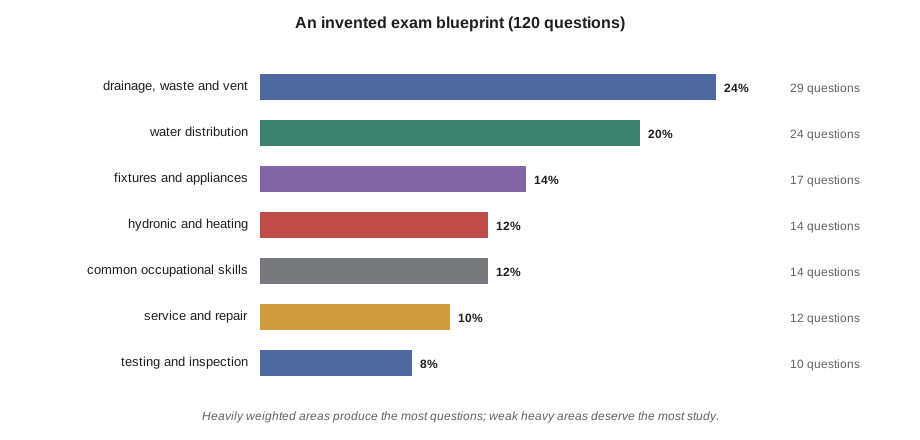
Most trade license exams are written, multiple-choice tests of 50 to 100 or more questions with a time limit of several hours. Many are built on a published content outline that lists the topics covered and how many questions come from each: for a plumbing exam, for example, drainage and venting, water supply, fixtures, gas, tests and inspections, and general regulations. Many electrical and plumbing exams are open-book, which means you may bring specific code books, tabbed but not written in, and the exam tests how quickly and accurately you can find and apply the right rule. Others are closed-book. Check the candidate bulletin for your exam: it lists the content outline, the allowed references, the time limit and the pass mark.
Knowing the weightings is the single most useful thing you can do before you study. If one area is 25 percent of the exam and another is 5 percent, your study time should reflect that, while still covering everything. Many apprentices spend most of their time on the topics they enjoy or already know and too little on the heavily weighted areas they find hard.
Reading multiple-choice questions
Trade exams test knowledge, but they also test careful reading. Many wrong answers come from misreading the question. A few habits help:
- Read the whole question, including every word in it, before looking at the choices. Watch for words like not, except, minimum, maximum, first and most likely.
- Work out your own answer before reading the choices, especially in calculation questions. Then look for it.
- Read all four choices. The first one that looks right may be a near miss; another choice may be more complete or more correct.
- Eliminate choices you know are wrong. Choosing between two is much easier than choosing between four.
- Check units. A calculation answer in the wrong unit is a common trap.
- Answer every question. There is usually no penalty for a wrong answer, so a guess is better than a blank.
Many questions are written as short scenarios: A journeyworker is installing a water heater in a basement. Which of the following is required? These test whether you can apply knowledge to a real situation, not just recall a fact. The best preparation is real experience combined with studying why things are done the way they are.
Building a study plan
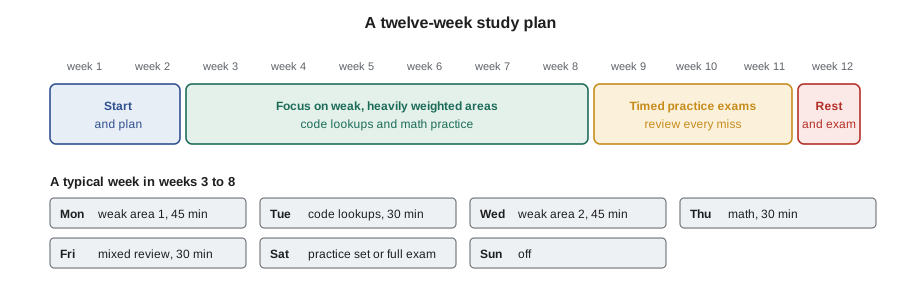
Most successful candidates start studying two to three months before the exam, a little each day, rather than cramming in the last week. A plan helps you cover everything and spend more time where you need it.
- Get the official exam information: the standard or content outline, the weightings, the allowed references and the pass mark.
- Take a practice test early to see where you stand, and use the results to set priorities.
- Spend most of your time on heavily weighted areas where you are weak, but review everything.
- Practice with the code book in timed conditions if the exam is open-book, so finding things becomes automatic.
- Review the math: pipe sizing, offsets, slopes, volumes, pressure, electrical calculations, whatever your trade uses. TRD-102 covers trade math.
- Use your own experience. For every topic, think of a job where you did that work and what could have gone wrong.
- Do full timed practice exams in the last few weeks to build stamina and pace.
The program below takes practice-test scores by area and the exam weightings and calculates a study priority for each area: how many questions you are likely to lose there. The areas at the top are where an hour of study is worth the most.
# study priority: expected questions lost by area, from practice scores and weightings
exam_questions = 120
weights = {"drainage, waste and vent": 0.24, "water distribution": 0.20, "fixtures and appliances": 0.14,
           "hydronic and heating": 0.12, "service and repair": 0.10, "testing and inspection": 0.08,
           "common occupational skills": 0.12}
practice = {"drainage, waste and vent": 0.78, "water distribution": 0.70, "fixtures and appliances": 0.85,
            "hydronic and heating": 0.50, "service and repair": 0.62, "testing and inspection": 0.88,
            "common occupational skills": 0.80}
rows = []
for area, w in weights.items():
    q = w * exam_questions
    lost = q * (1 - practice[area])
    rows.append((lost, area, q, practice[area]))
rows.sort(reverse=True)
expected = sum(q * p for _, _, q, p in rows) / exam_questions
print(f"expected score at current level: {expected:.0%} (pass mark 70%)")
for lost, area, q, p in rows:
print(f"{area:28s} {q:5.1f} questions, practice {p:.0%}, about {lost:4.1f} lost")expected score at current level: 73% (pass mark 70%) water distribution 24.0 questions, practice 70%, about 7.2 lost hydronic and heating 14.4 questions, practice 50%, about 7.2 lost drainage, waste and vent 28.8 questions, practice 78%, about 6.3 lost service and repair 12.0 questions, practice 62%, about 4.6 lost common occupational skills 14.4 questions, practice 80%, about 2.9 lost fixtures and appliances 16.8 questions, practice 85%, about 2.5 lost testing and inspection 9.6 questions, practice 88%, about 1.2 lost
When Maya ran this with her own practice results, she found that her weakest area, hydronic heating, was also one of the heavier ones, and that water distribution was costing her more questions than she had thought because it was so heavily weighted. She shifted her study plan so that those two areas got half her time for the first month.
Open-book exams and the code book
If your exam allows the code book, do not let that make you relaxed. Open-book exams are timed so that you cannot look up every answer. Candidates who pass know the common answers without looking and use the book to confirm and to find less common rules. Practice looking things up against a timer. Use the index and table of contents, learn where the main tables are, and follow the exam's rules about tabs and highlighting exactly; references that break the rules can be taken away at the door.
Exam day
Get a full night's sleep before the exam and eat before you go. Arrive early with the identification and references required, and leave everything else in your vehicle. Read the instructions. Pace yourself: divide the time by the number of questions and check your progress at intervals. If a question is taking too long, mark it, choose your best answer and move on; come back if time allows. Do not change answers unless you find a clear reason. Stay calm if you hit a run of hard questions; everyone does.
Many license exams are delivered by computer at testing centers run by private testing companies, and some offer remote proctoring. Computer-based exams usually let you flag questions and review them before submitting. Practice with any sample tests your exam provider offers.
If you do not pass
Many people do not pass on the first attempt, and failing is not the end. You will usually receive a score report showing your results by content area. Use it. Testing agencies and licensing boards set how soon you can retest and what fees apply; in Columbus, a failed attempt does not bar you from taking the plumbing exam again. Plan your next attempt with a targeted study plan rather than repeating what you did before.
| Time before exam | What to do |
|---|---|
| 3 months | Get the official exam information; take a practice test; build a plan |
| 2 months | Study weak, heavily weighted areas daily; practice code lookups and math |
| 1 month | Full timed practice exams weekly; review every wrong answer |
| 1 week | Light review; confirm location, time, ID and allowed references |
| The day before | Rest, prepare what you need, sleep well |
Calculation questions
Most trade exams include calculation questions: pipe and conductor sizing, offsets, slopes and grades, volumes and capacities, pressure and head, heat loss, voltage drop or load calculations, depending on the trade. They are often the questions candidates fear most, but they are also the most predictable, because the same few kinds of calculation come up again and again. Make a list of the calculation types in your trade's standard or content outline and practice each one until you can do it quickly and accurately.
For each calculation question, write down what is given, what is asked and the formula or table you will use before you start. Work in consistent units and convert at the start, not the end. Estimate the answer roughly before calculating, so you can spot a result that is ten times too big or small. Then check your answer against the choices. If your answer is not among them, look for a unit mistake or a misread number before guessing.
Bring the calculator the exam rules allow and practice with that exact calculator, so you know where every key is. Some exams provide a basic on-screen calculator instead. Either way, do not rely on a calculator you have never used before exam day.
Using your experience
Experienced apprentices have an advantage that no textbook can give: they have seen how systems are really built and how they fail. When you study a topic, link it to a job you worked on. When you read about venting, picture the stacks you ran on Kingsway Tower; when you read about water heater installation, picture the last one you set. Questions that feel abstract become concrete when you can see the real installation in your mind.
Be careful, though, with habits from the field that do not match the code or the standard. Every crew has its shortcuts and local practices, and some of them are not what the exam is looking for. When your experience and the book disagree, answer by the book and then ask your journeyworker or instructor about the difference.
Looking after yourself
Exam preparation happens on top of a full-time job, often with family responsibilities. Protect your sleep, keep study sessions short and regular, and take one day a week off from studying. Exercise helps memory and stress. If anxiety is a problem, practice under exam-like conditions until the format feels familiar, and talk to your instructor or training center about support. Remember that the exam measures knowledge you have been building for years; your job in the last months is to organize it, not to learn a whole trade from scratch.
Maya booked her exam date as soon as she was eligible, which gave her a fixed target to plan backward from. Having the date in her calendar, she said, turned studying from something she meant to do into something she had to do.
Common mistakes
MistakeStudying only the topics you enjoy.
InsteadUse the weightings and practice results to set priorities.
MistakeCramming in the final week.
InsteadStudy a little every day for two to three months.
MistakeRelying on the code book to answer everything in an open-book exam.
InsteadKnow common answers and practice timed lookups.
MistakePicking the first answer that looks right.
InsteadRead all four choices and eliminate the wrong ones.
MistakeLeaving questions blank.
InsteadAnswer every question; a guess is better than a blank.
Summary and key terms
- License exams are usually multiple-choice, often open-book, built from a published content outline with a set pass mark, often 70 percent.
- Use the exam weightings and practice results to decide where to spend study time.
- Read every word of the question, work out your answer first, read all choices and eliminate wrong ones.
- Study a little every day over two to three months and finish with full timed practice exams.
- On exam day, rest, arrive early, pace yourself and answer every question.
- If you do not pass, use the score report to target your next attempt.
- License exam
- The exam required by a state or city to receive a trade license.
- Content outline
- The published list of topics covered by an exam and the number of questions from each.
- Candidate bulletin
- The testing agency's guide to an exam: content, references, rules, time and scoring.
- Open-book exam
- An exam in which specified code books may be used.
- Pass mark
- The minimum score needed to pass, often 70 percent for trade exams.
Practice problems
Work each problem on paper first, then reveal the answer to check.
Why should study time follow the exam weightings?
Show answer
More questions come from heavily weighted areas, so improving there gains the most marks.
Name three habits for reading multiple-choice questions.
Show answer
Any three of: read every word, watch for words like not and except, work out your answer first, read all choices, eliminate wrong ones, check units.
How far ahead should you start studying?
Show answer
About two to three months, a little each day.
In the study priority program, what does the lost value mean?
Show answer
The number of questions you are likely to miss in that area at your current practice score.
Why practice code lookups against a timer?
Show answer
Open-book exams are timed so you cannot look up every answer; speed matters.
What should you do with your results if you fail?
Show answer
Use the area-by-area report to build a targeted study plan for the next attempt.
Lesson quiz · 5 questions
Score 60% or more to complete this lesson.
Create a free account to save your progress, take quizzes and earn a certificate.