
TRD-107 · Lesson 5 of 12 · 19 min
Logging hours and competencies
An apprenticeship is measured in two ways: how long you have worked in the trade, and what you can do. Hours show that you have had enough time on the job to build experience. Competencies, sometimes called skills, tasks or work processes, show that you have actually learned the things the trade requires. To finish an apprenticeship, you need both, and you need records that prove both. This lesson explains how hours and competencies are recorded, why the records matter and how to keep them accurate.
Why records matter
Your apprenticeship records are your evidence. They decide when you move up the wage schedule, when you are eligible for school, when you can write your exam and, in many places, whether you can get a license. They are what a new sponsor looks at if you change employers. Lost or inaccurate records can delay all of that by months. Apprentices who keep their own careful records almost never have that problem, and when an employer's records do go wrong, their own notes fix it quickly.
In a registered program, the sponsor keeps records of your on-the-job learning hours, the work processes you have performed and your related instruction, and reports your progress to the registration agency. The program standards include a work process schedule: a list of the main areas of work with approximate hours for each. In a competency-based or hybrid program, there is also a list of competencies that must be demonstrated and signed off. When everything is complete, the sponsor reports your completion and the agency issues the Certificate of Completion.
Hours
Hours are the simplest part to record but the easiest to get wrong. Only hours worked in the trade, under proper supervision, while registered usually count. Time spent driving, doing general labor outside the trade or working while unregistered may not count, depending on the rules. Overtime hours usually count as hours worked. Time in school usually counts separately, toward the in-school or related instruction requirement, rather than toward on-the-job hours.
Most registered construction programs require 2,000 hours of on-the-job learning per year of the program, so a four-year program means about 8,000 hours and a five-year program about 10,000. Licensing boards often have their own experience requirements, such as a number of years with a minimum number of hours in each, which may differ from the program's. Check both.
Keep a daily record, not a weekly or monthly one. Write the date, start and finish times, unpaid breaks, the area or task, and the journeyworker you worked with. Many employers now use apps; if yours does, check your entries each week and keep screenshots or exports. A simple notebook in your lunch bag works just as well as a backup.
Competencies
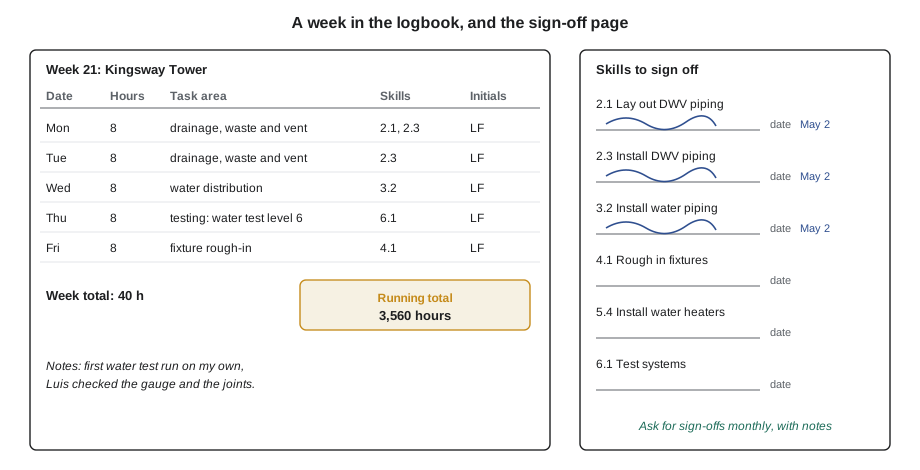
Competencies are the specific things an apprentice must be able to do. A plumbing training standard, for example, might include laying out and installing drainage, waste and vent piping; installing water distribution systems; installing and testing fixtures; installing water heaters; testing and inspecting systems; and servicing and repairing existing systems. Each area is broken into specific skills, and each skill is signed off when the apprentice can perform it to the standard, safely and without detailed help.
Getting sign-offs is partly your job. Your journeyworker is busy, and it is easy for months to pass without anyone looking at the standard. A good habit is to keep a list of the skills you have practiced recently and ask for sign-offs regularly, such as at the end of each month, with your notes as evidence: On level 6, I laid out and installed the drainage for twelve suites with Luis checking. Can we sign off skill 2.3?
Sign-offs should be honest. A journeyworker who signs off a skill you cannot actually do is not doing you a favor: it will show up in your exam, or worse, on a job where nobody is checking. If you have done a task only once, or only with lots of help, ask for more practice before the sign-off.
Getting a range of work
Most training standards are broad on purpose. A plumber needs to know drainage, water supply, fixtures, gas or heating in some trades, service and testing. A sponsor that does only one kind of work cannot cover the whole standard on its own. Track which areas you have covered and which you have not, and raise gaps early with your foreman. Solutions include rotating to another crew, spending time with the company's service department, or working for another sponsor for part of the apprenticeship.
The program below tracks hours by area against an invented set of targets and shows where an apprentice is ahead or behind. A table like this, kept up to date, makes conversations with your foreman about the range of work concrete instead of vague.
# hours by work area against invented targets for a plumbing apprenticeship
targets = {  # area: target hours over the whole apprenticeship
    "drainage, waste and vent": 2400, "water distribution": 2000, "fixtures and appliances": 1600,
    "hydronic and heating": 900, "service and repair": 1200, "testing and inspection": 500,
}
logged = {  # hours logged so far
    "drainage, waste and vent": 1450, "water distribution": 1180, "fixtures and appliances": 420,
    "hydronic and heating": 0, "service and repair": 120, "testing and inspection": 390,
}
total_t = sum(targets.values()); total_l = sum(logged.values())
share = total_l / total_t
print(f"overall: {total_l} of {total_t} h ({share:.0%})")
for area, t in targets.items():
    have = logged[area]; expected = round(t * share)
    note = "behind" if have < 0.6 * expected else ("ahead" if have > 1.3 * expected else "on track")
print(f"{area:26s} {have:5d} / {t:5d} h (expected about {expected:5d}) {note}")overall: 3560 of 8600 h (41%) drainage, waste and vent 1450 / 2400 h (expected about 993) ahead water distribution 1180 / 2000 h (expected about 828) ahead fixtures and appliances 420 / 1600 h (expected about 662) on track hydronic and heating 0 / 900 h (expected about 373) behind service and repair 120 / 1200 h (expected about 497) behind testing and inspection 390 / 500 h (expected about 207) ahead
When Maya ran a version of this with her own numbers, she found she had almost no hours in hydronic heating and little in service and repair, because Kingsway Tower is a new-construction job with a separate boiler contractor. She showed the table to Dave, who arranged for her to spend three weeks with Grace Lin in the service department over the winter and to join a crew installing in-floor heating at a townhouse project in the spring.
Projecting your completion date
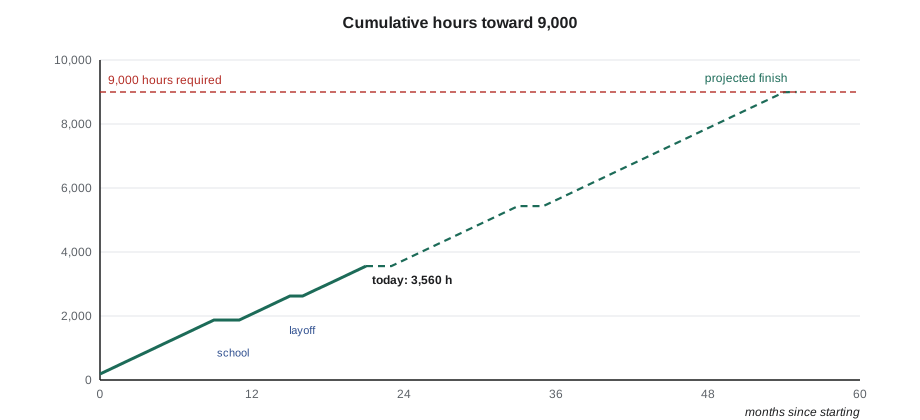
Knowing roughly when you will finish helps you plan school, exams and finances. The projection depends on how many hours you work each week, how many weeks you lose to school, holidays and layoffs, and how many hours you still need. A projection is only an estimate, but it helps you spot problems, such as a long layoff, early enough to do something about them.
# project an apprenticeship completion date from hours logged so far
from datetime import date, timedelta
required = 9000          # total hours needed (illustrative)
logged = 3560            # hours logged so far
start = date(2026, 3, 16)
hours_per_week = 40
weeks_lost_per_year = 10 # school blocks, holidays and slow periods
work_weeks_per_year = 52 - weeks_lost_per_year
remaining = required - logged
years = remaining / (hours_per_week * work_weeks_per_year)
finish = start + timedelta(days=round(years * 365))
print(f"remaining {remaining} h, about {years:.1f} years at {hours_per_week} h/week for {work_weeks_per_year} weeks a year")
print(f"projected finish: {finish:%B %Y}")remaining 5440 h, about 3.2 years at 40 h/week for 42 weeks a year projected finish: June 2029
Keeping records safe and honest
- Keep your own copy of everything: logbook pages, app exports, school transcripts, sign-off pages, pay stubs and letters.
- Back up digital records somewhere other than your phone.
- Check your employer's records at least every few months against your own.
- Fix errors openly and quickly, with evidence, rather than waiting until you apply for your exam.
- Never inflate hours or ask for sign-offs you have not earned. False records can lead to canceled registration, and they leave you unprepared for the exam and the work.
When you change sponsors, ask the old sponsor to confirm your hours and work processes before you leave, and check that the registration agency has them.
| Record | Who keeps it | What it proves |
|---|---|---|
| Daily hours log | You, and your employer's time system | Hours worked in the trade |
| Work process and competency sign-offs | Your journeyworker or sponsor | Skills demonstrated |
| Related instruction records | Training center, sponsor | Classroom training completed |
| Pay stubs | Your employer | Hours paid and wage rates |
| Apprenticeship agreement | Registration agency and you | That you were registered and when |
Using photos and notes as evidence
A photo taken at the end of a task is one of the easiest ways to show what you did. Many apprentices keep a folder of photos from each job, sorted by month, with a short caption: level 6 drainage for suites 601 to 612, tested with Luis. These photos help when you ask for sign-offs, when you write a resume, and when you study for your exam, because they remind you of real examples. Follow your employer's rules about photos on site, and never photograph customers' homes or private information without permission.
Short notes help too. After a task that taught you something new, write two or three lines: what you did, what went wrong, what you would do differently. Over four or five years those notes become a personal handbook. Luis still keeps a notebook from his own apprenticeship and sometimes opens it to show Maya how he worked out a tricky offset the first time.
Hours when work is slow
Construction is cyclical. Projects end, winters are slow in some regions, and economic downturns can leave apprentices laid off for weeks or months. Slow periods delay your hours, so plan for them. Ask about recall when you are laid off and stay in touch with your foreman. Use the time to study for your next level or exam, take short courses such as safety training, or look for temporary work with another sponsor in the trade. If you work for another employer, make sure the hours are recorded and, where needed, that a training agreement is in place so they count.
Long gaps also affect your registration. Most systems allow breaks, but an apprentice who does no trade work or school for a long time may have their registration put on hold or canceled. If you expect a long break, for health, family or other reasons, tell the registration office and ask what you need to do to keep your file active.
Finally, remember that hours alone do not make you skilled. Two apprentices with the same hours can have very different abilities, depending on the range of work they did and how much attention they paid. Use your hours well: ask why things are done the way they are, volunteer for unfamiliar tasks and watch how experienced workers solve problems.
A final tip: when you finish each school level or each year of classes, take ten minutes to update your records in one place: total hours, hours by area, skills signed off and levels completed. That snapshot is what you will need for your wage step, your next school booking and, eventually, your exam application.
Common mistakes
MistakeLogging hours once a month from memory.
InsteadLog every day: date, times, task and journeyworker.
MistakeLeaving sign-offs to the end of the apprenticeship.
InsteadAsk for sign-offs regularly with notes as evidence.
MistakeAccepting a sign-off for a task done once with lots of help.
InsteadAsk for more practice first; the exam and the work will test it.
MistakeIgnoring gaps in the range of work.
InsteadTrack hours by area and raise gaps early with your foreman.
MistakeRelying only on the employer's records.
InsteadKeep and back up your own copies.
Summary and key terms
- Apprenticeships are measured by hours worked and competencies demonstrated; you need records of both.
- Only hours worked in the trade, supervised and while registered usually count; school counts separately.
- Log hours daily with task and journeyworker; check your employer's records regularly.
- Ask for skill sign-offs regularly with evidence, and keep them honest.
- Track hours by area to make sure you get the full range of work the standard requires.
- Project your completion date to plan school, exams and finances, and keep backed-up copies of everything.
- On-the-job learning
- Time worked in the trade, under supervision, while registered.
- Competency
- A specific skill an apprentice must be able to perform to the standard.
- Work process schedule
- The list of the main areas of work in a program with approximate hours for each.
- Sign-off
- A journeyworker's or sponsor's confirmation that an apprentice can perform a task.
- Certificate of Completion
- The credential issued when an apprentice completes a registered program.
Practice problems
Work each problem on paper first, then reveal the answer to check.
What two things are apprenticeships measured by?
Show answer
Hours worked and competencies demonstrated.
Name three things to record in a daily log.
Show answer
Any three of: date, start and finish times, breaks, task or area, journeyworker.
Why should you not accept a sign-off for a skill you cannot do?
Show answer
It leaves you unprepared for the exam and the work, and it makes the record false.
How can you get experience in an area your crew never works in?
Show answer
Rotate to another crew or department, or spend time with another sponsor.
In the completion program, what happens to the finish date if weeks lost rise from 10 to 16 a year?
Show answer
Fewer work weeks per year, so the projected finish moves later.
What should you do before leaving a sponsor?
Show answer
Get your hours and sign-offs confirmed and check the registration office has them.
Lesson quiz · 5 questions
Score 60% or more to complete this lesson.
Create a free account to save your progress, take quizzes and earn a certificate.