
SLS-150 · Lesson 7 of 12 · 18 min
Calls, texts and email: the TCPA, CAN-SPAM and do-not-call rules
▶ Video coming soon A video version of this lesson is on the way.
Owen Pelletier, who leads Ridgeline's inside sales team, had a plan for November. A list vendor offered 400 names and email addresses of office managers at small businesses in the region, with mobile numbers for about half. Owen wanted to load the list into the CRM and start a six-touch sequence: three emails, two calls and a text message. He brought the plan to the weekly sales meeting. Leah Marchand, who had been invited to talk about something else, asked three questions. Where did the vendor get the addresses? What consent do we have to message these people? And what happens when someone asks us to stop? Nobody in the room could answer the first two.
Electronic messages and phone calls are the main tools of modern prospecting, and both are tightly regulated. The rules differ more between Canada and the United States here than almost anywhere else in sales law, and the penalties can be counted per message, which means a single careless campaign can create enormous liability. This lesson explains the rules for email, text and other electronic messages, and for sales calls, in your country.
CAN-SPAM and commercial email
The federal CAN-SPAM Act governs commercial email: messages whose primary purpose is to advertise or promote a commercial product or service. Unlike Canada's law, CAN-SPAM does not require consent before a first message. It is an opt-out law: a business may email people who have not asked to hear from it, as long as the message follows the rules and the business honors requests to stop. The rules apply to business-to-business email as well as email to consumers. The FTC enforces CAN-SPAM, and each separate email that violates it can bring a civil penalty of more than 53,000 dollars, adjusted for inflation each year. Text messages to mobile phones are governed mainly by the TCPA, covered below, rather than by CAN-SPAM.
What a commercial email must do
Every commercial email must meet several requirements. The header information, including the from line and routing, must be accurate. The subject line must not be deceptive. The message must be identified as an advertisement, unless the recipient gave prior affirmative consent. It must include the sender's valid physical postal address. It must give a clear way to opt out, which must work for at least 30 days after the message is sent, and opt-out requests must be honored within 10 business days, without charging a fee or asking for more than an email address and opt-out preferences. A business may not sell or transfer an address after the person has opted out. A company that hires another firm to send its email remains responsible for compliance. Bought lists are legal under CAN-SPAM, but they still have to be screened against the company's own opt-out records.
Prospecting email that works and complies
Because CAN-SPAM does not require consent, many sellers assume any prospecting email is fine. Two cautions apply. First, deliverability depends on consent in practice: major email providers now require bulk senders to authenticate their domains, offer one-click unsubscribe and keep spam complaint rates very low, and messages to bought lists produce complaints. Second, state laws can add requirements, especially for misleading headers and subject lines, and other federal laws, such as the FTC Act, apply to the content of the email. The best practice is the same as in Canada: send to people with a real business reason to hear from you, write a truthful subject line, identify yourself, include the postal address, and make unsubscribing easy.
Worked problem
Counting an unsubscribe deadline
A prospect replies "unsubscribe" to one of Owen's sequence emails on Monday, November 2, 2026. By what date must Ridgeline have stopped sending her commercial messages?
Show solution
- Both countries require unsubscribe requests to be honored within 10 business days.
- Business days exclude weekends and federal holidays. Veterans Day, Wednesday, November 11, is a federal holiday.
- Count from Tuesday, November 3: November 3, 4, 5 and 6 are days 1 to 4; November 9 and 10 are days 5 and 6; November 11 is skipped; November 12 and 13 are days 7 and 8; November 16 and 17 are days 9 and 10.
- The deadline is Tuesday, November 17, 2026.
Answer: The legal deadline is November 17, but Ridgeline's CRM processes unsubscribes automatically within minutes. The deadline is a maximum, not a target.
The TCPA and calls and texts to mobile phones
The Telephone Consumer Protection Act and the FCC's rules under it govern calls and texts. Calls or texts to mobile phones using an automatic telephone dialing system or a prerecorded or artificial voice require the called party's prior express consent, and for telemarketing, prior express written consent. In Facebook v. Duguid, decided in 2021, the Supreme Court read "automatic telephone dialing system" narrowly, as equipment that generates random or sequential numbers, but prerecorded and artificial voice messages, including AI-generated voices, remain covered. Telemarketing calls and texts are not allowed before 8 a.m. or after 9 p.m. at the recipient's location. The TCPA lets consumers sue for 500 dollars per violation, or up to 1,500 dollars if the violation was willful or knowing, so class actions are common.
Do-not-call rules and recent changes
Telemarketers must not call consumers on the National Do Not Call Registry unless they have an established business relationship, which lasts 18 months after a purchase or transaction and 3 months after an inquiry or application, or the person's express written permission. Every telemarketer must also keep an internal do-not-call list. The FTC's Telemarketing Sales Rule adds requirements such as transmitting caller ID, limits on abandoned calls and, since 2024, keeping records for five years; 2024 amendments also extended its ban on misrepresentations to business-to-business calls. Several recent changes are important. The FCC's one-to-one consent rule, which would have required consent to be given to one seller at a time, was vacated by a federal appeals court in January 2025 before it took effect. An FCC rule requiring an opt-out from one type of message to apply to all robocalls and robotexts from the same caller was delayed to January 31, 2027, and on September 30, 2026 the FCC adopted an order replacing it: callers may now limit an opt-out to the category of informational calls it addresses, while telemarketing stays a single category, with the new rules taking effect 30 days after publication in the Federal Register. And in McLaughlin Chiropractic v. McKesson, decided in June 2025, the Supreme Court held that federal courts are not bound by the FCC's interpretations of the TCPA, which makes outcomes in TCPA lawsuits less predictable. Several states, such as Florida, Oklahoma and Maryland, have their own stricter telemarketing laws.
What Ridgeline did with the list
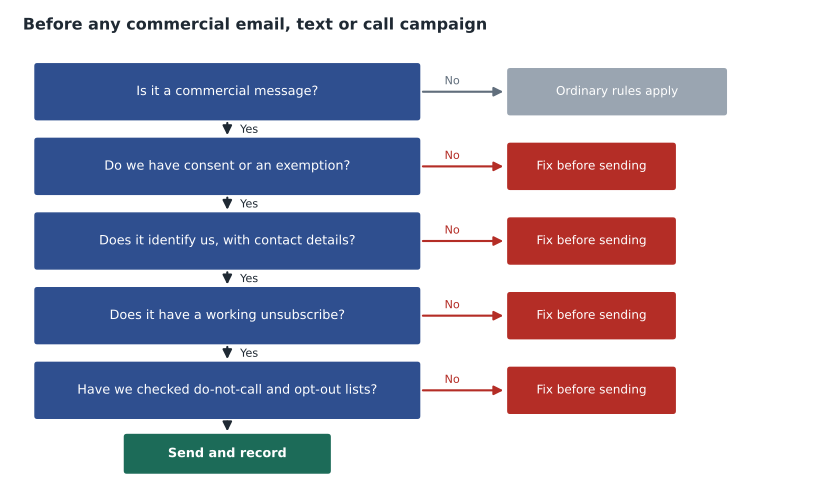
Leah asked the list vendor how it collected the addresses. The answer was that it gathered them from public websites and trade directories. Emails to the business addresses could go ahead under CAN-SPAM, provided every message met the content rules and anyone who had previously opted out of Ridgeline's email was removed first. The mobile numbers were a different matter. Without prior express written consent, using a dialing platform or prerecorded messages to call or text them for telemarketing was too risky, so the text step was dropped and the numbers were deleted. Grace kept a record of the source for each address. Owen rewrote the first email as a short, relevant introduction, and calls to the businesses' main lines went ahead by hand, with the rep identifying Ridgeline at the start of every call and an internal do-not-call list kept in the CRM.
The campaign reached fewer people than Owen wanted, but its reply rate was higher than any sequence the team had run that year. Relevance does more for response than volume, and it is also what the law rewards.
Writing a compliant first email
Owen's rewritten first email shows how the rules translate into a message. It was short, specific to the recipient's business, honest in its subject line and complete in its required elements. Its structure is a useful model for any first outreach.
| Part | What Owen wrote | Why |
|---|---|---|
| Subject line | "Meeting rooms at Westgate & Rowe" | Accurate and specific; no false urgency or fake reply prefix |
| Opening | Why he was writing to this firm in particular | Relevance is what earns a reply |
| Value | One sentence on a result other firms had seen, from the substantiation file | Claims must be supported |
| Request | A low-pressure question about whether a short call would help | |
| Identification | Owen's name, Ridgeline's name, mailing address, phone and website | Required in both countries |
| Unsubscribe | A one-click link and an offer to reply "stop" | Must work and be honored quickly |
Other channels: social messages, voicemail and recordings
CAN-SPAM covers commercial email; direct messages on social media platforms are governed mainly by the platform's own rules and by general deception law, though the FTC has said the same honesty standards apply. Prerecorded voicemail messages are a different matter: the FCC has ruled that so-called ringless voicemail, delivered straight to a mobile voicemail box, counts as a call under the TCPA, so it needs the same prior express written consent as other prerecorded telemarketing calls. And if a sales call is recorded, the caller must follow federal and state recording consent rules, which in some states require every party's consent; those rules were covered in SLS-120.
Across every channel, the practical test is the same as the legal one: would the person reasonably expect to hear from you, does the message say clearly who you are, and can they easily make it stop? A campaign that passes those three questions is usually on the right side of the law and also performs better.
Building compliance into the CRM
Most compliance with these rules happens through systems rather than memory. Grace configured Ridgeline's CRM so that every contact record carries a consent field showing the type of consent or exemption, its source and its date, and the system blocks sequence emails to contacts without a valid entry. Implied consent based on an inquiry or purchase is given an expiry date, and the CRM alerts the owner a month before it lapses so the seller can ask for express consent. Unsubscribe links update the record automatically, and any "please don't call" note logged by a rep adds the number to the internal do-not-call list.
| Field | Example entry |
|---|---|
| Consent type | Opted in at trade show |
| Source | RoomFlow webinar registration form |
| Date obtained | April 20, 2026 |
| Expiry | None, unless the contact opts out |
| Do-not-call | No |
| Last unsubscribe or opt-out | None |
Systems do not remove judgment. A seller still has to decide whether a message is relevant, whether a call at that moment is welcome and whether a contact who seemed annoyed should be left alone. But systems catch the routine errors that create most legal exposure, such as emailing someone who unsubscribed last month or calling a number on the internal list. Owen now checks the consent report every Monday before his team starts a new sequence, and the team treats a blocked message as a prompt to ask for consent, not as an obstacle to work around.
The rules can feel restrictive to a new inside sales rep, but Owen frames them as a description of good prospecting. Messages go to people with a real reason to hear from Ridgeline, say clearly who is writing, and stop when asked. Teams that prospect that way get fewer complaints, better deliverability and more replies, so following the rules and hitting targets rarely pull in different directions for long.
One last habit helps when rules change, as the telemarketing rules in particular often do: the team checks with Leah before launching any new channel, tool or kind of campaign, rather than assuming last year's answer still holds.
Common mistakes
MistakeIf an address is on a bought list, we can email it.
InsteadBought lists are legal under CAN-SPAM, but they must be screened against opt-outs, and texts and calls to mobiles need consent.
MistakeBusiness recipients are not covered by anti-spam law.
InsteadBoth countries' email rules apply to business recipients, with only specific exemptions.
MistakeTen business days to unsubscribe is a target.
InsteadIt is a legal maximum; good systems process requests immediately.
MistakeAn exemption from the do-not-call list means we can ignore requests not to call.
InsteadInternal do-not-call lists must be kept and honored in every case.
MistakeA text is just a short email.
InsteadTexts are governed by the TCPA, which requires consent for automated and telemarketing texts to mobiles.
Summary and key terms
- CAN-SPAM is an opt-out law for commercial email: accurate headers and subject lines, identification, a postal address and a working opt-out.
- Texts and automated or prerecorded calls to mobile phones are governed by the TCPA and generally need prior express, and for telemarketing written, consent.
- Unsubscribe or opt-out requests must be honored within 10 business days.
- Telemarketing is not allowed before 8 a.m. or after 9 p.m.; numbers on the National Do Not Call Registry cannot be called without an established relationship or permission.
- Every telemarketer must keep an internal do-not-call list and honor requests not to be called.
- Commercial email
- Under CAN-SPAM, an email whose primary purpose is to promote a product or service.
- Prior express written consent
- A signed, written agreement, which can be electronic, to receive telemarketing calls or texts.
- Established business relationship
- A recent purchase or inquiry that allows calls to numbers on the Do Not Call Registry for a limited time.
- Internal do-not-call list
- A telemarketer's own list of people who have asked not to be called.
Practice problems
Work each problem on paper first, then reveal the answer to check.
Does Ridgeline need consent before sending a first prospecting email to a business address under CAN-SPAM?
Show answer
No, but the email must follow the content rules and the address must not have opted out.
An unsubscribe request arrives on Monday, November 2, 2026. When is the legal deadline to stop sending?
Show answer
Tuesday, November 17, 2026, counting 10 business days and skipping the November 11 holiday.
Can Ridgeline send automated marketing texts to mobile numbers from a bought list?
Show answer
No, not without prior express written consent, which the list did not provide.
Lesson quiz · 5 questions
Score 60% or more to complete this lesson.
Create a free account to save your progress, take quizzes and earn a certificate.