
SLS-150 · Lesson 2 of 12 · 22 min
Contracts: offer, acceptance and terms
▶ Video coming soon A video version of this lesson is on the way.
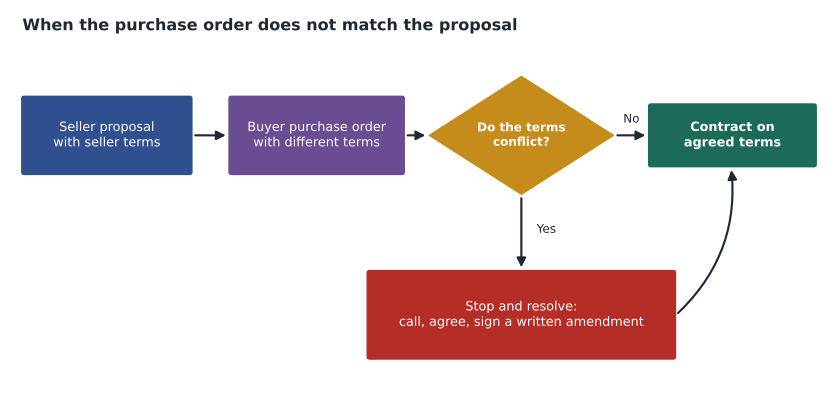
In mid-October, Keystone Grain Equipment accepted Maya's proposal for video equipment and RoomFlow booking software in four meeting rooms. Or at least, Maya thought it had. What arrived was a purchase order from Keystone's purchasing department that referred to her proposal by number but attached Keystone's own standard terms on the back: payment in 60 days instead of Ridgeline's 30, a right to cancel at any time before installation, and a warranty clause much broader than the one Ridgeline offers. Maya forwarded it to Leah Marchand, Ridgeline's contracts manager. Leah called back within the hour. "Good catch," she said. "Right now we don't have a deal. We have two documents that disagree."
Every sale is a contract. Whether it is a sofa bought on the floor at Juniper & Pine or a five-year managed print agreement with a clinic, the buyer and seller have made promises to each other that the law will enforce. Sellers do not need to be lawyers, but they need to understand how contracts are formed, what the key terms mean, and which of their own words and actions can bind their employer. This lesson covers the basics that apply in both Canada and the United States, where contract law grew from the same English common law roots, and notes where the details differ.
What makes a contract
A contract is an agreement that the law will enforce. For an agreement to be a contract, a few elements must be present. One party makes an offer, the other accepts it, each gives something of value, both intend to be legally bound, both have the capacity to contract, and the purpose is legal.
| Element | What it means | In a sale |
|---|---|---|
| Offer | A definite proposal that the other party can accept | A signed proposal with products, price and terms |
| Acceptance | Unqualified agreement to the offer, communicated to the offeror | The buyer signs the proposal or confirms in writing |
| Consideration | Each side gives something of value | Goods or services in exchange for payment |
| Intention | Both intend to create legal obligations | Presumed in business dealings |
| Capacity | Both parties can legally contract | Adults of sound mind; an authorized person for a company |
| Legality | The purpose is lawful | A lawful product sold lawfully |
Offers, quotes and invitations
Not every statement about price is an offer. A price tag in a store, a catalog, a website listing or a general price sheet is usually treated as an invitation to treat: an invitation for the customer to make an offer, which the seller can accept or decline. That is why a store is not normally bound by an obvious pricing error on a shelf tag, although consumer protection and advertising law, covered in lessons 4 and 5, still require prices to be honest and some retailers have voluntary codes for scanning errors.
A formal written quotation or proposal is different. A proposal that sets out specific products, quantities, prices and terms, addressed to a specific buyer, is often an offer that the buyer can accept. That is why Ridgeline's proposals include a validity period, such as "Prices valid for 30 days from the date of this proposal". An offer can be withdrawn before it is accepted, and it lapses when its stated time runs out, or after a reasonable time if none is stated.
Worked problem
Working out a validity date
Maya sends Northfield Family Clinic a proposal for expansion furniture dated Wednesday, October 14, 2026, with prices valid for 30 days. On what date does the offer lapse, and what should she do if the clinic wants more time?
Show solution
- Count 30 days from October 14. October has 31 days, so 17 days remain in October after the 14th.
- 30 minus 17 leaves 13 days in November.
- The offer lapses at the end of Friday, November 13, 2026.
- If the clinic needs more time, Maya should issue a written extension or a revised proposal with a new date, after checking that the prices still hold with Ridgeline's suppliers.
Answer: The proposal lapses on November 13, 2026. A verbal "don't worry, we'll honor it" creates confusion; a dated written extension does not.
Acceptance and counteroffers
Acceptance must match the offer. If a buyer replies "We accept, but with payment in 60 days", that is not an acceptance. It is a counteroffer, which rejects the original offer and puts a new one on the table. The seller can then accept the counteroffer, reject it or make another counteroffer. Much of what sellers call negotiation is, legally, an exchange of offers and counteroffers until one is accepted without changes.
Acceptance must usually be communicated. Silence is generally not acceptance: a seller cannot write "If we don't hear from you by Friday, we'll assume you've agreed" and bind the buyer. Conduct can be acceptance, though. If the buyer lets Ridgeline install the equipment and starts using it, a court may find that the buyer accepted by conduct, and the question becomes which terms apply.
The battle of the forms
Keystone's purchase order is a classic example of what lawyers call the battle of the forms. The seller sends a proposal with its standard terms. The buyer sends a purchase order with its own, different standard terms. Each side assumes its terms govern. Often the goods are delivered and paid for without anyone noticing, until something goes wrong.
In the United States, sales of goods are governed by Article 2 of the Uniform Commercial Code, which every state except Louisiana has adopted in full and which South Dakota has adopted in Title 57A of its codified laws. Section 2-207 of the Code changes the common law mirror image rule for goods. A definite acceptance can form a contract even if it adds or changes terms. Between merchants, additional terms usually become part of the contract unless they materially alter it, the offer limited acceptance to its own terms, or the other side objects. Where the forms conflict, many courts strike out both conflicting terms and fill the gap with the Code's default rules. Services, such as software subscriptions and installation work, follow common law rules instead, which matters for mixed deals like Keystone's.
Leah resolved Keystone's purchase order the practical way. She called Keystone's purchasing manager, agreed on 45-day payment terms as a compromise, explained that Ridgeline could not accept unlimited cancellation once equipment had been ordered from the manufacturer, and sent a short written amendment that both sides signed. Then the order went ahead. The cost was a day's delay. The alternative was a dispute months later about which payment terms applied.
Terms that sellers should understand
Contracts contain many clauses, and most sellers will not draft any of them. But sellers discuss contracts with buyers every day, and they need to understand the terms well enough to explain them accurately and to know when to involve the contracts team.
| Term | What it does | Why sellers should care |
|---|---|---|
| Scope and specifications | Defines exactly what is sold | Vague scope causes most disputes |
| Price and payment terms | Sets price, due dates and late charges | Changing them changes the deal's value |
| Delivery and acceptance | When and how the buyer receives and accepts the goods | Promised dates must be realistic |
| Warranty | What the seller promises about quality and remedies | Sellers must not promise more than the written warranty |
| Limitation of liability | Caps or excludes certain damages | Buyers often ask to change it; sellers should not agree on the spot |
| Term, renewal and termination | How long the contract runs and how it ends | Automatic renewals need clear notice |
| Entire agreement | Says the written contract replaces earlier discussions | Verbal promises outside the contract may not count, or may cause disputes |
Automatic renewal deserves special attention because it touches both law and trust. Many service contracts, including Ridgeline's RoomFlow subscriptions, renew automatically unless the customer gives notice before a deadline. In business contracts, this is generally enforceable if the term was clear. For consumers, both countries have rules on how automatic renewals must be disclosed, and some regulators treat surprise renewals as unfair. The ethical practice, whatever the law requires, is to remind customers before a renewal deadline.
Worked problem
Calculating a renewal notice deadline
Northfield's RoomFlow subscription runs for one year from October 9, 2026, to October 8, 2027, and renews for another year unless either side gives 60 days' written notice before the end of the term. By what date must Northfield give notice if it does not want to renew?
Show solution
- The term ends on October 8, 2027.
- Count back 30 days to September 8, 2027.
- Count back another 30 days. August has 31 days, so 30 days before September 8 is August 9, 2027.
- Northfield must give notice on or before August 9, 2027.
Answer: The notice deadline is August 9, 2027. Ridgeline's practice is to email customers a reminder about 30 days before any notice deadline, so Maya sets a CRM task for early July 2027.
Who can bind the company
A company acts through people. When a seller makes a promise, the company may be bound by it, even if the seller had no permission to make it. Two ideas matter. Actual authority is the authority the company has actually given the seller, for example permission to offer discounts of up to ten percent. Apparent authority is the authority that the company's conduct leads a reasonable buyer to believe the seller has. A buyer dealing with an account executive whose business card, title and past dealings suggest she can set prices may be entitled to rely on a price she quotes, even if it breaks an internal rule.
This is why companies use approval matrices and why sellers must follow them. Ridgeline's matrix lets account executives approve discounts of up to 10 percent, requires Darnell's approval up to 20 percent and the VP's beyond that, and routes any change to standard warranty, liability or payment terms to Leah. A seller who promises a 25 percent discount or a free extra year of service without approval may create an obligation the company has to honor, and a problem the seller has to answer for.
Verbal promises and side deals
Sellers make many statements during a sale. Some become part of the contract, some are simply sales talk, and some can undo the contract if they turn out to be false. A false statement of fact that persuades someone to enter a contract is called a misrepresentation. If Ridgeline's seller had told the dental office that parts were no longer available, and the office had signed because of that statement, the office might be able to cancel the contract, claim damages, or both. Vague praise, such as "This is a great printer", is generally treated as puffery rather than a statement of fact, but specific claims about speed, compatibility, availability or savings are facts.
Side deals are promises made outside the written contract, such as "Don't worry, we'll throw in training for free" or "You can cancel if it doesn't work out". Entire agreement clauses try to exclude these, but courts do not always enforce such clauses against clear misrepresentations, and in any event the customer will remember the promise. The rule for sellers is simple: if it matters, put it in the contract. If you cannot put it in the contract, do not say it.
Signing electronically
Most sales contracts are now signed electronically. The federal Electronic Signatures in Global and National Commerce Act (E-SIGN) and the Uniform Electronic Transactions Act, adopted in South Dakota and almost every other state, give electronic signatures and records the same legal effect as paper ones for most purposes. A few kinds of documents, such as wills, still have special requirements, and E-SIGN adds consumer consent and disclosure steps before certain required notices can be delivered electronically. Article 2 of the UCC also requires a signed writing for sales of goods of 500 dollars or more, and an electronic record and signature can satisfy that requirement.
Whatever the method, the seller's job is the same. Send the final version, not a draft. Make sure the person signing has authority to sign for the buyer. Keep the signed copy in the CRM. And confirm in a short email what was agreed, in plain language, so that both sides share the same understanding.
Common mistakes
MistakeThe buyer's purchase order confirms our proposal.
InsteadRead it. If its terms differ from the proposal, there may be no agreement on those terms until the conflict is resolved.
MistakeA price tag is a binding offer.
InsteadUsually it is an invitation to treat, though advertising and consumer protection law still require honest pricing.
MistakeSmall verbal promises do not count.
InsteadThey can become part of the deal or a misrepresentation. If it matters, put it in writing.
MistakeI can agree to the buyer's change to the liability clause to close faster.
InsteadRoute changes to standard legal terms through the contracts team.
MistakeSilence means yes.
InsteadAcceptance generally has to be communicated.
Summary and key terms
- A contract needs an offer, acceptance, consideration, intention, capacity and a lawful purpose.
- Price tags and catalogs are usually invitations to treat; formal proposals are often offers with a validity period.
- An acceptance that changes the terms is a counteroffer; conflicting forms should be resolved in writing before performance.
- Sellers should understand scope, payment, delivery, warranty, liability, renewal and entire agreement terms.
- Sellers can bind their company through actual or apparent authority, so approval rules matter.
- False statements of fact can be misrepresentations; if a promise matters, it belongs in the contract.
- Invitation to treat
- An invitation for the other party to make an offer, such as a price tag or catalog.
- Counteroffer
- A reply that changes the terms of an offer, rejecting it and making a new offer.
- Battle of the forms
- A conflict between the standard terms on a seller's and a buyer's documents.
- Apparent authority
- Authority a reasonable third party believes an agent has, based on the principal's conduct.
- Misrepresentation
- A false statement of fact that induces someone to enter a contract.
Practice problems
Work each problem on paper first, then reveal the answer to check.
A buyer replies to a proposal: "Agreed, subject to delivery by November 1." Is this an acceptance?
Show answer
No. It adds a condition, so it is a counteroffer.
Why do proposals carry a validity period?
Show answer
So the offer lapses on a known date and the seller is not bound indefinitely to old prices.
What is the difference between actual and apparent authority?
Show answer
Actual authority is what the company has really given the seller; apparent authority is what a reasonable buyer would believe the seller has, based on the company's conduct.
What should a seller do if a buyer asks to change the limitation of liability clause?
Show answer
Note the request and route it to the contracts or legal team rather than agreeing on the spot.
Lesson quiz · 5 questions
Score 60% or more to complete this lesson.
Create a free account to save your progress, take quizzes and earn a certificate.