
SLS-150 · Lesson 11 of 12 · 18 min
Codes of conduct and professional designations
▶ Video coming soon A video version of this lesson is on the way.
After the events of the fall, from the parts-availability call to the trade show approach, Rob Kowalski decided that Ridgeline needed something more than a policy binder. He asked Darnell, Farida Haddad and Leah Marchand to draft a one-page sales code that every seller would sign and that the team would actually use. Their first draft was four pages long. Their second was two. The final version, adopted in November, fits on one page and opens with a sentence Farida wrote: "We would rather lose a sale than lose a customer's trust."
Laws set the minimum, and personal ethics guide individual choices. Between the two sit codes of conduct: written standards adopted by companies, industry associations and professional bodies. This lesson explains the kinds of codes that apply to sellers, what good codes contain and how to use them, and the role of professional designations and licenses in sales careers.
Three levels of codes
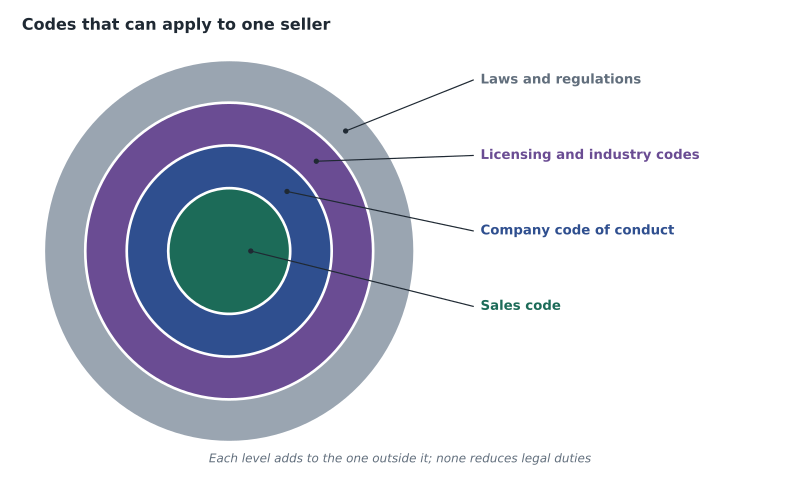
Sellers are usually covered by codes at three levels. The company code of conduct applies to every employee and covers topics such as honesty, conflicts of interest, gifts, confidentiality and compliance with law. A sales code, like Ridgeline's new one, applies those principles to selling specifically. And industry or professional codes apply to everyone in a particular industry or association, whatever company they work for.
| Level | Examples | Who enforces it |
|---|---|---|
| Company code of conduct | Ridgeline's code of business conduct; Juniper & Pine's employee handbook | The employer, through discipline up to dismissal |
| Sales code | Ridgeline's one-page sales code | Sales managers and the employer |
| Industry code | The Direct Selling Association's Code of Ethics; the advertising self-regulation programs of BBB National Programs | The association or self-regulatory body, through complaints and membership sanctions |
| Professional or licensing code | Codes for licensed insurance, securities and real estate sellers in South Dakota | Regulators and licensing bodies, with power to suspend or cancel licenses |
What a good sales code contains
Codes that work are short, specific and tied to real situations. Codes that fail are long, vague and filed away. Ridgeline's drafting team tested every line of their draft by asking whether a seller could tell, from that line alone, what to do in a real situation they had faced that year. Lines that did not pass the test were rewritten or removed.
| Commitment | What it means in practice |
|---|---|
| We tell the truth | No false statements, misleading half-truths or best-case promises presented as likely |
| We recommend what fits | Recommendations are based on the customer's needs, not on commission or bonuses |
| We keep our word | Promises are realistic, confirmed in writing and kept, or corrected quickly |
| We compete fairly | No discussions of prices or bids with competitors; truthful comparisons only |
| We respect privacy and consent | Customer data is used only for its purpose; consent and opt-out rules are followed |
| We follow the gifts policy | Nothing of value to buyers during tenders; anything over the limit needs approval |
| We speak up | Concerns are raised early, and nobody is penalized for raising one in good faith |
The last commitment matters most. A code that nobody dares to invoke is decoration. Rob added a line to the team's quarterly reviews asking each seller to describe one situation in which they used the code, and he shares examples, without names, at sales meetings.
Industry self-regulation
Some industries regulate themselves through codes enforced by associations. The Direct Selling Association requires its member companies to follow a Code of Ethics covering honest presentations, cooling-off rights and fair treatment of customers and the independent sellers who work for members, enforced by an independent code administrator. BBB National Programs runs the National Advertising Division, which reviews challenges to the truthfulness of national advertising, often brought by competitors, and refers companies that refuse to comply to the FTC. These codes do not replace the law, but they often go further, and companies that belong to the associations agree to be bound by them.
Professional designations in sales
Unlike accounting, law or engineering, most sales roles are not regulated professions. Anyone can sell office furniture or software. Designations exist, but they are voluntary credentials that signal training and a commitment to a code of ethics, not licenses to practice.
Several organizations offer voluntary sales designations in the United States. Sales and Marketing Executives International, for example, offers the SMEI Certified Professional Salesperson and Certified Sales Executive credentials, which require education or experience, an exam and agreement to a code of ethics. Universities and colleges offer certificate programs in professional sales, and many sellers earn vendor certifications for particular products or sales methods. When choosing a credential, check who awards it, what it requires, whether it includes a code of ethics with real enforcement, and whether employers in your field recognize it.
When selling requires a license
A few kinds of selling are regulated because the products are complex, the stakes for buyers are high or there is a history of abuse. In these fields, the seller, not just the company, needs a license, must meet education and exam requirements, must follow a code of conduct and can lose the license for misconduct.
| Field | In South Dakota |
|---|---|
| Insurance | License from the South Dakota Division of Insurance |
| Securities and investments | Registration with FINRA and the state, after exams such as the SIE and Series 7 |
| Real estate | License from the South Dakota Real Estate Commission |
| Direct sales to consumers | No general seller license, but federal and state home-sales rules apply, and some cities require solicitor permits |
| Vehicles | Dealer licensing, with rules on how salespeople represent vehicles |
Licensing rules matter even for sellers outside these fields. Juniper & Pine's associates do not sell credit, but when they help customers apply for financing through the store's lending partner, they must not describe the loan's terms beyond what the lender's materials say, because explaining credit terms is the lender's regulated role. Aiden's rule, which Bev taught him, is to hand the customer the lender's disclosure, answer only what it covers and refer other questions to the lender.
Worked problem
Choosing a credential
Aiden is thinking about his next two years. He has 1,200 dollars set aside for training. Option one is a 12-week evening certificate in professional sales at a local college, costing 950 dollars, with a final project and no ongoing requirements. Option two is a two-day workshop from a sales training company costing 1,150 dollars, with a certificate of completion. Option three is a product certification from a furniture manufacturer, free to Juniper & Pine staff, taking about 20 hours online. How should he compare them?
Show solution
- Who awards it: a public college, a private trainer and a manufacturer, which affects how widely each is recognized.
- What it requires: 12 weeks with a project, two days with attendance only, and 20 hours of product modules.
- Cost per hour of instruction: the college certificate, at about 3 hours a week for 12 weeks, is 36 hours, or about 26 dollars an hour; the workshop, at about 14 hours, is about 82 dollars an hour; the manufacturer course is free.
- Fit: Aiden wants to move toward high-ticket sales and eventually store management, so broad skills and recognition matter more than a single product line.
Answer: Aiden chose the manufacturer course this winter, because it is free and immediately useful, and the college certificate next fall. Together they cost 950 dollars, leaving 250 for books and travel.
Using codes in hard moments
A code's real value shows up when someone is under pressure. A seller who is asked by a manager to stretch the truth, or by a buyer to bend a rule, can point to the code: "Our sales code says we don't discuss bids with competitors, so I can't do that." Pointing to the code takes the personal element out of the refusal. It is not the seller being difficult; it is the standard everyone has signed.
Codes also help managers. When Darnell coaches a seller after a complaint, he starts with the code's commitment that applies and asks the seller to describe what happened against it. The conversation becomes about the standard, not about blame, which makes it easier for the seller to learn from the mistake.
Speaking up and protection from retaliation
Every good code includes a commitment that people who raise concerns in good faith will not be punished for it. That commitment is backed in part by law.
Federal and state laws protect employees who report certain kinds of misconduct. The Sarbanes-Oxley Act protects employees of public companies who report securities fraud, the False Claims Act protects those who report fraud against the government and lets them share in recoveries, and the Dodd-Frank Act gives whistleblowers who report securities violations to the SEC protections and possible awards. Many states protect employees who refuse to break the law or who report violations, and many companies have their own non-retaliation policies and confidential reporting lines.
Knowing these protections exist does not make speaking up easy, but it should remove the fear that doing the right thing will automatically cost a job. In practice, the safest route is usually the company's own channel first, with facts written down, unless the concern involves the people who run that channel.
Writing your own code
Company and industry codes are written by others. Many experienced sellers also keep a short personal code: a handful of commitments they decided on in advance, so that they do not have to decide under pressure. Darnell asked everyone in the fall clinic to write one. Maya's had five lines.
| Commitment | Why she chose it |
|---|---|
| I will never say something I would not write in the CRM | It is her version of the record test |
| I will quote realistic dates, not hopeful ones | She lost a deal by guessing |
| I will recommend what fits, even if it pays less | Trust earns referrals |
| I will say "I don't know" and find out | Guessing is where mistakes begin |
| I will raise concerns early, with facts | She saw that it works |
Aiden's was shorter: "Explain first, offer second, never push." Bev put it on the board in the staff room. Personal codes work because they are personal, so there is no right list. What matters is that the commitments are specific enough to use in the moment, and that the seller has thought about them before the moment arrives.
How codes change over time
A code is never finished. Ridgeline's drafting team agreed to review the sales code every year and after any significant incident. The review asks three questions: which commitments did people use, which situations came up that the code did not cover, and did anything in the code turn out to be unclear. The side agreement rule added after the Keystone case in lesson 12 is an example: a real situation exposed a gap, and the code was improved so the next seller would not face the same pressure without guidance.
Industry codes change too, often in response to complaints or new technology. Advertising codes have added guidance on influencer marketing, online reviews and environmental claims over the past decade, and direct selling codes have added rules on income claims made to people recruited as sellers. Sellers who belong to associations should read updates when they are published, and companies should check that their own codes still match the industry standards they have signed up to.
Finally, codes are most useful when they are visible. Ridgeline prints its one-page sales code on the back of every new seller's onboarding checklist and links to it from the CRM home page, so the standard is in front of people at the moment they are making decisions, not only on the day they sign it.
Common mistakes
MistakeCodes of conduct are just legal protection for the company.
InsteadGood codes give sellers specific, usable guidance and support for saying no.
MistakeLong, detailed codes are better.
InsteadShort, specific codes tied to real situations are the ones people use.
MistakeA sales designation is a license to sell.
InsteadMost sales designations are voluntary credentials; licenses apply only in regulated fields.
MistakeIf I am not licensed, licensing rules do not affect me.
InsteadUnlicensed sellers must still avoid doing a licensed person's regulated work, such as explaining loan terms.
MistakeIndustry codes replace the law.
InsteadThey add to the law; they never reduce legal obligations.
Summary and key terms
- Sellers are covered by company codes of conduct, sales codes, industry codes and, in some fields, licensing codes.
- Good codes are short, specific, tied to real situations and backed by a culture where people can raise concerns.
- Industry self-regulation, such as direct selling and advertising codes, adds standards beyond the law.
- Most US sales designations, such as SMEI credentials, are voluntary and signal training and a code of ethics.
- Insurance, securities, real estate, direct sales and vehicle sales usually require licenses, and unlicensed sellers must stay within their role.
- Code of conduct
- A written set of standards for how employees or members must behave.
- Self-regulation
- Standards set and enforced by an industry or association rather than by government.
- Designation
- A voluntary professional credential awarded by an association or institution.
- License
- Legal permission from a regulator to carry out a regulated activity, such as selling insurance.
Practice problems
Work each problem on paper first, then reveal the answer to check.
Give two features of a sales code that people actually use.
Show answer
Any two of: short, specific, tied to real situations, linked to reviews and coaching, protects people who raise concerns.
Why can't Aiden explain the financing partner's loan terms in detail?
Show answer
Explaining credit terms is the lender's regulated role; he should give the lender's disclosure and refer other questions to the lender.
What four questions should you ask when choosing a sales credential?
Show answer
Who awards it, what it requires, whether it has an enforced code of ethics and whether employers recognize it.
Lesson quiz · 5 questions
Score 60% or more to complete this lesson.
Create a free account to save your progress, take quizzes and earn a certificate.