
SLS-150 · Lesson 3 of 12 · 21 min
UCC Article 2 and warranties
▶ Video coming soon A video version of this lesson is on the way.
On a Saturday in late September, a customer came into Juniper & Pine with a photo on her phone of a recliner sofa she had bought eight months earlier. The power mechanism on one seat had stopped working. She had not bought a protection plan, and the manufacturer's warranty on the mechanism had been only six months. Aiden Laroque, who was covering the front desk, started to tell her that the warranty had run out. Bev Halvorsen stepped in and asked him to pull up the sales record instead. Later she explained: "The manufacturer's warranty isn't the only promise that comes with a product. The law adds its own. Before we tell anyone they're out of luck, we need to know what the law says they're owed."
Warranties are promises about the quality of goods and what happens if they fall short. Some are written by the seller or manufacturer. Others are created automatically by law. Sellers need to understand both, because they talk about warranties every day, they sell extended protection plans, and a careless sentence about what a product will do can become a warranty in its own right. This lesson explains the warranty rules in your country, how written and legal warranties fit together, and how to talk about protection honestly.
Express warranties: what the seller says
An express warranty is a promise about the goods that the seller makes, in words, writing, a description or a sample. It does not need the word "warranty". A specification sheet saying a printer prints 45 pages a minute, a sales associate saying a sofa fabric is stain-resistant, or a demonstration unit that the buyer is told matches what will be delivered can all create express warranties. Vague praise, such as "This is the most comfortable sofa we sell", is usually puffery and not a warranty. Specific statements of fact that a buyer would reasonably rely on usually are.
This is why accurate product knowledge is a legal issue as well as a sales skill. When Aiden told a customer that a dining table's finish was "heat-proof" because he thought he remembered it from a training session, he created a risk: if the finish marked from a hot dish, the customer would have a claim based on what he said. The manufacturer's specification said "heat-resistant to 70 degrees Celsius", which is a different promise. Bev's rule is to quote the specification, not memory.
Implied warranties under Article 2
Article 2 of the Uniform Commercial Code, adopted in South Dakota as Title 57A of its codified laws, implies two main warranties into sales of goods. The implied warranty of merchantability, in section 2-314, applies when the seller is a merchant in goods of that kind: the goods must be fit for the ordinary purposes for which such goods are used, pass without objection in the trade and conform to any promises on the label. The implied warranty of fitness for a particular purpose, in section 2-315, applies when the seller knows the buyer needs the goods for a particular purpose and that the buyer is relying on the seller's skill or judgment to select them. The Code also implies a warranty of title: the seller has the right to sell, and the goods are free of undisclosed liens.
Article 2 lets sellers disclaim implied warranties, but only in specific ways. Under section 2-316, a disclaimer of merchantability must mention merchantability and, if written, be conspicuous; a disclaimer of fitness must be in writing and conspicuous. Expressions such as "as is" or "with all faults" generally exclude implied warranties. Sellers can also limit remedies, for example to repair or replacement, and exclude consequential damages, unless the limitation fails of its essential purpose or is unconscionable. A buyer generally has four years from delivery to sue for breach of a sales contract under section 2-725, although the parties can shorten this to no less than one year. Some states restrict "as is" sales and disclaimers in consumer transactions, and federal law adds limits whenever a written warranty is given, as the next section explains.
The Magnuson-Moss Warranty Act
The federal Magnuson-Moss Warranty Act governs written warranties on consumer products, meaning tangible goods normally used for personal, family or household purposes. It does not require anyone to give a written warranty. But a seller or manufacturer who does give one must follow its rules. A written warranty on a consumer product costing more than 10 dollars must be clearly labeled either a full warranty, which meets federal minimum standards such as free repair within a reasonable time and a refund or replacement if repair fails, or a limited warranty. Under FTC rules, the terms of a written warranty on products costing more than 15 dollars must be disclosed in a single, clear document and made available to buyers before the sale, including online. A warrantor may not require the buyer to use a particular brand of parts or service to keep the warranty unless the parts or service are provided free or the FTC grants a waiver.
Magnuson-Moss also protects implied warranties. A supplier who gives a written warranty, or who sells a service contract within 90 days of the sale, cannot disclaim the implied warranties under state law. A limited warranty may limit the duration of implied warranties to the duration of the written warranty, if the limit is reasonable and clearly disclosed, but cannot eliminate them. Consumers can sue for breach of a written warranty, an implied warranty or a service contract, and can recover attorney fees if they win, which gives the law real force. Many states also have their own consumer warranty statutes and lemon laws for new vehicles.
Back to the recliner
Bev's answer to the recliner customer followed the implied warranty of merchantability. Juniper & Pine sells furniture as a merchant, and a power mechanism that stops working after eight months of normal household use is arguably not fit for the ordinary purpose of a power recliner. The manufacturer's limited warranty covered the mechanism for six months and limited implied warranties to that period, but Juniper & Pine's own sales contract had not disclaimed implied warranties, and the store had sold the customer a product it represented as durable. The store contacted the manufacturer, which agreed to send a technician, and committed to a replacement if the mechanism could not be repaired.
Worked problem
Estimating a refund reduced by use
Suppose the recliner cost 2,400 dollars before tax and the mechanism cannot be repaired. If the store and customer agree to value her use by spreading the price evenly over an expected life of ten years, what refund would that give after eight months?
Show solution
- Expected life: 10 years, which is 120 months.
- Use so far: 8 months, which is 8 out of 120 months of the expected life.
- Value of use: 2,400 multiplied by 8, divided by 120, which is 160 dollars.
- Refund: 2,400 minus 160, which is 2,240 dollars, plus the tax originally paid on the refunded amount.
Answer: A refund of 2,240 dollars plus the tax on it. This straight-line method is one reasonable way to value use; the law does not prescribe a formula, and a court could use a different one.
Manufacturer warranties, store policies and protection plans
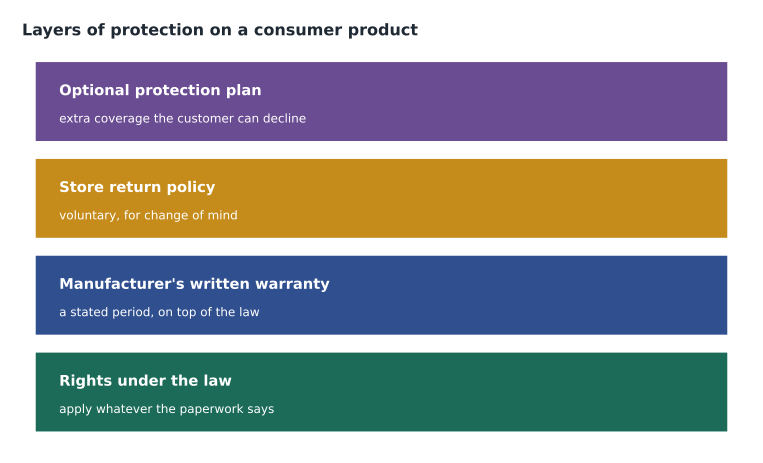
Customers often confuse three different things: the manufacturer's written warranty, the store's return policy, and an extended protection plan. A good seller explains each clearly.
| Kind | Who gives it | What it usually covers | Key point to explain |
|---|---|---|---|
| Manufacturer's warranty | The manufacturer | Defects in materials and workmanship for a stated period | It sits on top of the rights the law gives, not in place of them |
| Store return policy | The retailer, voluntarily | Change-of-mind returns within a set number of days | It is separate from warranty rights for defective goods |
| Extended protection plan | Usually a third-party administrator, sold by the retailer | Repairs after the manufacturer warranty ends; sometimes accidental damage | Explain what it adds beyond warranties and the law, and what it excludes |
Extended protection plans are a significant source of profit for many retailers, and a frequent source of complaints. Consumer advocates in both countries have long warned that plans often overlap with protection customers already have, and that sellers sometimes overstate what the plans cover. Bev's rule at Juniper & Pine, introduced in lesson 1, is that associates explain the manufacturer's warranty and the customer's legal rights first, then describe what the plan adds, including its exclusions, and let the customer decide.
Worked problem
Is the plan worth it for this customer?
A customer is buying a front-load washer for 1,800 dollars. It has a one-year manufacturer's warranty on parts and labor. A five-year protection plan costs 249 dollars and adds four years of repair coverage after the manufacturer's warranty ends. How should Aiden help the customer think about it?
Show solution
- The plan adds four years of coverage beyond the manufacturer warranty.
- Cost per added year: 249 divided by 4 is 62.25 dollars.
- Compare that with the likely cost of a repair if something fails, which Aiden can describe from the store's service records, and with the customer's own situation, such as whether they could absorb a repair bill.
- Explain what the plan excludes, such as cosmetic damage or misuse, and that the law already requires the washer to be durable for a reasonable time.
Answer: The plan costs about 62 dollars for each extra year of coverage. Whether that is good value depends on the customer; Aiden's job is to give accurate information, not to push the plan.
Warranties in business sales
Ridgeline's business contracts work differently. Its standard terms give a written warranty on equipment and services, replace the implied terms with that warranty where the law allows, limit remedies to repair, replacement or refund of the price, and exclude indirect losses such as lost profits. These clauses are normal in business contracts and are usually enforceable between businesses, but they must be clear, and they are only as strong as the seller's words allow. If Maya tells a clinic that a printer "will never jam on your label stock", she may have created an express warranty that overrides the careful wording of the contract. The same discipline applies: describe products accurately, check specifications for unusual uses, and put any special promise in writing after the contracts team approves it.
When a customer reports a defect
How a seller responds in the first two minutes of a warranty conversation often decides whether the customer becomes a loyal one or a complaint. Bev trains every associate at Juniper & Pine to follow the same steps, and Ridgeline's service desk uses a similar sequence for business customers.
| Step | What the seller does | Why |
|---|---|---|
| Listen and record | Write down what failed, when, and how the product was used | Facts decide which warranty or legal right applies |
| Find the sale | Pull up the invoice, model number and any plan the customer bought | Dates and model numbers settle most questions |
| Check every layer | Manufacturer's warranty, the customer's legal rights, any protection plan | The written warranty is not the only source of rights |
| Avoid premature answers | Do not say "you're out of warranty" until all three layers are checked | A wrong refusal can breach the law and loses the customer |
| Explain the next step | Technician visit, repair, replacement or refund, with a date | A clear plan lowers frustration |
| Follow up | Call after the repair to confirm it worked | It closes the loop and catches repeat failures |
The words matter too. "Your warranty has expired" sounds final and is often wrong. "Let me check what you're covered for" is accurate, buys time to find the facts and signals that the seller is on the customer's side. When the answer really is that the customer has no remaining rights, for example because the damage came from misuse, the seller should explain why, in plain terms, and offer what help is available, such as a paid repair estimate.
Selling warranties without overselling them
A short honest script helps associates who feel pressure to sell protection plans. Aiden's version, which Bev approved, has four parts. First, what the customer already has: "This washer comes with a one-year manufacturer's warranty on parts and labor, and the law also expects it to last a reasonable time." Second, what the plan adds: "The plan adds repair coverage for four more years, including the service call." Third, what it does not cover: "It doesn't cover cosmetic damage or problems from installation that we didn't do." Fourth, the decision: "Some people like knowing a repair bill is covered; others prefer to self-insure. Either is fine."
Aiden's attachment rate on plans dropped slightly after he started using the script, from about one sale in three to about one in four. His customer survey scores went up, and none of his plan customers asked to cancel in the following month, which is when buyers who feel pushed often change their minds. Bev pointed out that a plan canceled for a refund pays no bonus anyway.
Common mistakes
MistakeThe manufacturer's warranty has expired, so the customer has no rights.
InsteadRights under the law can last longer than a written warranty.
MistakeA warranty only exists if we use the word warranty.
InsteadSpecific statements of fact, descriptions and samples can create express warranties.
MistakeA "no refunds" sign removes the customer's warranty rights.
InsteadStore return policies do not override warranty rights for defective goods.
MistakeProtection plans are always good for the customer.
InsteadExplain what the customer already has and what the plan adds and excludes, then let them decide.
MistakeIn business deals, anything I say is covered by the contract's warranty clause.
InsteadSpecific promises can create express warranties; put special promises in writing after approval.
Summary and key terms
- Express warranties come from the seller's words, descriptions and samples; specific facts count, vague praise usually does not.
- Article 2 implies warranties of merchantability, fitness for a particular purpose and title, which can be disclaimed only in specific ways.
- The Magnuson-Moss Warranty Act regulates written warranties on consumer products and stops warrantors from disclaiming implied warranties.
- Manufacturer warranties, store return policies and protection plans are different things, and sellers should explain each honestly.
- In business sales, written warranty and liability clauses are common, but a seller's specific promises can override careful wording.
- Express warranty
- A promise about goods created by the seller's words, description or sample.
- Implied warranty of merchantability
- A merchant seller's implied promise that goods are fit for their ordinary purposes.
- Full warranty
- Under Magnuson-Moss, a written warranty meeting federal minimum standards for remedies.
- Puffery
- Vague, subjective praise that a reasonable buyer would not treat as a statement of fact.
Practice problems
Work each problem on paper first, then reveal the answer to check.
A seller says a table finish is "heat-proof". Why is this risky?
Show answer
It is a specific statement of fact that can create an express warranty, and it may promise more than the specification supports.
Can a retailer that gives a written warranty on a consumer product disclaim the implied warranty of merchantability?
Show answer
No. Under Magnuson-Moss, it can only limit the duration of implied warranties in a limited warranty, reasonably and clearly.
What should an associate explain before offering a protection plan?
Show answer
The manufacturer's warranty, the customer's rights under the law, then what the plan adds and excludes.
Lesson quiz · 5 questions
Score 60% or more to complete this lesson.
Create a free account to save your progress, take quizzes and earn a certificate.