
SLS-150 · Lesson 10 of 12 · 20 min
Conflicts of interest and honesty with customers
▶ Video coming soon A video version of this lesson is on the way.
When Prairie Valley's request for proposals for classroom furniture arrived in October, Maya noticed a name on the evaluation committee: her cousin Ethan, who had joined the school division's purchasing department in the summer. They were close, saw each other most Sundays and had talked about their new jobs over family dinners. Nothing improper had happened. But Maya realized that if Ridgeline won the contract, a competitor could reasonably ask whether family ties had played a part. She told Darnell the same afternoon. Ethan, it turned out, had already told his own manager and been replaced on the committee. "You both did the right thing," Darnell said, "and you both did it before anyone had to ask."
The previous lessons dealt mainly with laws. This one deals with two everyday ethical skills that the law only partly covers: recognizing and managing conflicts of interest, and being honest with customers in the many situations where the truth is inconvenient. Both are central to trust, and both are tested constantly in sales.
What a conflict of interest is
A conflict of interest exists when a person's personal interests, or duties to someone else, could interfere with their duty to act in the best interests of the person or organization they serve. For a seller, the seller's duties run mainly to their employer, but also, in an honest-dealing sense, to the buyer. A conflict does not mean anyone has done anything wrong. It means there is a risk that judgment could be influenced, or could look influenced.
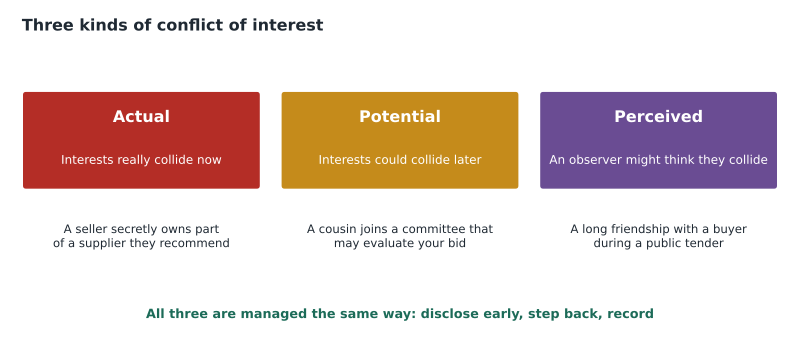
There are three kinds. An actual conflict exists when the interests really do collide, for example a seller recommending a supplier they secretly own part of. A potential conflict exists when the interests could collide in the future, like Maya's cousin joining a committee that might evaluate Ridgeline's bid. A perceived conflict exists when a reasonable observer might think the interests collide, even if they do not. All three need managing, because trust depends on appearances as well as facts.
| Situation | Why it is a conflict | Usual way to manage it |
|---|---|---|
| A close relative works for the buyer | Personal loyalty could affect either side's decisions | Disclose to your manager; one or both people step back from the decision |
| A side business that sells to your customers | You could steer customers to your own business | Disclose and get approval, or do not do it |
| Gifts or favors from a customer or supplier | They create a sense of obligation | Follow the gifts policy and record them |
| Higher commission or a manufacturer bonus on one product | Pay could affect your recommendation | Recommend on fit; disclose incentives when asked or when required |
| A romantic relationship with a buyer | Judgment on both sides may be affected | Disclose and hand the account to a colleague |
| Using a customer's confidential information for another customer | It breaks a duty of confidence to the first customer | Never do it; keep each customer's information separate |
Managing a conflict: disclose, step back, record
The standard way to manage a conflict has three parts. First, disclose it early to the right person, usually your manager, before it affects anything. Second, step back from decisions where your judgment could be influenced, or hand the account to a colleague. Third, record the disclosure and the decision so that, if anyone asks later, the company can show the conflict was handled properly. In Maya's case, Darnell assigned a different account executive to prepare Ridgeline's Prairie Valley response and noted the reason in the CRM.
Disclosure only works if it happens before the conflict matters. A seller who mentions a conflict only after a competitor complains looks as if they were hiding it, even if they were not.
Commission and honest recommendations
The most common conflict in sales is built into the pay plan. Commission, bonuses and manufacturer incentives, sometimes called spiffs, reward the seller for selling particular products or selling more. That is not wrong in itself: incentives are how companies direct effort. The ethical line is crossed when the incentive, rather than the customer's needs, drives the recommendation.
Worked problem
When the higher commission points the wrong way
A small accounting office asks Maya for a multifunction printer that handles about 3,000 pages a month. Model A, rated for 5,000 pages a month, costs 8,000 dollars. Model B, rated for 15,000 pages a month, costs 9,500 dollars and carries a manufacturer bonus of 150 dollars for the seller this quarter. Maya earns 5 percent commission on either. What is the difference in her pay, and what should she recommend?
Show solution
- Commission on Model A: 5 percent of 8,000 dollars is 400 dollars.
- Commission on Model B: 5 percent of 9,500 dollars is 475 dollars, plus the 150 dollar bonus, for 625 dollars.
- Difference: 625 minus 400 is 225 dollars in Maya's favor if she sells Model B.
- Fit: Model A's rating of 5,000 pages comfortably covers 3,000 pages a month with room to grow. Model B adds cost the office does not need.
Answer: Model B would pay Maya 225 dollars more, but Model A fits the customer. She recommended Model A and mentioned that a larger model existed if their volume tripled. Six months later, the office referred a neighboring law firm to her.
On the retail side, Bev noticed that one of the mattress brands Juniper & Pine carries was offering associates a bonus for each unit sold during October. Carl Jensen, the store's top mattress seller, asked her how to handle it. They agreed on a simple practice: associates would keep showing customers the full range based on what they said they needed, and if a customer asked whether staff earned more on a particular brand, the associate would answer truthfully. Some regulated industries, such as financial products, go further and require sellers to disclose commissions or to put the client's interest first. In ordinary retail and business selling, the law rarely requires disclosure, but honesty when asked is the minimum professional standard.
Honesty beyond the literal truth
Most sellers would never tell an outright lie. The harder tests of honesty are subtler. A statement can be literally true and still misleading. An omission can leave a buyer with a false belief. And a seller can be honest in words while creating a false impression through emphasis.
| Question | Literally true but misleading | Honest |
|---|---|---|
| "Is installation included?" | "Installation is always part of our service." (It costs extra.) | "We install it, and that's 180 dollars on top of the equipment price." |
| "Will this arrive before our open house?" | "It's in stock." (In stock at the manufacturer, six weeks away.) | "The manufacturer has it, and delivery is usually six weeks, so it would be tight. Let's check options." |
| "Have other clinics had problems with this model?" | "It's our best seller." | "Two clinics had a paper-feed issue last year; a firmware update fixed it." |
| "Is this the lowest price?" | "This is a great price." | "This is our standard price. I can ask about a multi-year discount." |
Delivery dates and other promises
Unrealistic promises are one of the most common honesty failures in sales, partly because sellers want to say yes. A seller who quotes the best case as if it were the likely case is not lying in the ordinary sense, but the buyer is misled all the same, and the consequences, such as a missed open house or an installation in the middle of a busy week, fall on the buyer. In her third week at Ridgeline, as SLS-101 described, Maya lost a deal at Halverson Law partly because she guessed at an installation time. Her rule now is to quote the realistic estimate, explain what it depends on, and confirm in writing.
Worked problem
Quoting a realistic delivery window
A clinic wants new reception chairs for an open house on Friday, December 11, 2026. Ridgeline's supplier quotes a lead time of four to six weeks from order, plus three business days for Ridgeline to receive and deliver. The clinic can sign on Monday, November 16. Can Maya promise delivery in time?
Show solution
- Best case: four weeks after Monday, November 16 is Monday, December 14, already after the open house.
- Add three business days for receiving and delivery: Thursday, December 17 at the earliest.
- Worst case: six weeks is Monday, December 28, plus three business days, which takes delivery into early January.
- The order cannot arrive before December 11 even in the best case.
Answer: Maya told the clinic honestly that the chairs could not arrive in time, offered two in-stock models that could be delivered the week of December 7, and let them choose. They chose an in-stock model.
Correcting mistakes and saying "I don't know"
Every seller makes mistakes: a wrong price on a quote, a feature that turns out not to exist, a promise that the warehouse cannot keep. The honest response is to correct it quickly, before the buyer relies on it, and to say plainly what went wrong. Correcting a mistake rarely loses a deal. Being caught in one often does.
Saying "I don't know, but I'll find out" is one of the most trust-building sentences a seller can use, as long as the seller does find out and comes back when promised. Guessing to avoid looking uninformed is the opposite: it trades a moment of comfort for a risk of misleading the buyer.
Confidential information
Sellers learn a great deal about their customers: budgets, plans, problems and sometimes the prices competitors have quoted. That information is given in confidence and should be used only to serve that customer. A seller should never tell one customer what another is paying or planning, never pass a customer's confidential information to a competitor, and never use confidential information or customer lists from a former employer. Many employment contracts include confidentiality and non-solicitation clauses, and trade secrets are protected by law in both countries, so taking customer data to a new job can lead to lawsuits as well as broken trust.
When a colleague misleads a customer
Maya's experience in lesson 1, hearing a colleague tell a dental office something untrue, is one of the most common ethical problems newer sellers face. The steps in that case apply generally. First, make sure of the facts. Second, raise it with the colleague or your manager, through the normal channel, rather than going around them to the customer. Third, if the normal channel does not work, use the company's formal reporting route. The aim is to get the customer the correct information quickly while giving the colleague the chance to correct their own mistake.
Honesty about competitors
Buyers often ask sellers about competitors' products. The honest answer is limited to what the seller actually knows and can support. "I'm not sure how their service works now; you might ask them about response times" is honest. Guessing at a competitor's weaknesses, repeating rumors or describing an old problem as if it were current is not, and it can also be a misleading representation. Sellers who are scrupulous about competitors are often trusted more by buyers, because buyers notice who is willing to criticize without evidence.
Honesty also means being clear about what a seller cannot do. When a customer asks Aiden whether a sofa will fit through a narrow stairwell, the honest answer is to measure or to offer the store's fit-check service, not to guess. When a buyer asks Maya whether RoomFlow can connect to a booking system Ridgeline has never tested, she says so and asks the technical team.
Over time, sellers who handle these moments honestly build a reputation that buyers notice and mention to each other, which is worth more than any single deal.
Common mistakes
MistakeA conflict of interest means someone did something wrong.
InsteadA conflict is a risk, not a wrongdoing; it becomes a problem when it is hidden or mishandled.
MistakeI will mention the relationship if someone asks.
InsteadDisclose conflicts early, before they affect decisions.
MistakeIf every word is true, the answer is honest.
InsteadLiterally true statements and omissions can still mislead.
MistakeQuoting the best-case delivery date is just being positive.
InsteadQuote the realistic estimate and explain what it depends on.
MistakeA competitor's price that a customer told me is fair game to share with other customers.
InsteadInformation customers share is confidential and should be used only to serve them.
Summary and key terms
- A conflict of interest is a risk that personal interests or other duties could influence judgment; it can be actual, potential or perceived.
- Manage conflicts by disclosing early, stepping back from affected decisions and recording what was done.
- Commission and incentives are normal, but recommendations must be based on the customer's needs, and sellers should answer honestly when asked about incentives.
- Honesty means avoiding misleading half-truths, omissions and best-case promises, not just avoiding lies.
- Correct mistakes quickly, say "I don't know" when you don't, and keep each customer's information confidential.
- Conflict of interest
- A situation in which personal interests or other duties could interfere with a duty owed to someone else.
- Perceived conflict
- A situation in which a reasonable observer might think interests collide.
- Spiff
- A short-term bonus paid to sellers, often by a manufacturer, for selling a particular product.
- Confidential information
- Information given in confidence that should be used only for the purpose it was shared.
Practice problems
Work each problem on paper first, then reveal the answer to check.
What are the three steps for managing a conflict of interest?
Show answer
Disclose it early, step back from affected decisions, and record the disclosure and decision.
Model A pays 400 dollars in commission; Model B pays 625. Which should a seller recommend?
Show answer
Whichever fits the customer's needs; in the example, Model A.
Rewrite "It's in stock" for an item six weeks away at the manufacturer.
Show answer
Something like: "The manufacturer has it, and delivery usually takes six weeks."
Lesson quiz · 5 questions
Score 60% or more to complete this lesson.
Create a free account to save your progress, take quizzes and earn a certificate.