
SLS-150 · Lesson 1 of 12 · 20 min
Ethics in selling
▶ Video coming soon A video version of this lesson is on the way.
Three weeks into the fall, Maya Chen sat in on a call that one of Ridgeline's more experienced account executives was making to a dental office. The office's printers were six years old. Partway through the call, the seller told the office manager that the manufacturer had "stopped supporting" the model and that parts would soon be impossible to find. Maya knew from the service team that parts for that model were still in stock and would be for at least two more years. After the call she asked Darnell Brooks, her manager, whether that was normal. Darnell did not answer right away. Then he said, "It's common. It isn't normal for us, and it isn't OK. Let's talk about why."
This course is about the rules, written and unwritten, that govern how people sell. Some of those rules are laws: contract law, consumer protection, competition and advertising law, anti-spam and telemarketing rules, privacy law and anti-bribery law. Others are ethical standards that go further than any law, such as not exploiting a buyer's confusion even when it would be legal to do so. A professional seller needs both. This first lesson sets out what ethics means in selling, why sales roles face particular ethical pressures, and a practical method for making hard calls in the moment.
One note before starting. This course explains the law at a working level, the level a seller needs to recognize a problem and avoid creating one. It is not legal advice. When a real deal raises a real legal question, the right step is to ask the company's legal or compliance contact before acting.
What ethics means in selling
Ethics is the study of what we ought to do, especially when our choices affect other people. In selling, it covers how a seller treats buyers, competitors, colleagues and the seller's own employer. Most ethical questions in sales are not dramatic. They are small choices made many times a day: whether to mention a limitation the buyer has not asked about, whether to round a delivery estimate optimistically, whether to let a buyer believe a discount expires sooner than it does.
Ethics and law overlap but are not the same. Some conduct is illegal and unethical, such as bribing a purchasing manager. Some conduct is legal but unethical, such as pressuring an elderly customer into an extended warranty they plainly do not need. A few actions may be technically unlawful yet widely seen as harmless, such as a minor paperwork lapse, though a professional still fixes them. The useful lesson is that legality is the floor, not the ceiling. A seller who asks only "Is this legal?" will eventually do something that damages trust and, often, something that turns out to be illegal after all.
| Situation | Legal? | Ethical? | Why it matters |
|---|---|---|---|
| Telling a buyer a part is unavailable when it is in stock | Often not: it can be a misleading representation | No | It is a false statement of fact that the buyer relies on |
| Not mentioning that a cheaper model would meet the buyer's needs | Usually yes | It depends on the relationship and what the buyer asked | A buyer who asks for advice is relying on the seller to give it honestly |
| Using a deadline to encourage a decision when the deadline is real | Yes | Yes | Real deadlines are information, not pressure |
| Inventing a deadline to rush a decision | Often not: false urgency can be misleading | No | It manipulates the buyer with a false fact |
Why sales roles face particular pressure
Selling is not more unethical than other work, but it combines several conditions that make ethical lapses more likely. Researchers who study workplace misconduct point to a familiar set of pressures, and sales roles often have all of them at once.
First, incentives are tied closely to outcomes. Commission, bonuses and quota rankings reward the sale itself, not the way it was made. Second, information is unequal. The seller usually knows far more about the product, the price structure and the alternatives than the buyer does. Third, much of the work is unobserved. A seller is alone with the buyer, on the phone or in a meeting, and nobody else hears exactly what was said. Fourth, there is often time pressure, at the end of a month, quarter or year. Fifth, many sellers work in cultures that celebrate the number without asking how it was reached.
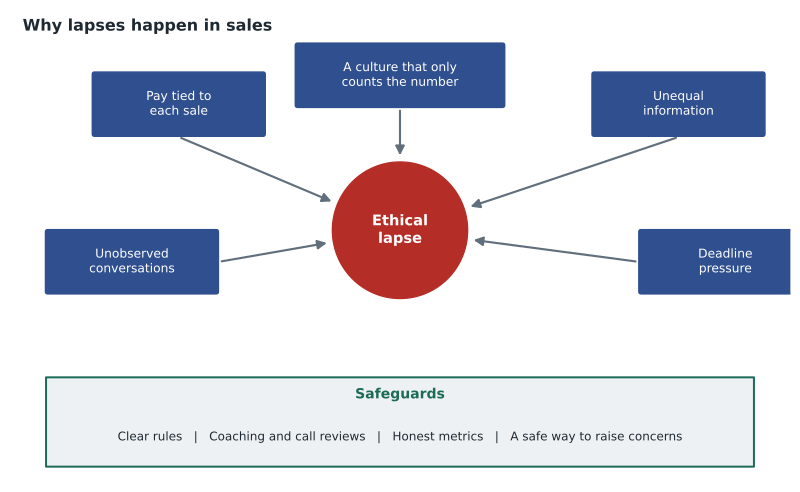
None of these pressures excuses misconduct, but naming them helps. A seller who knows that the last week of the quarter is when shortcuts look most tempting can plan for it. A manager who knows that unobserved conversations invite exaggeration can build in ride-alongs, call reviews and customer follow-up surveys.
When a sales culture goes wrong
The best-known example of a sales culture going wrong is the Wells Fargo case. In 2016, federal and city regulators fined the bank 185 million dollars after finding that employees, under intense pressure to meet cross-selling targets, had opened as many as 1.5 million deposit accounts and more than 500,000 credit card applications that customers may not have authorized. The bank's own later review raised the estimate of potentially unauthorized accounts to about 3.5 million, and in 2020 Wells Fargo agreed to pay 3 billion dollars to resolve criminal and civil investigations by the Justice Department and the Securities and Exchange Commission. Senior executives lost their jobs, and the bank operated under an asset cap imposed by the Federal Reserve for years afterward.
The lesson for sellers is not that big banks are uniquely bad. It is that ordinary people, working under targets that could only be met by cutting corners, did things most of them would never have done on their own. Goals and pay plans shape behavior. When a seller notices that a target can only be hit by misleading customers, that is a signal to raise the problem, not to solve it alone at the customer's expense.
Three ways to think about a hard choice
Philosophers have developed several frameworks for ethical decisions. A seller does not need to master them, but three are useful because each asks a different question.
| Framework | The question it asks | In a sales decision |
|---|---|---|
| Consequences | Which choice produces the best results for everyone affected? | Think beyond this sale: the customer, the next customer, your colleagues and the company's reputation |
| Duties and rights | Which choice respects the duties I owe and the rights others have? | You owe buyers honesty, and they have a right to make decisions with accurate information |
| Character | What would a person of good character do here? | Ask which seller you want to become over a career |
In practice the three frameworks usually point the same way. Misleading the dental office about parts may produce a sale this month, but it produces a worse result overall once the office discovers the truth, it breaks the duty of honesty, and it is not what a trustworthy professional does. When the frameworks disagree, the disagreement itself is useful: it shows that the situation needs more thought or a second opinion.
Quick tests for the moment
Sellers rarely have time for a philosophy seminar in the middle of a call. A few quick tests, each of which captures part of the frameworks above, help in the moment.
| Test | Ask yourself |
|---|---|
| Disclosure test | Would I be comfortable if the buyer found out exactly what I knew and did? |
| Front-page test | Would I be comfortable if this were reported in the local news, with my name in it? |
| Reversibility test | Would I accept this treatment if I were the buyer? |
| Mentor test | What would the most respected person I know in this business do? |
| Record test | Would I write this down in the CRM notes exactly as I said it? |
The record test is particularly practical. Ridgeline's sellers log every customer conversation in the CRM. Darnell tells new sellers that if they would hesitate to type what they just said into the notes, they should not have said it.
A method for harder decisions
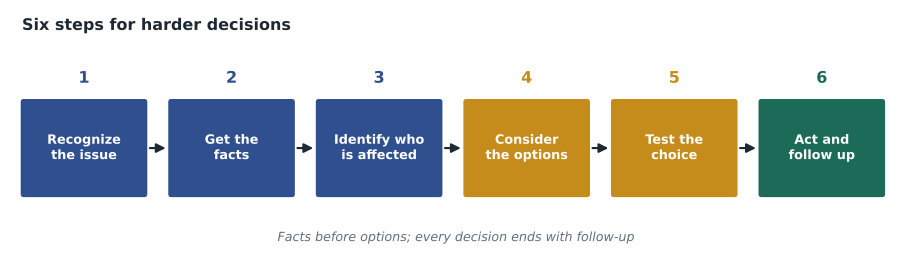
Some situations are not settled by a quick test. A buyer asks a direct question about a weakness in the product, a colleague asks for help with something that feels wrong, or a manager suggests a tactic that seems misleading. For these, a short structured method helps.
Worked problem
Applying the six steps
After the dental office call, Maya used the six steps to decide what to do. The office manager had said she would think about replacing all four printers in the next month.
Show solution
- Recognize: a customer was given a false statement of fact about parts availability, and she may make a purchase decision based on it.
- Get the facts: Maya checked with the service team, who confirmed in writing that parts for the model are stocked and will be for at least two more years.
- Identify who is affected: the office manager and the dental office, the seller who made the statement, Ridgeline's reputation and, if the sale went ahead, the service team who would know the truth.
- Consider the options: say nothing; tell the seller privately; tell Darnell; contact the customer directly.
- Test the choice: saying nothing fails the disclosure and record tests. Contacting the customer directly, without the account owner knowing, would undercut a colleague without giving him a chance to fix it.
- Act and follow up: Maya told Darnell. Darnell spoke with the seller, who called the office manager the next morning to correct what he had said and to explain the real service timeline.
Answer: The office still replaced two of the four printers, the oldest ones, on a smaller order. The correction cost some revenue in the short term and kept a customer who now trusts what Ridgeline tells her.
Ethics on the sales floor
The same principles apply in retail, where the pressures look slightly different. At Juniper & Pine, associates earn commission on furniture and a small bonus on protection plans, and the store has weekly sales goals. Aiden Laroque noticed in his first month that some customers agreed to protection plans simply because they did not understand that the product already came with a manufacturer's warranty and with rights under the law. Bev Halvorsen, the store manager, set a simple rule: every associate explains what the customer already has before offering anything extra. "If the plan is worth buying," she told him, "it's worth buying after they understand what they already get."
Retail sellers also deal with vulnerable customers more often than business sellers do: people who are grieving, confused, rushed or new to the country. Taking advantage of a customer who cannot protect their own interests is not only unethical, it is also an unfair practice under consumer protection law, as lesson 4 explains.
Speaking up
Ethical problems in sales are often seen first by the newest or most junior person, as Maya's was. Speaking up is hard. It feels disloyal, it may affect relationships, and new employees worry about being wrong. Several habits make it easier. Start with the facts, not accusations. Raise it with the person involved or with your manager first, unless that is unsafe. Know your company's formal channel, such as an ethics line, for cases where the normal route does not work. And remember that many organizations, and in some situations the law, protect employees who report misconduct in good faith from retaliation.
Managers set the tone. When Darnell heard Maya's concern, his first words were "Thank you for telling me." A manager who reacts to bad news with irritation teaches the whole team to stay quiet. A manager who reacts with thanks and follows through teaches the opposite.
Common mistakes
MistakeIf it's legal, it's ethical.
InsteadLaw is the minimum. Many legal tactics still damage trust and relationships.
MistakeEveryone in the industry does it, so it's fine.
InsteadCommon practice is not a defense. Ask whether it is honest and fair to the buyer.
MistakeSmall exaggerations don't count.
InsteadBuyers rely on small statements of fact, such as delivery dates and parts availability, and small falsehoods add up.
MistakeRaising a concern makes you look disloyal.
InsteadRaising concerns with facts, through the right channel, protects customers, colleagues and the company.
MistakeEthics slows down selling.
InsteadTrust speeds up later sales, referrals and renewals.
Summary and key terms
- Sales ethics covers how sellers treat buyers, competitors, colleagues and their employer, mostly through small everyday choices.
- Law is the floor, not the ceiling: some legal tactics are still unethical.
- Sales roles combine outcome-based pay, unequal information, unobserved conversations, deadlines and number-focused cultures, which raise the risk of lapses.
- The consequences, duties and character frameworks usually agree; quick tests such as the disclosure and record tests help in the moment.
- A six-step method helps with harder decisions: recognize, get the facts, identify who is affected, consider options, test the choice, and act and follow up.
- Speaking up with facts through the right channel is part of a seller's job.
- Ethics
- The study of what we ought to do, especially when our choices affect others.
- Information asymmetry
- A situation in which one party, usually the seller, knows much more than the other.
- Disclosure test
- Asking whether you would be comfortable if the buyer knew exactly what you knew and did.
- Record test
- Asking whether you would write down what you said, word for word, in the customer record.
Practice problems
Work each problem on paper first, then reveal the answer to check.
Give one example of conduct that is legal but unethical in selling.
Show answer
Pressuring a confused or vulnerable customer into an add-on they do not need, without saying anything false.
Name three conditions that make ethical lapses more likely in sales.
Show answer
Any three of: pay tied to each sale, unequal information, unobserved conversations, deadline pressure, a culture that counts only the number.
What does the reversibility test ask?
Show answer
Whether you would accept the same treatment if you were the buyer.
Why did Maya tell Darnell rather than calling the dental office herself?
Show answer
So that the seller who made the statement had the chance to correct it, through the proper channel, without being undercut.
Lesson quiz · 5 questions
Score 60% or more to complete this lesson.
Create a free account to save your progress, take quizzes and earn a certificate.