
SLS-130 · Lesson 7 of 12 · 18 min
Difficult customers and de-escalation
▶ Video coming soon A video version of this lesson is on the way.
Most customers are reasonable most of the time, even when they are annoyed. But every service worker meets people who are very angry, distressed, demanding or, occasionally, abusive. On the Saturday before Halloween 2026, a man arrived at Juniper & Pine's service desk shouting that the store had "ruined" his daughter's birthday: the bunk bed she had been promised for that weekend had not arrived. He was red-faced, standing too close to the counter, and several shoppers had stopped to watch. Aiden was at the desk. Bev, who had been on the floor, walked over and stood beside him, and together they brought the conversation down to a level where the problem could be solved. This lesson explains how.
It covers why customers become difficult, how anger escalates and de-escalates, specific techniques for calming tense conversations, how to handle common types of difficult behavior, when to set limits, and how to look after staff who deal with difficult customers regularly.
Why customers become difficult
Most "difficult" behavior is a reaction to something: a failure the customer experienced, a feeling of not being heard, fear about money or time, or pressure from other parts of their life. The father at the desk was not angry about furniture. He was upset because he felt he had let his daughter down, and he was embarrassed in front of strangers. Seeing behavior as a reaction, rather than as the customer's character, makes it easier to respond calmly and to look for what would change it.
Some situations raise the risk of strong emotions: the product affects the customer's home, family or health; the customer has already tried to get help and failed; money is tight; time is short; or the customer feels the business holds all the power. Knowing this helps staff prepare. A call about a third missed delivery will be harder than a first enquiry, and it is worth reading the record before picking up the phone.
A small number of customers are difficult for reasons that have little to do with the business: they may be trying to get something they are not entitled to, or they may behave aggressively as a habit. Staff should still begin with the assumption of a genuine grievance, because that is true most of the time, and because treating a genuinely wronged customer as a manipulator makes things far worse.
How anger rises and falls
Anger tends to follow a pattern. Something triggers it; it rises, often quickly; it peaks; and, if nothing feeds it, it gradually subsides. While anger is high, people find it hard to take in information or think through options. That is why explaining policies or offering solutions during the peak rarely works. The first job is to help the customer move past the peak, and only then to solve the problem.
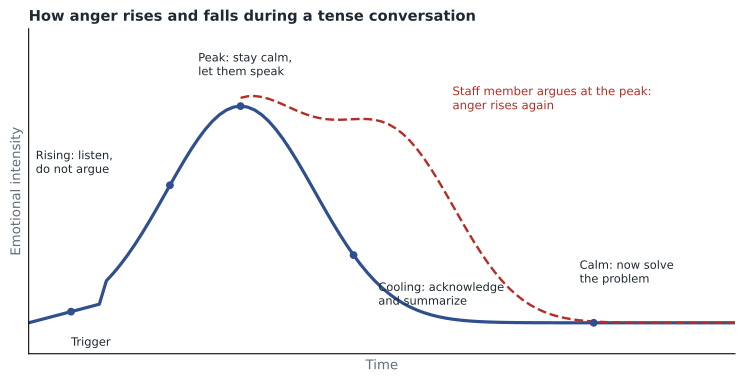
What feeds anger at the peak is usually something the staff member does: arguing, interrupting, correcting the customer's facts, matching their volume, using a dismissive phrase such as "calm down" or "that's our policy", or physically turning away. What helps is the opposite: listening, staying calm, lowering one's own voice and speaking slowly, and acknowledging the feeling.
De-escalation techniques
De-escalation means reducing the intensity of a tense situation so that it can be resolved safely. Many organizations, from retailers to hospitals, train staff in versions of the same core techniques.
- Stay calm yourself. Breathe slowly, keep your voice low and even, and keep your body relaxed. Calm is contagious, and so is agitation.
- Give space. Do not stand too close or block the customer's way. In a store, invite them to a quieter spot if they are willing; an audience makes it harder for people to back down.
- Listen without interrupting. Let the customer say what they need to say. Short acknowledgments such as "I see" or "go on" show you are listening.
- Acknowledge the feeling. Name it carefully: "I can see how upsetting this is, especially with the birthday this weekend." This is often the single most effective step.
- Avoid arguing about facts at the peak. Even if the customer is wrong about a detail, correcting them now feels like a fight. Facts can be checked later.
- Use the customer's name if you know it, and introduce yourself. People are less likely to stay angry with a person than with an organization.
- Focus on what you can do. Once the customer has calmed a little, move to options: "Here's what I can do right now."
- Offer choices. Choices give back a sense of control, which angry customers often feel they have lost.
Bev used most of these at the service desk. She introduced herself and Aiden, asked the father his name, and suggested they step to the side counter away from the queue. She let him speak for almost two minutes without interrupting. Then she said, "Mr. Arcand, I'm really sorry. You promised your daughter a bed for her birthday and we didn't deliver it. I'd be upset too." His voice dropped noticeably. Only then did she ask Aiden to check the order.
Solving once the customer is calm
The bunk bed had been delayed at the supplier, and the store had texted the customer about it, but the text had gone to an old phone number. That explained why he had been taken by surprise. Bev did not lead with this explanation, which might have sounded like blame. She checked what could be done. A floor model of the same bed, slightly scratched on one rail, was available. She offered two options: the floor model delivered the next morning at a discount, with the new bed swapped in later at no charge if he wanted, or the new bed in nine days with a credit for the delay. He chose the floor model, delivered the next day. Then Bev told him about the text and asked him to confirm his number, framing it as making sure he would never miss an update again.
The order of steps mattered as much as the solution. Calm first, then facts, then options, then the explanation of what went wrong, then confirming next steps. The same steps in a different order, starting with "we did text you", would probably have made the conversation much worse.
Common types of difficult behavior
| Behavior | What often lies behind it | Helpful response |
|---|---|---|
| Shouting or very angry | Feeling unheard, embarrassed or powerless | Stay calm, give space, let them speak, acknowledge the feeling, then offer options |
| Demanding a manager immediately | Belief that front-line staff cannot help | Say what you can do; if they still want a manager, arrange it without taking offense |
| Repeating the same point | Not feeling heard yet | Summarize their point back clearly so they know it has landed |
| Making unreasonable demands | Anger, testing limits, or genuine misunderstanding | Acknowledge, explain what is possible, offer real options, hold the limit politely |
| Distressed or crying | Fear, grief, stress beyond the transaction | Slow down, be kind, offer privacy and time, keep the solution simple |
| Threatening reviews or legal action | Wanting to be taken seriously | Stay calm, do not argue, focus on fixing the problem; escalate legal threats to a manager |
Setting limits
De-escalation does not mean accepting any behavior. Staff have a right to work without being abused or threatened, and employers have legal duties about workplace safety. US employers have a general duty under federal workplace safety law to keep workplaces free of recognized serious hazards, and many state laws and employer policies address harassment by customers.
A clear way to set a limit is to describe the behavior, state the limit, and offer a way forward: "I want to help you, and I can't do that while you're swearing at me. If we can talk calmly, I'll sort this out." If the behavior continues, the next step is to end the conversation or bring in a manager. On the phone, staff can say they will end the call if the abuse continues, and then do so, noting it in the record. In person, any threat of violence, or any situation where a staff member feels unsafe, should go straight to a manager and, if necessary, to the police. No sale or customer relationship is worth a staff member's safety.
Juniper & Pine's policy, written by Bev and Marcus Dube, says that any associate may step away from an abusive customer and ask for a manager, and will not be criticized for doing so. That one sentence made associates more confident in difficult conversations, because they knew they had a way out.
Difficult conversations with business customers
Business customers rarely shout, but they can be difficult in other ways: sharp emails copied to senior people, threats to cancel a contract, refusal to pay invoices, or blunt criticism in front of colleagues. The same principles apply in a quieter form. Respond promptly, acknowledge the problem and its effect on the customer's organization, do not argue in writing, move the discussion to a call or meeting where tone is easier to manage, and come with options.
When the finance director of Keystone Grain Equipment emailed Maya to say Ridgeline's latest invoice was "unacceptable" and that he would not pay it, Maya resisted the urge to reply with a long explanation. She wrote two sentences acknowledging the concern and asking for a 20-minute call that afternoon. On the call she listened first. The problem turned out to be a price increase that had been agreed in the contract but never explained to finance. She walked through the contract clause, apologized that nobody had warned him, and offered to spread the increase over three months. He paid.
Looking after yourself and your colleagues
Dealing with difficult customers is tiring. Staff who absorb anger every day without support can become stressed, cynical or burned out, which harms them and the service they give. A few habits help. Take a short break after a hard interaction if possible. Talk it through with a colleague or manager rather than carrying it alone. Remember that most of the anger is aimed at the situation, not at you personally. And notice the good interactions, which usually far outnumber the bad.
Managers have a responsibility here too. They can step in during difficult interactions, as Bev did, debrief afterwards, give staff authority to solve problems so that fewer interactions become difficult, and fix the underlying causes that keep producing angry customers. A store that keeps missing deliveries will keep producing shouting customers, however well trained its staff are.
Worked problem
Measuring the effect of de-escalation training
Juniper & Pine trained all associates in de-escalation in September 2026. In the three months before training, the store logged 42 incidents in which a complaint was escalated to a manager because the customer was too upset to continue, out of 118 complaints. In the three months after, it logged 19 such escalations out of 104 complaints. Compare the escalation rates.
Show solution
- Before training: 42 ÷ 118 × 100 = 35.6 escalations per 100 complaints.
- After training: 19 ÷ 104 × 100 = 18.3 escalations per 100 complaints.
- Change: 35.6 − 18.3 = 17.3 fewer per 100, a fall of 17.3 ÷ 35.6 = about 49 in 100 of the earlier rate.
- Check other explanations: complaints also fell from 118 to 104, and the new delivery texts may have reduced the angriest complaints. Comparing rates per 100 complaints helps, but the result is not proof that training alone caused the change.
Answer: The share of complaints needing manager escalation roughly halved, from about 36 to about 18 per 100. Training probably helped, but delivery improvements made at the same time may also have contributed, so the store should keep tracking the rate.
Common mistakes
MistakeExplaining policy while the customer is at the peak of anger.
InsteadHelp the customer cool first by listening and acknowledging; explain and solve afterwards.
MistakeTelling an angry customer to calm down.
InsteadModel calm yourself, acknowledge the feeling and give the customer space to speak.
MistakeCorrecting the customer's facts in the middle of a tense moment.
InsteadLet minor factual errors go until the customer is calmer; check facts afterwards.
MistakePutting up with abuse to keep a sale.
InsteadDescribe the behavior, state the limit, offer a way forward, and bring in a manager if it continues.
MistakeTreating de-escalation as only a front-line skill.
InsteadManagers should step in, debrief staff and fix the causes that keep producing angry customers.
Summary and key terms
- Difficult behavior is usually a reaction to a failure, a feeling of not being heard, fear or pressure.
- Anger rises, peaks and subsides; people cannot take in solutions at the peak, and arguing sends anger back up.
- De-escalation means staying calm, giving space, listening without interrupting, acknowledging the feeling, avoiding arguments about facts, using names and then offering options.
- The order matters: calm first, then facts, options, explanation and next steps.
- Different behaviors have different likely causes and responses.
- Staff are entitled to set limits on abusive behavior, and employers have legal duties about workplace safety and harassment.
- Business customers are difficult in quieter ways, and the same principles apply.
- Staff need support and managers need to fix the causes of anger.
- De-escalation
- Reducing the intensity of a tense situation so it can be resolved safely.
- Escalation of anger
- The rise in a customer's emotional intensity, often fed by arguing or dismissive responses.
- Acknowledging a feeling
- Naming the customer's emotion to show it has been understood.
- Setting a limit
- Describing unacceptable behavior, stating the boundary and offering a way forward.
- Workplace harassment
- Unwelcome conduct that a worker experiences at work, which can include conduct by customers.
- Debrief
- A short conversation after a difficult interaction to review it and support the staff member.
Practice problems
Work each problem on paper first, then reveal the answer to check.
Why does explaining the policy at the peak of a customer's anger usually fail?
Show answer
People at the peak of anger cannot take in information, and the explanation feels like an argument, which feeds the anger.
Write a limit-setting statement for a customer who is swearing.
Show answer
For example: "I want to help you, and I can't do that while you're swearing at me. If we can talk calmly, I'll sort this out."
A store had 30 escalations out of 120 complaints. How many per 100 complaints is that?
Show answer
30 ÷ 120 × 100 = 25 per 100.
Lesson quiz · 5 questions
Score 60% or more to complete this lesson.
Create a free account to save your progress, take quizzes and earn a certificate.